Showing posts with label Nate Powell. Show all posts

Wednesday, February 25, 2026

Run, Book One

The March trilogy of graphic novels is a modern classic, a multi-award-winning set of books that chronicle the life of John Lewis during the first part of his life. This book, Run, was proposed as the first in another series, but Lewis died just as the final edits were made to it, and it is up in the air if it will ever continue. Still, it is a worthy and fascinating book well worth reading and revisiting.

This volume takes place after the first push of civil rights victories, and it shows how even that segregation was legal and voting rights cleared that equality was far from the norm. This book opens with a white congregation refusing to allow blacks to enter their church and worship, and shows more examples of how entrenched power structures made it difficult for true justice to be practiced. I think it is important to see just how much struggle existed and continues to exist, even after "progress" was made. We are still fighting some of these same battles now, sadly.

This book also features much detail about the workings and politics of the Student Nonviolent Coordinating Committee that Lewis headed, and how it morphed into a different sort of movement that eventually gave rise to the Black Panther Party. 

It also chronicles several contemporary events, such as the Vietnam War and Watts riots, and how they all contributed to the political atmosphere of the times. This book ends with Lewis deciding to run for office, and even if it ends in an open-ended manner that may never be resolved, readers would know that Lewis was elected and served for decades as a US Representative. And I feel that what makes this book relevant and moving is how it shows the friction and effort necessary with any political action. 

Like the March trilogy, this book was written by Lewis and Andrew Aydin, with art by L. Fury, in her graphic novel debut, with some assists by Nate Powell. Fury has been at work on her own graphic novel project, Condemned, and Powell has a long list of credits, including the March books, an adaptation of Lies My Teacher Told Me, and his own works like Fall Through.

This book has received many accolades and glowing reviews. Publishers Weekly concluded their starred review, "Lewis’s stunning American story and legacy lives on in these pages." In another starred entry, Kirkus Reviews called it "an intimate, powerfully revealing look at a crucial, complex time, through the eyes of a true American hero." In a third starred review, Eric Carpenter wrote that it was "as informative and essential an addition to the nonfiction comic canon as its much-lauded predecessors."

Run, Book One was published by Abrams ComicArts, and they offer a preview, a teaching guide, and more information about it here.

Friday, February 25, 2022

Save It For Later: Promises, Parenthood, and the Urgency of Protest

We are living through "interesting times," and Save It For Later is a great collection of essays that survey much of what has been transpiring over the past decade, with a rise in fascism as well as the need for political action and attention to our environment. These essays do not offer easy answers, but they do offer insight into how one might speak to one's children about the world and how they should act in order to make sure that they have a future that is equitable and safe. It is a raw and emotionally direct book that elicits feelings of pain and anxiety that accompany difficult events. It is also a harrowing look at political movements that seek to silence many and enforce a single autocratic ideology.

It would be easy to say that this book is a response to the rise of Trump, and now that he is gone many of the issues brought with his regime are gone with him. But these essays show that his presidency is but one manifestation of a slow, persistent political tide, where white supremacists and toxic masculinity have amassed political currency for hatred and authoritarianism. He also points out many ways that a progressive response to this should not be to ridicule or treat these movements as clownish, even when they might seem ridiculous, because the consequences of their actions can be harmful and even deadly. 

Still, the book is not all gloom and doom. Hope does lie in the future, with people who strive to find justice despite adversity, but it will take a lot of effort from many. Taking up the mantle of figures like John Lewis, this book is about how parents can talk to their children thoughtfully, discuss the political world, and act in ways that promote equity, equality, and freedom. It is not an easy book to read, but I feel it's an important one, especially right now.

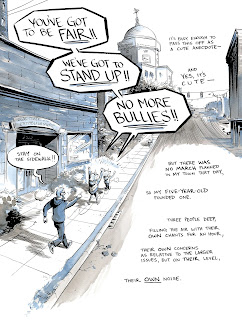
This book was created by Nate Powell, one of the most accomplished graphic novelists of his generation. He is a veteran creator with a long list of praised works, including the Eisner and National Book Award winning March trilogy. He has also drawn a number of other graphic novels, such as The Silence of Our Friends, Swallow Me Whole, Any Empire, Come Again, and Run. He speaks about his work on these essays in this interview.

All of the reviews I have read about this book have been positive. In a starred review, Publishers Weekly concluded, "This sincere volume carries off parenting inspiration with gravitas." Henry Chamberlain wrote, "Powell manages to retain a certain level of rawness that adds authenticity. This is a real person who is just trying to figure things out, what’s best for him, his family, and his community." Hillary Chute called it "an absorbing reflection on intergenerational inheritance."

Save It For Later was published by Abrams, and they offer a preview and more here.

Wednesday, January 15, 2020

Come Again

In my last post I noted the death of Tom Spurgeon, a huge figure in contemporary comics. Today I start a series of remembrances about my friend and collaborator Derek Royal. Derek's death was too soon, as he was only 55. I met him several years back through our mutual friend Andy Kunka, and it was a couple of years ago now that he asked me to be the regular co-host of the Comics Alternative Podcast. Derek was a great ambassador of all comics. Our podcast focused on alternative comics, those not published by the big 2 comics companies. In that purview were works by independent presses, self-publishers, manga, European comics, webcomics, and comics for younger readers. I did a bunch of shows with him, got to interview some great creators, and also read a lot of comics that I might not have otherwise.
Derek, as rendered by Andy Hirsch
Derek was a voracious reader who read all sorts of work from all sorts of creators and publishers, big and small, local and international. He really pushed the boundaries of how I look at comics, and what is more he pushed me to examine my own thinking about comics. Most of all, he was a good friend and conversationalist. I really miss talking to him, not just about comics but also mundane stuff. We had lots of ideas for different directions to take the podcast, and I am sad not to get to realize those with him. In the spirit of revisiting my time with Derek and also revisiting some of the books we might have reviewed together, I plan to spend the rest of this month reviewing works pertaining to him. It is one small way I have to share his legacy of spreading the joy of reading a great variety of comics.

There are a good number of other tributes and memorials to Derek out there. The Philip Roth Society, which he founded, has a lovely write-up here. Comics for Fun and Profit has a good podcast about him here. I just listened to that one, and it was weird hearing him again. He sounds so vital and enthusiastic, as per usual, and I could not help but be struck by how I used to listen to him make our own episodes, how he would read the copy for our sponsor every time, and how I would also jump in at opportune moments to bolster what he was pitching. Derek did pretty much all the work on The Comics Alternative, and I felt most of what I had to do was read, be prepared with some talking points, and just be a good conversationalist. He did all the editing, posting, and everything else technical, which I find amazing.

My favorite tribute about Derek was from Paul Lai, who was co-hosted the podcast before I did. He and I had similar experiences with Derek, and I think he is much more eloquent in crystallizing just how special a guy Derek was. Go give it listen.

In one of the last podcasts we did together, Derek chose this book as one of his honorable mentions for favorite books of 2018. At the time, I thought I have it but have not gotten to it yet; I should put it on the top of my to-read pile. Then, after our hiatus and Derek's death, I did not really want to read it, almost as if I did another part of him would be gone. So, it has been on my shelf a long time, and I feel like now is the time for me to start addressing my feelings.

Come Again is by Nate Powell, a veteran and expert creator with a long list of praised works, including the Eisner and National Book Award winning March trilogy. He has also drawn a number of other graphic novels, such as The Silence of Our Friends, Swallow Me Whole, and Any Empire. He is one of the most accomplished graphic novelists of his generation. Powell spoke with Derek and Paul about his work on this book in this podcast interview.

This book is a unique one that defies easy categorization. It is a period piece, set in the 1970s at a commune in the Ozark mountains. The protagonists are a young boy named Jake and his mother Halushka (Hal, for short). They are pretty close to another family who has a young boy named Shane, but there are some secrets that are buried in that relationship. In a touch of magic realism, that secret is embodied by a cave where some illicit activities take place and where a mysterious creature lurks. I will try not to spoil so much, but one day Jake and Shane find and play in that cave, and one of the boys does not come out, touching off a frantic series of events.
 

The interplay between narrative and illustrations here is deftly woven. The characters are well portrayed with clear expressions and relatable emotions. This book is pretty dark, especially communicated via the artwork, which is very atmospheric. There are drastic contrasts between what transpires at night versus in the light of day, and I think the visuals definitely convey the idea of a tainted past impeding on the present.  Hal has a lot of baggage with her ex and others, and those feelings of dread creep into her relationship with Jake. In the end, she has to decide what to let go of in order to resolve matters. I won't way that I found the ending completely satisfying, but I this book sat with me a while and I have found myself flipping though its pages and revisiting what transpired. In terms of story and art, it sets a definite tone, and I feel that its exploration of personal relationships is thoughtful and haunting.

The reviews I have read about this book have been mixed. Etelka Lehoczky wrote, "Few creators could envision a story as unique as Come Again, and even fewer could have as much fun with it." Oliver Sava called it "striking but flawed." Tegan O'Neil was also ambivalent about the book, noting "I don’t know if the happy ending is necessarily earned because there’s something less than satisfactory" about how things resolve (If you want the spoilers, go read that review).

Come Again was published by Top Shelf, and they have more information about the book available here. This book features some profanity and adult situations, so it is suggested for more mature readers.

Sunday, April 15, 2018

March: Book Three

I have been remiss in reading this book, especially since it won a National Book Award. I thought that the second book in the trilogy was better than the first one, and this third volume is just as excellent. Mostly it covers the events of the march from Selma to Montgomery, a pivotal event in US civil rights history and an impetus for the passing of a national Voting Rights Act.
 

As with the other books in this series, it is simply amazing just how much John Lewis was involved in during his life. This book covers much ground, giving light to a tumultuous and important era of US history, showing the brutality of racism, the courage of those involved in the movement, and the eventual positive effects of non-violent protest. This book is an emotional roller coaster, but it's not simply cheap drama. The events it chronicles are still vital to our present day circumstances, and I daresay it should be read by people young and old, in-school and out. It's an important tale, and it deserves as wide an audience as possible.

Congressman Lewis and his staffer Andrew Aydin penned the narrative, and it was illustrated by Nate Powell, a veteran and expert creator with a long list of praised works, including the graphic novels The Silence of Our Friends, Swallow Me Whole, and Any Empire. As you can see from the excepts, Powell's artwork is dynamic and energetic, and he makes excellent tonal use of black and white to tell riveting, moving, and powerful tales, even when people are simply speaking. All three creators speak about their work on the March trilogy in this interview.

Not surprisingly, all the reviews I have read about this book have been glowing. Michael Cavna concluded, "This is, flat out, some of the most immersive graphic-novel art I’ve experienced in years." Oliver Sava called it "an essential read in a turbulent political climate." In a starred review from the School Library Journal Mahnaz Dar summed up, "This essential addition to graphic novel shelves, history curricula, and memoir collections will resonate with teens and adults alike."

March, Book 3 was published by Top Shelf, and they have lots more info about it here. Its list of honors is historically impressive:

Friday, February 10, 2017

March: Book Two

The second book in a trilogy can feel padded out, like the author is laying the groundwork for the grand conclusion but still holding back on the "good stuff." I am happy to say that the second book of March does not fall into that trap, and I daresay it is even better than Book One. The framing sequence of Obama's 2009 Inauguration remains a constant, but the past events depicted left me breathless and astounded.
This book is a highly informative piece of nonfiction in terms of facts as well as emotions. So much is chronicled in this book, from the Freedom Riders to multiple sit-ins and protests in Nashville and Birmingham, to the March on Washington where co-author Congressman John Lewis was a prominent speaker and MLK delivered his "I Have a Dream" speech. And most impressively, the many people and events packed into this book are all briefly and deftly identified, which was no small feat to accomplish.
What sits with me the most after reading this book is just how much brutality and hatred Lewis and his stalwarts had to deal with. This book does not hold back in its depictions of those who opposed the civil rights movement, and their actions rightly are cast in terrible light. And although it does not cast its heroes solely in the glowing light of the entirely innocent, it does show just how much patience and perseverance they needed. It also shows just how much pain and misery they had to go through in terms of beatings and imprisonment. Certainly, the stories and travails portrayed here are essential reading for any informed US citizen. I know I am behind, and I will likely have to wait some right now, but I am eager to read Book Three.

Lewis and his staffer Andrew Aydin penned the narrative for this book, and it was illustrated by Nate Powell, a veteran and expert creator with a long list of praised works, including the graphic novels The Silence of Our Friends, Swallow Me Whole, and Any Empire. As you can see from the excepts, Powell's artwork is dynamic and energetic, and he makes excellent tonal use of black and white to tell riveting, moving, and powerful tales, even when people are simply speaking. You can watch all three creators talk about this book in this interview.

This book won an Eisner Award and has been lauded by many. Etelka Lehoczky wrote, "Speeches and meetings might seem like dull stuff for a comic book — or, at least, like the dull parts of a comic book — but award-winning artist Nate Powell doesn't let that happen." Michael Cavna called it "a must-read monument." Publishers Weekly gave it a starred review and remarked, "Lewis, Aydin, and Powell’s combined experiences combine to recreate scenes of incredible feeling."

March: Book Two was published by Top Shelf, and they have a preview and much more available here. Book Three recently won the National Book Award for Young People's Literature.

Thursday, November 17, 2016

BIG NEWS! March Book 3 wins the National Book Award

In a huge first for graphic novels, March, Book 3 (published by Top Shelf) has won the National Book Award for Young People's Literature. This book concludes the trilogy of the autobiographical account of Congressman John Lewis's life and involvement in the civil rights movement. I reviewed the first book in the series here.

This is a historic moment for comics and graphic novels. Congratulations to all involved!

Sunday, January 5, 2014

March, Book One


March, Book One is the first of a trilogy chronicling the life and times of John Lewis, a US Congressman, civil rights activist, and the last remaining speaker from the March on Washington, the occasion for MLK's historic "I Have a Dream" speech.

The book shifts from the past to the present, framed by Barack Obama's 2009 inauguration, but delving into the past and showing scenes from Lewis's childhood growing up as a sharecropper in Alabama, his calling to become a preacher, his going to college and meeting other civil rights activists, and his roles in various sit-ins and marches. These stories are not sugar coated and have strong elements of the dangers and realities of these historical situations.
Simultaneously, the story and art also practice nonviolence and move toward understanding and acceptance. Even when depicting horrible events, the story and art refuses to demonize those who practice prejudice and violence, even while showing that those practices are morally and ethically wrong. The journalistic tenor of the book captures a palpable sense of struggle, conviction, and consequence.

Lewis and his staffer Andrew Aydin make their debuts as graphic novel writers with this book, but artist Nate Powell is a veteran and expert creator with a long list of praised works, including the graphic novels The Silence of Our Friends, Swallow Me Whole, and Any Empire. He has much to work with, both in terms of history and experiences, and as demonstrated in the excerpts above he makes excellent tonal use of black and white to tell riveting, moving, and powerful tales. All these creators speak about the origins and their role in making this book in this NPR profile.

A best-seller and listed among the best books of 2013 by many, including USA Today, The Washington Post, Publishers Weekly, Library Journal, School Library Journal, Kirkus Reviews, The Horn Book, Paste, Slate, ComicsAlliance, Amazon, and Apple iBooks, this book has been much acclaimed. Michael Cavna called it "riveting and beautiful." Cornelius Fortune praised the artwork especially for conveying meaning and feeling, stating that "Powell’s style is somewhere in between the worlds of photorealism and animation, the images at times seeming to move on the page." Esther Keller summed up, "This book would be a wonderful addition to any library, private, public, or school. It would especially enhance any curriculum unit on the Civil Rights Movement."

March, Book One is available from Top Shelf, and they provide a preview, reviews, links, and much more here.


Saturday, June 15, 2013

Swallow Me Whole


Swallow Me Whole won an Eisner Award and Ignatz Award and was a finalist for the Los Angeles Times Book Prize when it was published in 2008. It was an impressive debut, and its creator Nate Powell has gone on to great a good number of excellent graphic novels since, including The Silence of Our Friends, Any Empire, and the forthcoming collaboration with congressman and civil rights icon John Lewis March. He has had a variety of experiences, working for a decade with developmentally disabled adults, managing a punk rock record label for 16 years, and also playing in some bands. Powell speaks extensively about his work on Swallow Me Whole in this 4-part interview with the Daily Cross-Hatch.

The book tackles some complicated subject matter, focusing on a duo of adopted siblings dealing with their own mental issues in poignant and human manner. The book is also disturbing, murky, and baffling, an attempt to portray what is going on in their minds via the art and story. Perry has delusions about a wizard who compels him to draw. He tries to drown the voice out of his head or ignore it completely, but these both prove difficult.

Ruth is compulsive and collects cicadas and other insects in formaldehyde jars. They swarm, buzz, and also communicate with her. She also has dissociative episodes where she loses blocks of time while focused on some task or idea.

Additionally, their grandmother "Meemaw" is also at home, dealing with her own dissociative situations and needing looking after. Of some comfort is that Perry and Ruth have each other to lean on and confide in. They are very troubled but loving of each other, and their family does its best to cope with the various situations, even if the tasks are wearying and frustrating. Also, there is a parade of well meaning but sometimes limited figures who deal with the various episodes, doctors, police officers, teachers, counselors, and school administrators. Some are more successful or well-meaning than others. The complexity of dealing with mental health issues is shown in realistic, difficult, and heartbreaking accuracy.

In terms of art Powell does an excellent job performing a balancing act between realism and imagination. He depicts the family as individuals with unique features and personalities in realistic fashion: 


But he also shows bends in reality where the reader can glimpse into what is going on in some of the characters' heads, which leads to some strange, unsettling, and insightful effects:


The interplay between reality and madness is what makes this book work so well for me. It makes for compelling and revelatory reading, leading to a devastating and dreamlike conclusion that begs rereading. I won't call the book enjoyable but it is powerful and wonderfully composed.

Reviews of the book point to its craft and complexity and praise Swallow Me Whole as an excellent debut. Seth T. Hahne commented that "the climax is amazing and, whether taken literally or figuratively, demonstrates well Powell’s grasp of the material. Great stuff!" Andrew Wheeler wrote that "Powell’s art has immense immediacy and energy" and that this book is "clearly a major work by an impressive young cartoonist." Brigid Alverson concluded, "This is not an easy book to read. It is a very good book, and worthwhile reading, but it is not a pleasant book."

Swallow Me Whole is published by the fine folks at Top Shelf. They provide reviews, excerpts, and all kinds of other resources here.

Tuesday, February 7, 2012

Nate Powell on The Silence of Our Friends

There is an in-depth interview with Nate Powell about this recent graphic novel publication at Comic Book Resources. Check it out!

Wednesday, January 25, 2012

The Silence of Our Friends

"In the end, we will remember not the words of our enemies, but the silence of our friends."

These words from the late Civil Rights leader Dr. Martin Luther King, Jr. are used in the title of this gripping graphic novel. It is a memoir set in 1967 in Houston, Texas during a contentious time. Author Mark Long lived in a white suburb at the time, and his father was a news reporter for a local television station who endeavored to cover heated, often violent civil rights protests. During one such protest a policeman is shot and killed and 5 seemingly innocent black college students are arrested and tried with murder.

Racist thought was prevalent everywhere at the time, it seems, in suburban and urban neighborhoods as well as in the TV station management. They show that everyone, regardless of what side of town they live in, deals with racist thoughts and seems afraid, suspicious, and ready to react. Mark's father tries to extend a hand of friendship to a local black writer/professor, but easy answers and solutions do not follow.

This graphic novel is a collaboration between Mark Long, Jim Demonakos, and artist Nate Powell. Long is a video game designer and author who is known for his work for Zombie Studios and the Shrapnel series of graphic novels. Demonakos speaks about his work in this interview, and he is the Convention Director of Seattle's Emerald City Comicon, founder of The Comic Stop retail chain, and songwriting half of the nerd rock band Kirby Krackle. Nate Powell is an Eisner Award winning artist and writer whose Swallow Me Whole won Best New Graphic Novel in 2009.

Thus far, this book has been very well reviewed. Publishers Weekly gave it a starred review and wrote, "This graphic novel presents an engrossing narrative about race in America, while honestly dealing with a host of other real-world issues, including familial relationships, friendship, dependency, “other”-ness, and perhaps most importantly, the search for common ground." Librarian Jen Bigheart commented on Powell's excellent, evocative artwork and wrote that after reading the book she "was a little blown away for a few minutes."

There are multiple previews of this book available online. One is from Publishers Weekly. Another is at the book's official website. The book's publisher First Second provides another here.