Showing posts with label politics. Show all posts

Sunday, March 15, 2026

Very Bad at Math

First off, this book is another I checked out from my local library. Local libraries rule! Very Bad at Math is about Verity "Very" Nelson, who is a real go-getter. She is a three-term class president, excellent English and social studies student, top debater, first-chair clarinetist, and can do more push-ups than anyone in gym class. 

See?

On the surface, it looks like there is nothing she can't do, but secretly she is failing math. She is ashamed of it and hides this fact from everyone, including her friends and parents. When she learns that failing a class would disqualify her from student government, she is offered the chance to participate in a "math pod" with a doctoral student who is working at the school where eventually she learns that she has dyscalculia.

Before this revelation, however, all of the secrecy does some damage. Her miscalculations seem to ruin a fundraiser for a class trip that was her main campaign promise. Even worse, her friends do not know what is going on with her and jump to some conclusions that she is being aloof, snobby, and/or uncaring. It also does not help that a middle school podcaster is snooping, secretly recording her, and creating misinformation. In the end, I found this a very compelling and realistic book in how it dealt with the current realities with social media, friendships, and learning disabilities. Also, the characters are also well defined and interesting. I like how they are drawn, how they interact, and how surprising some turn out to be.

This book's author, multiple Eisner Award winner Hope Larson is very good at comics. She practically invented YA graphic novels with her book Chiggers, adapted the graphic novel version of A Wrinkle in Time, wrote the Four Points series and Salt Magic drawn by Rebecca Mock, and created a trilogy of books starting with All Summer Long. She speaks about her work on Very Bad at Math in this interview.

All of the reviews I have read of this book have been positive. In a starred review from School Library Journal, Amy Ribakove wrote, "With captivating characters and a thoughtful exploration of dyscalculia, this book is a wonderful addition to any library." Kirkus Reviews summed it up as "a buoyant misadventure with some lessons along the way." Crystal Wilder concluded, "This graphic novel does a beautiful job of portraying the anxieties that may surround learning disabilities and the many ways family, friends, and learning professionals can be supportive."

Very Bad at Math was published by HarperAlley, and they have a preview and more available here. 

Wednesday, February 25, 2026

Run, Book One

The March trilogy of graphic novels is a modern classic, a multi-award-winning set of books that chronicle the life of John Lewis during the first part of his life. This book, Run, was proposed as the first in another series, but Lewis died just as the final edits were made to it, and it is up in the air if it will ever continue. Still, it is a worthy and fascinating book well worth reading and revisiting.

This volume takes place after the first push of civil rights victories, and it shows how even that segregation was legal and voting rights cleared that equality was far from the norm. This book opens with a white congregation refusing to allow blacks to enter their church and worship, and shows more examples of how entrenched power structures made it difficult for true justice to be practiced. I think it is important to see just how much struggle existed and continues to exist, even after "progress" was made. We are still fighting some of these same battles now, sadly.

This book also features much detail about the workings and politics of the Student Nonviolent Coordinating Committee that Lewis headed, and how it morphed into a different sort of movement that eventually gave rise to the Black Panther Party. 

It also chronicles several contemporary events, such as the Vietnam War and Watts riots, and how they all contributed to the political atmosphere of the times. This book ends with Lewis deciding to run for office, and even if it ends in an open-ended manner that may never be resolved, readers would know that Lewis was elected and served for decades as a US Representative. And I feel that what makes this book relevant and moving is how it shows the friction and effort necessary with any political action. 

Like the March trilogy, this book was written by Lewis and Andrew Aydin, with art by L. Fury, in her graphic novel debut, with some assists by Nate Powell. Fury has been at work on her own graphic novel project, Condemned, and Powell has a long list of credits, including the March books, an adaptation of Lies My Teacher Told Me, and his own works like Fall Through.

This book has received many accolades and glowing reviews. Publishers Weekly concluded their starred review, "Lewis’s stunning American story and legacy lives on in these pages." In another starred entry, Kirkus Reviews called it "an intimate, powerfully revealing look at a crucial, complex time, through the eyes of a true American hero." In a third starred review, Eric Carpenter wrote that it was "as informative and essential an addition to the nonfiction comic canon as its much-lauded predecessors."

Run, Book One was published by Abrams ComicArts, and they offer a preview, a teaching guide, and more information about it here.

Saturday, October 15, 2022

Good On Both Sides: A (Th)Ink Anthology

Good on Both Sides is a collection of political and historical comics strips by Keith Knight, who has been publishing regular comic strips such as the K Chronicles since the early 1990s. Knight's work here is contemporary, commenting not only on current events but also the current state of our country. I love his point of view, acerbic sense of humor, and his insights. 

Note: I got images from Knight's website. The book is in black and white.

The general issue with collections like this is that the humor often gets lost as time goes by and people forget the contemporary references that make the jokes work. I think Knight smartly protects against this by including many historical portraits that add their own context. By including several celebrations of and quotations from historic figures like Thurgood Marshall and Edna Lewis he provides a long view on how long certain struggles have been going on. Many of the issues we deal with today in terms of civil rights and race have been fomenting for a long time. 

Reading over what I have written above, I am making this book of comic strips sound like a textbook, which is entirely not the case. Knight's artwork is a delight, offering lots of energy and character with seemingly simple and streamlined line-work. Good On Both Sides made me laugh several times. It is funny, insightful, and provocative, and I very much enjoyed catching up on strips that I had not seen.

As I mentioned above, gentleman cartoonist Keith Knight has been a fixture in the alt-comics scene for decades now, and he has also received added exposure by having his life/works used to make the Hulu series Woke. He has won a number of accolades, including a Harvey Award for his strip K Chronicles, multiple Glyph Awards, an Inkpot Award for his career achievements, and an NAACP History Maker Honor. He spoke about the current state of his life and work in this interview.

I was not able to find many reviews of this book online, but the one I found was positive. Joel Oliphint wrote that although "the subject matter in Knight’s cartoons...can be heavy, he uses humor to help the medicine go down."

Good On Both Sides was published by Keith Knight Publications, and you can find more info about it here. You can also support Knight on Patreon here.

Thank you to the author/publisher for providing me with a review copy!

Friday, February 25, 2022

Save It For Later: Promises, Parenthood, and the Urgency of Protest

We are living through "interesting times," and Save It For Later is a great collection of essays that survey much of what has been transpiring over the past decade, with a rise in fascism as well as the need for political action and attention to our environment. These essays do not offer easy answers, but they do offer insight into how one might speak to one's children about the world and how they should act in order to make sure that they have a future that is equitable and safe. It is a raw and emotionally direct book that elicits feelings of pain and anxiety that accompany difficult events. It is also a harrowing look at political movements that seek to silence many and enforce a single autocratic ideology.

It would be easy to say that this book is a response to the rise of Trump, and now that he is gone many of the issues brought with his regime are gone with him. But these essays show that his presidency is but one manifestation of a slow, persistent political tide, where white supremacists and toxic masculinity have amassed political currency for hatred and authoritarianism. He also points out many ways that a progressive response to this should not be to ridicule or treat these movements as clownish, even when they might seem ridiculous, because the consequences of their actions can be harmful and even deadly. 

Still, the book is not all gloom and doom. Hope does lie in the future, with people who strive to find justice despite adversity, but it will take a lot of effort from many. Taking up the mantle of figures like John Lewis, this book is about how parents can talk to their children thoughtfully, discuss the political world, and act in ways that promote equity, equality, and freedom. It is not an easy book to read, but I feel it's an important one, especially right now.

This book was created by Nate Powell, one of the most accomplished graphic novelists of his generation. He is a veteran creator with a long list of praised works, including the Eisner and National Book Award winning March trilogy. He has also drawn a number of other graphic novels, such as The Silence of Our Friends, Swallow Me Whole, Any Empire, Come Again, and Run. He speaks about his work on these essays in this interview.

All of the reviews I have read about this book have been positive. In a starred review, Publishers Weekly concluded, "This sincere volume carries off parenting inspiration with gravitas." Henry Chamberlain wrote, "Powell manages to retain a certain level of rawness that adds authenticity. This is a real person who is just trying to figure things out, what’s best for him, his family, and his community." Hillary Chute called it "an absorbing reflection on intergenerational inheritance."

Save It For Later was published by Abrams, and they offer a preview and more here.

Thursday, February 10, 2022

Twins

Twins is about Maureen and Francine Carter, identical twins who struggle with the transitions in their lives in unique ways. As they start middle school,  they have different academic schedules for the first time ever. 

Maurine especially feels anxious without her sister around, and she also struggles to perform well in the youth cadet corps (An ROTC-type program at her school). Francine starts wanted to be called Fran, and she is becoming more invested in school chorus activities. Also, as the more outspoken and extroverted sister, she is going to run for class president. Maureen, partly in order to get some extra credit for YCC, also decides to run not only for a class office, but for president as well. The two sisters' lives get consumed with their competition, which tests their relationship with each other, their mutual friendships, and their family.

The clear, colorful, and vibrant artwork excels in telling the story and setting tones, depicting the characters as distinct while also highlighting their various emotional states.  Where this book excels is in capturing the tenor of family relationships. Francine and Maureen love each other, but they are frequently at odds and argue. As a sibling from a large family and a parent who has multiple children, I have found that interpersonal dynamics can be mercurial, volatile, and/or comforting. I saw much here I could empathize with, from both twins. It is refreshing to see a book that explores just how messy family relationships can be while also showing how they can lead to growth and self-actualization. I also admire how much the parents are involved in their daughters' lives, trying to make choices to help both, even if their overtures are not always welcome.

I think that it would have been very easy for this book to be formulaic, but the character work elevates the enterprise. It takes its genre conventions and spins them in a way that makes it unique and human, relatable but also surprising. I loved reading this book.

Twins was a collaboration between writer Varian Johnson and artist Shannon Wright. Johnson has received many accolades and honors for his books, the most recent of which is Playing the Card You're Dealt. Wright is an illustrator and cartoonist who has worked with several prominent publishers and platforms. Johnson and Wright both speak about their work on Twins in this interview.

All of the reviews I have read of this book have been stellar. In a starred entry, Kirkus Reviews summed it up as "a touching, relatable story of identity, sisterhood, and friendship." Avery Kaplan called it "a comic that you’ll want to start over from the beginning as soon as you’ve reached the last page." Rene Watson wrote that it is "a page-turner with moments that make you laugh out loud. Anyone with a sibling will appreciate the sarcastic and witty banter of these sisters."

Twins was published by Scholastic, and they offer more about it here. This book is titled Twins #1 in various places, though I have not seen a sequel solicited at this time. I very much hope to see more stories about these characters.

Saturday, February 5, 2022

Montana Diary

Montana Diary is an interesting travelogue/mini-comic that melds history with current politics. It is about a road trip through "Big Sky Country" that delivers a history of the state, exploration of its national parks, sample of local culture, and reflection on contemporary politics and race relations. As a person in a mixed race marriage, Taylor shares her discomfort with social situations on her trip, admitting how she let her husband do the speaking, as she did not know how locals would react to them. She is also responding to the historical moment, living in the US after years of divisive hate becoming more and more pronounced. 

Thus, this book captures a few unique facets in its pages. It contains a response to a specific time, set in a particular place, and elucidating that place's history and geography. I think that the artwork is elegant and economical, depicting very human and occasionally humorous situations. It is alternately affecting, informative, and moving, portraying an intimate look into relationships and traveling. I think that it exemplifies the best characteristics of both diary writing and a travelogue, a compelling book that is surprisingly complex and enlightening in the short space of 32 pages. You will feel like you are there in the car with her, knocking back a huck shake while worrying about climate change.

Montana Diary is the work of Whit Taylor, who has been a very active cartoonist, editor, and contributor to multiple anthologies. She has won multiple Ignatz Awards, one for co-editing the anthology Comics for Choice and the other for outstanding series for Fizzle. She is also a contributing editor for The Nib.

The reviews I have read of this book have been positive. Rob Kirby wrote, "This thirty-two-page zine boasts a rich tapestry of content, more in fact, than many full-length graphic novels I’ve read of late. It’s an entertaining, genuinely rewarding read, created with equal parts heart and mind." Scott Cederlund opined, "It’s great to come away from a comic like this feeling like you’ve shared at least a part of the experience with the cartoonist and that’s what Taylor does in her cartooning."

Montana Diary was published by Silver Sprocket, and they offer a preview and more info here. You can also read the entire comic here, though I suggest you also buy a copy.

Friday, August 20, 2021

The Fifth Quarter

4th grader Lori Block LOVES basketball, and she is on her school's team, but she is not so good and only gets to play in the "fifth quarter" when things don't count. After getting a small taste of actual gameplay, she wants more and gets the opportunity to take part in some camps where she can learn more skills and practice. She is driven to succeed and relishes her opportunities, even though her desires come at odds with her friendships.

Lori's friends are not into basketball as much a she is, and at recess they rather play unicorns or four-square than shoot baskets, which causes her distress. She is also awkward at times and makes comments that are meant as jokes but get taken as insults, especially to her fellow "double-dribble twin" Sophia. So she has a lot to navigate in terms of her social world.

Adding to this mix is her family, which includes her mom and dad as well as her younger twin siblings, Jason and Becky. They are all depicted in realistic manner, with a plot following her mother's run for local political office (trying to do something to help the kids) against a smug incumbent, and her put-upon father trying to hold down the fort and keep the two little one's faces out of screens as much as possible. One of the aspects of this books I liked the most was how much space and respect was given to her family, who are important players in this story, which I find is not often the case in YA/tween graphic novels.

This book excels at capturing the excitement of the games as well as the variety of social and emotional dynamics. The relationship aspects of this book are complex and compelling, and I love how it captures the messiness/uncertainties of human interactions and growing up. Just check out this sequence from early on in the book:

In terms of artwork, I think that the coloring pops and the facial expressions and gestures are economical and highly expressive. I found the Fifth Quarter to be utterly riveting and read it in one sitting. It's a very human and relatable book that I feel I will revisit multiple times. If there is any justice in the world, it will sell millions of copies.

I am a big fan of this book's author Mike Dawson. He has written and drawn a few graphic novels over the years, including Freddie & Me, Angie Bongiolatti, and Troop 142. He also has done a lot of  graphic nonfiction and essay work, including the collection Rules for Dating My Daughter and plenty of comics for The Nib. He speaks about his work on The Fifth Quarter in this interview.

All of the reviews I have read about this book indicate its high quality. Publishers Weekly wrote that it was full of "sincerity, humor, and strong character development." Kirkus Reviews gave it a thumbs up, concluding, "Nothing but net." Hillary Brown commented about Dawson's art style and storytelling, especially on how refreshing it was to see the adults portrayed as "real humans, dealing with their own shit."

The Fifth Quarter was published by First Second, and they offer a preview and more information here. It is also the first of a series, and I am eager to see more of these characters and their lives.

Saturday, April 10, 2021

Some Recent Silver Sprocket Publications

In this time of social distancing and no comics conventions, I have been checking out books from various small, independent presses whenever I can. That's how I came upon the two titles I am reviewing today, from one of my favorite presses Silver Sprocket.

That Full Moon Feeling is a queer, supernatural, love story about a witch and a werewolf who meet on a dating app. They go on a series of dates, but each one ends in disasters, like being attacked by a swamp monster, a necromancer's army of skeletons, disembodied hands, or giant praying mantises. Somehow, despite all these adversities (or maybe because of them?), they find a connection.

I loved this story, as it is very sweet without being cloying. I found a lot to empathize with a situation where two people just figure out that they are right for each other, and I loved the amount of character work done throughout the book. Both Suzy (the witch) and Jada (the werewolf) are unique, and I found it easy to fall in love with both characters. Also, although this book is clearly set in a fantasy realm, it is an authentic and refreshing take on contemporary romance. 

The artwork complemented the story perfectly, with characters being imbued with lots of heart and emotion. Also, there is a lot of delight in the various monsters and other horrific denizens of this world, not to mention that animal familiars that Suzy associates with. In addition to all the fun imagery, there is also an interesting incorporation of technology in the storytelling, like the interactions on the dating app, texting, and the various group messages that Jada receives from her pack.

This book's creator Ashley Robin Franklin also has published a number of other comics, including the horror/romance tale One Million Tiny Fires. She discusses her career and work on That Full Moon Feeling in this interview.

All of the reviews of this book have found it delightful. Ryan C. wrote that it "lithely threads the needle between two genres that are by and large of little interest to me, specifically romantic comedy and the supernatural, yet nevertheless managed to warm my cynical middle-aged cis white male heart and plant an entirely unforced smile on my face for the duration of its 64 pages." David Charles Bitterbaum called it "a stupendous comic. It is very sweet, fantastically illustrated, and immensely cute."

You can find more info and a preview of That Full Moon Feeling here.

I was way more familiar with this creator's work, as Matt Lubchansky is an Associate Editor and regular contributor to The Nib, so I see a lot of their work regularly. The Antifa Super-Soldier Cookbook is a hilarious, long-form satire about Max Marx, a radical who gets a huge call-up from Antifa. Because of his past successes, the secret council selects him to become a super-soldier.

I love how this book amplifies a paranoid conservative conspiracy theory that what is a loose affiliation of political activists is really a covert, highly organized organization along the lines of COBRA. Their various training initiatives and sabotage operations are shown in nefariously absurd detail, but underlying the silliness is the serious counterpoint that in the police/political realm, such action is actually happening. I found much to laugh at in this book, but the humor is tempered with an edge about what is occurring in our country/world today.

Well suiting its subject matter, the artwork in this book is appropriately over-the-top, with shady police officers, fantastical inventions, and lots of bombastic action. I especially adored all the nifty gadgets built into Max's new robotic body. This book is an excellent satire that balances ridiculous and outrageous imagery with sobering social commentary.

The reviews I have read about this book have been positive. Brett Schenker called it "a solid satire that has fun with the absurd reality some people live in." Ryan C. wrote about it coming from a specific political stance, opining "If...you’re a rational and well-adjusted human being, then you’ll probably get a solid kick out of it."

Also, for those interested, Lubchansky speaks more about this book and their career in this interview.

You can find a preview and more info about The Antifa Super-Soldier Cookbook here.

Because of profanity and adult themes, I recommend both of these books for more mature readers.

Wednesday, February 10, 2021

The Black Panther Party: A Graphic Novel History


Reading this book showed me how little I actually knew about the Black Panther Party. The Black Panther Party: A Graphic Novel History is not a long book, but it is substantive and comprehensive. It touches on every major figure associated with the BPP, and heavily focuses on the pivotal years of 1967 - 1969. There are spotlights on people like Huey P. Newton, Bobby Seale, Fred Hampton, and Angela Davis as well as gripping, suspenseful portrayals of major events in the formation and social actions taken by the Black Panthers.

As you can see from the excerpt above, this book is about detailing the history of this group and also placing it in the broader context of US and civil rights history. It is one of the more information-rich graphic novels I have read, but it balances exposition with dramatic action scenes. It utilizes dynamic, iconic artwork full of bold imagery. I appreciated how well it captures both realistic depictions of the participants as well as a sense of the propaganda/visual messages broadcast by the BPP. Even in the passages that are more text heavy and dense, the images are vibrant and realistic, adding much context to the proceedings. 

As a common theme with other books I've read recently, like Big Black: Stand at Attica and Kent State, this book shows how US society has not progressed as much as we would like. The Panthers arose in a response to the racial violence being perpetrated by police forces. Their militaristic response was to show that they could not simply be intimidated and pushed around any more. This arm of the movement was coupled with more charitable ones I did not really know about, such as establishing a school and a program for feeding the hungry, though those aspects are largely overlooked today.

A sizable amount of the book is also devoted to J. Edgar Hoover and the FBI's many incredibly shady and illegal methods of infiltrating the BPP, sowing discord, and outright murdering some of its leadership. I know that not everyone approved of the methods for seeking equality, even within the various civil rights movements of the day, but the level of subterfuge and sabotage accounted here is shocking. I think this book is the perfect introduction for someone who knows nothing about the Black Panther Party, and an excellent resource for any US history, government, or language arts class studying African-American history or civil rights.

This book was created by writer David F. Walker and artist Marcus Kwame Anderson. Walker is a prolific author and is best known in comics for his work on the Eisner Award winning series Bitter Root, runs on Marvel series such as Luke Cage and Power Man & Iron Fist, and the DC Comics series Naomi. He has also written another nonfiction graphic novel, a biography of Frederick Douglass. Anderson is best known for his creator owned series Snow Daze and has also illustrated a number of projects for Action Lab.

All of the reviews I have read of this book have been very positive. In their starred review, Publishers Weekly concluded, "This concise yet in-depth guide offers a timely resource for activists, history buffs, and students alike." Ed Park called it "ambitious and informative." In a rollicking review, S.W. Sondheimer wrote, "I learned more from this 98-page graphic novel history than I did from Chernow’s 818 page biography of Hamilton or anything I had to read for my college course on the WWII Pacific theater."

The Black Panther Party was published by Ten Speed Press, and they provide a preview and more here.

Wednesday, December 30, 2020

Kent State: Four Dead in Ohio

My Friend Dahmer is one of my all-time favorite graphic novels, a dark exploration of high school friendships and the many issues that underlie people's lives, which in the case of Jeffrey Dahmer resulted in horrific murder and mayhem. Derf Backderf's combination of autobiography and journalism made for a highly nuanced and haunting book that has stayed with me for years. Kent State: Four Dead in Ohio has a bit of autobiography at its beginning, when young Derf saw the National Guard rolling through his town on the way to Kent State, but its strength lies in its exhaustive research. This book focuses specifically on the four young people who died in the May 4 Massacre in 1970, putting a human face on history. Over the course of the book, I got to know these people, their friends, and their aspirations, and so when the gruesome events take place toward the end of the book, they feel even more tragic and pointless.

This book meticulously recounts the event that lead up to the massacre, and it is structured in four chapters to correspond to the first four days of that May. Piece by piece fall into place, from the "law and order" governor trying to show just how strong he is during an election year to the paranoid, draconian military leaders who headed the National Guard contingents to the exhausted and misinformed troops themselves. In hindsight, the massacre is made to look like a perfect storm, complete with misinformation, wild and untrue accusations made against the student protestors, and a culture war between liberal and conservation factions. The military action comes to be, ironically, as a result the fomenting protests against the increasingly unpopular and cruel military actions in Vietnam. 

What is most informative and distressing about this book is the role that manipulating media and casting political aspersions played in the National Guard's actions, which is mirrored by contemporary protests and police brutality in Portland and other places. Acerbating the situation, government agencies and police planted spies and moles to make the protestors appear much more violent and extremist, just like today. The violent factions within the protestors are a minority, and do not reflect the whole, but they are attributed all sorts of (non-existent) power and agency. Rampant rumors among the local population and military/community leadership paint the students as communists and radicals. They say that the students have snipers and stockpiles of weapons. They dehumanize the students and their demands. It is depressing to see how much things have not really changed and how short we have come in the 50 years since these events took place. 

Spoiler: The bad guys win and suffer no consequences.

I was impressed by just how much this book does. It portrays a set of individual portraits of the students, a history of the campus, and an account of the state of politics of the time on a city, state, and national level. There is a lot of information in this book, and most of it is presented in incredibly artful manner. There are a few pages that are text-heavy and more expository, but none of it is off-putting. And the pacing of the last chapter, where the shootings occur is paced to highlight its brutal, oppressive, and unjust aspects, is a clinic in storytelling an action sequence. The illustrations map not just the place but also the people and events in a visceral and incredibly moving fashion.

Reading this book, I could not help but also think of Big Black: Stand at Attica, which recounts events that happened at a prison uprising a year later, events referenced in this book's epilogue. Great books use history to illuminate the present, and that is exactly what Kent State does. Certainly it comes from a particular political viewpoint, but it is backed by a vast amount of research and personal accounts. And the facts (those that have not been obfuscated and lost) point to terrible and avoidable injustice and murder. Derf has crafted another masterpiece graphic novel.

In addition to the multiple award-winning My Friend Dahmer, Derf Backderf is also known for his long running alt-comic The City as well the graphic novel Trashed, about his time as a garbage collector. He speaks extensive about his work on Kent State in this interview.

All the reviews I have read of this book have praised it. It has received multiple starred reviews. The one from Publishers Weekly called it an "expertly crafted chronicle of this defining moment in U.S. history" that also "serves as a deeply moving elegy for the victims." The one from Kirkus Reviews concluded, "Backderf’s vivid, evocative book does a splendid job of keeping their memories alive." Leonard Pierce wrote, "By buying into the details so heavily, he makes a story that means something more today – and serves as a warning as we see the story repeated, again and again, every day, always as tragedy."

Kent State: Four Dead in Ohio was published by Abrams Books, and they offer a preview and more here.

Tuesday, September 15, 2020

Action Presidents, Books 3 & 4

I reviewed the first two volumes in this series last year, but they have recently been re-issued in color, to coincide with these two new, full-color releases.

In that review, I wrote, "Not only do these books present distinct portraits of both men, it also situates their lives and actions in historical and governmental contexts. They are great resources for learning about the US government, policies, and laws, and I was very impressed by how many of the social studies they entailed. Also, there is also a good dose of humor throughout the volumes, embodied by the narrator, a pardoned turkey named Noah (the Historkey), and not a few fart jokes. Sometimes those instances felt a little like "sugar to make the medicine go down," but overall I feel the tone and content of these books was spot-on. I heartily recommend either (better, both!) volume to any class library."
 
I feel that the same words apply to these two new volumes in the series, but without fart jokes. But I am also more conflicted about these books, especially the fourth one, because I found some huge issues with representation, as you will read below.
As you can see, Book 3 is about Theodore Roosevelt, and it is framed by the Historkey meeting up with a couple of children who got lost on a camping expedition. The set-up helps get at some of the naturalistic aspects of the president's life. This book introduces TR as a privileged, if sickly, member of a rich and powerful family. It goes on to show how he was simultaneously an adventurer who got himself into some sticky situations (including being a rancher out west and soldier) and also accomplished a number of Progressive accomplishments, including breaking down monopolies, fighting government corruption, and establishing a number of pro-environmental policies. He also played a large part in shifting political powers to the presidency via executive orders, a legacy that lasts to present day.
There are also a number of other common stories in the mix, like the famous teddy bear episode as well as the Rough Riders and their role in battles in Cuba, which included quite a few more facts than I was familiar with. The teddy bear story ended up being a bit more gruesome than I remembered, and the Rough Riders' adventures were slightly less heroic also. So overall, I think that this portrait of TR is a fairly even-handed one, with him being cast as an unlikely hero who had some character flaws. My only quibble is a matter of representation of some peoples. I get that this books uses graphic shorthand to communicate, and I am not so sure of how well researched the garb of native peoples was, but it seemed stereotypical to me. More so with the representation of the Spanish government as a toreador.
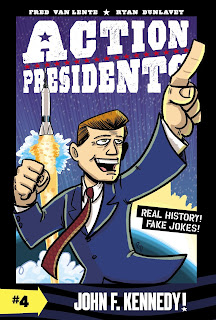
Book 4 focuses on John F. Kennedy, and in contrast with TR, he came from a family of immigrants who fought hard to establish themselves in the USA in legal and illegal manner. The framing sequence here is of a couple of children (one apparently Pakistani and the other more a generically depicted Asian) who are isolated from the main group of children during a trip to the Kennedy Space Center because their lunches "smell weird." The theme of immigration and integration runs throughout the book, with the ethos of the USA being a place of opportunity for all being reinforced by JFK's story as a model for those two children. I don't know if I am being cynical or if I am being affected by the immense anti-immigrant agenda I see in the US government and society right now, but something about this message just seemed a bit too pat and color-blind. Like my colleague Dr. Laura Jimenez recently wrote, I expect a little more in this day and age. 
 
A lot of US history is affected by whiteness, which conveys the dominant narrative, and in hindsight I think that is a major blind-spot the books in this series books have, as well-meant as they are. Perhaps it is the perception that younger readers should be protected from these more complex, oppressive views of history, and maybe I am asking a lot of a series of books narrated by a talking turkey, but I still felt they came up short in the area of representation. 
 
This disparity really hit me in the JFK volume. The two children who are held up at the end of the book as the resilient hope for our future simply do not enjoy the same built-in advantages as the four Christian white men (Washington, Lincoln, TR, and JFK) spurring them on. I get the drive to extend from JFK's famous exhortation to "Ask not what your country can do for you...," but I also get that systemic racism goes well beyond children being mean to each other at lunchtime (though that may be a relatable and apparent symptom to younger people). This ending puts all the onus to adapt and effect change on the young people, and I think that is a huge burden that is not acknowledged. Also, it ignores the fact that it is the very system being celebrated that is doing the oppressing. Thus, the ending seems pat and disingenuous to me.
Oy.
Regarding the rest of the book, it is chock full of historical information. It offers a look at the many aspects of JFK's life and how it was affected by his father's drive to involve his children in politics, serving in Wold War II, dealing with the Cold War, getting elected to the Senate and then President, and the many conflicts he had to deal with, including those with Cuba and the Soviet Union. There is also a good bit about the Civil Rights movement of the time, with its accomplishments and accompanying violence. Ironically, all this work took place in the past and is not really explicitly tied to the present-day plight of the two children. This to me is a lost opportunity to make the connection to the ongoing battle for civil rights, implying that those battles were fought (and won) in the past. This book also gets into the Camelot period of his presidency, though it is not exalted as much as I have seen in other works. 

As you might tell by now, I was not as taken by this book as I was the others from this series. In terms of history and government, this book covers a lot of ground. In some ways, I think this left me a bit breathless, and I wonder how much context unfamiliar readers would need to deal with the text. It is an ambitious book, and perhaps that drive to do so much detracts from other areas, like the framing sequence where I feel perhaps the two children should have been a bit more fleshed out so as not to seem generic types that feed into the same sorts of stereotypes the book tries to transcend.

These books are the product of Fred Van Lente and Ryan Dunlavey, frequent collaborators who both have numerous comics credits for multiple publishers. They have collaborated on two prior historical comics projects, Action Philosophers! and The Comic Book History of Comics. Currently the duo are working on The Comic Book History of Animation, which I helped fund via their Kickstarter.

I have not been able to locate any reviews of these two books yet, but the TR one has a 3.67 (out of star rating on Goodreads, and the JFK one has a 3 star rating (as of this post).

Action Presidents! were published by Harper Collins, and there is more information about all the books in the series here.

Saturday, August 15, 2020

Mr. Butterchips: A Collection of Cantankerous Commentary

Mr. Butterchips is an interesting character, a monkey who aspires to be a stand-up comedian but who is largely relegated to make ends meet by partnering with an organ grinder. His job brings him into contact with a wide cross-section of people, making a sturdy platform for him to express his cantankerous views of social conditions, politics, popular culture, and all sorts of other matters. The first half of the book is episodic, in the vein of a weekly comic strip. And I was pretty amused to see how he tackles contemporary hypocrisy and injustice through comedic commentary, targeting things like "the war on Christmas," pro-lifers, big pharma, Comicsgate, and anti-vaxxers. 

The second half of the book is a single, sustained narrative about Mr. Butterchip's misadventure with controlled substances in the streets (and sewers) of San Francisco. This story is more surreal, reminiscent of underground comix, with the city and its denizens being the butt of the jokes. I have only been to SF once, so I might not get all of the "in" humor, but I was still entertained by the tale, which also has a few mild suspense elements. 

One of the best features of this book to me was seeing how the character, setting, and situations evolved over time. At first, the episodes are given to finding a tone and also establishing the character, which has it fits and starts with mundane things like girlfriend trouble and struggling to make rent. Over time, Mr. Butterchips develops more of a voice and the targets of its satire become more pronounced. By the time I got to the large story that ends the book, I felt a familiarity with things that made the plot hum. It was a lot like reading old volumes of comic strips and seeing how they grow into themselves. I'd be interested to see if there will be more adventures with this acerbic primate in the future.

These comics were created by Alex Schumacher, and most of them appeared monthly in Drunk Monkeys. He has completed a number of projects, including the webcomic Decades of (in)Experience and the self-published print collection Defiling The Literati. He speaks more about his work and career in this interview.

I was only able to find one review of this book, but it was very positive. Aaron Iara wrote, "Our news feeds and social media are chock-full of people arguing and discussing the issues of the day. However, hearing these arguments from a heated drunken monkey is so much more fun." He summed up by recommending "Mr. Butterchips to fans of political cartoons, boisterous stand-up comedians, and off-beat comic books."

Mr. Butterchips was published by SLG, and they offer more info about it here. This book features profanity, adult themes, drug use, and some sexual situations, so it is recommended for readers mature enough to handle those things.

Friday, May 15, 2020

The Nib, Issue 5: Animals

The latest issue of The Nib magazine came out a few weeks ago, and its theme was animals. Not only was I treated to a variety of art styles and tones, I learned a lot from reading this book, including the fact that in the 1930s there was a supposed talking mongoose(!), most fur for clothing comes from a raccoon dog(!!), and Mickey Mouse wearing gloves comes from a minstrel tradition(!!!). I also got to see lots of other interesting information, including distances and migration patterns of various creatures and drawings of a series of endlings, the last known individuals of a species.
Among the more lengthy feature articles, two particularly stood out to me. Arwen Donahue wrote and drew an thought-provoking piece about raising, milking, and butchering goats and how that squares up with her views of vegetarianism, environmentalism, and community. It is not a very cut-and-dried issue, and I appreciated just how much she elucidated a debate about the ethics of farming and raising various sorts of livestock.
Writer Dorian Alexander, journalist Sarah Mirk, and artist Levi Hastings collaborated on an article about the economic and ethical dilemmas regarding smuggling and selling parrots from tropical locales. It is a big business for some, with an impact on local ecologies as well as the people looking to profit from these birds. Not to mention that the birds themselves also suffer because of these practices. What I loved about both of these works was how they mingled personal experiences with research and journalism to make some very impactful writing.

And just to remind people that not everything in this magazine is so heady and complex, there are also a series of gag strips as well as illustrated letters to the editor that round out this collection. I truly feel that the contributors at The Nib are making some of the best comics right now. Herblock Prize-winning, Pulitzer Prize-nominated editor Matt Bors has assembled another murderers' row of creators here.

The reviews I have read of this volume have been positive. Zack Quaintance noted "that that reading experience was quite good, adding that journalism done via this medium is so rare that whenever I come across some of this quality, it tends to linger with me for days (and days...and days)." You can see a bunch of other reviews at Goodreads, where it has a 4.40 stars (out of 5) rating as of this blog.

Content for The Nib is published regularly online, though the print version features exclusive content and comes out about three times a year. You should consider becoming a member and supporting their high quality, independent artistic and journalistic endeavor.

Friday, March 20, 2020

Noisemakers: 25 Women Who Raised Their Voices & Changed the World

Noisemakers is an impressive collection of stories, 25 mini-biographies of notable women who have left profound marks on the world. This project was accomplished by 25 different creators, who were all women or non-binary, which adds a unique take on these accounts as well. The book is divided into six sections (Grow, Tinker, Play, Create, Rally, and Explore) that cast a light on scientists, inventors, athletes, artists, activists, and explorers. Some of the figures, like Hedy Lamarr, Frida Kahlo, and Rosa Parks are well known, but there are others, like Emily Warren Roebling, Madam C.J. Walker, and Junko Tabei that I knew little or nothing about beforehand (and shame on me!). I think they did a great job of covering a wide array of people and nationalities, and even though this book is aimed at younger readers I feel it is also an informative introduction to older ones.
The artwork in this volume covers as wide a range of pallettes as it does subjects. Some, like Shauna Grant's take on Maya Angelou, are more manga-inspired and cartoonish. Others, like Rebecca Mock's account of Ida Lewis, hew a little more to reality. I think all of the stories are extremely well illustrated, and the worst thing I can say about this book is that some seem more fleeting and slight than others. 8 pages is not a lot of space to work with, and some of the entries are more dense, in terms of panels and information, than others. Still, this is a great book full of excellent stories. It's a wonderful introduction to these women and a jumping off point for those seeking out further reading.
The mix of creators in this book is admirable, with more seasoned creators as well as new faces. For me, the most notable entries were Emil Ferris's bio of Mary Shelley, Lucy Knisley's look at Julia Child, Molly Brooks's tale of Kate Warne, and Jackie Roche's account of Nellie Bly. But there is not a clunker in the bunch. More context about the book and the process of making it can be found in this interview with editor Erin Bried.

The reviews I have read of this book have been positive. tasting menu of short biographical comics...[that] serves up enticing bits of history for an array of readers with varying interests."

Noisemakers was published by Alfred A. Knopf, and they offer more info about it here.

Tuesday, August 20, 2019

The Nib Magazine Issue 4: Scams

I just read the fourth issue of The Nib print magazine, and it is a top notch collection of political cartoons, tales, and reports by excellent writers and cartoonists. I am a huge fan of The Nib, as a magazine and as a website that updates fairly regularly (practically daily). As of July, the entire enterprise is independent and reliant on the support of its readers, and I am glad to take this time to highlight what I feel is an excellent source of comics goodness.

This particular issue focuses on Scams, and it covers multiple topics, including the classic Nigerian Prince email swindle, ways that refugees are robbed by supposed help agencies, various Ponzi schemes, seemingly criminal real estate practices, good-old-fashioned counterfeiting, and electronic fraud. The stories are current, topical, and fascinating. Also, many also feature a good dose of humor. I love nonfiction comics, and this book is full of them.

Stand-out stories in this book include:

Emi Gennis's account of John Romulus Brinkley, "The Goat Gland Doctor" who was an infamous huckster with a huge radio signal.
"My Heart Burns" by Yazan al-Saadi and Tracy Chahwan, about smugglers and how they fleece Syrian refugees who are most vulnerable and desperate.
Josh Carter and Liz Enright's "Secret Agent Man," about one father's search for a big online score and its aftermath on his family's lives.
These stories are profoundly moving as well as eye-opening. These are the best kinds of comics: educational, informative, funny, and emotional. There is something here for everyone.

The Nib's website, where original work is regularly published, is here. Memberships to The Nib are available here. Rates start at $2/month, and the print copy costs $4/month. It's well worth it!

They are also currently running a summer fundraiser, if you are just inclined to make a donation, I say it's for a great bunch of folks.