Showing posts with label critical thinking. Show all posts

Sunday, August 25, 2013

How to Fake a Moon Landing: The Truth Behind Science Denial


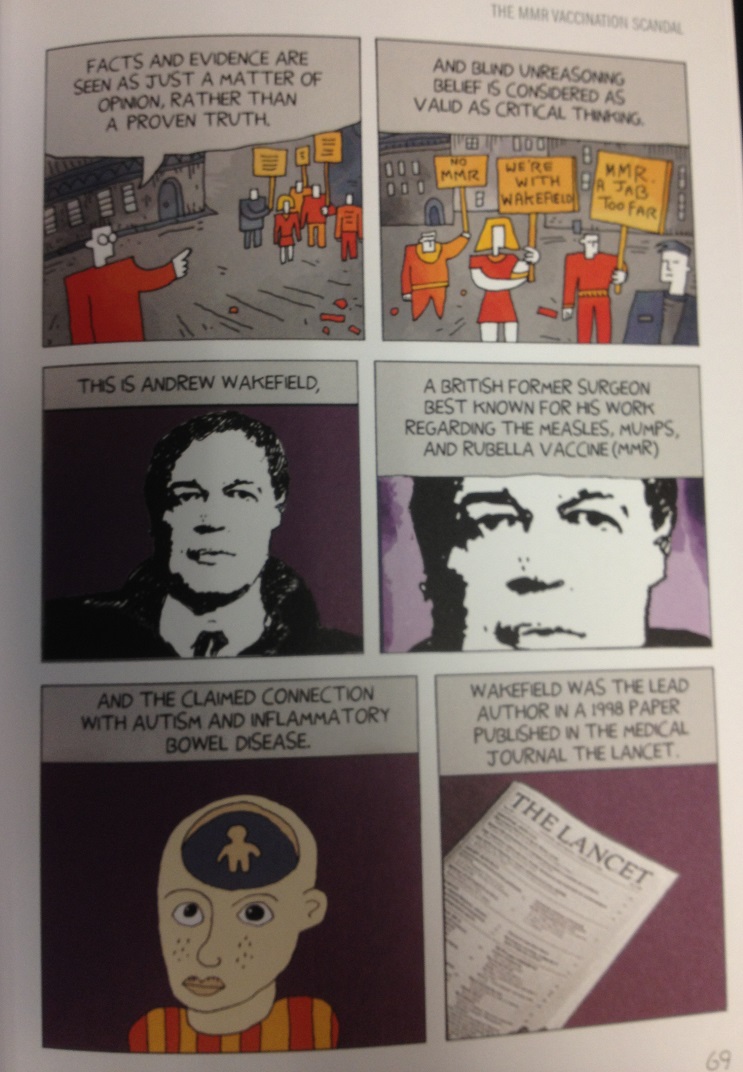
How to Fake a Moon Landing is a collection of essays about various topics having to do with scientific inquiry. It looks at issues of translating research into popular media and how conceptions and misconceptions are created. Lots of juicy topics are tackled, including climate change, the Apollo 11 moon landing, chiropractic, the MMR vaccine, fracking, and homeopathic cures. These essays are passionately argued, and well structured individually. The takedown of a certain Dr. Wakefield in regards to faulty research about connections between the MMR vaccine and autism is particularly thorough and eye-opening, but the rest are similarly compelling and well argued.

Still, after enjoying the author's last offering, Psychiatric Tales,so much, I felt let down by this book's lack of a framing sequence or explicit connections between essays save for two introductions. The former book was much more personal, and although this one is still well researched and presented, it smacks more of infotainment than it does of an aesthetic whole. As well argued as the essays are, they are separate entities that can be read entirely on their own. I would suggest taking one's time with this book and tackling each chapter over time, only because the topics vary and the essays do not hang together so well in a narrative sense. Still, the individual pieces are great examples of science reporting.

Author/illustrator Darryl Cunningham specializes in nonfiction comics, tackling diverse topics in his blog Darryl Cunningham Investigates. He primarily publishes online, but also has the aforementioned collection of his experiences as a health care assistant in a psychiatric facility. He speaks more about his work on this book in this interview with John Hogan as well as this one with Robot 6.

Cunningham's art is sturdy and straight-forward. I enjoyed his use of abstract stylized cartoons with occasional realistic, photographic drawings interspersed in the panels. His art is not flashy, but it does convey information and arguments in clear fashion. Here are a couple of different pages from the book that are characteristic of his style:
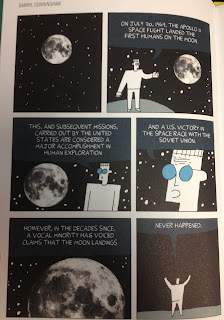
From the moon landing section.
From the MMR vaccine section.

Although it is certainly written from a particular point of view, the book is not overtly didactic in its intentions, pushing readers more to think for themselves than to accept simple accounts of events or situations. In these interests, Cunningham includes many sources for his essays in the back matter so readers can verify what he said or go off and do their own fact checking.

Reviews I have read of the book online range from positive to lukewarm. Robert Greenberger wrote, "Cunningham does a remarkable job with difficult material and for high school students, just opening their eyes to the world around them, this is a terrific primer." The reviewer at Geeks of Doom called it "fun and informative without being preachy." Nick Smith was slightly less enthusiastic, stating, "The artwork is cartoony, which may distract some readers from the serious nature of the information presented," but added,  "the book is readable by teens, if they’re interested in science."

How to Fake a Moon Landing is published by Abrams ComicArts. They offer a teaching guide and more here. Here is a short excerpt at Boing Boing.

Saturday, November 10, 2012

Burma Chronicles


This is the third travelogue from Guy Delisle, an illustrator and animator who travels the globe for work and also to accompany his wife who is involved in Doctors without Borders. Thus, he gets around to some very interesting places. He is a Canadian and his primary language, as you can tell from his blog, is French.

This is his most best, most insightful book to me, as it delves into the political milieu in Myanmar as it relates to Doctors without Borders much more than the others. There is much discussion about whether the organization can operate in this country independently in ways that treat those in need or if it is being turned into an instrument of the state that openly discriminates against those the dictatorial regime deems enemies. Added to this political dilemma is the fact that Delisle is for the first time in a country along with his infant son, placing him in everyday contexts and allowing him to see the social conditions as both a citizen and a parent.

Reviews I have read about the book have been very positive. The Guardian's Rory MacLean praised the book, calling it "the most enlightening and insightful book on Burma in years," and adding, "The key to its success are Delisle's whimsical, black-and-white drawings, as well as his endearingly naïve and humorous self-portrait. Together his honesty and minimal line disarm the reader, drawing him or her into Delisle's life, learning as he learns the truth about the struggle for survival under the generals." J. Caleb Mozzocco called Delisle's work "highly evocative minimalism," going on glowingly, "He’s spent a decade in animation, and it certainly shows in his command of the page, and the time and space the panels suggest upon it." Kirkus Reviews called the book an "insightful, illuminating memoir."

This book was published by Drawn and Quarterly. Some preview images and reference material for the book have been provided here by the author.

Thursday, February 10, 2011

Everybody is Stupid Except for Me

Not so much a graphic novel as a collection of cartoons from Reason Magazine, this book is full of the excoriating wit of Peter Bagge. Bagge has been cartooning since the 1980s, with work frequently appearing in the seminal comics anthology Weirdo. He went on to his own anthology series Neat Stuff, where he drew and wrote stories about suburban families, talk radio DJs, and assorted social misfits, which led into Hate, a series that followed Buddy Bradley as he moved from suburban New Jersey to grunge-era Seattle. His work is highly regarded, and he has won multiple Harvey Awards for his art and writing.

In this collection, Bagge voices his libertarian views to skewer many topics, from political machinations of war, debates over legalizing marijuana, the mall-ification of America, public funding of professional sports complexes, public funding for art, casino gambling, and funding public transportation. He attacks the political right and left, even his own Libertarian Party. Often, he places himself in the story, as a reporter from a swingers convention or a War on Drugs conference and acts as an average Joe, probing into the ridiculous or shaky underpinnings of political stances and opinions. Although not every topic in the book is appropriate in school, an instructor could find many great examples to cherry-pick for instructional use.

All of the reviews I've read about this book show an appreciation for Bagge's loopy art style but also have some reservation about his opinions. Robot 6's Chris Mautner wrote that whether you agree with his views or not, Bagge is "still one of the funniest cartoonists in America today." Esquire's Tim Hefferman opined that the book is as "combative, iconoclastic, and embittered as its title suggests it would be. It is also smart, thought-provoking, and funny as hell." Ashley Cardiff offers a contrasting opinion of the book, eviscerating Bagge's libertarian views. All said, it seems that the book has the potential to amuse and agitate, an indication Bagge did his job well with these cartoons.

Here is a preview from the collection's publisher Fantagraphics Books.

Most of the cartoons featured in the book can be found on Reason's website if you search for them by title.

Friday, May 21, 2010

Shenzhen: A Travelogue from China

The second illustrated travelogue from Guy Delisle, Shenzhen is a record of the artist/animator's trip to the large Chinese city neighboring Hong Kong. Shenzhen is a growing metropolis that attracts many people looking for employment and opportunity, and Delisle was there for three months in the late 1990s to supervise a team of animators. Delisle's descriptions of the city are sometimes harsh, pointing out the filth and omnipresence of government propaganda, but they also include very human observations about local food, entertainment, and constant construction projects. One of the overwhelming feelings the reader gets from his accounts is that he felt pretty isolated and lonely in China.

As I noted in my entry on Pyongyang, Delisle is an illustrator and animator who travels the globe for his work and also to accompany his wife who is involved in Doctors without Borders, so he gets around to some very interesting places. He is a Canadian and his primary language, as you can tell from his blog, is French. This interview sheds some more light on Delisle's feelings on his trips to China and some of the decisions he made in creating this travelogue.

Shenzhen is generally well regarded, and it was nominated for a Wright Award for Best Book in 2007. Paul Karl Lukacs writes a thoughtful review of the book and also notes that he had very different experiences and that Shenzhen has undergone large changes since Delisle's time there. Renee, President and Publisher of Shen's Books, called it very realistic and felt Delisle's experiences were very similar to her own. Reviewer Danya David says that despite its flaws, Shenzhen is a "fast and interesting read" and suggests it may be a good addition to an 11th or 12th grade history or government class.

A preview is available from the publisher Drawn & Quarterly.

Monday, February 15, 2010

Pyongyang: A Journey in North Korea

Is creating a graphic novel worth getting blacklisted by an entire country? Guy Delisle might be a good person to ask. He is a French-Canadian animator who spent two months in 2001 (before 9/11) supervising animation work out-sourced to North Korea. While there, he took notes on what he saw and experienced; these became the basis for this graphic travelogue. Apparently the fruits of his labors are not much appreciated by the current regime.

This result may not be so surprising given that Delisle does not paint a positive picture of North Korea in general, and of its capital city Pyongyang specifically. His response may be best understood via his situation there. Sequestered in a lightly inhabited hotel with limited dining options, Delisle was not allowed to travel without an accompanying guide. When he did get to travel, he was constantly confronted by bleak, spare surroundings, omnipresent images of Kim Jong-il and his father Kim Sung-il, and propaganda praising North Korea and decrying its capitalist enemies.

So he paints a depressing national portrait. Most of the North Korean people are shown being fed a constant stream of propaganda through images, song, and film. They are fearful not to say or do anything to appear critical of the state. Stores are full of huge quantities of the exact same items, with hardly any buyers. Electric lights are scarce; fresh fruits and vegetables are only made available when foreign dignitaries are present; there are no traffic lights, and entire sections of the city are kept off-limits. Also, half finished construction projects, including the colossal, 2-decade-old shell of the Ryugyong Hotel and a largely unused opera house, abound.

Delisle has worked as an animator for more than a decade, working in a number of Asian countries. His wife is an administrator for Médecins Sans Frontières (known as Doctors Without Borders in the US), a job that has led to their family living in a number of different countries. Delisle has turned these experiences into other illustrated travel stories, including volumes about China and Burma. This news story from the National Post and this interview with TimeOut Hong Kong shed more light on his reasons for creating these works.

Reviews about this book are a bit mixed. Some reviewers, like Gary Butler see it as a work of activism, giving voice to a people who live in fear and cannot speak for themselves. Andrew D. Arnold speaks about how he is glad to see light shined on a country shrouded in secrecy while being disappointed that Delisle did not delve into how this experience changed him or add any particular constructive insight into the exchange between cultures. This range of reviews from Goodreads goes further with criticisms, with some reviewers calling Delisle racist and condescending to the North Korean people.

Pyongyang was originally written in French but was published in English by Drawn & Quarterly. They publish periodic news updates about his work here. They also have an 8 page preview available in pdf format here.