Showing posts with label 1970s. Show all posts

Wednesday, March 25, 2026

Boy vs. Shark

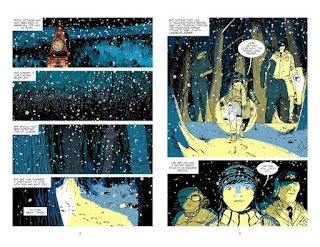
You know what is still awesome? Libraries! I recently borrowed and read the e-comic version of Boy vs. Shark through Libby, because the physical copy from my local branch was already checked out. I don't regularly read comics on my laptop, but the interface was intuitive and I enjoyed the reading experience. Logistically, it also made it super easy for me to take a screen capture and provide this short excerpt:

This graphic novel, set in 1975, was totally up my alley, not just for the pop culture references of the times (there is a handy glossary for those references in the end matter, for you whippersnappers) but also for its good senses of characters and humor. The story here is one of transitions, as young Paul is 10-years-old and feeling threatened for a couple reasons. First, he feels like he is losing touch with his best friend David, who he has known forever, because he has started hanging around with some older kids. Second, everyone seems obsessed with the new movie Jaws, a huge summer blockbuster that he is probably too young to watch but he feels compelled to in order to keep up appearances. Also, the older kids seem OK with initiating these younger ones into their club, but it involves some questionable activities like throwing apples at people's windows and shoplifting.

Paul is caught up in many emotions: he wants to act grown-up, to keep his friendships stable, and does not want to disappoint his parents. I should also add that he thinks that his father has the "Irish eye," which is an ability to see what he is doing at all times. He and his dad do not always see eye to eye, and a large part of this book is a look at their realistic, imperfect, and loving relationship.

Of course, things go wrong and there is trouble with the law, store owners, and the next-door neighbor. And people get hurt, both literally and figuratively. I do not want to spoil much, but I was impressed with how Paul deals with things and also how he relates to his friends and family. Bravery can take different forms, and he certainly shows ways to face responsibility and find an alternative to toxic masculinity. This graphic novel tells a coming-of-age tale in excellent fashion.

The deceptively simple artwork and moving story were done by Paul Gilligan, who is known for his comic strip Pooch Cafe. He has been twice nominated by the National Cartoonist Society for best strip, and he also has a couple of other books series, Pluto Rocket and King of the Mole People. He speaks about his work on Boy vs. Shark in this article.

All of the reviews I have read about this book have been glowing. In a starred entry Kirkus Reviews called it "an authentic and funny look at masculinity and growing pains that resonates across the decades." Kasey summed up, "Gilligan creates a compelling balance of humor and heart in his exploration of masculine values and growing up." Allison Giggey wrote that it "never feels preachy or overly sentimental" and added, "it’s funny, upbeat, and overall a great read."

Boy vs. Shark was published by Tundra Books, and they have a preview and more available here. 

Monday, November 10, 2025

Abbott 1973

Sometimes when I read a book, I am struck by how much some things change and how much other things stay about the same, especially regarding how some social groups are treated and mistreated. Abbott 1973 is the second entry in the series, and I have to admit that I have not read the first book but still was able to jump right in and enjoy this one. The main character is Elena Abbott, a Black, lesbian reporter who works for a Black-run newspaper in Detroit. Because of the times, she and her partner have to stay closeted. In this book, she has a new editor, and he treats her condescendingly because she is a woman, which creates friction. Also, she is covering the tense mayoral race that would result in the first Black mayor of Detroit being elected, though there are some sinister forces working against that happening. 

The twist in this realistic fiction is that those forces draw from the occult. However, Abbott has access to power called the Lightbringer, and she is able to combat those supernatural villains on her own terms. What I feel this book does best is traverse two genres, urban historical fiction and supernatural fantasy, in a way that both work. This book is a great piece of suspense and the fantastical elements add a different, satisfying twist to the proceedings. The character work is also strong, and I really liked the detail and care to depict a time period from about 50 years ago, warts and all. 

This series is a collaboration between writer Saladin Ahmed, artist Sami Kivelä, and colorist Mattia Lacono. Ahmed is an author whose novel Throne of the Crescent Moon was nominated for a Hugo Award, and he has also done several runs for Marvel Comics on characters such as Miles Morales, Daredevil, and Ms. Marvel. Finnish artist Kivelä is known for several series, most notably Undone by Blood and Machine Gun Wizards. Italian artist Lacono has done extensive work coloring comics, mostly for Marvel Comics.

All of the reviews I have read about this book have been positive. Zack Quaintance wrote that it does "a great job of building upon its established premise to begin a story that feels intriguing, timely, and important as ever." Marion Deeds called the first series "an immersive read and a look at an important time period in the USA, and one we are being encouraged to forget." Publishers Weekly summed up, "Pulp and politics mix in this relatively straightforward supernatural tale; though it doesn’t elevate the genre, it satisfies its goals and does so with a refreshingly diverse cast."

Abbott 1973 was published by Boom! Studios, and they offer more info about it here.

Saturday, March 15, 2025

Light It, Shoot It


I love a good noir story, especially one that features excellent artwork like Light It, Shoot It. It follows the travails of Billy Bonney, a young man who has just gotten out of prison for arson. He has troubles getting along with his peers as well as just fitting in to society. Luckily, his older brother is in the film business (on a low rung, but still), and he helps him get a gig being a actor's assistant. Mainly that involves him making sure the older alcoholic leading man is in working shape and on time to the set, not very glamorous work.  

As you can see from the excerpt above, the artwork is very expressive and lovingly portrays the gritty realities of 1970s Hollywood. The excerpt also features a lot of characters and moving parts, which are a hallmark of this book. There is a lot going on and lots of people with their own motives. Billy is trying to fit in; his brother is trying to get laid; one of the producers has a plan to recoup shooting costs through insurance fraud; some people are trying to make a movie; some people are trying to get famous, and still others just want to bask in the glow of showbiz. I am not going to say that the plot is the most original I've ever read, but I think that this book hits its story beats hard: a quintessential exploitation tale in graphic novel form. It's clearly a labor of love, and I got very much caught up in the enthusiastic way this story was told both through its narrative and art.

Light It, Shoot It was written and drawn by Graham Chaffee, who mainly works as a tattoo artist. He has published a couple of other graphic novels, including To Have & To Hold and Good Dog. He speaks about his work on this book in this interview.

All of the reviews of this book I have read highlight its strengths. Publishers Weekly wrote, "Chaffee’s pastel washes, clear affection for the period, and well-stocked gallery of colorful hoodlums and reluctant heroes make up for the lack of suspense." Jason Green called it "an excellent example of noir storytelling at its finest, soaked in a uniquely 1970s mood." Paul Dunne opined, "Drawn in bold brushstrokes, and hand-painted in subtle washes, Chaffee brings vintage LA to the page in a propulsive adventure."

Light It, Shoot It was published by Fantagraphics, and they provide a preview and more info about it here. This book is suggested from mature readers.

Sunday, December 5, 2021

Friday Book One: The First Day of Christmas

The holidays can be a tough time of year for many people. This is especially true for Friday Fitzhugh, a young woman who comes home to her small New England town after her first semester at college and finds herself embroiled in a mystery. This situation is not novel to her, because she spent most of her childhood traipsing over town with her best friend Lancelot Jones, solving mysteries, foiling villains, and discovering all sorts of magical items. Something menacing and mysterious is lurking in the woods outside of town, driving some townfolk mad. However, something happened just before she left for college that estranged her from Lance, and she does not know quite how (or if) to deal with it. 

Friday is a sort of version of Sally Kimball,  tough and athletic and able to be a body guard for her friend. Also, she is a multi-faceted young woman who is trying to figure out her place in the world, and what a strange world it is. The seaside New England town where this book is set is like a character unto itself, full of interesting characters, adjoining a creepy forest, and a focal point for dark magic. 

I really enjoyed reading this book, and I may just be the perfect demographic for it. It smacks of things I read when I was a kid, like the Encyclopedia Brown series and John Bellairs novels, only with a twist that carries them beyond a children's book perspective. The characters and setting coalesce organically in the tightly plotted narrative, plus the artwork is exceptional. It is full of atmosphere, and I loved poring over pages to admire the archaic architecture, creepy critters, and spot-on character designs. My admiration of the art, along with the need for checking for clues to the mystery, led me to re-read this book a few times for fun. The worst thing I can say about it is that it is a long prologue for the real  narrative, because the last few pages of the book add a twist that I did not see coming. But it's so incredibly intriguing and well crafted  that I really did not care. It's a great piece of genre fiction, and I cannot wait for the next two books to see how things resolve.

Friday is a collaboration between writer Ed Brubaker, artist Marcos Martin, and colorist Muntsa Vicente. Brubaker is a multi-award winning comics creator whose works include Sleeper, Criminal, Incognito, Fatale, The Fade-Out, and Kill or Be Killed. Martin has also won Eisner Awards for his art in the superhero series Daredevil and the webcomic The Private Eye. Vicente has done design and illustration work for a number of high profile clients and more recently has also gotten into coloring comics.

Friday won the 2021 Eisner Award for Best Digital Comic, and all of the reviews I have read about this book have been positive. Publishers Weekly wrote that "this atmospheric first installment sets up compelling sequels, with a sucker punch ending that demands follow-up." Luke Chant opined, "Ed Brubaker’s script is excellent, while Marcos Martín and Muntsa Vincente combine to do a great job capturing the 70s feel." Steve Baxi called it "an incredible start to what is sure to be an incredible series."

This trade paperback of Friday Book One: The First Day of Christmas was published by Image Comics. All individual and future issues are and will be available from Panel Syndicate.

Wednesday, December 30, 2020

Kent State: Four Dead in Ohio

My Friend Dahmer is one of my all-time favorite graphic novels, a dark exploration of high school friendships and the many issues that underlie people's lives, which in the case of Jeffrey Dahmer resulted in horrific murder and mayhem. Derf Backderf's combination of autobiography and journalism made for a highly nuanced and haunting book that has stayed with me for years. Kent State: Four Dead in Ohio has a bit of autobiography at its beginning, when young Derf saw the National Guard rolling through his town on the way to Kent State, but its strength lies in its exhaustive research. This book focuses specifically on the four young people who died in the May 4 Massacre in 1970, putting a human face on history. Over the course of the book, I got to know these people, their friends, and their aspirations, and so when the gruesome events take place toward the end of the book, they feel even more tragic and pointless.

This book meticulously recounts the event that lead up to the massacre, and it is structured in four chapters to correspond to the first four days of that May. Piece by piece fall into place, from the "law and order" governor trying to show just how strong he is during an election year to the paranoid, draconian military leaders who headed the National Guard contingents to the exhausted and misinformed troops themselves. In hindsight, the massacre is made to look like a perfect storm, complete with misinformation, wild and untrue accusations made against the student protestors, and a culture war between liberal and conservation factions. The military action comes to be, ironically, as a result the fomenting protests against the increasingly unpopular and cruel military actions in Vietnam. 

What is most informative and distressing about this book is the role that manipulating media and casting political aspersions played in the National Guard's actions, which is mirrored by contemporary protests and police brutality in Portland and other places. Acerbating the situation, government agencies and police planted spies and moles to make the protestors appear much more violent and extremist, just like today. The violent factions within the protestors are a minority, and do not reflect the whole, but they are attributed all sorts of (non-existent) power and agency. Rampant rumors among the local population and military/community leadership paint the students as communists and radicals. They say that the students have snipers and stockpiles of weapons. They dehumanize the students and their demands. It is depressing to see how much things have not really changed and how short we have come in the 50 years since these events took place. 

Spoiler: The bad guys win and suffer no consequences.

I was impressed by just how much this book does. It portrays a set of individual portraits of the students, a history of the campus, and an account of the state of politics of the time on a city, state, and national level. There is a lot of information in this book, and most of it is presented in incredibly artful manner. There are a few pages that are text-heavy and more expository, but none of it is off-putting. And the pacing of the last chapter, where the shootings occur is paced to highlight its brutal, oppressive, and unjust aspects, is a clinic in storytelling an action sequence. The illustrations map not just the place but also the people and events in a visceral and incredibly moving fashion.

Reading this book, I could not help but also think of Big Black: Stand at Attica, which recounts events that happened at a prison uprising a year later, events referenced in this book's epilogue. Great books use history to illuminate the present, and that is exactly what Kent State does. Certainly it comes from a particular political viewpoint, but it is backed by a vast amount of research and personal accounts. And the facts (those that have not been obfuscated and lost) point to terrible and avoidable injustice and murder. Derf has crafted another masterpiece graphic novel.

In addition to the multiple award-winning My Friend Dahmer, Derf Backderf is also known for his long running alt-comic The City as well the graphic novel Trashed, about his time as a garbage collector. He speaks extensive about his work on Kent State in this interview.

All the reviews I have read of this book have praised it. It has received multiple starred reviews. The one from Publishers Weekly called it an "expertly crafted chronicle of this defining moment in U.S. history" that also "serves as a deeply moving elegy for the victims." The one from Kirkus Reviews concluded, "Backderf’s vivid, evocative book does a splendid job of keeping their memories alive." Leonard Pierce wrote, "By buying into the details so heavily, he makes a story that means something more today – and serves as a warning as we see the story repeated, again and again, every day, always as tragedy."

Kent State: Four Dead in Ohio was published by Abrams Books, and they offer a preview and more here.

Wednesday, July 15, 2020

Jack Kirby: The Epic Life of the King of Comics

Captain America. The X-Men. Hulk. Iron Man. The Avengers. The New Gods. Black Panther. These are only a few of the hundreds of characters that Jack Kirby either created or co-created. They are household names and properties that have generated billions (trillions?) of dollars for the corporations that control them. But he received close to none of such profits. In terms of industry folks, most artists and creators revere Kirby as one of the all-time greats, but non-comics people tend to not know who he was and attribute all of his creations to his frequent collaborator Stan Lee. Finally here, he is given a full biography, in graphic novel form.

Jack Kirby: The Epic Life of the King of Comics tells his whole life story, from his early days as a hard-scrabble New Yorker to his becoming an artist and taking part in the formative years of the comic book industry. He was friends/associates with many of the people who shaped American comics, like Bob Kane, Will Eisner, and Joe Simon. He bounced around several companies, enlisted and served in the Army during World War II, co-invented the genre of Romance Comics, co-created the Marvel Universe as we know it, and went on later in life to work in animation. His was an eventful life, and this book captures it in a mostly realistic, painterly style that evokes the spirit of Golden Age comics as well as documentaries. Also, the paper itself is colored to resemble yellowed newsprint, the material used to display Kirby's works.
I have to say that this book moves at breakneck speed, and it is packed full of his accomplishments. There is a part of me that wanted there to be more breaks, perhaps in the form of chapters or parts, but I also feel that the sort of compressed storytelling at play here is more emblematic of Kirby's work. So the medium very well matches its subject, though I also made myself pause at times to catch my breath and take in the story.

I also appreciated the way the book used Kirby as the primary narrator (using various interviews and articles as reference points) with occasional shifts of POV to his wife Roz and collaborator Stan Lee. I'd say it does a good job at capturing the spirit and voice of the man, and I liked how it treated him in very practical terms, with his speaking to the need to be productive and work not only in terms of expressing himself but also to put food on the table and support his growing family. Certainly Kirby was an impressive creator, but this books demystifies some of the origins of his most famous works, showing how he cobbled together his experiences, learning, and media consumption in spinning his fantastic stories and amazing characters. Kirby is impressively human.

This book also touches on the more controversial aspects of Kirby's life, namely how he was cheated out of his due as a creator and spent much of his life battling in vain to retain control of his stories, characters, and artwork. Surely there is lots of blame to assign for his treatment, and I felt this book captured well the conditions that led to it. It also has lots of source material behind it to help flesh out the proceedings well.

In seeing people's responses to this book online, the most glaring aspect people have latched onto is the depiction of Kirby himself, which you can see from the cover image. While everyone else is realistically drawn, Kirby is rendered in a cartoonish way, with a huge head and big eyes. I think this choice does two things: it draws attention to him in every way as an otherworldly presence, and it makes it clear who he is in every instance, making for smoother storytelling. Others have noted how this choice is related to how another comics titan Osamu Tezuka (the "God of Manga") drew himself in his own works, and I feel that there is a similar semiotic move made here, a marker of a similarly legendary figure. In reading the book, I have to say that I did not find the choice jarring in the least, and I was quickly drawn into the narrative flow of the story. Even though I was very familiar with many aspects of his life, I still found this book fresh and vibrant. And I feel it is extremely important now, especially as an introduction to those who are unaware of just how impactful Kirby's life was.

This book was created by long-time Jack Kirby fan Tom Scioli. His own works clearly owe debts to Kirby in terms of style, particularly his series Gødland and American Barbarian, not to mention his recent Fantastic Four: Grand Design limited series. He has also drawn a number of licensed properties, including Transformers Vs. G.I. Joe. Scioli speaks about his work on this book in this interview. For more about his entire career, check out this interview with TCJ.

All of the reviews I have read about this book have sung its praises. In a starred review Publishers Weekly called it "a must-read for Kirby fans, and beyond—it captures the mythos of the of the 20th century comic industry’s golden age."  Kirkus Reviews summed it up as "a fast-paced celebration of an underheralded legend within the comic-book industry." Steven Thompson wrote, "The public deserves to know Kirby’s story and Tom Scioli, the obsessive Kirby fan/writer/artist, tells it here in a way I can’t help but think the King himself would’ve liked, and in the medium Jack Kirby loved."

Jack Kirby: The Epic Life of the King of Comics was published by Ten Speed Press, and they offer a preview and more here.
Kirby's influence extends way beyond comics.

Wednesday, January 15, 2020

Come Again

In my last post I noted the death of Tom Spurgeon, a huge figure in contemporary comics. Today I start a series of remembrances about my friend and collaborator Derek Royal. Derek's death was too soon, as he was only 55. I met him several years back through our mutual friend Andy Kunka, and it was a couple of years ago now that he asked me to be the regular co-host of the Comics Alternative Podcast. Derek was a great ambassador of all comics. Our podcast focused on alternative comics, those not published by the big 2 comics companies. In that purview were works by independent presses, self-publishers, manga, European comics, webcomics, and comics for younger readers. I did a bunch of shows with him, got to interview some great creators, and also read a lot of comics that I might not have otherwise.
Derek, as rendered by Andy Hirsch
Derek was a voracious reader who read all sorts of work from all sorts of creators and publishers, big and small, local and international. He really pushed the boundaries of how I look at comics, and what is more he pushed me to examine my own thinking about comics. Most of all, he was a good friend and conversationalist. I really miss talking to him, not just about comics but also mundane stuff. We had lots of ideas for different directions to take the podcast, and I am sad not to get to realize those with him. In the spirit of revisiting my time with Derek and also revisiting some of the books we might have reviewed together, I plan to spend the rest of this month reviewing works pertaining to him. It is one small way I have to share his legacy of spreading the joy of reading a great variety of comics.

There are a good number of other tributes and memorials to Derek out there. The Philip Roth Society, which he founded, has a lovely write-up here. Comics for Fun and Profit has a good podcast about him here. I just listened to that one, and it was weird hearing him again. He sounds so vital and enthusiastic, as per usual, and I could not help but be struck by how I used to listen to him make our own episodes, how he would read the copy for our sponsor every time, and how I would also jump in at opportune moments to bolster what he was pitching. Derek did pretty much all the work on The Comics Alternative, and I felt most of what I had to do was read, be prepared with some talking points, and just be a good conversationalist. He did all the editing, posting, and everything else technical, which I find amazing.

My favorite tribute about Derek was from Paul Lai, who was co-hosted the podcast before I did. He and I had similar experiences with Derek, and I think he is much more eloquent in crystallizing just how special a guy Derek was. Go give it listen.

In one of the last podcasts we did together, Derek chose this book as one of his honorable mentions for favorite books of 2018. At the time, I thought I have it but have not gotten to it yet; I should put it on the top of my to-read pile. Then, after our hiatus and Derek's death, I did not really want to read it, almost as if I did another part of him would be gone. So, it has been on my shelf a long time, and I feel like now is the time for me to start addressing my feelings.

Come Again is by Nate Powell, a veteran and expert creator with a long list of praised works, including the Eisner and National Book Award winning March trilogy. He has also drawn a number of other graphic novels, such as The Silence of Our Friends, Swallow Me Whole, and Any Empire. He is one of the most accomplished graphic novelists of his generation. Powell spoke with Derek and Paul about his work on this book in this podcast interview.

This book is a unique one that defies easy categorization. It is a period piece, set in the 1970s at a commune in the Ozark mountains. The protagonists are a young boy named Jake and his mother Halushka (Hal, for short). They are pretty close to another family who has a young boy named Shane, but there are some secrets that are buried in that relationship. In a touch of magic realism, that secret is embodied by a cave where some illicit activities take place and where a mysterious creature lurks. I will try not to spoil so much, but one day Jake and Shane find and play in that cave, and one of the boys does not come out, touching off a frantic series of events.
 

The interplay between narrative and illustrations here is deftly woven. The characters are well portrayed with clear expressions and relatable emotions. This book is pretty dark, especially communicated via the artwork, which is very atmospheric. There are drastic contrasts between what transpires at night versus in the light of day, and I think the visuals definitely convey the idea of a tainted past impeding on the present.  Hal has a lot of baggage with her ex and others, and those feelings of dread creep into her relationship with Jake. In the end, she has to decide what to let go of in order to resolve matters. I won't way that I found the ending completely satisfying, but I this book sat with me a while and I have found myself flipping though its pages and revisiting what transpired. In terms of story and art, it sets a definite tone, and I feel that its exploration of personal relationships is thoughtful and haunting.

The reviews I have read about this book have been mixed. Etelka Lehoczky wrote, "Few creators could envision a story as unique as Come Again, and even fewer could have as much fun with it." Oliver Sava called it "striking but flawed." Tegan O'Neil was also ambivalent about the book, noting "I don’t know if the happy ending is necessarily earned because there’s something less than satisfactory" about how things resolve (If you want the spoilers, go read that review).

Come Again was published by Top Shelf, and they have more information about the book available here. This book features some profanity and adult situations, so it is suggested for more mature readers.

Tuesday, November 5, 2013

Marble Season


Marble Season is a coming of age story in the vein of works like Our Gang, Peanuts, or the Cosby Kids, where children's personalities, rich fantasy lives, senses of play, imaginations, and mercurial social relationships are highlighted. In this sort-of-autobiography Gilbert Hernandez threads together the monumental and routine into a tapestry that reflects childhood experiences and sensibilities with a sense of whimsy, nostalgia, and also poignancy.

The book mostly follows Huey, the middle brother in a family. He roams the neighborhood, usually with his kid brother Chavo in tow. He gets annoyed by having him trail along all the time, but he also has a similar relationship with his older brother Junior, who is a teenager trying to act cool and hit on girls. The boys' lives revolve around comic books, professional wrestling, and television shows, and they play lots of games outside modeled on those media.
They also have lots of interesting neighbors, like the girl who compulsively eats marbles
or the new kids who are oblivious, volatile, and very physical.
In all, this is a thoughtful and moving look at childhood and its many intricacies.

All of the reviews I have read about this book have deemed it praiseworthy. In a starred review Publishers Weekly called it "a masterful, involving, funny, and real portrait of kids and their wide world, unlimited by reality—until, at least, it’s time to go home for dinner." The Comics Journal's Rob Clough summed up his review, "Hernandez’s understanding and recollection of the formative moments of childhood is surpassed only by his ability to depict it on the page with a style that is both naturalistic and cartoony." Rachel Cooke called it "a treat: beady, nostalgic and sometimes unexpectedly piercing."

A preview is available here from Drawn & Quarterly.


Saturday, December 25, 2010

Monkey Food

Monkey Food is a treasure trove of 1970s memories. Fads such as CB radio, reading self-help books like You're OK, I'm OK, feathered hair, and waterbeds are all touched upon. The impact of the free-wheeling 1960's is also felt: Ellen and her family are a bit liberal to say the least. They belong to the Unitarian Society, vacation at a nudist camp, keep marijuana in the house, and host some pretty wild parties. Holding all of these references together are the very human portraits of the Forney family. Whether they are suffering through road trips, visiting mosquito-plagued campsites, or saving each other from flaming microwave ovens, their personalities really show through.

I Was Seven in '75 was created by Ellen Forney, an experienced artist and graphic novelist who has published a more adult collection titled I Love Led Zeppelin. She also worked with author Sherman Alexie, providing the illustrations for his well-received YA novel, The Absolutely True Diary of a Part-Time Indian.

Reviews of this book have been very positive, particularly focusing on the vibrant and expressive artwork. Johanna Draper Carlson admires the loving and non-judgmental portrayals of the family members and who also appreciates the ability to browse this book because of its anthology format. Bob's Comic Reviews loves how Forney captures the feelings of childhood and called the book "just about perfect."

A preview for this and Forney's other works is available here.