Showing posts with label science. Show all posts

Wednesday, March 25, 2020

Astronauts: Women on the FInal Frontier

Jim Ottaviani and Maris Wicks are two of the best graphic novel creators who work in the arena of science. They collaborated years ago on Primates, which is one of my favorite books about biology, and here they combine forces again to chronicle the history of women and space flight. They chose to do it through the eyes of Mary Cleave, a veteran of two Space Shuttle flights, which I think gives the whole enterprise a specific and detailed account that makes everything more personal and engaging, even funny at times.
Cleave was involved for a good while with NASA, and so she had all sorts of information about the prerequisites for being an astronaut, the laborious application process, and the intense training program. Along the way, we are privy to info about how astronauts go to the bathroom in space, how they eat, and how they learn to live together in the confinements of their vehicles. I really like how the science here is well balanced with mundane features of space travel. And I got a good look into the workings of the Space Shuttle program as well.

Those looking for general information about women astronauts will also not be disappointed. Even with all the specificity, this book is chock full of other information, including a look at the Soviet space program and Valentina Tereshkova, the first woman to go to space (in 1963!). It took a long while for the US to involve women as astronauts in the space program, mainly due to sexism and relatively few women trained as pilots or engineers. And we get insight into this era also.

The artwork is very attractive and colorful. This book features strongly rendered characters as well as lots of technical details. Emotions shine through well, and we also get to see all the buttons, gadgets, and other doo-dads in clear fashion. It is a substantive and entertaining book that I could see being used for lots of purposes, in a classroom as well as for a free reading choice for the science-curious.

In addition to their collaboration on Primates, these creators have a sizable corpus of science-themed books. Ottaviani has written a number of great graphic novels about scientific inquiry including ones about the early days of paleontology, the space race, physicist Niels Bohr, women science pioneers, and the biographies Hawking and Feynman. Wicks tends to focus mainly on biological topics like Coral Reefs and Human Body Theater.

All of the reviews I have read of this book have been glowing. It received starred reviews from Kirkus Reviews and Publishers Weekly. KR summed it up, "Exhilarating—as well as hilarious, enraging, or both at once depending on the reader." PW remarked positively on Cleave's "colloquial storytelling, humorous observations, and asides are highlights—Wicks and Ottaviani skillfully capture Cleave’s infectious enthusiasm up to the last page." Corey S. Powell wrote, "Its only real shortcoming is that the book leaves you wanting more; fortunately, it ends with a helpful bibliography and list of resources."

Astronauts was published by First Second, and they a preview and much more here.

Friday, March 20, 2020

Noisemakers: 25 Women Who Raised Their Voices & Changed the World

Noisemakers is an impressive collection of stories, 25 mini-biographies of notable women who have left profound marks on the world. This project was accomplished by 25 different creators, who were all women or non-binary, which adds a unique take on these accounts as well. The book is divided into six sections (Grow, Tinker, Play, Create, Rally, and Explore) that cast a light on scientists, inventors, athletes, artists, activists, and explorers. Some of the figures, like Hedy Lamarr, Frida Kahlo, and Rosa Parks are well known, but there are others, like Emily Warren Roebling, Madam C.J. Walker, and Junko Tabei that I knew little or nothing about beforehand (and shame on me!). I think they did a great job of covering a wide array of people and nationalities, and even though this book is aimed at younger readers I feel it is also an informative introduction to older ones.
The artwork in this volume covers as wide a range of pallettes as it does subjects. Some, like Shauna Grant's take on Maya Angelou, are more manga-inspired and cartoonish. Others, like Rebecca Mock's account of Ida Lewis, hew a little more to reality. I think all of the stories are extremely well illustrated, and the worst thing I can say about this book is that some seem more fleeting and slight than others. 8 pages is not a lot of space to work with, and some of the entries are more dense, in terms of panels and information, than others. Still, this is a great book full of excellent stories. It's a wonderful introduction to these women and a jumping off point for those seeking out further reading.
The mix of creators in this book is admirable, with more seasoned creators as well as new faces. For me, the most notable entries were Emil Ferris's bio of Mary Shelley, Lucy Knisley's look at Julia Child, Molly Brooks's tale of Kate Warne, and Jackie Roche's account of Nellie Bly. But there is not a clunker in the bunch. More context about the book and the process of making it can be found in this interview with editor Erin Bried.

The reviews I have read of this book have been positive. tasting menu of short biographical comics...[that] serves up enticing bits of history for an array of readers with varying interests."

Noisemakers was published by Alfred A. Knopf, and they offer more info about it here.

Friday, August 30, 2019

Marie Curie: A Life of Discovery

As you might guess from the title Marie Curie: A Life of Discovery is a biography of the famed scientist, and this book certainly captures the high points of her career from her pioneering work in radiation to her discovering multiple new elements to her multiple Nobel Prizes. She is still the only person to win those prizes in two separate fields, chemistry and physics. She was a pivotal scientist whose work is paved the way for many others, and I feel it is pretty easy to either lionize as an otherworldly figure or highlight her as a token great scientist. But she was also a person, and that aspect of her life is what this book portrays very well.

Its primary way of making Marie Curie's life feel palpable is through its artwork, which is painted in impressionistic fashion. It inserts color into what could be a drab, factual account, and it also features some broader scenes and landscapes, setting tone as much as conveying plot.

What I liked is how much the art contributes to the pacing, especially with some of the larger moments where double page spreads allow the story to breathe. In particular, I felt the sequence where Pierre met his unfortunate end was powerfully rendered. The artwork also packs an emotional wallop when used to show intimate moments of her life, including the aftermath of a miscarriage, her struggles being a woman in a male-dominated field, and the fallout from her husband's untimely death. In addition, the framing sequence, where Marie and Pierre's daughter Irène recounts these tales as part of a family history also makes everything feel more personal and direct.
Marie and Pierre talking about her work. In the original Italian version of the book.
What I also appreciated about this book was how it featured multiple facets of her life, from her cultural identity as a Polish woman living in Paris to her celebrity, where she was portrayed in the press in negative ways. It is strange seeing just how much she was used to bash on women in the news of the day, first described as a mere assistant to her husband (when she was actually his peer) and later as gossip fodder for her relationship with Paul Langevin. Overall, I enjoyed this book and how it depicted Marie Curie's life and work in nuanced ways. In the end she comes across as a human being and not just some figure from a textbook.

This book's creator Alice Milani is based in Italy. She has also published a graphic biography of Wisława Szymborska, a Polish author who won the Nobel Prize for literature in 1996. She shares her art in this blog.

All of the reviews I have read about this book have been positive. BookDragon wrote, "When Milani isn’t explaining in the text – fluidly translated from the original Italian by Kerstin Schwandt – she relies on atmospheric, pencil-and-watercolor art to augment the narrative of Curie’s brilliant life." Kirkus Reviews summed it up as "An appealing volume for graphic novel and science enthusiasts." Jody Kopple concluded, "With a complex story structure and sophisticated science content, this addition to the canon about Curie is ideal for upper middle and high schoolers."

Originally published in Italy, Marie Curie: A Life of Discovery was published in the US by Graphic Universe, and they offer more info and an excerpt here.

Saturday, August 25, 2018

Brief Histories of Everyday Objects

I found this book at my local independent bookseller a few months ago and immediately had to buy it. I love books about the history of common objects, like the Uncle John's Bathroom Readers or the various gallimaufries (look it up) by Charles Panati. That this book presented such information in comic form just made me excited, and I am glad to report that this book did not disappoint. Brief Histories of Everyday Objects is chock full of interesting, surprising, and enchanting tales of invention and gorgeous, meticulous drawings. I loved reading it.

The tales within are presented in various sections about items you would find in the bathroom, bedroom closet, grocery store, kitchen, living room, coffee shop, office, bar, and great outdoors.


As you can see from the excerpt above, each section has 4-5 entries that run 4 pages each, making a very accessible and readable book. I learned much about things I was ignorant about, like the origins of the toothbrush or paper bags, and I was also surprised to find I was also misinformed about other items, like the board game Monopoly (which was supposed to be an anti-capitalist teaching tool!) and indoor toilets. And adding icing to any already delicious cake, the author injects a great sense of humor, social commentary (particularly about the disparities women inventors faced), and attention to ancillary matters (like patents and business dealings) that pertained to the topics at hand. The book lived up to my every expectation. I only wish it were longer (or had a sequel already!).

This book's creator Andy Warner has taught comics and cartooning in a number of prominent settings, and he has also published in a number of venues. Notably, he is a contributing editor for award-winning online webcomic collective The Nib. He speaks more about his art and career in this interview.

All of the reviews I have read about this book praise it. Publishers Weekly called Warner "a deft cartoonist, able to convey a lot of information, humor, and emotion within a single panel." Johanna Draper Carlson called the book "a terrific read, the kind of popular history full of trivia we used to see more of before the internet."Megan Volpert wrote, "The entire book can be read cover to cover in about 90-minutes with fair attention to detail, but Brief Histories of Everyday Objects is also dense enough to be worth savoring."

Brief Histories of Everyday Objects was published by Picador, and they offer a preview and more here.

Sunday, May 20, 2018

Awkward

I came to read this book, Awkward, in a backward way. While judging books for the Excellence in Graphic Literature Awards, I got a copy of its sequel Brave. I read and very much enjoyed it, so when I came upon this book at the local library sale I totally snapped it up. I had read work by these books' author Svetlana Chmakova years before (the series Dramacon, which was more of a soap opera/romance set at comic conventions), and I very much was impressed at how she crafted characters and relationships. This book is similarly excellent, only in a middle school setting.

Awkward follows the exploits of Penelope (Peppi) Torres, a transfer to a new school who on the first day tries to stay below the radar but accidentally knocks over a geeky boy named Jaime. When people start to tease her that she is his girlfriend, she shoves him and runs away. This event opens a rift between the two, and it weighs heavily on Peppi because 1. she knows she should do the right thing and apologize, and 2. she thinks Jaime is a good guy and she (small spoiler) develops a crush on him.


Complicating that awkward situation, the two also end up belonging to two clubs (Peppi the Art Club and Jaime the Science Club), that are actively hostile toward each other, playing pranks and getting into a competition where only one will get a table at the annual Club Fair.
What makes all of these happenings work is that the characters in this book are vibrant and well defined. They are complicated and interesting, not playing into stock stereotypes and often offering up surprising insights. Also, there are a bunch of gags, funny expressions, and an overall light-hearted, fun tone about the everyday goings-on at school as well as the idiosyncrasies of people's relationships with the friends and family. I know that it's been a while since I was that age, but this book made me remember some of the tentative, confusing, and intense feelings that go with being a middle schooler. I loved getting to know the characters in this book, and the plot, with its competitions and over-the-top hi-jinx, is suitably fun and heartfelt.

This book's author Svetlana Chmakova has won a slew of awards and accolades for her works. Along with this series and Dramacon, she also has published a supernatural themed series called Nightschool. She speaks more about her work and career in this interview.

All of the reviews I have read of this book have been glowing. The School Library Journal's Mike Pawuk called it "another shining example of kids comics done right," and added, "It’s got plenty of heart and soul." I agree with Amanda M. Vail who wrote, "Once you pick up Awkward, you’ll have a hard time putting it down." Johanna Draper Carlson wrote, "I enjoyed spending so much time with Peppi and her classmates, seeing them grow and learn. Events resolve in surprising but rewarding ways, as the kids get to know each other as people instead of stereotypes."

Awkward was published by Yen Press, and they offer more info about it here. Like I wrote, this book has one sequel already, Brave that I will be reviewing in the near future, and a new one coming soon entitled Crush.

Friday, April 20, 2018

One Day a Dot

One Day a Dot is a simple and ambitious book. It tells the story of the universe from the Big Bang until the present day, in 33 pages, and its audience is elementary school age readers. The snarky part of me wants to call this book a compact Cartoon History of the Universe for first graders, but it's more unique than that.

Of course, some of the scientific concepts are abridged or presented in simple manner, but what is communicated is told in forthright, clear, and apt fashion. Dots stand in for all kinds of concepts, from atoms to planets to cells. Sometimes this simple characterization works well, such as when the unique qualities of the Earth are described, which in turn led to the development of life. I also think it worked well as a platform for how single cell creatures evolved over time into different forms and eventually multi-cellular ones.
I also think that the latter pages, where the descriptions of the various animals from prehistory fall and give rise to mammals is well described. And I very much appreciated how the specific niches human beings have been able to carve out were attributed to how they used their brains to make up for particular physical attributes or abilities that gave other animals advantages. For instance, they did not have claws, but they could make weapons; they cannot fly, but they have developed the ability to flight via science. Those explanations were made in very elegant fashion, though they also smack of humans being perhaps pre-destined to control the Earth.

Overall, I think that this book is spot on, information-wise. My biggest issue with this book lies in how it anthropomorphizes some of the dots, because I do not think that plant cells have the concept of loneliness that led them to want to reproduce. Apart from that quibble, amateur scientist that I am is pretty satisfied with what I have read here. I think that this book would even appeal to those who are more religious in their understandings of science, as the authors leave a lot of room open for speculation of origins and perhaps even a plan/progress to the developments described in these pages. I don't think Richard Dawkins would necessarily love this book, but I do think that it could be used to introduce young people to some pretty heavy duty concepts.

This book was a collaboration of writer Ian Lendler with illustrators Shelli Paroline and Braden Lamb. Lendler has written a number of children books as well as the Stratford Zoo graphic novel series. Paroline and Lamb have won an Eisner Award for their work on Adventure Time comics, and Lamb has also colored a good amount of notable graphic novels. Lendler speaks a little about his process for writing One Day a Dot in this interview.

The reviews I have read about this book have been largely positive. However, Kirkus Reviews took issue with the implications of this book, stating  that "the oversimplification of ideas creates an underlying implication that animals are the only living things and that humans are superior beings; there is no hint of ecological interdependence." Publishers Weekly gave it a starred review and concluded that it should inspire "spirited debates." Amanda MacGregor called it "a beautiful and vibrant picture book."

One Day a Dot was published by First Second, and they provide a preview and more here.

A preview copy was provided by the publisher.

Saturday, March 10, 2018

Brazen: Rebel Ladies Who Rocked the World

I am a HUGE fan of Pénélope Bagieu's comics. California Dreamin' and Exquisite Corpse were two of my favorite graphic novels in recent years, and I feel that her artwork is ethereal and gorgeous to behold. So when I got the review copy of this book I was very excited to read it. I am pleased not only to report that it did not disappoint, but that I loved this book, and it gets my highest recommendation.

Brazen is a one-person anthology of stories about strong, impactful women from across history and cultures. It is a hefty volume containing 29 mini-biographies that range in length from 2 to 10 pages, via 9 panel grids. One thing I loved about it was that I could read it a few stories at a clip or simply laze over one and then come back to the book later. The stories themselves are condensed, colorfully illustrated, and very substantive. They are also told in a simultaneously respectful and cheeky manner that I found extremely engaging and informative. This book is the best combination of art and education, and I found I learned much from it while also being quite enchanted while reading.
The women profiled range from the well known, like investigative reporter Nellie Bly and Wicked Witch of the West actress Margaret Hamilton, to the more obscure (at least to me) like Giorgina Reid and Angolan Queen Nzinga. What I appreciated, even with the ones I knew something about, was that she included lots of detail about their accomplishments and contributions to society across history. Some folks know that Hedy Lamarr was a famous actress, but they do not know perhaps that she was also an important scientific inventor.

All of the reviews I have read about this book have been glowing, including starred reviews from Publishers Weekly and Kirkus. Rachel Cooke wrote, "This book already feels like a classic, one to be loved by every girl who reads it from now until the end of time." Michael Cavna wrote "that it belongs in most every girl’s — and boy’s — hands by middle school." Rosemary at Mom Read It called it a "a must-add to your collections." Oliver Sava highlighted the lovely representative spread that follows each entry, stating,  "After the waves of information in the preceding strips, these clever, bold illustrations give the reader moments to meditate on what they’ve just read, enriching each individual history."

Brazen was published by First Second, and they have more information and a reading guide for it here.

A review copy was provided by the publisher.

Sunday, January 10, 2016

Zombies and Forces and Motion

There is a dearth of decent graphic novels about science, and certainly even fewer aimed at younger readers, so I decided to check Zombies and Forces and Motion when I got the chance. What I found was that this book is entertaining (though not really laugh out loud funny to me) and also educational. It covers a bunch of ground, from Issac Newton's laws of motion to definitions of gravity, acceleration, momentum, mass, weight, and inertia, in an amusing and engaging way. There is not really an overarching narrative, so much as there is a bunch of vignettes that illustrate scientific principles and laws with reference to a zombie apocalypse survival guide. Most of these deal with a couple of guys trying to escape from zombies by rolling downhill in a car or zombies being shunted around in the payload of a pick-up truck. Basically we have cars and zombies bouncing off each other, which makes for some compelling imagery.
And as you can see, the illustrations are great and very clear, as are the explanations of the science. Even though the subject matter is gruesome, it's in a fun, wholesome way that's not off-putting or too gross. Sure, zombie arms get pulled off, but there's no blood or gratuitous gore. Probably the worst thing I can say about this book is that it is very short and not very detailed. Still, I found it breezy and fun to read. For those looking for a quick introduction/refresher of basic scientific ideas, there are many worse places to look.

This book was made by writer Mark Weakland and artist Gervasio. Weakland is a reading specialist, educational consultant, and pretty prolific writer of books for children. Gervasio is an Argentinian illustrator who belongs to a collective called La Productora. I can't say much else about either of them, but I enjoyed their work here.

I was not able to find many reviews of this book, but the few I found spoke well of it. Diane R. Chen called it "the number one crowd pleaser among upper elementary and middle school teachers and librarians" she presents to. Daniel Kraus praised the artwork, stating, "Gervasio’s comic panels and green-faced ghouls are well above par for the typical nonfiction stab at this kind of high-interest presentation." Jessica Bingham wrote, "The illustrations are wonderful and the text is very easy for lower elementary students to understand."

Zombies and Forces and Motion was published by Capstone Press as part of their Monster Science series.  You can get more info about the book here. I plan to check out more books from this series as soon as I can.

Tuesday, March 10, 2015

Reading with Pictures

Reading with Pictures is a non-profit organization started by comics creator Josh Elder, who is known for his work on Mail Order Ninja. He, like me, thinks that comics are very engaging and found comics to be a large part of his diet when he was learning to read. He is seeking to make connections between comics and learning standards, and one of his projects is to make a textbook composed entirely of comics, which is what we have here. This volume was funded in part via a Kickstarter campaign, and it contains a number of comics stories sorted by content area.

Being that I am an educator by trade, and that I am a reading education person to boot, I am pretty much inclined to like this book. I have to say though, I am not thrilled with the tagline, "Comics That Make Kids Smarter," pretty much for the argument Tim O'Neil made when talking about books. Reading itself does not make a person smarter, but it is the content of the material, whether it be stories, nonfiction descriptions, or otherwise, that engages people and helps them think and perhaps amass some background knowledge through the process. And some books are better than others at doing those things.

So, how did this book do, you ask? Well, let me start with the good parts.There are some top-notch creators involved in this book, including Roger Langridge, Fred Van Lente, Ryan Dunlavey, and Chris Schweiser. For the most part, the artwork in this book was attractive and vibrant. And there were a couple of excellent entries:

I am a sucker for Van Lente and Dunlavey's work in the past, and their "George Washington...Action-President!" entry was no disappointment. I felt it offered a measured look at a vastly important historical figure that offered a complex picture of the man, warts and all.
Additionally, I had never read Chris Schweiser's Crogan Adventures until "The Black Brigade" tale offered here, but I will need to dig into some more soon. His account of Colonel Tye and a brigade of freed slaves fighting during the Revolutionary War was absorbing, dramatic, and very well rendered.
I have to say I was excited to see a mathematics section, because there are so few engaging and informative graphic novels about math, but I felt let down by these entries. One of the big problems I had with the book is characterized in the math story "Probamon" by Geoffrey Golden and Nathan Pride. It is a parody of the formerly ubiquitous Pokemon, and the jokes are pretty juvenile, mostly puns and poking fun at the protagonists (and I am OK with those, given the audience). But the danger of popular culture references such as this one, and they are pretty frequent in this book, is that they become quickly dated. I actually was amused by this story and I found it likeable enough, but I wonder how students five years from now might take it, or if they would even get the references. The story relies on the assumption that the reader knows how the game works and also that the reader can relate the concept of probability to its rules. So if such connections are not made, I wonder how successful or potentially bewildering this story might be.
“Probamon,”

Other stories in this book were less successful, for a variety of reasons. Some I felt were uninteresting in how they presented information, like comics stories with information thrown in. Some felt very pedantic and leaden in their delivery, like boring lectures. I know this book is aimed at elementary readers, but they can handle relatively complex information if it is presented in interesting ways. In the end, I felt that there were a couple of really great, engaging, and informative stories mixed with a bunch of tales full of clunky exposition and a few I felt were a waste of time. The biggest problem with this book is the problem with most textbooks: it tries to do too much. There are some factual and editing errors; the content seems thin and forced in most stories; and overall the book is inconsistent. I love puns, academic knowledge, and comics, but I felt disappointed reading most of this book.

It was an ambitious undertaking, and I think that I would have a difficult time finding much worth in any book that tried to shoehorn all of language arts, math, science, and social studies into its pages. There are a few graphic novels that I think would work excellently as textbooks, but they have much more of a focused topic. Off the top of my head, I can think of these in biology, world history, US history/government, World War I, and economics.

The reviews I have read for this book have been, at best, very mixed. Kirkus Reviews summed the book up as "wildly uneven in execution." Nick Smith recommended the books for classrooms and libraries but also commented that "not every segment is a brilliant success." Gretchen Wagner wrote, "Most of the pieces I did find both engaging and informative, but others I felt took too much exposition to introduce characters and backstory before getting to the concept, and others I could not find the point at all (although they were fun to read)." Jacob Canfield eviscerated the book in his review, writing "Despite all the good intentions in the world, The Graphic Textbook is a waste of money and time. With only a couple exceptions, none of the comics in this book are worth reading for any reason, much less educational ones."
Despite all the good intentions in the world, The Graphic Textbook is a waste of money and time. With only a couple exceptions, none of the comics in this book are worth reading for any reason, much less educational ones. - See more at: http://www.hoodedutilitarian.com/2013/10/leave-those-kids-alone-the-graphic-textbook-reviewed/#sthash.NYVrNoKD.dpuf

A preview, teachers guide, and more information about Reading with Pictures is available here from its publisher Andrews McMeel.
Would elementary students get this reference? Bueller? Anyone?

Thursday, November 20, 2014

Terra Tempo, Volume 3: The Academy of Planetary Evolution

Imagine you were a student in a selective class where you could study natural history by actually traveling through time. Where you could hear lectures about whales from Herman Melville, from Andrew Carnegie about the evolution of the horse in North America, from Annie Montague Alexander on paleontology, and from Alfred Russel Wallace on mammalian evolution. That is the premise of this book, The Academy of Planetary Evolution, the third entry in a series of Terra Tempo titles. I must admit I have not read the earlier titles in the series, but if they are anything like I've seen in this book, they are also very worthwhile reading that can enliven any science class or be of interest to a science-minded reader.

The focal point of this book, and the series are three children from Oregon, Ari, Jenna, and Caleb. Ari seems to be the ringleader, and he possesses a map of geologic time he found on one of his earlier journeys. Joining their clique in this book are Annie, who is from Berkley, California where her mom works as a professor, and Mara, a girl from West Virginia who has more economic interests than the others and who is quite interested in the potential windfalls of fracking. Of course, this is a contemporary issue where there is continual debate on whether it is harmful for the environment or not (disclaimer: I do not know if it is much of a debate in terms of the science. Most of what I have read is about how dangerous it is).
The inclusion of Mara in this group introduces some tension, because she and Ari are constantly trying to demonstrate just how much smarter each is over the other. Also, there is a move toward a more nuanced debate over issues of how much development humans should undertake with nature. Mara is not entirely unsympathetic, but in the end I think the debate presented here is pretty one-sided. Most of the scientists and naturalists the group encounters are interested in peer-reviewed, open access work, but there is a mustachioed, villainous figure, Seth Wilson who you can see in that crystal ball scene above. He tries to take the map from Ari, and he has been chasing these kids for a while now. Here, we learn that he is trying to recruit talent from the Academy for the seemingly innocuous company Resource and Energy Development, Inc. Thus, potentially anti-environmental business interests become associated with this nefarious character, and it's hard to find a reason to stand with his reasoning.

This is not to say that I think this book is entirely a leftist piece of propaganda. Andrew Carnegie was one of the wealthiest businessmen in the world and here he is portrayed rather positively. I think the overall message, which is particularly hammered home in the ending, is for there to be open and honest debate based on scientific facts and foresight, not simply based on economic interests.
One area I feel that this book really shined was in its artwork. It is somewhat sketchy and cartoonish at times, bringing energy to the proceedings. The coloring is done to great effect, and in particular the naturalistic scenes where the characters travel back in time, such as the one above, are fantastic. Those scenes are so lush and detailed that I really bought that these characters were transported to other epochs and eras. There were a few sequences where I felt the exposition took over a little too much from the artwork, but for the most part this book succeeds in storytelling with its action and naturalistic sequences.

This book is a collaboration between writer David R. Shapiro and artist Christopher Herndon. Shapiro is a business developer, author, and the founder and driving force behind Craigmore Creations. I am unaware of any other comics work Herndon has published, but he has illustrated a number of children's books. Also, he has awesome facial hair and shares a lot of fun pictures on his blog.

There were not many reviews of this book I could find online, but the ones I did read were positive. Kirkus Reviews called it "edifying and entertaining" and stated that it is "recommended for serious dinosaur aficionados looking for scholarly, in-depth information." Katie Cardwell wrote that the series "takes concepts which could be considered dull when read in a textbook and brings them to life in a full color graphic novel that will keep audience’s attention without question." In addition these reviews also remark on the usefulness of the academic features, which include a set of maps, bios, and a glossary.

The Academy of Planetary Evolution was published by Craigmore Creations. They have a preview and much more information about the book here. 

A review copy was provided by the publisher. Thank you, whoever chose to send it to me!

Wednesday, September 10, 2014

Leo Geo

I know that I have talked a little about books I got at this year's HeroesCon, and today I am going to look at two that are not only gorgeous to look at but also great for content learning. They are by Jon Chadurjian (aka Jon Chad), who is an instructor at at The Center for Cartoon Studies. He also wrote and drew a bunch of mini-comics and zines as well as the horrible and hilarious The Bad-ventures of Bobo Backslack. Unlike that graphic novel, these two books, with their sense of adventure, science content, and playful formats, are great for many age groups.

In this first book, Leo Geo and His Miraculous Journey Through the Center of the Earth, scientist Leo Geo travels down, down, down into the Earth, along the way elucidating us about Earth facts and geology knowledge. Along with the facts, there is also some fiction in the form of fantastic creatures and an underground city from which he must escape. It's a pretty fun story in terms of plot, and the factoids along the way are interesting. Additionally, Chad packs the illustrations full of details, jokes, and characters. It's like a picture book version of Pop-Up Video in some ways, and I love this book like I loved that show.

Perhaps the most fun part of the book is its format. It is a long and skinny volume, and immediately you have to turn it 90 degrees as Leo starts his journey downward. About halfway through the book, perspective changes and you have to flip the book 180 degrees as Leo starts his journey upward. I loved the novelty of this type of reading format, and I think that adventurous readers would also appreciate this playfulness and willingness to play with space.


The reviews I have read about this book have been very positive. Trever Van As called it "strange, wonderful and totally different." Rob Clough wrote, "The book rewards multiple readings, if only to soak in the sideline details and little jokes that Chad throws in on every single page. The book is tightly paced, dense, and is short enough to end without wearing out its welcome." Publishers Weekly offered their opinion that "budding scientists should find the geology fascinating, and the magic dagger fighting with monsters gives it a good story to go along with the facts."

Leo Geo and His Miraculous Journey Through the Center of the Earth was published by Roaring Brook Press, and they provide much more information here.

This sequel actually has two titles, Leo Geo and the Cosmic Crisis is the one they sell it under, but if you flip the book and start from the "back," you will read Matt Data and the Cosmic Crisis. In the first narrative, Leo learns that a comet is hurtling toward his brother Matt's space station, and being a good sibling, he runs out in a rocket to rescue him. In the meantime, Matt  learns that Leo's computer is about to malfunction and he sets off with his ultra-smart and resourceful space dog, Maff, to help his brother. Along the way, each brother encounters robots, strange creatures, even space pirates who complicate their journeys. And they also drop a bunch of science knowledge about space along the way.

This book is full of detailed illustrations and wonderful asides. It also plays with gravity some, requiring the reader to turn the book in order to orient themselves. Up is not always up in space, and that fact is used to good effect in this book. This sequel is just as playful as the first volume, and what is more, it's in color:


Like its predecessor, this book has also been received well. Kirkus Reviews gave it a starred review, writing, "Readers who carefully trace the science-minded sibs’ circuitous pathways will be rewarded with a nonstop barrage of chases, battles, goofy sight gags and silly details. They’ll also enjoy numerous meaty minilectures on topics astronomical, from how multistage rockets work and types of asteroids and stars to algebraic formulas for computing gravitational attraction and escape velocity." The School Library Journal's Marian McLeod also gave it a starred review and summed it up as "a great offering for graphic-novel enthusiasts or kids looking for a fun read." FirstThursdaysReviews added, "The colorful cartoon style illustrations will engage any reader as they follow the two different stories to the end."

Leo Geo and the Cosmic Crisis was also published by Roaring Brook Press, who has lots of information about the book here.

Sunday, August 25, 2013

How to Fake a Moon Landing: The Truth Behind Science Denial


How to Fake a Moon Landing is a collection of essays about various topics having to do with scientific inquiry. It looks at issues of translating research into popular media and how conceptions and misconceptions are created. Lots of juicy topics are tackled, including climate change, the Apollo 11 moon landing, chiropractic, the MMR vaccine, fracking, and homeopathic cures. These essays are passionately argued, and well structured individually. The takedown of a certain Dr. Wakefield in regards to faulty research about connections between the MMR vaccine and autism is particularly thorough and eye-opening, but the rest are similarly compelling and well argued.

Still, after enjoying the author's last offering, Psychiatric Tales,so much, I felt let down by this book's lack of a framing sequence or explicit connections between essays save for two introductions. The former book was much more personal, and although this one is still well researched and presented, it smacks more of infotainment than it does of an aesthetic whole. As well argued as the essays are, they are separate entities that can be read entirely on their own. I would suggest taking one's time with this book and tackling each chapter over time, only because the topics vary and the essays do not hang together so well in a narrative sense. Still, the individual pieces are great examples of science reporting.

Author/illustrator Darryl Cunningham specializes in nonfiction comics, tackling diverse topics in his blog Darryl Cunningham Investigates. He primarily publishes online, but also has the aforementioned collection of his experiences as a health care assistant in a psychiatric facility. He speaks more about his work on this book in this interview with John Hogan as well as this one with Robot 6.

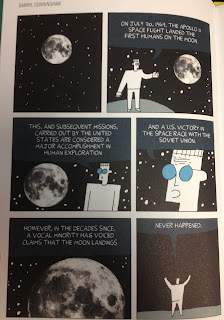
Cunningham's art is sturdy and straight-forward. I enjoyed his use of abstract stylized cartoons with occasional realistic, photographic drawings interspersed in the panels. His art is not flashy, but it does convey information and arguments in clear fashion. Here are a couple of different pages from the book that are characteristic of his style:

From the moon landing section.
From the MMR vaccine section.

Although it is certainly written from a particular point of view, the book is not overtly didactic in its intentions, pushing readers more to think for themselves than to accept simple accounts of events or situations. In these interests, Cunningham includes many sources for his essays in the back matter so readers can verify what he said or go off and do their own fact checking.

Reviews I have read of the book online range from positive to lukewarm. Robert Greenberger wrote, "Cunningham does a remarkable job with difficult material and for high school students, just opening their eyes to the world around them, this is a terrific primer." The reviewer at Geeks of Doom called it "fun and informative without being preachy." Nick Smith was slightly less enthusiastic, stating, "The artwork is cartoony, which may distract some readers from the serious nature of the information presented," but added,  "the book is readable by teens, if they’re interested in science."

How to Fake a Moon Landing is published by Abrams ComicArts. They offer a teaching guide and more here. Here is a short excerpt at Boing Boing.

Tuesday, August 20, 2013

Genius


Ted is a really smart guy who has lots going for him but also some struggles. He is married and has a family as well as a great academic job at a physics think-tank, but he has not had a strong new idea in years. He fears that he will be surpassed by the young turks at work and also that he will never meet the potential he showed as a youngster, when he easily skipped grades, and a young man, when he wrote exciting and interesting papers full of fresh ideas. Additionally, he has to care for an increasingly ornery and scatter-brained father-in-law who constantly berates him. And he receives an additional scare when his wife discovers a mass in her body.

Add to all of this the revelation that his father-in-law knew Albert Einstein and swore an oath to protect a secret the physicist told him. As he deals with adversities, Ted obsesses over this secret, thinking it holds the key to unlocking secrets of the universe that would help him with his job and also  safeguard his family.

Clearly, there is much going on in this book, and what really makes it all work as a cohesive tale full of humanity, impact, and wonder is the expert storytelling of the writer and artist. Collaborators Steven T. Seagle and Teddy Kristiansen have worked previously on the series House of Secrets and most notably on the graphic novel It's a Bird..., for which Kristiansen won a 2005 Eisner Award for Best Comics Painter. They have obviously built a strong working relation over the years, evident in the flow and deceptive simplicity of the narrative in terms of plot and visuals.

Seagle is a prolific comics writer who created the Vertigo series American Virgin as well as wrote a long run of Sandman Mystery Theater. He is also a member of Man of Action, a collective of creators who work on various media projects including the television shows Ben 10 and Avengers Assemble. Seagle speaks about his works in this extensive interview. Both creators speak of their work on Genius in this interview.

The way that the art and words propel the story displays a high level of craftsmanship. Rendered with fine lines and a muted color palette, the ethereal and atmospheric images show that Ted is haunted by many things: his fears, his past, the demands of being a father and husband, the ghost of Albert Einstein, and the attitude of his father-in-law.


This is a book about physics and abstract thought, but it also is very human. The interplay between big ideas and mundane details of life make for some interesting philosophical and existential moments. In the end, it is those moments that are the most powerful parts of the book, when Seagle and Kristiansen use metaphor masterfully to highlight multiple facets of the human condition. The plot also somewhat resembles a train of thought, with the reader being privy to Ted's problem solving processes and seeing where his conclusions originate.


Reviews I have read have been mostly positive. Sonia Harris called it "simply and elegantly beautiful." Melissa Grey wrote, "Though the book has a somewhat saccharine finale, overall, it's a heartfelt, sincere exploration of the beauty that there is to be found even in our darkest moments." Publishers Weekly focused on the sequential art aspects, noting, "Most remarkably, Seagle and Kristiansen allow the connection of words and pictures to mirror the reader’s own comprehension of Ted’s journey to awareness."

A preview and more are available here from First Second.

Thank you, Gina, for the review copy!

Friday, July 5, 2013

The Manhattan Projects, Volume 1: Science Bad


I have been enjoying Jonathan Hickman's run on Marvel's Avengers right now, and I have heard all kinds of good things about other comics he has written, plus I like reading about science, so I thought I would give this book a shot. I was glad I did.

Science Bad is the first story arc from the ongoing series The Manhattan Projects. In this alternate history version of Earth, beating the Nazis is not the most important outcome of World War II, rather it was an era when a secret government project wrought amazing technical advances, including space travel, artificial intelligence, inter-dimensional teleportation, and contact with alien life. The main players are reconceptualized versions of some major figures, including Robert Oppenheimer, Albert Einstein, Richard Feynman, Enrico Fermi, and Wernher Von Braun. Moreover, these characters are not always what they seem. Many are conniving or insane or sociopathic. In all, without spoiling what goes on too much, I have to say that between the frenetically beautiful art and the twisting plot this book is an absolute winner.

Einstein v. Feynman, Round 1

What is amazing to me about fictional universes like Marvel or DC is how sturdy, complex, and articulated they are, but they have the benefit of having been developed over a period of decades, under the watch of some talented and dedicated creators. In the space of the five chapters of this volume, Hickman pulls off an impressively similar feat, engaging in a fictional universe-building that is simultaneously logical, insane, intense, and clearly well thought-out. When he shows you a device, alien race, or seemingly random event, it fits into a whole. He has woven a complex kind of continuity that seems simple on the surface but which must have taken much time and effort to conceive.

This book's creators Jonathan Hickman and Nick Pitarra are frequent collaborators and Eisner Award nominatees. Hickman is famous as a writer for a number of series, including his own The Nightly News as well as flagship series for Marvel such as The Fantastic Four and The Avengers. Pitarra has also drawn the limited series The Red Wing. His artwork here is kinetic, gross, darkly humorous, and incredibly detailed.

Oppenheimer is a baaaad man


All the reviews I have read about this book have been full of praise. David Fairbanks gushed, "if you haven't been reading this amazing series, you should be grabbing this trade, canceling whatever you were planning to do, and burying your nose in it until you're done." The reviewer at Guys Lit Wire wrote, "This book is insane," and also commented that "I'm not sure how this is going to sustain as a long term series, but it's quite a fun ride at this point." Dave Buesing called it "a fantastic blend of historical truth and completely insane fiction."

I am not sure if this series is for everyone or if it would play as well to someone who did not have a knowledge of the main players in this series. Still, I think it plays like a tightly plotted, sober version of Men in Black populated with calculating, sinister scientists. I enjoyed this initial offering very much, and I will be getting later volumes for sure.

The Manhattan Projects is published by Image Comics. They provide a brief preview here.