Showing posts with label World War II. Show all posts

Tuesday, February 10, 2026

The Girl Who Sang: A Holocaust Memoir of Hope and Survival

Holocaust survivors are growing older and fewer, and The Girl Who Sings is a graphic novel made to ensure their stories are preserved and told to future generations. It tells the tale of Estelle Nadel, who lived in Poland as a girl, and whose story is recorded and featured by the United States Holocaust Memorial Museum. It is divided into four parts, the first the lead-up to Nazi occupation, the second an account of her family hiding, the third a look at their liberation that brought new terrors, and the fourth the tale of how they finally arrived to America and struggled to make new lives.

What is powerful about this book is its first-hand account of the genocide and harrowing events of the period, ones that are being replicated in the present in multiple places despite a vow to "never again" abide such prejudice and hatred. People were labeled subhuman, detached from social structures like education, relegated to ghettos, and eventually sent to camps to either work or die. Others were killed with bullets and bombs in the course of war. I know there are those who would like to pretend none of this ever happened or even those who would like to replicate these events to perpetuate their own foul beliefs, and one of the strongest ways to combat them is to keep these stories visible. I was deeply moved by this book, more than I expected to be. It is a vital tale of survival and hope in the face of despair, and I feel it is an important story for others to see.

The Girl Who Sang is Estelle Nadel's story, but she died in 2023, and it was translated into graphic novel form here by editor Bethany Strout and artist Sammy Savos. Savos is a storyboard artist and cartoonist who has a strong sense of storytelling, character design, and emotional expression. Through the interaction of plot, words, and images the people and events depicted in this book seem palpable and alive.

 This book has received many accolades and has been very well reviewed. In a starred review from School Library Journal, Darby Wallace called it a "must have." In another starred review, Kirkus Reviews described it as "sweeping, stark, tragic, and triumphant." Emily Schneider wrote that the "metic­u­lous nar­ra­tion and insights, com­bined with Sam­my Savos’s com­pas­sion­ate artis­tic vision, ensure that this sto­ry will not be forgotten."

The Girl Who Sang was published by Roaring Brook Press, and they offer a preview and more here.

Monday, May 15, 2023

Asadora! Volume 1

My experiences with manga are pretty limited, I feel, but there are certain authors whose works I seek out and Naoki Urasawa is chief among them. Asadora! shares many features with his other works, including an exploration of how the past affects the present, a compelling mystery, expressive art, and a series of breathtaking cliffhangers. The titular star of this book comes from a large family, and is often overlooked in the shuffle of daily life. (SPOILERS ahead!) One eventful day, she gets kidnapped, a giant hurricane hits, and she and her kidnapper have to band together to survive. While trapped, she learns about his background as a fighter pilot in World War 2, and when they finally survey the damage they see what appears to be a giant footprint among the wreckage. (end/SPOILERS)

What are they looking at? Buy the book and find out!
Three things recommend this book: 1. It is incredibly well crafted in terms of plot. Each chapter ends with a revelation/cliffhanger that compelled me to keep going. 2. The characters and their personalities are quickly introduced and communicated, both visually and narratively. They are drawn in an incredibly expressive style, and I found myself intrigued and enchanted by them in short order. 3. It sets up a captivating mystery, adding a touch of magical realism into an otherwise straight-forward action tale. There is so much going on that is unresolved and unanswered, and this book is a great introduction to a nuanced and detailed serial comics series. I have read the next four books already, and I cannot get enough of them.

Naoki Urasawa is regarded as one of the premier manga creators, and he has won the Shogakukan Manga Award three times, the Tezuka Osamu Cultural Prize twice, two Eisner Awards, and the Kodansha Manga Award once. His works have been some of the most celebrated of recent times and include Monster, 20th Century Boys, and Pluto. More recently, he has started a YouTube channel where he demonstrates his artwork (in Japanese).

All of the reviews I have read of this book have been positive. Tom Shapira contextualized it against others in his oeuvre, and although he has some issues with some tics, he concluded that "Urasawa can do it all." Will called it "another strong entry in Urasawa’s career." Publishers Weekly wrote, "Urusawa excels in focusing on human drama and multifaceted characters, and the storytelling is matched with dynamic, classic realist manga artwork."

Asadora! is published by Viz Books, and they offer  more information about it here.

Monday, June 15, 2020

White Bird: A Wonder Story

White Bird was the big winner at this year's Excellence in Graphic Literature Awards, winning both the Best Middle Grades Literature and Book of The Year honors. It is set in the same universe as her hit YA novel Wonder, a best-seller about a young boy named August, born with a severe facial difference, who deals with bullying at school. It also was made into a major motion picture. There have been other works set in this world, including the short story collection Auggie and Me, where the main character of this book was introduced.
August's main antagonist, Julien, is a key figure in White Bird, as it is through a correspondence with his Grandmère (named Sara) that he gets to hear her story. When she was a girl, she lived in France during the Nazi occupation, and a family took her in and hid her away. She endures a whole spectrum of emotions and tribulations during this ordeal, and this graphic novel chronicles the many trials she endures as well as the peril that her host family put themselves in their quest to protect her. From the many actual holocaust accounts I have read or viewed, I can say that much of what transpires in this book hews very closely to reality. This book is a moving, harrowing account that lays bare the horrible reality that people endured in the past and that many people still have to contend with, a point hammered home with Julian's participation at a pro-immigration protest at the end of the book.

There is only one quibble that I have, and it has to do with a touch of magical realism that tinges the ending of Grandmère's story. I get the dramatic effect, but it also was a bit jarring to me given that so much of the rest of the book was deeply rooted in realism. It did not ruin things for me, but I felt it was a bit discordant with the rest of the narrative. Still, I feel that this book is a worthy addition to any classroom library, and it will be attractive to fans of other books by R.J. Palacio set in this world.

What is especially impressive to me about Palacio's work is that not only is she an accomplished writer, she is also a wonderful illustrator. She drew this book herself, adapting her own prose in very effective and impactful fashion. There may be a lot of "talking head" type layouts, but she captures character's gestures and emotions well, telling a tale full of drama and suspense. She has also designed book jackets and drawn a number of picture books, including Peter Pan: The Original Tale of Neverland and Ride, Baby, Ride. She speaks extensively about the evolution and inspirations of White Bird in this interview.

The reviews I have read about this book have been very polarized, either full of praise or offering major critiques in terms of tone and content. In a starred review, Kirkus Reviews called it "A must-read graphic novel that is both heart-rending and beautifully hopeful." Esther Keller praised the artwork, "There are moments of joy between Julien and Sara, and the artwork captures those moments in such a haunting way. Contrasted with the scary moments, the story will grab readers." Hillary Brown offered a contrasting take, writing "Preaching and hoping the message sinks in is basically just hoping for divine intervention, which is exactly what happens to Sara when she’s about to be caught, not just once but repeatedly." Boris Fishman concluded that it is "full of neat coincidences, grown-up clichés, sentimentality and stock portraiture. However, the story does end on the 'right' note with Julian inspired to engage in social activism of his own. Should that be enough?"

White Bird was published by KnopfBooks for Young Readers, and they offer more information about it here.

Thursday, October 10, 2019

They Called Us Enemy

Looking over my past few entries, I have been grossly over-using the word "fun." Well, I am breaking the streak, because, not to downplay how good this book is, there's no chance of it appearing today. At a time when the US government is actively engaged in arresting and detaining refugees and immigrants, They Called Us Enemy is a strong reminder that such an atrocity is not unique to our times. After the bombing of Pearl Harbor, FDR signed Executive Order 9066, which allowed the military to define certain regions as military zones and take actions to relocate questionable parties. This order meant that the military could round up all people of Japanese ancestry, whether they be US citizens are not, and regard them as potential spies or enemy sympathizers. That was the context for George Takei's family, who were Japanese-Americans living in California.
They were speedily allowed to pack a limited amount of belongings one night and then were put on a series of trains that brought them to some difficult, Spartan camps across the US. Some of them were put in places originally meant to house livestock. There, they had to learn to make do, cognizant that they were being treated as enemies by a country that they had accepted and worked hard to belong to. Although George and his brother were children who somewhat treated the whole thing as a weird adventure, his parents had to shoulder tough burdens of being disrespected and deemed inhuman.
What makes this book exceptional is how it pairs a strong narrative with artwork that is incredibly expressive and energetic. Between the postures and facial expressions, it is impossible not to feel something for the people depicted here. Their lives turned upside-down, their government betraying them, and them being treated like animals are all palpable experiences for the reader. Although this subject matter is difficult, I am glad that it is still being memorialized and brought back to light here. Especially now.

This book was a collaboration between writers George Takei, Justin Eisinger, and Steven Scott, and artist Harmony Becker. Takei is best known for his role as Sulu on Star Trek and is also a highly visible activist for civil rights. Eisinger is an Editorial Director for IDW, and I think this is his first comics writing gig. Scott also goes by the name Scott Duvall and is a blogger and comics writer with a number of credits for Archie and Arcana. This book also seems to be Becker's graphic novel debut but she also has created mini-comics and webcomics like Himawari Share. Takei speaks more in this interview about the creation of this graphic novel.

This book has been very well received and has gotten a number of starred reviews. Etelka Lehoczky wrote that "despite the grimness of its subject matter, They Called Us Enemy is a lively, vibrant book." Kirkus Reviews summed up,"A powerful reminder of a history that is all too timely today." Esther Keller wrote, "The black and white artwork is vibrant despite the lack of color," and added that the book "will add to a growing collection of nonfiction graphic stories that will help today’s younger generation understand our history and why we must say #neveragain."

They Called Us Enemy was published by Top Shelf, and they offer a preview and much more here.

Sunday, March 10, 2019

Anne Frank's Diary: The Graphic Adaptation

The Diary of Anne Frank is one of the most read books in the world, which may beg the question of whether or not a graphic adaptation of it is necessary, but I have to say that I was blown away by this work. It is expressive, incorporates disparate pieces of artwork into the story, and creates a context for both exploring humanity and horror at the same time. Anne and her family spent years hiding from Nazis in an annex in Amsterdam during World War II. Along with some others they shared the cramped quarters, living in as quiet and unobtrusive fashion as possible. And all the while they listened for scraps of news and hope while hearing bombing and shooting all around them.
As if this atmosphere was not bad enough, Anne also had to deal with lots of other personal dynamics, including a rivalry with her older sister, a crush on a boy, and having to share her room with an adult man dentist. What I feel this book captures best about the work is 13-year-old Anne's sense of figuring out the world and her place in it, ironically at a time when she was sequestered and eventually taken out of it. This book is full of humanity, wisdom, and sadness, and the artwork only exemplifies the beauty and thoughtfulness of its prose.

As an educator, I often think of how to use a book like this, and I feel that it could be used in several ways. It could be read alone, in tandem with the original book that it excerpts, or it could also be excerpted itself to draw attention to particular passages. I was very impressed with this book, especially in how it uses various visual styles and formats to adapt the diary entries. Sometimes, it plays with a single image, often cribbed from a classical art source.
Sometimes, it uses straight forward comics, and others it features an illustration with an entire diary entry. I think that its creators were savvy in selecting which sections to summarize and adapt and which to present in more whole fashion. This adaptation is superlative, and it is prelude to an animated feature that is nearing the end of production. If it is anything like this book, it should be excellent.

This adapted book was a collaboration between Ari Folman and David Polonsky. Folman is an Orphir Award and Golden Globe Award winning director and screenwriter. Polonsky has worked as an art director, children's book illustrator, and animator. Both collaborated on the lauded animated film Waltz with Bashir. This interview sheds light on both creators' work on this book.

The reviews I have read about it have been largely positive. Ruth Franklin wrote, "Their book is brilliantly conceived and gorgeously realized." Publishers Weekly's starred review concluded, "The beauty of Anne’s life and the untarnished power of her legacy—here further elevated by Folman and Polonsky—are heartening reminders of the horror of her fate." Gene Ambaum called it "spacious, interpretive, and altogether wonderful."

Anne Frank's Diary was published by Pantheon, and they offer a preview and more here.

The publisher provided a review copy.

Sunday, December 30, 2018

The Three Escapes of Hannah Arendt: A Tyranny of Truth

Hannah Arendt is a writer/thinker whose work on totalitarianism has come back into popular demand these days of "interesting times." The Three Escapes of Hannah Arendt is a biographical chronicle that gets at her private and public lives in interesting fashion. It follows chronologically, beginning with her precocious and troubled childhood. As you can read from the following excerpt, her father's descent into syphilitic insanity was only part of the experience:
 
 
I got these preview images from Tablet Magazine

She was also a brilliant thinker who worked and studied with contemporary movers and shakers of the time, most notably Martin Heidegger, who was both her teacher and lover for a number of years. Over the course of this book, she escapes twice from the Nazis, once from Germany and the second time from Paris, and the third escape more has to do with how she reconciled her own thinking with Heidgger's, even as he was a Nazi sympathizer. She was a complicated woman who lived in complicated times, and I feel that her thinking is vital for dealing with thoughts of personal responsibility and justice, especially today.

In many ways, this book is dense with events, ideas, and the past. There is some built-in support in the footnotes, which helped the reader keep up with all the various historical figures, provided context, and served as further avenues for reading and research for those inclined. The art style is on the sketchy side, but I feel it is still rather evocative and energetic. Overall, this book provided me a compelling and very informative reading experience.

Ken Krimstein created this book, and his extensive research is apparent from the plotting and footnotes. His comics work has appeared in the Chicago Tribune, The New Yorker, and other high profile venues. He has a collection of cartoons called Kvetch as Kvetch Can, and he also teaches at DePaul University. His prose writing has been published in McSweeney's. Krimstein speaks about his work on The Three Escapes of Hannah Arendt in this print interview, this podcast interview, and in this comic.

The reviews I have read about this book have been largely positive. Kirkus Reviews gave it a starred review that concluded, "A compelling performance with great pacing that makes abstruse political theory both intelligible and memorable." Publishers Weekly called it a "fascinating if cluttered biographical portrait." Bookmunch summed up, "Krimstein’s artistic style may not be to everybody’s tastes but the story he tells, of a woman who fought for the importance of thought itself, is one that needs telling and retelling."

The Three Escapes of Hannah Arendt was published by Bloomsbury, and they offer a preview and more here.

The published provided a review copy.

Monday, January 15, 2018

Raid of No Return

If you have read my blog for a while you may have noticed that I think Nathan Hale is brilliant. He makes fantastic, informative, and inventive comics, and his series Nathan Hale's Hazardous Tales is the best historical series in the graphic novel business. I even liked his non-historical work like One Trick Pony. What amazes me about his work is how consistently excellent it is, and Raid of No Return is no exception.

The plot of the book is set during World War II. In the events following the bombing of Pearl Harbor, there was an extremely covert, risky, and dangerous mission set in place to bomb the Japanese mainland. This book recounts that mission with lots of details about the individual pilots, their crews, and the various outcomes of each bombing run. But additionally, and most impressively to me, it also delved deeply into the Japanese planning of the bombing and gave insight into their side of the military conflict.
This book is full of action and suspense, with multiple plot threads running simultaneously. It is difficult to have so many different stories and to make the reader feel invested in each one, but Hale does exactly that, making the stories both historically detailed as well as personally affecting. Raid of No Return is chock full of compelling, true-life stories that will keep you on the end of your seat and is a worthy addition to an extraordinarily well-crafted series of books.

The reviews I read about this book were all aptly full of praise. Lori Henderson wrote that it "does a great job of illuminating historical events in an entertaining and sometimes sobering way. It’s a great addition to library shelves." Tanya Turek called it "a powerful story that is suspenseful, emotional and almost unbelievable."

Raid of No Return was published by Amulet Books, and they offer more info about it here.

Saturday, December 30, 2017

Rock Candy Mountain, Volume One: No Exit

First off, if you have been reading my blog for long, you'll know that I am totally in the bag for whatever Kyle Starks creates. I have pledged to multiple Kickstarter campaigns and send him money every month via Patreon (you can, too!). I love his brand of action/intrigue/punching/jokes/pop culture sensibility, and I try to sing his hosannas when given chance. Needless to say, I was excited to see he had an ongoing series in the works. And better yet, I am tickled to tell you that it's great. If you love action/mystery stories set in post-WWII America that feature lots of punching and witty dialogue, not to mention starring people who go by names of their geographic points of origin and/or prominent physical features, Rock Candy Mountain is the book for you.

Mostly, it tells the tale of a couple of hobos in post-WWII America. The first, a failed actor named Pomona Slim, is new to riding the rails and he needs lots of hand-holding. The second is Jackson, a mysterious figure who is great in a fight and has many secrets. Jackson takes up with Slim, and the two meet lots of interesting people along the way, like other hobos, tramps, bums, the King of the Hobos, and The Devil himself. They also end up in some shady spots, including railway lots, underground fight clubs, and prison. In addition, I should note, Jackson is wanted by the US government for having a specific (though unnamed) artifact. All of these ingredients add up to one spicy and delicious stew.

Abetting Starks in this series is Chris Schweizer, himself also an accomplished graphic novelist whose series The Crogan Adventures and The Creeps are some of my favorite comics from the past decade. He does the colors, contributing a muted though effectively nuanced atmosphere to the proceedings, which complements the energetic and emotive artwork to a T. He also has a Patreon page where I contribute every month. Starks talks about his collaborating with Schweizer as well as his work on this series and in general in this interview.

All of the reviews I have read about this book have sung its praises. Samantha Puc stated, "This book completely shocked me with its palpable humor and emotional depth." River Godbee called it "very unique," adding that it featured "a great story with some amazing art." Jeremy Nisen wrote, "Our only complaint is that this first volume only holds four issues' worth of the series, and we want more. Now. Perhaps even more than that mythical lake of stew, and of whiskey too."

Rock Candy Mountain was published by Image Comics, and they offer previews and more here. This book contains the first four issues of the series, and it features a fair amount of swearing and violence, not to mention a couple of adult situations, so it is recommended for readers mature enough to deal with such material (as you'll see in the excerpt below).


Sunday, November 15, 2015

Trinity: A Graphic History of the First Atomic Bomb

Trinity is just what the title says, a graphic history of the first atomic bomb. This account details the Manhattan Project, the top secret project where the US developed the nuclear weapons that would end World War II. It does so in two ways. One, by introducing the major players behind the project, including the military leaders who organized it and the scientists whose work were instrumental in developing the weapon.
Two, it also does well in explaining just the scientific concepts that underpinned the eventual development of the bomb, by looking at elementary chemistry and physics. Thus, it is much a book about science as it is about history.
As you can see from the excerpts, the narrative is relatively straight forward and the art is very documentary, but they also have some personality and a sense of intrigue that keeps things from becoming dry. This book is an impressive debut graphic novel by Jonathan Fetter-Vorm. He has since gone on to create a second called Battle Lines, which is another graphic history about the US Civil War. He talks about his work on Trinity in this interview and also speaks about his process in this video.

Most of the reviews I have seen about this book have been very positive. Kirkus Reviews gave it a starred review and summed up that it "succeeds as both a graphic primer and a philosophical meditation." Michelle Legro called it "a fascinating visual reimagining of a story that is at once tremendously culturally significant and thrillingly human." John Dupuis called it "a real gem" and "a wonderful example of the graphic novel as social history of science." Publishers Weekly was much less taken with the book and criticized a few of its features.

Trinity: A Graphic History of the First Atomic Bomb was published by Hill and Wang, and they provided a preview and more information here.

Tuesday, October 20, 2015

Omaha Beach on D-Day

This book is a unique one, an auspicious beginning of a series of books that are part graphic novel, part photo-essays, and part historical commentary about great moments of World War II. Omaha Beach on D-Day focuses on the life and work of Robert Capa, whose internationally famous photos of the June 6, 1944 battle captured the horror and brutality of war in an intimate way. Amazingly, he lost many of those photos due to wear and tear in the ocean as well as a chemical accident during development, but the ones that survived made quite an impact. Here, we see how he prepared for that day when he bravely rode in with the troops on a seafaring transport.
 
Capa's photos were the inspiration for the opening scene of Saving Private Ryan, and the war sequences in this book are equally harrowing. The rest of the tale depicted here is fascinating, though, and I was very taken with its attention to detail and historicity. Following the comics story is a gallery of his WWII pictures, and following those were a series of articles about Capa's life, career, artistry, and technical take on photography. I found myself fascinated by the entire package, and I love how the whole work coalesced into a pretty complete reading experience.

Writers Jean-David Morvan and Séverine Tréfouel collaborated with artist Dominique Bertail to create the comics in this book. Morvan is an award winning writer for his work on youth comics, and he and Tréfouel  also write a comic series called Ocelot. Bertail is a prolific illustrator who has been making comics for two decades.

I was not able to find many reviews for this book, but the ones I read were glowing. The reviewer at Coverless Review simply stated that "Writer, Jean-David Morvan and artist Séverine Tréfouel do an amazing job with this book." Kelly Fineman summed up, "This book, through its combined story-telling methodologies, makes these images accessible today in a powerful and gripping way." And I agree with Nick Smith who wrote, "This book will appeal to fans of serious graphic non-fiction, but also to World War II buffs and students of photography."

Omaha Beach on D-Day was published by First Second in collaboration with Magnum Photos, and they have a preview and much more available here.

Thank you, Gina, for the review copy!

Friday, July 10, 2015

Breath of Bones: A Tale of the Golem

Breath of Bones is a collection of a three issue limited series. The story focuses on Noah, a young man who we see as a slightly older soldier in a framing sequence. The main narrative focuses on him and his family during World War II. They live in a small, rural village and they all fear the advances of the Nazi German forces. One day, the younger, able-bodied men, including Noah's dad, decide they must join in the defense of their country and assemble to join the larger army. The town is then left populated with women, children, and older people. All is quiet, but tense, until the day a plane crashes nearby.
Inside is a British soldier, whom they rescue and give aid, but not far behind are Hitler's forces. Much fear is struck into the populace, and some want to send the British pilot away without sanctuary. Another debate arises whether to flee or to stay, hoping that either the Nazis don't show up or that they will not create conflict in the town. In the end, they do stay and the Nazis do show up. Noah's grandfather decides it's time he told his grandson some truths about his family and culture, and he is given the knowledge to create a golem to protect his people. What follows is a tale tinged with magic and hope in even the most dire circumstances. Most of the book is set in a time before the Nazis or the golem arrive, so there is a fair and good amount of character work, and I especially like how the relationship between Noah and his grandfather is developed.
In the end, even though I appreciate the character work, I am not sure what I feel about the story. It is revisionist in its scope, not in a way that is so disrespectful or irreverent as something like Inglourious Basterds, but it is a piece of convenient wish fulfillment. The fictional drama here may be diminished in comparison to real accounts of Nazi occupation, and I am not sure I quite buy the magical realism within, but what is exceptional in this book is the artwork created by Dave Wachter. His characters are well defined and full of affect. His pacing and storytelling are excellent, and the larger page size of this collection really features his exquisite line work and watercolor shading. This book contains a beautiful display of visual artistry.

The story in this book is by Steve Niles and Matt Santoro. Niles is known primarily as a horror writer, and his first major work was the comic book series 30 Days of Night, which was adapted into a major motion picture. Santoro is an actor, and as far as I can tell this is his only work in comics. Wachter has a number of comics credits, but is probably best known for the series Scar Tissue and The Guns of Shadow Valley. Niles and Wachter speak about their work on this book in this interview.

This series was well received, and it has been picked up as a property for development into a movie. The reviews about it I have read have been mostly celebratory. Gary Makries called it "amazing" and stated that he "cannot recommend this enough." Gregory Paul Silber was very impressed with the artwork, but in the end was disappointed by some story details, finding it "a bit problematic that there is not a single mention of Jews or Judaism throughout the story" and also troubled that no specific geographic setting is named. Kimberly summed up that if you are "a fan of great artwork and great storytelling, you cannot go wrong with Breath of Bones."

Breath of Bones was published by Dark Horse, and they provide a preview and more here.

Sunday, July 5, 2015

Moving Pictures

Moving Pictures is an apt title for this book for two reasons, neither of which has to do with movies. It is about the effort of French museum workers to hide and protect great works of art (some are "moving pictures") from the Nazi occupation during World War II. This book follows the exploits of the curator Ila Gardner, a Canadian woman who decided to stay in Paris, where she is in charge of "third rate" works at the Louvre.

The main narrative involves her being interrogated by Rolf Hauptman, a Nazi officer in charge of tracking down and cataloging great works of art. To say that their discussions are politically charged is an understatement, but matters are further complicated because they also have some version of a romantic relationship. Ila has many methods to stand up for herself and also defend an important part of civilization against an overpowering enemy, and over the course of the book she proves quite resourceful. However, Hauptmann is not a two-dimensional villain nor a pushover himself, and the study of these two characters as they joust is fascinating.
As you can see, the art is relatively clean and simple yet complex. There is an excellent interplay between lights and darks that obscure people's faces at times but also set great atmosphere. Also, characters and settings are defined through negative space, which further abstracts the events of the book in a way that adds import and layers of meaning. The reader's job is to fill in those spaces, a task which is aided by copious flashbacks to various scenes from Ila's life. This book is intelligent, complex, non-chronological, and deals with some very serious subject matter. I found it very rewarding to read and re-read, but I feel because of its subject matter and presentation, it is best suited for mature, capable readers.
Moving Pictures is a collaboration between Kathryn and Stuart Immonen, a wife and husband who have worked on many comics over the years. Kathryn has also written multiple series for Marvel Comics, most notably Patsy Walker: Hellcat and Journey into Mystery. The Joe Shuster Award winning Stuart has drawn multiple series for both major comics companies and is the artist for the latest batch of Star Wars comic books. They speak more extensively about their work on Moving Pictures in this interview and also this one.

This book has received its share of praise and was nominated for the Stumptown and the Doug Wright Awards. Publishers Weekly gave it a starred review and wrote that "the Immonens keep the story spare and focused to allow the ambiguity of survival itself to become the drama." Rich Johnston wrote that there is "an energy on the page making the pictures work just as hard as the words." Seth T. Hahne called it "a fantastic little book."

Moving Pictures was published by Top Shelf Productions, and they have a preview and much more information about the book here.

Saturday, April 5, 2014

Hidden


Hidden is a book about family and also about the Holocaust. It might be simplistically called Maus for middle schoolers, but that facile description detracts from this book's unique and powerful approach to depicting one girl's experiences and the effects of these events on her adulthood and role as a mother and grandmother.

The main narrative happens in France, and the main character is Dounia. We see the treatment of Jews through her young, naive eyes. Her parents try to shield her from the oppression and mistreatment, explaining that the Star of David she is obligated to wear is actually a symbol of her new job as sheriff. Little by little she sees through that facade to the injustices being done to her, her family, and her friends.
Eventually, she is separated from her family and has to pretend to be another couple's child. For her safety she is sent to life in the country, and she fears she will never see her parents again.
This tale is framed with sequences of Dounia as an old woman. She tells her story to her granddaughter Elsa, and it turns out that this is the first time she has said anything about her childhood to anyone in her family, including her own children. This revelation opens up some old wounds, and casts more light on the pain, suffering, and effects of this historical atrocity.

I found this book powerful and deceptively complex, an informative and evocative tale in the form of a child's account. It contains a combination of extremes that balance each other well, tempering its horrors with art that recalls Schulz's Peanuts with its aura of childhood, wisdom, and innocence. The story was direct, compelling, heartbreaking, redemptive, and full of suspense and drama. I really enjoyed reading it and was moved much more than I thought I would be.

This book is the product of a trio of French creators, writer Loic Davillier and artists Marc Lizano and Greg Salsedo (all their websites are in French).

Hidden does an excellent job explaining the realities of the Holocaust to a middle grades audience (any audience really), and it has received a number of very positive reviews. Terry Hong remarked that this book effectively tells a story that is horrible and relatable, stating that "the French creative team proves spectacularly adept in balancing the nightmare with moments of innocent humor (“pink shoes”), unexpected laughter (“‘Does Grandpa know you were in love with another boy?’”), and joyful discovery (“‘I did it! I did it!’”)." Publishers Weekly also stated that the book "balances the cruelty of the persecution she experiences with the miraculous generosity of her neighbors." There are a number of other reviews at Library Thing, and one called this book "Highly Recommended."

Hidden was published by First Second. They provide a preview and much more here.

Thank you, Gina, for the review copy!


Sunday, October 20, 2013

I Killed Adolf Hitler

I really enjoy time travel stories like The Terminator and Dr. Who, with all their baggage about the ethics of changing the past and possibly damaging the time stream that they bring. This story is ostensibly about that, set in a world where assassins are commonly employed to deal with family troubles, marital strive, or conniving co-workers. One of these assassins is hired to go back in time to kill Adolf Hitler and prevent the horrors of World War II.
The rules are fixed so that there won't be multiple trips back and forth, making for a high stakes trip.
Unfortunately for the protagonist, he does not get things right the first time, and in fact not only muffs the assassination but also allows Hitler to flee to the future, leaving himself trapped in the past. Seeing how he deals with his plight and how all of these actions connect to his relationship with his estranged girlfriend make for some very interesting and all too human character dynamics. The narrative is an unpredictable and subtly complex ride, and it is no surprise to me that this book has been optioned by a British producing company to be made into a movie.
I Killed Adolf Hitler was created by Jason, a Norwegian comics artist whose actual name is John Arne Sæterøy. He has been a prolific author of international renown, publishing many books such as Athos in America, Low Moon, Hey Wait..., and The Left Bank Gang. He has received many accolades, winning an Inkpot Award, multiple Eisner Awards, and a Harvey Award. He speaks about his work and influences in this interview.

As you can see from the excerpts, Jason's style is pretty stylized and spare. Words can be sparse in his panels. The use of anthropomorphic animals adds a creepy vibe to the proceedings; they are deadpan "funny animals" that do not seem funny at all. I think they add a surreal touch to all of his works, and also their expressionless faces and animal identities leave them pretty open to interpretation and expression. I think that they are very sturdy, empty vessels for readers to fill with meaning.

Also, despite the funny animal characters, this is not a book for young children. There is some explicit language as well as bloody violence.

This book won the Eisner Award for best US Edition of International Material, and reviews I have read about it have been very positive. Seth T. Hahne called it "a terse, well-told, and well-managed story that is equal parts humourous, morbid, thoughtful, and touching." Mark Andrew commented that Jason's works, in particular this book, "demonstrate a huge breadth of understanding of the multiple dimensions of the human experience," even if he does draw all that well in his opinion. The reviewer at read/RANT marveled at "the subtle, yet conceptually complex, love story that slowly emerges from the background and transmutes unexpectedly into the main plot."

I Killed Adolf Hitler is published in the US by Fantagraphics, who provide a brief preview and more links here.

Friday, July 5, 2013

The Manhattan Projects, Volume 1: Science Bad


I have been enjoying Jonathan Hickman's run on Marvel's Avengers right now, and I have heard all kinds of good things about other comics he has written, plus I like reading about science, so I thought I would give this book a shot. I was glad I did.

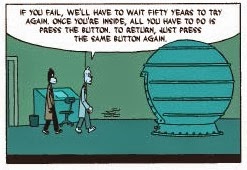
Science Bad is the first story arc from the ongoing series The Manhattan Projects. In this alternate history version of Earth, beating the Nazis is not the most important outcome of World War II, rather it was an era when a secret government project wrought amazing technical advances, including space travel, artificial intelligence, inter-dimensional teleportation, and contact with alien life. The main players are reconceptualized versions of some major figures, including Robert Oppenheimer, Albert Einstein, Richard Feynman, Enrico Fermi, and Wernher Von Braun. Moreover, these characters are not always what they seem. Many are conniving or insane or sociopathic. In all, without spoiling what goes on too much, I have to say that between the frenetically beautiful art and the twisting plot this book is an absolute winner.

Einstein v. Feynman, Round 1

What is amazing to me about fictional universes like Marvel or DC is how sturdy, complex, and articulated they are, but they have the benefit of having been developed over a period of decades, under the watch of some talented and dedicated creators. In the space of the five chapters of this volume, Hickman pulls off an impressively similar feat, engaging in a fictional universe-building that is simultaneously logical, insane, intense, and clearly well thought-out. When he shows you a device, alien race, or seemingly random event, it fits into a whole. He has woven a complex kind of continuity that seems simple on the surface but which must have taken much time and effort to conceive.

This book's creators Jonathan Hickman and Nick Pitarra are frequent collaborators and Eisner Award nominatees. Hickman is famous as a writer for a number of series, including his own The Nightly News as well as flagship series for Marvel such as The Fantastic Four and The Avengers. Pitarra has also drawn the limited series The Red Wing. His artwork here is kinetic, gross, darkly humorous, and incredibly detailed.

Oppenheimer is a baaaad man


All the reviews I have read about this book have been full of praise. David Fairbanks gushed, "if you haven't been reading this amazing series, you should be grabbing this trade, canceling whatever you were planning to do, and burying your nose in it until you're done." The reviewer at Guys Lit Wire wrote, "This book is insane," and also commented that "I'm not sure how this is going to sustain as a long term series, but it's quite a fun ride at this point." Dave Buesing called it "a fantastic blend of historical truth and completely insane fiction."

I am not sure if this series is for everyone or if it would play as well to someone who did not have a knowledge of the main players in this series. Still, I think it plays like a tightly plotted, sober version of Men in Black populated with calculating, sinister scientists. I enjoyed this initial offering very much, and I will be getting later volumes for sure.

The Manhattan Projects is published by Image Comics. They provide a brief preview here.

Sunday, December 30, 2012

Ichiro


This is a tough book to explain because it has a lot going on. Ichiro is a young son of a Japanese woman and American GI who finds himself in Japan for his mom's job. Unbeknownst to him, the move may be permanent, which bothers this lifelong New Yorker. Dealing with the change in geography as well as his father's death, Ichiro is helped acclimate by his grandfather, who shares with him a great many stories about Japanese and Chinese history and legend as well as about his own family.

That's about half of the book. The rest involves a plot with a mischievous, shape-shifting raccoon who takes the form of a tea pot and traveling to the spirit world where Ichiro sees the results of an on-going struggle between legendary figures Amaterasu, Lord Yoritomo, Hachiman, and Susano. This fictional war has overtones that mesh with the events of World War II and also the Iraq War, where Ichiro's father was killed.

Apparent from all I have described is that this book has plots within plots, and that its mix of fictional and real world concerns makes for an interesting presentation. Themes of loss, loyalty, betrayal, war, pride, and identity undulate like waves throughout. I felt this was a complex, thoughtful book that left me perplexed in places but also willing and eager to reflect and reread. I am not sure all this material coalesces in a satisfying manner, but this is certainly a book that begs to be read more than once.

This book's creator Ryan Inzana is a designer and illustrator whose work has appeared in advertisements and magazines. He has also produced two other graphic novels, Johnny Jihad, a fictional account inspired by John Walker Lindh and the Columbine shootings, and an adaptation of Stud Terkel's Working, written by Harvey Pekar. I thought his artwork and storytelling in Ichiro was strong, with good use of color and line. The size, format, and excellent paper quality also added to its luster. Inzana speaks about his work on this book in these two interviews.

Reviews I have read about Ichiro have been mixed, commenting on its strengths and drawbacks. The reviewer at Literary Treats "applaud[ed] his creative approach at tackling such a disturbing, emotional subject matter" and also added that this is a "great graphic novel for anyone who wants to learn more about Japan, or about the Japanese side of World War II history." In a lukewarm review Infodad commented that this book "simply tries too hard to do too much – it has well-done moments but is not, as a whole, especially compelling."

Ichiro is published by Houghton Mifflin. There is a preview available at Amazon.