Showing posts with label Zander Cannon. Show all posts

Saturday, October 10, 2026

Sleep

Let me start off by saying that Zander Cannon is one of my favorite comics makers, and I have reviewed almost every book he's drawn. His series Kaijumax is one of the most enjoyable comics out there, as is his book Heck. He has also drawn a few nonfiction graphic novels along the way, including Bone Sharps Cowboys and Thunder Lizards, T-Minus, and The Stuff of Life. His art style is somewhat cartoonish, but also packs a punch in terms of drama, expression, and pacing. And I love that he adds lots of small touches that reward readers with multiple re-readings of his books.

Sleep is a horror comic, about a man named Jonathan Reason. When he falls asleep and wakes up, he finds himself in strange situations and amid carnage but with no memory of what has transpired.

He begins to realize that when he goes to sleep he becomes something else, something unknown to him. That something hurts and even kills people, and he does not know who to turn to for help. Jonathan has been a good Samaritan for most of his life, and he has one good friend, Tabby, who gives him support, but he is deeply troubled by the ethical consequences of his actions. Also, he has no idea why this is happening to him, or at all really.

Two things make this book work for me. The first is that it is told so that the reader is just as in the dark as Jonathan, which ramps up the tension and anxiety and conveys the horror story in a compelling and visceral way. Second, the black and white artwork is accentuated occasionally with the color red, in the form of Jonathan's glasses usually, but over the course of the book it also comes into play with the reveal of what has been happening. As soon as I finished reading the story, I started going back and seeing what information was being left as clues along the way, a hallmark of a book with exceptional plotting and execution.

Also, I have to say that this book really sticks the landing. The final image is simultaneously revelatory, terrible, and sweet, and it has haunted me since I read the book. If you are a fan of horror, go get this book in your hands as soon as you can.

All of the reviews I have read of this book have been positive. Eric Marcotte delved deeply into the philosophical aspects of Sleep and called it "a series where you will benefit from a second read-through – it is easy to miss a lot of subtle details and clues as you get caught up in the propulsive thriller aspects." Landon Kuhlmann called it "a slow-burn mystery that rewards patient readers."

Sleep was published by Image Comics, and they offer a preview and more info about it here. This book features violence, gore, and profanity, so it is recommended for readers mature enough to read about those things.

Francisco Goya "The Sleep of Reason Produces Monsters"


Saturday, March 5, 2016

Kaijumax: Season 1

I am a pretty big fan of Zander Cannon's comics. His work on the anthology Double Barrel that later got compiled independently as Heck is top notch, and his drawings for various science themed graphic novels, like T-Minus and The Stuff of Life, have only endeared me more to his works. So when I saw that the 2-time Eisner Award winner was working on a series about one of my favorite things, Kaiju (giant Japanese monsters like Godzilla and Gamera), I was extremely interested.

Kaijumax is a look at what happens in between those classic monster movies, when the creatures are imprisoned on a special island prison. This place is not pleasant, and many of the common tropes of prison stories are in play: corrupt guards, internal gangs, trade in illegal goods, inmate-on-inmate violence, lots of double crossings, and escape schemes. The main plot focuses on Electrogor, a monster who feels wrongfully accused and is desperate to attend to his two children who have been left parentless and adrift in the world. But there are multiple subplots that propel an energetic and suspenseful narrative.
Nothing good happens to that poor goat critter in this book.
What I really enjoyed most about the book was its attention to detail in creating a fully realized world. There are many subtle (and not so subtle) touches that make the settings and characters come alive. The monsters in the yard lift weights that are in the shape of buildings. They engage in recreational drug use, but with radioactive materials. The characters speak in a specialized slang,  make references to common movie tropes, and the guards are a bunch of Ultraman-type guardians. The end result is an interesting mix of hard-boiled action, clever science fiction, a touch of humor, and real drama.
The reviews I have read about it online have been positive. Matt Peterson wrote that "you will find yourself laughing, cringing, and quickly turning the pages for the next panel. You might even find yourself briskly wiping away a single tear." Publishers Weekly summed up, "Though the story suffers slightly from its reliance on established genre tropes, and it would benefit from further exploration of life beyond the prison, it still establishes a fresh take on monsters and prison drama."

Kaijumax: Season 1 was published by Oni Press. Here is a preview from Comic Book Resources. And I should note that I know that many children are into kaiju, but this book contains some disturbing situations that make it for mature readers only.

Also, for those who get into this series, there will be a Season 2 sometime in the future.

Saturday, August 30, 2014

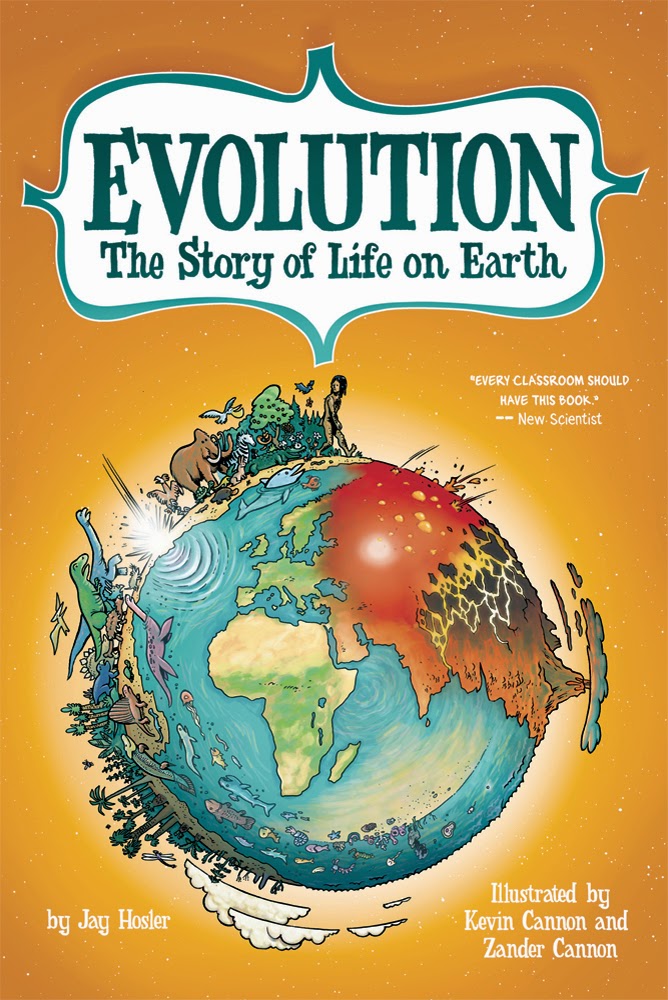
Evolution: The Story of Life on Earth


First, let me start off that I am predisposed to like this book. I have read Jay Hosler's other comics, including The Sandwalk Adventures and Clan Apis. Additionally, I met Jay at the Sequential SmArt conference at Juniata College a couple of years ago, and got a chance to hang out, chat, and socialize with him. I even got to eat ice cream at his house afterward with a group of other folks. All this is to say that I know him a lot better than I know the typical writer/artist featured on my blog.

I should also reiterate that I love his comics. They are smart, funny, and a joy to read. This book, a sequel to The Stuff of Life, continues the narrative where scientist Bloort-183 is trying to explain life on Earth to an alien king. Their species is threatened by a disease and they think that examining life on Earth will help them find a solution. So Bloort-183 continues from speaking about DNA to talking about evolution. And whereas the first book was more a report, this one is pitched more as a presentation being made to the king and young prince. And because the latter has not really done his homework, he asks lots of clarification questions, which makes this entire enterprise much more readable and approachable. There are still some dense parts where lots of concepts and vocabulary are explained, but I think this book works overall in terms of being accessible than the first, mostly because it is pitched much more conversationally. Basically, it is Jay Hosler giving a series of funny, smart lectures via images.

Part of the reason for this reading ease is the wonderful artwork by Kevin and Zander Cannon. These two artists are masterful storytellers who are able to balance the exposition and action with a sense of humor. Their characters are vibrant and alive, and their diagrams extremely helpful and informative. Certainly the great storytelling chops they possess are on display in these pages:
The two Cannons are well known for their anthology Double Barrel, with Kevin's narrative Crater XV and Zander's Heck. They also collaborated on the science-themed graphic novels T-Minus and Bone-Sharps, Cowboys, & Thunder Lizards. Hosler is an accomplished science writer, having already published a number of other graphic novels about biology, including the aforementioned The Sandwalk Adventures and Clan Apis as well as Optical Allusions. He talks about his work on these books in this interview.

The reviews I have read about this book have been rather glowing. Kirkus Reviews wrote, "the book may not win over science-phobic readers, but it’s a solid introduction," suggesting it for "adults who want a refresher and high-school teachers searching for a simple primer." Educator Scott Hatfield concluded, "Its engaging characters, informed content, and clever illustrations make this book an excellent selection for anyone, young or old, interested in learning more about evolution." Publishers Weekly stated that by the end of the book readers will find "that they've learned a tremendous amount about earth's evolution, and have had more than their fair share of amusement in doing so."

Evolution: The Story of Life on Earth was published by Hill and Wang, and they provide a preview and more here.


Wednesday, October 30, 2013

Heck


The set-up of this book is very much like many noir stories; our hero is visited by a pretty woman from his past because she wants him to do a job. But this book has a pretty infernal twist on that scenario.


In this case, our hero is Hector "Heck" Hammarskjöld, an ex-football player who became estranged from his father, coming home only after the old man's death. What he found was that his father was a mystic and that there was an opening to Hell in his house. Heck turns this circumstance into a vocation, going into Hell to retrieve secrets and messages from the damned for a price.

In this book, Heck is approached by a girl he had a crush on in high school, Amy, whose husband was a thief and a philanderer who died in a horrific and suspicious car crash. She has a question for him, and contracts Heck to go ask him. Heck and Elliot, a former waterboy and current friend/associate go into the infernal realm, which takes Dante's conception as its model, and they are tested beyond belief. They had forgotten just how much an ordeal going through Hell is, even for the living who do not belong to the place (yet). Eventually, the place tests their resolve, sanity, and very being.


In the end, however, they both realize insights about themselves, and the ending took me a little by surprise (in a good way). This story first appeared in installments in one of my favorite publications of the past year, Double Barrel. This anthology series was created by Zander and Kevin Cannon (who are not related to each other) to showcase a couple of serials, this one and Kevin's Crater XV, as well as some shorter works and a series of advice columns for making comics. Both of the main serials are excellent, and I am particularly taken with how Heck takes familiar scenarios and genres and bends them into a thoughtful, dark, suspenseful, and well-plotted tale.

Zander Cannon began this book as a 144 Hour Challenge, an experiment in creating 12 comics chapters over a year by drawing once a month in the space of 12 consecutive hours. Time and circumstances led Zander to abandon the experiment, but he continued with the narrative, drawing it out into a longer and more satisfying length. The latter chapters definitely seem less rushed and are better composed and clearer than some of the earlier ones. Still, I think the book is very well presented throughout, and this is one of my favorite works from the past year.

Zander Cannon has produced a number of graphic novels with Kevin Cannon, including Evolution in collaboration with Jay Hosler, The Stuff of Life with Mark Schultz, and T-Minus with Jim Ottaviani. He also created his own series The Replacement God and worked with Alan Moore on the series Smax. He speaks more about his work on Heck in this interview.

Cannon is an award winning comics creator, and his work here has received much praise. John Seven wrote, "you can enjoy the action and adventure and humor, but there is something at the core of Heck that runs deeper than any of those." Mark Flowers wrote in admiration of some of the cheeky aspects of the book, but added "at heart this graphic novel is a serious morality play, with the conflicted relationship between Elliot and Heck (who feels responsible for Elliot’s condition) at its center." JK Parkin summed this book up as "pretty awesome." In short, it has effective action and mystery elements, but it also has great heart.

A preview and much more is available here from publisher Top Shelf.

Sunday, July 10, 2011

Bone Sharps, Cowboys, and Thunder Lizards: A Tale of Edward Drinker Cope, Onthniel Charles Marsh and the Gilded Age of Paleontology

People today know lots about dinosaurs, to the point where children can become experts in names, eras, habitats, and probable behaviors at early ages. But 150 years ago during the Gilded Age things were very different. Only 9 species of dinosaur were known in North America then, but two men became involved in a conflict that changed that situation. After a brief collaboration, E. D. Cope and O. C. Marsh waged what was later known as the Bone Wars, striving to locate, obtain, and analyze fossils all over the US, particularly out west, and name as many new species as possible. Their falling out precipitated from an error Marsh publicly pointed out about Cope's reconstruction of an Elasmosaurus skeleton, with the head being placed on the tail instead of the neck.

In their haste to discover new species, they turned to dirty tactics, including throwing rocks at each other from their excavation sites, dynamiting sites, destroying fossils, deliberately relocating fossils, filling in excavation sites, and savaging each other through personal attacks in journal articles. The feud spread to the popular press and became quite a sensation. Cope had a head start and some fortune of his own but Marsh had a large inheritance plus the resources of Yale University funding his work. In the end, Marsh named 80 species and Cope 56. Among their findings were some of the most well-known dinosaurs, including Triceratops, Stegosaurus, Allosaurus, and Diplodocus. Along with their discoveries, there were also a number of misconceptions because of their haste to outdo each other, which took decades to suss out.

This graphic novel covers a lot of ground and also shows this duo's interactions with a number of historical figures, including Charles R. Knight, who went on to create some of the first and most recognizable dinosaur paintings; P. T. Barnum, who gathered and bought curiosities for his traveling shows; President U. S. Grant, and Chief Red Cloud, with whom Marsh deals in order to get access to excavation sites. A copious back matter section helps delineate how much of this book is fact and how much is embellished (or not, it turns out).

The product of Jim Ottaviani and Big Time Attic, Bone Sharps, Cowboys, and Thunder Lizards is their first collaboration, and they have since worked on the Space Race story T-Minus. Reviewers have largely enjoyed the book. Todd Klein found many of the intricate details in the art and lettering helped convey the story and set a tone, thought the huge cast of characters was sometimes confusing. Johanna Draper Carlson wrote that the politics made a potentially dusty story intriguing and that it was "Ottaviani's most entertaining book yet." Entertainment Weekly's Tom Russo felt the opposite, that the story needed more fictional embellishments. Personally, I felt the real drama made for a very compelling narrative that bears re-reading.

An excerpt, study guide, and a list of reviews is available from Ottaviani's publisher G. T. Labs.

Thursday, January 20, 2011

The Stuff of Life: A graphic guide to genetics and DNA

Many of the recent advances in genetics were not too long ago thought only possible in the realm of science fiction, so maybe it is only appropriate that science fiction elements are brought in here to explain scientific theories. This graphic novel (which is more of a graphic textbook, if you ask me) includes the full report of Bloort 183, an alien scientist. He comes from an asexual race of beings who resemble sea cucumbers and are being threatened by disease. In seeking a cure, he is charged with researching how life on Earth works.

His report is chock full of information, starting with chemical and biological explanations for how DNA works on the cellular level. From there, Bloort 183's report explains how heredity works, traits get passed on or selected, and how these genetic processes are coming to be manipulated by people. Along the way, many of the major genetic researchers are highlighted, including Darwin, Mendel, Franklin, Watson, Crick, and Thomas Hunt Morgan. Luckily for the reader, the alien monarch who sent Bloort 183 on this mission needs things explained more fully, so what can be dense information gets relayed in more relatable ways.

This book is the creation of Mark Schultz and the brother art team of Zander and Kevin Cannon. Schultz has been working in comics for decades, most famously on sci-fi adventure stories like his Xenozoic Tales (aka Cadillacs and Dinosaurs). He has won multiple Harvey and Eisner Awards and is currently writing the Prince Valiant newspaper comic. The Cannons often work together, on books with Jim Ottaviani and Alan Moore, but Kevin has published his own Eisner-nominated graphic novel Far Arden. Zander's most notable solo work is the Harvey-nominated series The Replacement God. Their expert craft and attention to detail are apparent in the artwork.

This interview segment on NPR sheds more light on what went into the book's making. Along with this media attention, the book has received mostly positive reviews. John Hogan appreciated the mix of serious science information in a not-so-serious format. Berel Dov Lerner thinks that the book is entertaining and informative, even if it does try to tackle a bit much at times. Johanna Draper Carlson was a bit put off by the text heaviness and amount of technical information, but in the comments section it seems like her critiques may be a function of audience.

A preview, video, and other reviews are available here from the book's publisher Hill & Wang.

A sequel of sorts, Evolution, is also available from creators Jay Hosler and the Cannon brothers.

Monday, November 30, 2009

T-Minus: The Race to the Moon

The race to put a man on the moon was one of the greatest competitions of the Cold War, and almost everyone is familiar with the end of contest and Neil Armstrong's famous speech from the lunar surface. What is not as well known is all of the hard work, calculations, and failures that preceded this great accomplishment. T-Minus captures many of the struggles that took place within both the US and the Soviet space programs beginning at T-minus 12 years before the first moon landing in 1969 (that would be 1957 for those of you who don't want to do the subtraction).

Movies like The Right Stuff and Apollo 13 show us the exploits of the astronauts, but they don't show as much about the engineers, technicians, and mathematicians who made space travel possible in the first place. Jim Ottaviani has almost cornered the market in terms of creating graphic novels about mathematics and scientists and here he shows just how much they contributed to the great success Armstrong eventually was celebrated for. However he does not give short shrift to the pilots and other space travelers. He paints a picture of them as people brave and capable enough to fly vehicles that were basically fancy projectiles.

This book contains a wealth of resources provided in an accessible manner. There is a time line of dates that runs parallel to the narrative, chronicling successful and failing launches. The important players in the story are identified clearly, credentials listed, and acronyms explained in footnotes. There is even a bibliography for further reading toward the end, neatly disguised as a newspaper page.

T-Minus would be a great resource for learning about Cold War positioning or aeronautic engineering. More information about the content of the book and Ottaviani's aims as an author can be found in this interview done by Tom Spurgeon. For all of the technical and historical information given, the narrative still flows well from moment to moment, capturing the wonder and spectacle of space travel as well as the tragic moments that often accompanied failure. Reviews online are frequently positive, noting the good blend between facts and drama, such as these by Ted Anderson and Jack Shafer.

The art is crisply presented in black and white. It was drawn by the Cannon brothers, Zander and Kevin, who are frequent Ottaviani collaborators. More about them can be seen at their blog Big Time Attic.

For more science-centered graphic novels, visit G.T. Labs, Ottaviani's official site.
On the T-Minus page, there are teacher resources, preview page links, and other links to space-related websites.