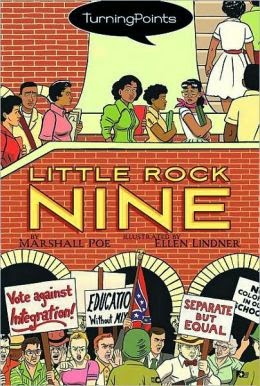
Turning Points is a series of graphic novels from
Aladdin Paperbacks, that tell about important moments and events in US history. These books are portable and affordable, and I have had them on my "to read" pile for a while now, so there is no time like to present to see how good they are. All three of these books I review below were written by
Marshall Poe, a writer and historian known for his work at
The Atlantic and also as editor in chief of the
New Books Network.
Little Rock Nine details the ongoing struggle in 1957 about integrating the public schools in Arkansas. Because of the
Brown v. Board of Education Supreme Court decision, school integration was national law, but the state laws in Arkansas forbid it. This conflict is embodied by looking at two families, a common conceit in these books I found, which makes the issues both more pressing and personal. The two families, of course are black and white, and the main focus is on their children. Walter McNally, a 16 year old white boy, listens to his family squabbles over the integration. His father is a lawyer fighting for the rights of black people while his grandfather is the conservative foil who argues for keeping things as they are. Poe makes these characters somewhat sympathetic and human, but he also makes sure that they wear their views on their sleeves.

There is more nuance when looking at Thomas Johnson's family. He is a 15 year old black boy, and he took part in an attempt to integrate the schools the year prior. Of course, he wants to be treated equally, but he and his family have experienced the intense backlash from those who want to keep things as it was, and they are hesitant to deal with all the potential degradation and violence that came with social action. I appreciated that civil rights issues were here considered with more attention to the context, because I think for some students these matters are such cut and dried, facile decisions and I feel they should see how much of an actual struggle such change was.
All the reviews I have read about
Little Rock Nine have been positive.
Snow Wildsmith wrote, "Poe’s insistance [sic] on showing as many sides of a story as possible
succeeds admirably here, resulting in two main character [sic] who are
believable boys caught up in a storm they don’t quite understand and
aren’t sure that they’re strong enough to face." The folks at the
Historical Novel Society called it "exciting and historically accurate."
Marya Jansen-Gruber offered this opinion, "This format will encourage young readers to ask questions about the
civil rights movement, and the book will provide an excellent platform
for a class segment about the Little Rock Nine."
The art in this volume is by
Ellen Lindner. She is a cartoonist and illustrator known for her
Ignatz Award nominated webcomic
The Black Feather Falls and various other
comics projects. Her artwork is somewhat cartoonish, but her storytelling is very clear. I also admire her ability to depict the emotions through her figures' faces and postures.
The artwork in the next two books is by
Leland Purvis, whose other graphic novel works include the
Resistance trilogy and a biography of
Neils Bohr. His work in this volume is a combination of strong ink lines and sketch-like illustrations. I think he captures the historical flavor through costumes and backgrounds, though sometimes it is difficult to keep track of which character is which.
Sons of Liberty follows a period of US history from 1768-1776, a time of great change and a number of historical events leading up to the
American Revolutionary War. The entryway into this story is Nathaniel Smithfield, a fictional apprentice to
Paul Revere. He is ten years old when the book begins, and over time he meets a number of prominent patriots, including
Sam Adams and
John Hancock, and is witness to many events, such as the
Boston Tea Party and combat in the battles of
Lexington and Concord. Although this book is a piece of historical fiction and uses much original dialogue, there are a number of sections based in real accounts that feature first-hand descriptions of events.
 |
| Nathaniel throws a pretty mean rock. |
The drama in this story is heightened by family tensions, with Nathaniel butting heads with his Loyalist father. In a clever way, this familial conflict mirrors the thought process of the colonists to rebel against England, and over time, the family dynamics shift and events cause people's minds to change. Even though I was pretty familiar with the actual events, I felt myself becoming concerned for the characters' lives. There is a lot to digest in the book, in terms of the sheer amount of facts, events, and characters, but I feel that the story is quite compelling and interesting.
The reviews I have read about
Sons of Liberty are pretty mixed.
Snow Wildsmith felt that this book was relatively weak, "mainly due to Poe attempting to cover too much time in too short of a book." The
Historical Novel Society commented positively that it "gets to the heart of what it felt like to be a young boy in the middle
of a thrilling period of history, with its conflicts, agreements and
world-changing events." The
Breed's Hill Institute summed it up as "an i
mperfect but interesting taste of history."
The third book in this series is
A House Divided, set in the years leading up to the
American Civil War.It follows a couple of brothers from the year 1856, Owen and Amos Bennington. They are close and very sympathetic to their parents' abolitionist rhetoric. After their parents deaths, they decide to take action and spread their message in the
contentious soon-to-be state of Kansas. While there, they see just how violent and sneaky the pro-slavery contingents are, which leads them both to question how they can best help help the abolitionist cause. Younger brother Amos decides to join up with
John Brown, because at least he is being proactive and taking the battle to those who would defend an unjust social system. Older brother Owen decides to go work for a politician he admires for his bold speeches,
Abraham Lincoln.
The dual narratives shows two very different paths on the road to abolishing slavery, and there are a great many events enumerated in the storytelling. In addition, Purvis's artwork is less sketchy than in
Sons of Liberty and includes more grey tones, which give it a more painterly sheen. The sum total of these features is an engaging set of tales that balance historical import with human emotion.
I was not able to find many reviews of
A House Divided, but
Snow Wildsmith praised it particularly because "one of the strongest points of this book (and of the series) is that Poe
doesn’t neglect to tell both sides of a story as much as he can" and because "Purvis’ art is also stronger in this volume." I agree with her on both counts.
Previews and more information about all these Turning Points books can be found
here from their publisher.