Showing posts with label European history. Show all posts

Sunday, August 30, 2026

Globetrotters: Nellie Bly and Elizabeth Bisland's World Tour

There are so many graphic novels published every year, and I sometimes have a hard time keeping track of what is out there. Lately, I have been checking out books (literally, from my local library) that have been nominated for awards. Globetrotters was nominated for the Eisner Award in the Best Reality Based Work category, and it is a fantastic look at a unique moment in US (and world) history. Looking for a news story, reporter Nellie Bly was sponsored by the New York World to try to travel round trip to beat the fictional journey of Jules Verne's Around the World in Eighty Days

Seeing their own opportunity to make a sensation, The Cosmopolitan sponsored literary writer Elizabeth Bisland to do the same, only traveling west. This books adapts both of their published travelogues that documented their much publicized and ballyhooed journeys. Both faced many obstacles, from traveling solo as women, which was frowned upon, to weather, to tight scheduling. I won't spoil things for people who do not know the history, but I will say that both arrived back in under 80 days. 

The pluses of this book are that it is very compelling in terms of the plot, gorgeously drawn, and full of interesting facts. I felt that the alternating looks at Bly and Bisland's journeys made for good competitive drama that reflected that being drummed up in the publications of the time. The artwork is obviously well-researched and detailed, and it is also dynamic and expressive in ways that highlight characters' actions and emotions. Lastly, there is a good amount of exposition that helps give more context to the places they visit, especially in terms of geography, which I found helpful. I enjoyed reading this exceptional book very much.

Globetrotters was a collaboration between writer Julian Voloj and artist Julie Rocheleau. Voloj has worked on a number of graphic novels, including the biographies BasquiatThe Story of Joe Shuster, and Ghetto Brother. Rocheleau has drawn the Eisner-nominated books Wrath of Fantomas and About Betty's Boob.

The reviews I was able to locate about this book have been positive. Ian Keogh called it "well told, intended to shock and surprise anyone unaware of the story." Robert Greenberger wrote "Julie Rocheleau’s limited color palette and cartoony expressiveness bring the pulse-pounding race to life, nicely capturing the look and feel of this bygone era."

Globetrotters was published by Abrams ComicArts, and they offer a preview and more information about it here.

Local libraries rule! 

Tuesday, February 10, 2026

The Girl Who Sang: A Holocaust Memoir of Hope and Survival

Holocaust survivors are growing older and fewer, and The Girl Who Sings is a graphic novel made to ensure their stories are preserved and told to future generations. It tells the tale of Estelle Nadel, who lived in Poland as a girl, and whose story is recorded and featured by the United States Holocaust Memorial Museum. It is divided into four parts, the first the lead-up to Nazi occupation, the second an account of her family hiding, the third a look at their liberation that brought new terrors, and the fourth the tale of how they finally arrived to America and struggled to make new lives.

What is powerful about this book is its first-hand account of the genocide and harrowing events of the period, ones that are being replicated in the present in multiple places despite a vow to "never again" abide such prejudice and hatred. People were labeled subhuman, detached from social structures like education, relegated to ghettos, and eventually sent to camps to either work or die. Others were killed with bullets and bombs in the course of war. I know there are those who would like to pretend none of this ever happened or even those who would like to replicate these events to perpetuate their own foul beliefs, and one of the strongest ways to combat them is to keep these stories visible. I was deeply moved by this book, more than I expected to be. It is a vital tale of survival and hope in the face of despair, and I feel it is an important story for others to see.

The Girl Who Sang is Estelle Nadel's story, but she died in 2023, and it was translated into graphic novel form here by editor Bethany Strout and artist Sammy Savos. Savos is a storyboard artist and cartoonist who has a strong sense of storytelling, character design, and emotional expression. Through the interaction of plot, words, and images the people and events depicted in this book seem palpable and alive.

 This book has received many accolades and has been very well reviewed. In a starred review from School Library Journal, Darby Wallace called it a "must have." In another starred review, Kirkus Reviews described it as "sweeping, stark, tragic, and triumphant." Emily Schneider wrote that the "metic­u­lous nar­ra­tion and insights, com­bined with Sam­my Savos’s com­pas­sion­ate artis­tic vision, ensure that this sto­ry will not be forgotten."

The Girl Who Sang was published by Roaring Brook Press, and they offer a preview and more here.

Wednesday, October 15, 2025

Nathan Hale's Hazardous Tales: Bones and Berserkers

The 13th book in one of my favorite graphic novel series, Bones and Berserkers changes up the format in that it features a collection of 13 tales rather than one overarching narrative. Still, all the major players are still here, and the range of horrific stories run a gamut of genres. There are folk tales like the Demon Cat, an adaptation of Edgar Allan Poe's "Hop-Frog," the real-life misadventures of pro-golfer Eben Myers with medicinal radium, and the terrible murders and arson at Frank Lloyd Wright's home/studio Taliesin. I felt that in some ways this book was a bit more documentary in places, like history mixed with true crime writing, which worked well.

This book is dedicated to Alvin Schwartz and Stephen Gammell, and it shares a real kinship to their Scary Stories to Tell in the Dark. It features some pretty graphic scenes, including a human head stripped bare by cancer treatments, a bunch of men dressed as orangutans who are set on fire, and butts being chopped off of people's bodies, so it is pitched toward an older audience than earlier volumes in the series. Still, there are moments of grim humor that punctuate the proceedings much like the Crypt-Keeper did in Tales From the Crypt. It's not a book for the squeamish, and I found it to be wonderfully gruesome and fun. This book is a treasure trove of horror for fans of both fiction and nonfiction.  

The Jersey Devil!
Bones and Berserkers was made by Nathan Hale (not related to the Revolutionary War spy), a highly accomplished graphic novelist. I love his work so much that I named one of my annual favorites list categories after him. Aside from his great success with this series, he has also published the fictional graphic novels The Mighty BiteOne Trick Pony and Apocalypse Taco. He has also drawn a few others, including Rapunzel's Revenge and Calamity Jack. I learned some more about Hale's work on this book and his upcoming projects in this article.

The reviews I have read of this book have been positive. Kirkus Reviews summed it up, "Not all true, but truly nightmarish." Susan Harari wrote that it would be "perfect for reluctant readers in middle or even high school who are brave enough to handle both fictional and factual horror stories."

Nathan Hale's Hazardous Tales: Bones and Berserkers was published by Abrams Fanfare, and they offer more information about it here.

Sunday, June 15, 2025

Roxanne Dunbar-Ortiz's Indigenous Peoples' History of the United States: A Graphic Interpretation

I got this book for Fathers Day this year, and reading it has been a moving ordeal. I have not read the source material for this adaptation, but this graphic interpretation is structured in a way that features its author, scholar and activist Roxanne Dunbar-Ortiz, as its narrator delivering a grand lecture. As lectures go, this one is engaging and chock full of information. It runs from a time 10,000 years ago when agricultural communities were being established around corn until protests and political actions very near our present day. In between is a vast channel of history, from the governmental and social structures of various tribes in North America to the ruling principles of European countries that eventually crossed the ocean in search of trade routes and treasures, only to conquer, enslave, and slaughter the people who already lived here.

This book is encyclopedic with historical figures such as Tecumseh and Andrew Jackson, events such as the Wounded Knee Massacre and the Trail of Tears, and (sadly) influential publications such as Last of the Mohicans. But this is no dry account, and what I appreciate about it most is how it explores historical concepts and expounds on how specific ideologies were formed and propagated and how large-scale murder and theft were made to look heroic and just. It covers the idea of Manifest Destiny and how a campaign of mass genocide was pitched as a moral crusade, and it also touches on how policies such as the Homestead Acts and economic happenings like the California gold rush mightily and swiftly led to native peoples losing land and rights. There is much to think about here that pertains to current events, propaganda, and modern history, questions and critiques that are worth pursuing to make a more equitable and just world. This book is the best sort, one that leaves the reader changed after putting it down.

One critique I do have is that the book features many large blocks of text, which can be dense, but I feel that it also scaffolds them well with detailed artwork that conveys not only images of the past but also a good amount of emotion and drama. The artwork well suits the prose, providing much needed context that supports and promotes comprehension of the big ideas within.

Pulling off the large feat of adapting this book was Paul Peart-Smith. He is a British artist who has been making comics for over three decades, drawing stories for 2000 AD and many other publishers, including a graphic adaptation of W.E.B. Du Bois's The Souls of Black Folks. Both he and Dunbar-Ortiz speak about this adaptation of Indigenous Peoples' History of the United States in this interview.

I was not able to find many reviews of this book online, but I very much agree with Brian Cronin who wrote, "This is a book that is very worth reading for anyone who wants to challenge what they think about American history."

Roxanne Dunbar-Ortiz's Indigenous Peoples' History of the United States was published by Beacon Press, and they offer more information about it here.

Tuesday, March 25, 2025

Sunburn

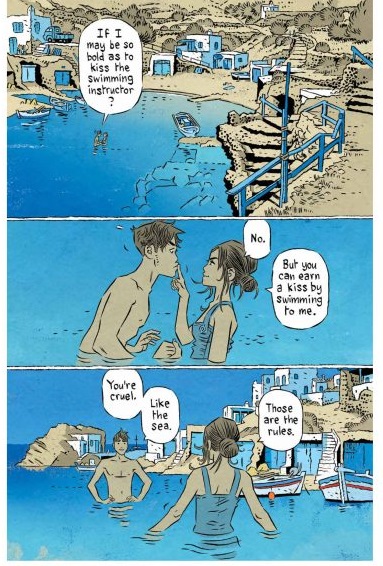
The main character of Sunburn is Rachel, a 16-year-old British teen whose summer plans involve working at a butcher shop where she'll be elbow-deep in pig guts as well as the typical week-long family trip to a rainy cabin. Those plans get exploded when a mysterious invitation appears from the Warners, family friends who own an island house in Greece. They invite her to a summer of fun and sun, and she happily accepts.

Once there, she lives a comfortable life, with wonderful food, free new clothes, and scenic views. She also gets daily visits to the beach, afternoon naps, and dinner parties at different people's houses. The cherry on top of this sundae is that she also gets to spend time with Benjamin, a slightly older British boy, and the two flirt and get involved. 

Of course, nothing this awesome comes for free, and over the course of the book Rachel uncovers the details about why she is there. I very much enjoyed this book, as it made me nostalgic for my own vacations in Greece when I was younger, but it is also a compelling combination of a mystery and character study. Aside from the interesting plot, the artwork is also gorgeous, with a limited color pallette and plenty of landscape imagery that sets the atmosphere.

Sunburn was a collaboration between writer Andi Watson and artist Simon Gane. Watson is a cartoonist, writer, and illustrator who has created a number of books and graphic novels and who has been nominated for four Eisner Awards, two Harvey Awards, and an official selection of the Angoulême International Festival. Gane has drawn a number of comics series and books, including They're Not Like Us and Ghost Tree. Watson talks about making this book as well as some of his other projects in this interview.

All of the reviews I have read of this book have been positive. Darryll Robson wrote, "You will not find immediacy here, but the narrative is better for its slow, dreamy walk through the lives of its characters." Kirkus Reviews called it "a contemplative study of a girl battered and disillusioned by her first glimpses of adult complexities." Ramon Piña opined, "The art in the book is nothing short of spectacular."

Sunburn was published by Image Comics, and they offer more info about it here


Sunday, November 5, 2023

Nathan Hale's Hazardous Tales: Above the Trenches

I have read and reviewed every graphic novel in this series (go see), and this one is a sequel of sorts to Treaties, Trenches, Mud, and Blood in that it also is about World War I. However, this one does not look at the broad scope of the war but at a specific area, namely the origins of aerial combat. 

It is crazy to think that people took their lives into their own hands in early airplanes and even crazier than not even ten years after man-powered flight was invented that someone thought to use these vehicles for war. At first, they were used to scout troop movements and plan assaults, then they were used to drop bombs, and finally someone had the bright idea to strap guns onto them. 

At the time, just flying an airplane was somewhat a daredevil enterprise, with lots of risk involved and little in the way of safety equipment. This book follows a small group of brave (or foolhardy, depending on your viewpoint) young Americans who enlisted in the French Foreign Legion in order to take part in a war that the USA had not yet entered. Their intention was to become pilots and help fight in the skies, and this book chronicles the long, bumpy road many of them took in order to become soldiers. Spoiler: As people who engage in highly dangerous situations they also frequently smoke and drink. Also, most of them die or get killed over the course of the war.

What is excellent about this book is how it puts a human face on the war. There are many stark, pronounced personalities among the pilots, and it is very easy to get to know and root for them. Also, as with all the other volumes in this series, there are plenty of details that make the past come to life. Among the various topics also at hand are the intricacies of dog-fighting, string of technical innovations, military developments, and a code of honor among all pilots. 

It is amazing to me that this book not only encompasses so much information but also communicates it clearly while also making for a compelling, human story. And I have not even mentioned how many visual references must have gone into depicting the intricate uniforms, planes, and people involved in the war. From the lack of reviews I have found online, not many people review the twelfth entry in a series, but I feel it bears repeating just how marvelous and exceptional this book and the entire series are. The art is phenomenal, the stories moving, and the facts fascinating. NHHT continues to be the gold standard for nonfiction graphic novels.

Author Nathan Hale (not related to the Revolutionary War spy) is a highly accomplished graphic novelist, so much so that I named one of my annual favorites list categories after him. Aside from his great success with this series, he has also published the fictional graphic novels The Mighty BiteOne Trick Pony and Apocalypse Taco. He has also drawn a few others, including Rapunzel's Revenge and Calamity Jack.

Above the Trenches was published by Amulet Books, and they offer more information about it here.

Thursday, October 20, 2022

Wake: The Hidden History of Women-Led Slave Revolts

Wake: The Hidden History of Women-Led Slave Revolts is a graphic novel that works on a number of levels, and I was gobsmacked by how much it affected it. One, it is a memoir by academic Rebecca Hall doing research for her dissertation projection. Two, it is an account of the facts of women's roles in slave revolts. Three, it contains a number of fictionalized accounts of the events concerning slave revolts, as very often there are no concrete records extent concerning women's involvement in them. Four, it is an exploration of how the institution of slavery still haunts and informs contemporary society. Five, it is enterprise that demonstrates how history gets defined and then redefined, and how this process has palpable effects on us all, whether acknowledged or not. It's a tour de force graphic novel that packs a wallop intellectually, aesthetically, and emotionally.

One especially affecting and effective trope in this book is a constant mirroring of the past and present in its imagery. A good part of the book takes place in New York City, and there are several panels and pages that show scenes from the 17th and 18th centuries and how they inform our present. Scenes of slave auctions push right up on images on contemporary Wall Street, juxtaposing the predominant business practices of both eras. The artwork by Hugo Martinez aptly emanates a rawness that highlights the horrific and dehumanizing social conditions depicted throughout the book. It is a difficult read in many ways, as it does not let anyone off the hook for their various roles in either perpetuating or trying to ignore grave injustices carried out over centuries. And the images touch many a nerve along the way.

In the end, I was amazed by the scope of this book. As an academic, I can appreciate the great effort and distress involved in doing this research and creating this account. As a reader, I was moved by the historical accounts and sheer horror of the depraved acts of slavery and racism. I was also moved by the bravery and perseverance of people who were enslaved and how they contended against their captors. As a citizen, I was distressed by how public institutions, including records clerks and companies like Lloyd's of London work to obscure and even protect past misdeeds. Additionally, I was struck by how Hall's background as a lawyer also informed insights into how the institution of slavery stripped people of basic humanity through legal codes. As a researcher, I can also appreciate just how frustrating it could be to delve into a topic where little to no historical record exists. This absence should be galling to us all in the present day.

Wake: The Hidden History of Women-Led Slave Revolts is an important, modern classic that belongs on library and classroom shelves as well as on syllabi. I am so glad that one of the students in the graphic novels class I am currently teaching selected it. I feel everyone should read it.

All of the reviews I have read of this book have been glowing. In a starred entry, Kirkus Reviews summed it up as "an urgent, brilliant work of historical excavation." Etelka Lehoczky called it a "remarkable blend of passion and fact, action and reflection," and added that "Wake sets a new standard for illustrating history." In a detailed and riveting review Jordan Alexander Stein wrote, "It pushes past the limits of what’s possible, to tell us a story that wasn’t but now can be."

Wake: The Hidden History of Women-Led Slave Revolts was published by Simon & Schuster, and they offer more information about it here.


Friday, June 10, 2022

Caravaggio: A Light Before The Darkness

To say that the pandemic has affected my life, work, and productivity is an understatement. This graphic novel I have been meaning to read and review for about a year, and I am happily and thankfully (and finally!) glad to post it today.

Caravaggio: A Light Before The Darkness is set in the late 16th/early 17th century, and this book took me back (not to the 17th century, I am not THAT old) to my undergraduate days when I took an art history class and attended a lecture about the art of Michelangelo Merisi da Caravaggio. He was an important figure of the Baroque style, and he lived a tumultuous and eventful life, all of which are conveyed effectively in this book. He is known for his sense of drama and lighting in his work, with a masterful use of chiaroscuro that influenced many painters afterward. In apt fashion, the artwork in this book employs his painterly style in its depictions.

Just as dramatic as his artwork was his personal life, which was characterized by sex scandals (with men and women), duels, and multiple brawls. Ultimately the fallout from this violence caused him to live in exile, and he died under controversial circumstances. This book delineates all these events in spirited and cinematic fashion, which is fitting as the script for this book came from an unproduced screenplay. I think it works well as a graphic novel, capturing the flare and intrigue of Caravaggio's life as well as the spirit of his artistic achievements.

This book is a collaboration between author and screenwriter Ken Mora and artist Cyrus Mesarcia. Mora is best known for a number of animation projects from his company Bella Fe Media. Mesarcia has drawn the comic book series Carson of Venus and a number of horror comics. Mora speaks about his work on this book in this interview.

All of the reviews I was able to locate of this book have been positive. Publishers Weekly called it "a spirited introduction to Caravaggio’s life and times that should appeal to readers of classic graphic illustrated style comics." Jean M. Roberts wrote, "I enjoyed this graphic novel and highly recommend it to readers of historical fiction who enjoy adult graphic novels and a unique reading experience." As of this review, it has a 4.43 (out of 5) star rating on Goodreads.

Caravaggio: A Light Before The Darkness was published by Markosia Enterprises Ltd. It was originally published as a six individual issues, partially funded by a Kickstarter campaign.  It is also available as webcomic on WEBTOON.

Tuesday, June 15, 2021

History Comics: The Wild Mustang: Horses of the American West

The History Comics series began last year, and I was impressed with the initial offerings. This volume, The Wild Mustang, lives up to the great start, featuring a wide range of history that touches on matters of biology, plate tectonics, politics, and culture wars. The story begins hundreds of millions of years ago when horses first evolved in what is now North America. About 150 million years ago, there were none of these creatures left there, as they had all migrated to other continents and were isolated by continental drift. It was only with the re-introduction of the Spaniards and other colonial powers that these creatures returned to where they originated.

What I liked about this book was that it takes a long view of history but also makes sure to show how these animals were used for various social and political means. Aside from agrarian labor, they were used for war purposes, for the Spanish to conquer native people or the Comanche to dominate land and property. It counters a lot of the romantic thinking of some idealistic native species that embodies the spirit of the American West, showing how they have since propagated, been hunted and slaughtered, and later protected by various laws, many championed by Velma B. Johnston (AKA, Wild Horse Annie).

This book is dense with facts, but it is still very readable and engaging. Plus, there are plenty of resources for further information in the end papers of the book, making a great starting point for eager readers. I think it would be attractive to people who love horses but it's also good for a general survey of US history and a great model for what historical research focused on a specific subject can look like. The artwork captures the energy of the animals and also communicates many shifts in scenery and tone, from pastoral plains to meat packing plants to villages to courtrooms. It's a excellent text to teach about the complexities of history in an entertaining and relatable medium.

This book's creators, writer Chris Duffy and artist Falynn Koch, have created a number of other graphic novels. Duffy has written or edited a number of anthologies, including Fairy Tale Comics, Fable Comics, Nursery Rhyme Comics, and an anthology of World War I poetry titled Above the Dreamless Dead. Koch has drawn a couple of entries in the Science Comics series, Bats and Plagues, as well as a Makers Comics book about baking. Koch speaks about her work on this book in this interview.

The reviews I have read about it have been mainly positive. Kirkus Reviews called it "A surprisingly comprehensive history of wild horses." Brett at Graphic Policy called it "a little weighty at times" but "well worth it." As of this review, it has a 4.05 (out of 5) star rating at Goodreads.

The Wild Mustang was published by First Second, and they offer a preview and more information about it here.

Monday, November 30, 2020

Blades of Freedom: A Tale of Haiti, Napoleon, and the Louisiana Purchase

I have a lot of books on my to-read list, but I got this one in the mail the other day and it jumped to the top of the heap. I have reviewed every volume of Nathan Hale's Hazardous Tales on this blog (click the link and see!), because I think it's the best nonfiction history series available in graphic novel form. Each book has been excellent, full of well researched facts and events and told in a highly engaging, sometimes humorous way. It's one of the series I recommend most to tween and adolescent readers who have an interest in nonfiction. Blades of Freedom is the tenth book in the series, and it is phenomenal.

Bookended with a look at the Louisiana Purchase, it runs far and wide filling in the context for that pivotal happening. Over the course of this book, I read about how mosquitoes spread Yellow Fever, Columbus decimated the Taino people, vodou arose as a religion, Napoleon rose from being a Corsican to the Emperor of France, and Haiti became the first country in the Americas to abolish slavery. It's a book about the politics of the day, moving from monarchies to revolutionary times, using the French Revolution as a backdrop for much of went on. It explains how the slave trade work in gruesome detail, focusing on the value of sugar cane as a product of the Caribbean islands. It also focuses on major figures involved, including Napoleon, legendary insurgent Mackandal, rebel general Toussaint L'Ouverture, Emperor of Haiti Jean-Jacques Dessalines, and eventual US President James Monroe


It manages to cover so many topics with a clever conceit: the narrator Nathan Hale has a wheel he spins to jump from topic to topic. This set-up keeps the narrative moving at a brisk pace without being overwhelming. It also sets up a context for building so much of the background necessary to understand these historical events. Personally, I knew little about the Haitian Revolution before I read this book, and after having read it I felt ashamed not to have known more about this landmark struggle. It was the largest and most successful slave revolt ever, and one of the big pluses of this book that it sheds light on a topic that I think gets short-shrift in terms of learning about history in the US. I think the lack of coverage is racist, with the long-held use of the Haitian Revolution being used as a specter to scare white people about the potential savagery of free black people. Having this matter being portrayed in such a popular series will mean that it won't be as arcane a topic going forward, I hope.

This book's author, Nathan Hale, who is not related to the Revolutionary War spy, is a highly accomplished graphic novelist. Aside from his great success with this series, he has also published a couple of fictional graphic novels One Trick Pony and Apocalypse Taco. He has also drawn a few others, including Rapunzel's Revenge and Calamity Jack.

Thus far, I have not been able to locate many reviews of this book, but the ones I've seen have been positive. Marissa Moss wrote, "This is the kind of history that will excite young readers and show them how disparate events, far from each other in time and space, can have major impacts on each other." Lori Henderson listed it as a weekly pick for Good Comics for Kids.

Blades of Freedom was published by Amulet Books, and they offer a preview and more here.

Sunday, March 10, 2019

Anne Frank's Diary: The Graphic Adaptation

The Diary of Anne Frank is one of the most read books in the world, which may beg the question of whether or not a graphic adaptation of it is necessary, but I have to say that I was blown away by this work. It is expressive, incorporates disparate pieces of artwork into the story, and creates a context for both exploring humanity and horror at the same time. Anne and her family spent years hiding from Nazis in an annex in Amsterdam during World War II. Along with some others they shared the cramped quarters, living in as quiet and unobtrusive fashion as possible. And all the while they listened for scraps of news and hope while hearing bombing and shooting all around them.
As if this atmosphere was not bad enough, Anne also had to deal with lots of other personal dynamics, including a rivalry with her older sister, a crush on a boy, and having to share her room with an adult man dentist. What I feel this book captures best about the work is 13-year-old Anne's sense of figuring out the world and her place in it, ironically at a time when she was sequestered and eventually taken out of it. This book is full of humanity, wisdom, and sadness, and the artwork only exemplifies the beauty and thoughtfulness of its prose.

As an educator, I often think of how to use a book like this, and I feel that it could be used in several ways. It could be read alone, in tandem with the original book that it excerpts, or it could also be excerpted itself to draw attention to particular passages. I was very impressed with this book, especially in how it uses various visual styles and formats to adapt the diary entries. Sometimes, it plays with a single image, often cribbed from a classical art source.
Sometimes, it uses straight forward comics, and others it features an illustration with an entire diary entry. I think that its creators were savvy in selecting which sections to summarize and adapt and which to present in more whole fashion. This adaptation is superlative, and it is prelude to an animated feature that is nearing the end of production. If it is anything like this book, it should be excellent.

This adapted book was a collaboration between Ari Folman and David Polonsky. Folman is an Orphir Award and Golden Globe Award winning director and screenwriter. Polonsky has worked as an art director, children's book illustrator, and animator. Both collaborated on the lauded animated film Waltz with Bashir. This interview sheds light on both creators' work on this book.

The reviews I have read about it have been largely positive. Ruth Franklin wrote, "Their book is brilliantly conceived and gorgeously realized." Publishers Weekly's starred review concluded, "The beauty of Anne’s life and the untarnished power of her legacy—here further elevated by Folman and Polonsky—are heartening reminders of the horror of her fate." Gene Ambaum called it "spacious, interpretive, and altogether wonderful."

Anne Frank's Diary was published by Pantheon, and they offer a preview and more here.

The publisher provided a review copy.

Saturday, January 5, 2019

The Prague Coup

The Prague Coup has a lot going on. It's a crime noir set in a specific historical context, following the movements of author/ex?-spy Graham Greene as he deals with various shady characters in Prague in 1948, when the formerly democratic Czechoslovakia became a communist state. Ostensibly there to research the area for his screenplay for now considered classic film The Third Man, Greene also dabbles in politics, clandestine entertainments, and at least one extramarital affair. I think knowing a lot about the historical context as well as Greene's life and/or the plot of The Third Man would help a reader out, but they are not essential for enjoying this book.
What helped make matters more plain and understandable is that the plot is told from the viewpoint of Elizabeth Montagu, a former actress and ex-spy who guided Greene to various underground spots in Prague. She has her own intentions and a complex set of personal connections, which all combine for some gripping drama and tense cloak and dagger action. All of this story is complemented by the photo-realistic artwork that grounds the book in a grainy, shadowy reality that echoes the look and feel of The Third Man.
This book is a collaboration between writer Jean-Luc Fromental and artist Miles Hyman. Fromental is a translator, script-writer, and author with many books for both adults and children to his credit. Hyman has drawn various comics over the years and also exhibits his art throughout Europe. Both creators speak about their work on this book in this interview.

All of the reviews I have read of this book have been positive. Publishers Weekly concluded, "This example of art imitating life should captivate lovers of spy fiction or Cold War history." Benjamin Welton wrote, "The Prague Coup has everything fans of The Third Man could want—an exploration of Vienna’s extensive sewer system, gunplay, a mysterious plot with international implications, and plenty of witty banter about art, faith, love, sex, and loyalty."

The Prague Coup was published by Hard Case Crime/Titan Books, and they offer more info and a preview here. This book features some nudity and violence, so I recommend it for readers mature enough to deal with those things.

Sunday, December 30, 2018

The Three Escapes of Hannah Arendt: A Tyranny of Truth

Hannah Arendt is a writer/thinker whose work on totalitarianism has come back into popular demand these days of "interesting times." The Three Escapes of Hannah Arendt is a biographical chronicle that gets at her private and public lives in interesting fashion. It follows chronologically, beginning with her precocious and troubled childhood. As you can read from the following excerpt, her father's descent into syphilitic insanity was only part of the experience:
 
 
I got these preview images from Tablet Magazine

She was also a brilliant thinker who worked and studied with contemporary movers and shakers of the time, most notably Martin Heidegger, who was both her teacher and lover for a number of years. Over the course of this book, she escapes twice from the Nazis, once from Germany and the second time from Paris, and the third escape more has to do with how she reconciled her own thinking with Heidgger's, even as he was a Nazi sympathizer. She was a complicated woman who lived in complicated times, and I feel that her thinking is vital for dealing with thoughts of personal responsibility and justice, especially today.

In many ways, this book is dense with events, ideas, and the past. There is some built-in support in the footnotes, which helped the reader keep up with all the various historical figures, provided context, and served as further avenues for reading and research for those inclined. The art style is on the sketchy side, but I feel it is still rather evocative and energetic. Overall, this book provided me a compelling and very informative reading experience.

Ken Krimstein created this book, and his extensive research is apparent from the plotting and footnotes. His comics work has appeared in the Chicago Tribune, The New Yorker, and other high profile venues. He has a collection of cartoons called Kvetch as Kvetch Can, and he also teaches at DePaul University. His prose writing has been published in McSweeney's. Krimstein speaks about his work on The Three Escapes of Hannah Arendt in this print interview, this podcast interview, and in this comic.

The reviews I have read about this book have been largely positive. Kirkus Reviews gave it a starred review that concluded, "A compelling performance with great pacing that makes abstruse political theory both intelligible and memorable." Publishers Weekly called it a "fascinating if cluttered biographical portrait." Bookmunch summed up, "Krimstein’s artistic style may not be to everybody’s tastes but the story he tells, of a woman who fought for the importance of thought itself, is one that needs telling and retelling."

The Three Escapes of Hannah Arendt was published by Bloomsbury, and they offer a preview and more here.

The published provided a review copy.

Monday, August 15, 2016

Today is the Last Day of the Rest of Your Life

So, Like I wrote earlier, I signed up for Comixology Unlimited. I have been diving into a few books lately, seeing what is offered and if the service is worth my while. Today is the Last Day of the Rest of Your Life was a title offered by one of my favorite publishers, and although I had not heard of the book (despite it being a multiple award winner-Where have I been?), it sounded intriguing and I thought I would give it a shot. It turns out that this chance reading ended up ending up being pretty lengthy, almost 500 pages of comics(!).

As it turns out, I was entirely enthralled by this book and I took it down in a few sittings. It was utterly compelling, raw, suspenseful, and revelatory. The narrative focused on a young Austrian woman who was into punk rock and decided to go on a trek with some friends in the summer of 1984. These women take off in search of a good time, and in turn they have many adventures, party, face the menace of sexual violence, and try to scrounge up money or food. They take part in many illegal activities and run afoul of displaced artists, pimps, wanna-be pimps, and organized crime.
The story is sort of nostalgic, but not sickeningly sweet or overly romanticized. I thought that the characters were very well defined, and the drama of all these situations was quite powerful and moving. I am very glad I took the time to explore this service and find this gem of a book.

This book's creator and main character is Ulli Lust, winner of an Ignatz and an Eisner Award nominee. I love her rough-edged artwork and masterful storytelling as well as the limited color palate that lend the proceedings a grungy authenticity. She speaks extensively about her life and career in this interview.

All of the reviews I have read about this book have been very positive. Robert Kirby opined that this book is so successful because Lust had so much time to reflect on these events, and he wrote, "She captures perfectly and without judgment the complex social, cultural, and personal maelstrom she willingly entered into that summer, offering readers a wonderfully vicarious thrill in the process." Publishers Weekly gave it a starred review and wrote, "Her recollections willfully expose the dark side of an anarchic lifestyle, yet are void of any didactic embellishment, and instead form a genuine and nonjudgmental look at aimless youth and rebellion." Eddie Campbell likened it to "a person who came to stay and I didn’t realize how much I was enjoying their company until after they’d left."

Today is the Last Day of the Rest of Your Life was published in the US by Fantagraphics Books, and they have a preview and more available here. If it is not clear by now, this is not a book for children.

Wednesday, June 15, 2016

The Thrilling Adventures of Lovelace and Babbage: The (Mostly) True Story of the First Computer

Something I can reveal about this book, The Thrilling Adventures of Lovelace and Babbage: The (Mostly) True Story of the First Computer, is that the stories in here are for the most part not real but they are constructed from some excellent research, facts, and historical events. It follows the exploits of an unusual duo, countess/mathematician Ada Lovelace and mathematician/grump Charles Babbage. In reality, these two met and had a great friendship/collaboration that resulted in the invention of two machines, a difference engine and an analytical engine, precursors to what we now recognize as computers. But, neither machine was actually fully built in either of their lifetimes. What is more, Lovelace died pretty young, so their collaboration was rather short-lived.
 
From those bits of reality, this book follows a narrative into a pocket universe where Lovelace and Babbage's lives played out differently: they both live longer lives, build their machines, and use them for various adventures. Along the way they meet major figures of the day, including Queen Victoria, the Duke of Wellington, and author George Eliot. These episodes are full of wit, humor, and well explained footnotes. The artwork is very expressive and vital, and the entire enterprise bursts with personality and energy. This is probably one of the geekiest books I have ever read, and I rather enjoyed it. I don't know if this quite a book for every reader, but it would certainly be a hit for those who like Victorian era antics, computer science, and/or sophisticated humor.

Sydney Padua is an animator and illustrator who began working on this project as a webcomic, just for kicks. It clearly has grown into something much larger, a bonafide graphic novel. She speaks about her work on this webcomic and book in this interview.

This work has received two Eisner nominations, so it was no surprise that all of the reviews I have read about it have been very positive. Publishers Weekly gave it a starred review and made it a special selection, summing up, "Permeated by delightful illustrations, obsessive foot- and endnotes, and a spirit of genuine inventiveness, it’s an early candidate for the year’s best." Maria Popova called it "layered and wonderful in its totality." Dr. James Sumner wrote a more academic review, and he remarked that "Padua’s work is, in fact, rather better researched than certain more solemn texts on Lovelace and Babbage."

The Thrilling Adventures of Lovelace and Babbage was published by Pantheon Books, and they have more info about it here.

Thursday, February 25, 2016

Crogan's Vengeance

There are some comics series that I am embarrassed to say that I have not read, because I just keep hearing about how great they are. Or I keep seeing them displayed at the artist's table at HeroesCon, but don't do pick them up. Chris Schweizer's The Crogan Adventures is one of those. It has been nominated for two Eisner Awards and it chronicles the adventures of various members of the fictional Crogan family tree, an interesting and varied group that includes cowboys, explorers, adventurers, scalawags, legionnaires, and ninja. This first book (out of a proposed 16!) focuses on the clever and resourceful Catfoot Crogan, a sailor turned pirate who lived in the 1700s.

As you can see from the excerpt below, the story is couched in real historical terms. I very much enjoyed seeing the amount of detail that went into depicting what life at sea would have been like at the time. I also appreciated how these details helped later propel the narrative.
 
After the scene and characters are quickly established, the book takes off into high gear. There are rumblings of mutiny, cruel captains, and pirate attacks, not to mention scheming, double-crossings, and sword-fights galore. This was the best kind of adventure tale, full of suspense, drama, and characters I cared about. And even though there are times that Catfoot is worse for wear, reading about how he dealt with his travails was a lot of fun.

As you have probably noticed from the artwork, it is pretty cartoonish. Even so, the attention to backgrounds, the ships, and the period garb are all on point, highlighting the expressive art style. Schweizer's storytelling and layouts are both expert and exceptional.

All of the reviews I have read about this book have been glowing. Don MacPherson wrote that it "stands up well as a self-contained, one-off story." Snow Wildsmith concluded, "Because of the well-crafted plot, strong writing and distinctive art, Schweizer’s series is off to a great start and should prove popular with teen and adult graphic novel fans."  Andrew Wheeler summed up that it was "a somewhat sanitized pirate story, but what popular pirate stories aren’t? It’s full of men swooping down from the crow’s nest, cannons roaring across narrow stretches of water, desperate hand-to-hand fights with pistol and cutlass, and men wearing earrings, bandannas, and strange hats. What’s not to love?"

Crogan's Vengeance was published by Oni Press, and they have more info about it here.

Wednesday, December 30, 2015

The Comic Book Story of Beer

First off, I love both comics and beer, so this book should be right up my alley. Second, even if I did not love both of those things I would have to admit that this book is impressive, both in its scope and execution. There are just so many things jam-packed in here about the history of human civilization:  the role beer probably played in the first agricultural settlements, literary allusions to the beverage from the epic Gilgamesh and beyond, and pointed historical analyses such as how Prohibition killed off all the small breweries and led to a few monolithic companies that controlled people's tastes. Just look at the excerpt below and notice how much they manage to fit in without overwhelming the reader:
As you can see, the artwork is clear, concise, and well paced while the writing is simultaneously dense and easily navigable. Also, interspersed in all of this history is some science in the form of the chemistry behind how beer is made:
as well as a few profiles on specific, historically significant styles of beer:
By far the prevalent type of beer made and sold internationally. Who knew? These guys!
I should have known from the onset that this would be an excellent book. It is by writer Aaron McConnell and artist Jonathan Hennessey, the two creators behind The United States Constitution: A Graphic Adaptation, one of my favorite nonfiction, historical graphic novels, as well as an adaptation of The Gettysburg Address, which I have not read. They are joined on this look at the history of beer by co-writer Mike Smith, former head brewer at Back East Brewery. This interview with all three creators sheds more light on their work on this book, as does this interview at CBR.

All of the reviews I have read about this book have been very positive. Publishers Weekly concluded, "The abundance of interesting little details in these illustrations pair well with the wealth of information that the authors provide." I was amused by this exchange in a forum at Beer Advocate (where, unsurprisingly, everyone seems to love this book) when one commenter called it the "'Beer Goggle History.' This consists of theories that credit beer with every major positive innovation" in western civilization. Emil Favila gushed that it was a book for anyone "whether you are a fan of beer, or just great storytelling." Matilo von Plume gave it an A+ and summed up, "This is a book that deserves a permanent place on one of your shelves; not only is it a fun and informative read, but the sheer wealth of beer style-specific portraits (easily located via TOC or index) makes this an invaluable resource for novice beer drinkers as well as those who want to broaden their tasting horizons."

You can see multiple previews and also learn a lot more about The Comic Book Story of Beer at its official website. It was published by Ten Speed Press.