Showing posts with label conspiracies. Show all posts

Saturday, July 25, 2026

Billy Bat, Volume 1

Set in 1949, Billy Bat tells the tale of Kevin Yamagata, a Japanese-American artist who has hit it big with his popular new series Billy Bat.


As you can see, that comic is a cartoon noir, with lots of subterfuge and, it turns out, communist spies. Everything is going all right until one day, Kevin learns that his character may be based on one that originated in Japan, where he was stationed during World War II. 

Even though the stories that character Billy Bat has are not based on any story he's consciously read, he feels obligated to travel to Japan and track down the original artist in order to get his blessing and also head off any issues with plagiarism. What Kevin finds in Japan instead turns into a tangled web of murder, politics, ancient texts, graffiti, tattoo artists, and communist spies. And the reaches of this conspiracy range far, maybe even beyond planet Earth. There are plenty of twists and turns in this single volume, likely a portent of the amount of suspense to follow.

The kick-off to this series was made by writer/artist Naoki Urusawa and Takashi Nagasaki. Urusawa is an internationally known manga creator, winner of the Shogakukan Manga Award three times, the Tezuka Osamu Cultural Prize twice, two Eisner Awards, and the Kodansha Manga Award. His works have been some of the most celebrated of recent times and include Asadora!Monster, 20th Century Boys, and Pluto. Nagasaki is also an award winning manga writer/editor with a long list of credits. Billy Bat has been completed in Japan for some time and only now being published in the US, and editor Kriistina Korpus explains more about why in this interview.

All of the reviews I have read of this book have been positive. Matthew Orozco opined that it is "an enthralling, genre-defying series that combines mystery, historical fiction, conspiracy theory, and metafiction, unfolding across multiple eras and continents." David Brooke called it "exactly the kind of ambitious, unpredictable storytelling that has made Naoki Urasawa one of manga’s most celebrated creators." Kara Dennison wrote, "The art is wonderfully dissonant, slipping easily between stylized mid-century cartoons and a more settled, faded realism."

Billy Bat was published by Kana, and they offer more information about it here.

Sunday, January 25, 2015

Strong Female Protagonist, Book One

Strong Female Protagonist began as a webomic in 2012, and this volume collects the first four chapters of the story. I actually began reading this series online, and I bought the first two chapters in hard copy, so this tale was not new to me. But I enjoyed it all the same, because I feel that this take on superheroes is fresh, smart, and very compelling.

The plot follows Allison Green, a powerfully strong and invulnerable young woman who just wants to go to college and live a normal life. Unfortunately for her, she used to be the superheroine Mega Girl, and her past keeps cropping up and complicating her life.
 
What makes this comic smart for me is that Allison is a surprisingly complex and interesting character surrounding by what could be stock characters but turn out to be quite intriguing in their own rights. Additionally, there are fascinating twists on the dynamics of superheroes and supervillains and a deep, dark conspiracy to contend with. There is so much greatness to digest in this comic.

The artwork and writing fit together seemlessly. And I love how the illustrations both cling to and expand on superhero conventions but also retain the flavor of the online work. I especially appreciate the use of alt-text in the print version, where it is placed at the bottom of each page. That text comments on the story, is metacommentary on the craft, or tells jokes, and I appreciate that extra touch.

This comic is the product of writer Brennan Lee Mulligan and artist Molly Ostertag. Mulligan is an improviser, actor, and author who performs with the Upright Citizens Brigade. Ostertag also works on a number of other comics, including Journey to the Valley of Whispers and Bacchanalia. Both creators speak about their collaboration in this interview.

The webcomic collected here is well received and very positively reviewed. It was also the focus of a successful Kickstarter campaign, which funded this collection. Marykate Jasper called it "a fascinating superhero book." Nightwing17 wrote, "It’s wonderful to see a series exploring areas of the superhero genre that are usually resigned to subtext and throw-away sideplots." Chris Sims summed up, "It’s well worth reading, and if you’re not already, you’re missing out."

This collection of Strong Female Protagonist was published by Top Shelf, who has a preview and much more here. The story continues online, updated on Tuesdays and Fridays.

I read this book on my Kindle Fire using the Comixology app, and I have to say I really liked the experience.

Sunday, August 25, 2013

How to Fake a Moon Landing: The Truth Behind Science Denial


How to Fake a Moon Landing is a collection of essays about various topics having to do with scientific inquiry. It looks at issues of translating research into popular media and how conceptions and misconceptions are created. Lots of juicy topics are tackled, including climate change, the Apollo 11 moon landing, chiropractic, the MMR vaccine, fracking, and homeopathic cures. These essays are passionately argued, and well structured individually. The takedown of a certain Dr. Wakefield in regards to faulty research about connections between the MMR vaccine and autism is particularly thorough and eye-opening, but the rest are similarly compelling and well argued.

Still, after enjoying the author's last offering, Psychiatric Tales,so much, I felt let down by this book's lack of a framing sequence or explicit connections between essays save for two introductions. The former book was much more personal, and although this one is still well researched and presented, it smacks more of infotainment than it does of an aesthetic whole. As well argued as the essays are, they are separate entities that can be read entirely on their own. I would suggest taking one's time with this book and tackling each chapter over time, only because the topics vary and the essays do not hang together so well in a narrative sense. Still, the individual pieces are great examples of science reporting.

Author/illustrator Darryl Cunningham specializes in nonfiction comics, tackling diverse topics in his blog Darryl Cunningham Investigates. He primarily publishes online, but also has the aforementioned collection of his experiences as a health care assistant in a psychiatric facility. He speaks more about his work on this book in this interview with John Hogan as well as this one with Robot 6.

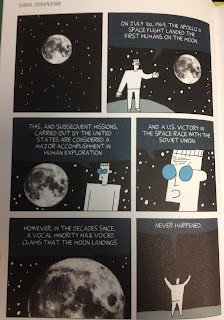
Cunningham's art is sturdy and straight-forward. I enjoyed his use of abstract stylized cartoons with occasional realistic, photographic drawings interspersed in the panels. His art is not flashy, but it does convey information and arguments in clear fashion. Here are a couple of different pages from the book that are characteristic of his style:

From the moon landing section.
From the MMR vaccine section.

Although it is certainly written from a particular point of view, the book is not overtly didactic in its intentions, pushing readers more to think for themselves than to accept simple accounts of events or situations. In these interests, Cunningham includes many sources for his essays in the back matter so readers can verify what he said or go off and do their own fact checking.

Reviews I have read of the book online range from positive to lukewarm. Robert Greenberger wrote, "Cunningham does a remarkable job with difficult material and for high school students, just opening their eyes to the world around them, this is a terrific primer." The reviewer at Geeks of Doom called it "fun and informative without being preachy." Nick Smith was slightly less enthusiastic, stating, "The artwork is cartoony, which may distract some readers from the serious nature of the information presented," but added,  "the book is readable by teens, if they’re interested in science."

How to Fake a Moon Landing is published by Abrams ComicArts. They offer a teaching guide and more here. Here is a short excerpt at Boing Boing.

Saturday, January 15, 2011

45

45 is not a traditional graphic novel, though it does offer an interesting take on superheroes and is a beautiful piece of world-building to boot. 45 reads like a compilation of magazine interviews set in a universe where superheroes (here called Super-S, because Marvel and DC have trademarked "superhero," no lie) are real. Protagonist James Stanley is a journalist who is expecting a baby but won't test him to see if he has the super-gene. Instead, he embarks on a mission to interview 45 people and superpeople to get a handle on what living the super-life is like.

The interviews are presented in age order, so the first interview is with parents who know their baby will have superpowers. The interviews that follow show a great range of lives, from children with overbearing parents to young people finding their place in the world. The interviews then move on to vigilante heroes, heroes-turned-villains (called Vaders), government and corporate agents, and retired Super-S. Each interview covers a page and faces a picture/comic done by individual artists to suit the text. Instead of reading as a set of unconnected interviews, the flow of the book across the lifespan makes it seem more of a narrative. A common thread of the shadowy XoDOS corporation, which plays a potentially sinister roles in raising, creating, and managing Super-S, also provides a narrative consistency.

Andi Ewington is more known as a graphic designer than a graphic novelist, so perhaps his design choices should come as no surprise. He keeps a blog about this book and his more recent activities here. Ewington has conducted a number of interviews about his work on 45 and creating a new superhero universe, including this one on the Forbidden Planet International blog, this one from the Graphic Novel Reporter, this one with Comic Book Resources, and one more at Techland.

Reviews about this book have been overwhelmingly positive. Elisabeth at ComicList wrote about how the range of artists and interviews provide a rich view of a diverse, complex cast of characters. Edward Kaye gushed that this book "is by far one of the most original and innovative graphic novels ever created." Richmond Clements noted that while not all of the interviews are great, especially when compared to some of the exceptional ones, he found this a great piece of compressed storytelling. He also heaped the following praise on the book: "Ewington has created something remarkable here. And not only remarkable, if there is any justice this will also become an important book in the superhero genre."

45 was published by the independent British comics company Com.X. A preview interview can be found at Bleeding Cool. A preview of the artwork can be found at Hypergeek.

Monday, December 21, 2009

The Boys, Volume 1: The Name of the Game

First, let me get this out of the way: There is lots of lurid sex and gory violence in this volume, as well as a liberal dose of black humor, and it is definitely not for children.

Alan Moore and Dave Gibbons asked, "Who watches the Watchmen?" Garth Ennis and Darick Robertson answered, "The Boys." This volume collects the first 6 issues of a comic book series about a task force the CIA has commissioned to deal with rogue superheroes.

In this world, superheroes are pretty common. The top dogs are the Seven, an analogue to the Justice League of America. They are corporately sponsored and appear to hold the moral high ground. But behind the scenes they bicker over money and popularity, and they also have seedy habits. Most of the superheroes act like celebrities and party like rock stars, abusing drugs and having exotic kinds of sex. The US government fears what happens when these superbeings forget abut their humanity and begin to abuse their power. So they contract with The Boys to keep the supers in check.

The story revolves around the leader of the group, Butcher, gathering his old mates Mother's Milk, the Frenchman, the Female of the Species (yes, the lone woman) to rejoin his mission to make the worlds safe for humans. A large part of the story also involves him trying to recruit a new member, Wee Hughie, to round out the quintet. The Boys are a motley crew. Butcher is scheming and strategic but not very details oriented. Mother's Milk is the calm center. The Frenchman is alternately loving and volatile. The Female is mysterious, quiet, and perhaps the deadliest of all. Wee Hughie is a pretty average guy, and his look is based on actor Simon Pegg (before he got famous in Shaun of the Dead). All of them can handle themselves well in a fight.

Author Garth Ennis has written a great number of comics, including the Punisher and Preacher. He is not a great fan of superheroes and many of his tales are violent and irreverent toward them. Darick Robertson provides the art for the series. He is most famous as the co-creator of Transmetropolitan, a sci-fi series following the exploits of a futuristic gonzo reporter, but has drawn a great number of superhero comics. He provides a very realistic, detailed style.

The series is currently published by Dynamite Entertainment. It was nominated for an Eisner Award for best continuing series in 2008. Reviews of this volume are largely positive, ranging from calling it a "guilty pleasure" as in this one from Adam McGovern, to calling it a "must read" at the Weekly Crisis, to a more reserved response from Andy at Grovel.

If you are interested to know more about the series, here is an interview with Robertson about it. Also, preview pages are available here.