Showing posts with label 1960s. Show all posts

Wednesday, June 15, 2022

History Comics: The Stonewall Riots: Making a Stand for LGBTQ Rights


History is a tough thing to conceive of for some learners, as it's difficult to remove oneself from one place in time and try to imagine themselves in another. This volume of History Comics, The Stonewall Riots: Making a Stand for LGBTQ Rights, tackles this issue by literally having its protagonists, a trio of adolescents named Natalia, Jax, and Rashad, who are diverse in terms of gender and sexuality, go back in time (without their cell phones, the horror!). Then and there, they are witness to the actual events leading up to the Stonewall Uprising, and they get to know some of its major players. 
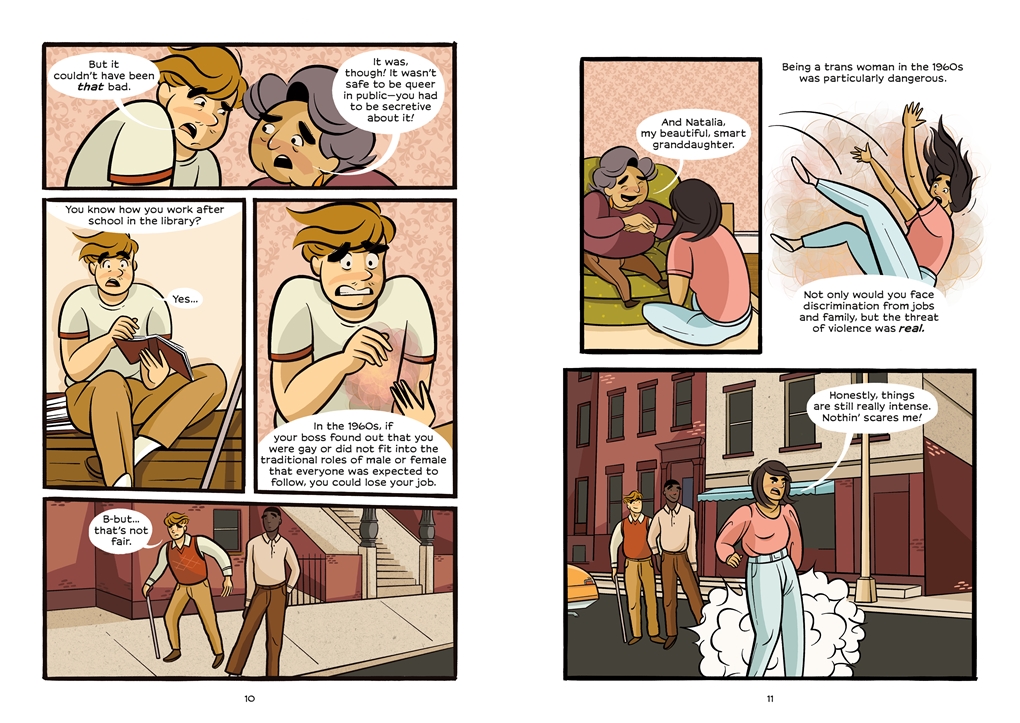
This graphic novel is more about getting to know a tone and people than it is about presenting specific facts and dates to memorize, and I think where it excels is in contextualizing what led to this series of protests that gave momentum to a significant push for LGBTQ rights. The artwork is full of personality and depicts characters in stark, energetic fashion, pairing well with the plot to make this book have a very human focus. The characters and readers both get well acquainted with the people who made history.

Significantly, this book also does not sugar-coat the people or events, nor does it conclude that the struggle is over in the present day. In fact, it points out how much work still needs to be done and also provides a slew of resources for how young people can also get involved in various organizations today. It is a fantastic resource for learning about history as well as for encouraging contemporary activism, and I think it is a much-needed book for classroom and school libraries.

The Stonewall Riots was co-created by writer Archie Bongiovanni and artist A. Andrews. Bongiovanni has co-created comics in all sorts of formats, from graphic novels like A Quick & Easy Guide to They/Them Pronouns to webcomics like Grease Bats and other shorter ones published at The Nib. Andrews also has created a number of different sorts of comics including A Quick & Easy Guide to Sex and Disability.

All of the reviews I have read of this book have been positive. Brett at Graphic Policy stated that it is a great primer that "captures the moment," "the feel," and "the build-up of it all." Krystal Moore and Felix Whetsel called it "a timely introduction to the history of the LGBTQ community, and the people who fought to get us where we are now." Kirkus Reviews summed up, "Engaging account that invites young people to continue to advocate for equality now."

The Stonewall Riots: Making a Stand for LGBTQ Rights was published by First Second, and they offer a preview and much more here.

Wednesday, February 10, 2021

The Black Panther Party: A Graphic Novel History


Reading this book showed me how little I actually knew about the Black Panther Party. The Black Panther Party: A Graphic Novel History is not a long book, but it is substantive and comprehensive. It touches on every major figure associated with the BPP, and heavily focuses on the pivotal years of 1967 - 1969. There are spotlights on people like Huey P. Newton, Bobby Seale, Fred Hampton, and Angela Davis as well as gripping, suspenseful portrayals of major events in the formation and social actions taken by the Black Panthers.

As you can see from the excerpt above, this book is about detailing the history of this group and also placing it in the broader context of US and civil rights history. It is one of the more information-rich graphic novels I have read, but it balances exposition with dramatic action scenes. It utilizes dynamic, iconic artwork full of bold imagery. I appreciated how well it captures both realistic depictions of the participants as well as a sense of the propaganda/visual messages broadcast by the BPP. Even in the passages that are more text heavy and dense, the images are vibrant and realistic, adding much context to the proceedings. 

As a common theme with other books I've read recently, like Big Black: Stand at Attica and Kent State, this book shows how US society has not progressed as much as we would like. The Panthers arose in a response to the racial violence being perpetrated by police forces. Their militaristic response was to show that they could not simply be intimidated and pushed around any more. This arm of the movement was coupled with more charitable ones I did not really know about, such as establishing a school and a program for feeding the hungry, though those aspects are largely overlooked today.

A sizable amount of the book is also devoted to J. Edgar Hoover and the FBI's many incredibly shady and illegal methods of infiltrating the BPP, sowing discord, and outright murdering some of its leadership. I know that not everyone approved of the methods for seeking equality, even within the various civil rights movements of the day, but the level of subterfuge and sabotage accounted here is shocking. I think this book is the perfect introduction for someone who knows nothing about the Black Panther Party, and an excellent resource for any US history, government, or language arts class studying African-American history or civil rights.

This book was created by writer David F. Walker and artist Marcus Kwame Anderson. Walker is a prolific author and is best known in comics for his work on the Eisner Award winning series Bitter Root, runs on Marvel series such as Luke Cage and Power Man & Iron Fist, and the DC Comics series Naomi. He has also written another nonfiction graphic novel, a biography of Frederick Douglass. Anderson is best known for his creator owned series Snow Daze and has also illustrated a number of projects for Action Lab.

All of the reviews I have read of this book have been very positive. In their starred review, Publishers Weekly concluded, "This concise yet in-depth guide offers a timely resource for activists, history buffs, and students alike." Ed Park called it "ambitious and informative." In a rollicking review, S.W. Sondheimer wrote, "I learned more from this 98-page graphic novel history than I did from Chernow’s 818 page biography of Hamilton or anything I had to read for my college course on the WWII Pacific theater."

The Black Panther Party was published by Ten Speed Press, and they provide a preview and more here.

Wednesday, July 15, 2020

Jack Kirby: The Epic Life of the King of Comics

Captain America. The X-Men. Hulk. Iron Man. The Avengers. The New Gods. Black Panther. These are only a few of the hundreds of characters that Jack Kirby either created or co-created. They are household names and properties that have generated billions (trillions?) of dollars for the corporations that control them. But he received close to none of such profits. In terms of industry folks, most artists and creators revere Kirby as one of the all-time greats, but non-comics people tend to not know who he was and attribute all of his creations to his frequent collaborator Stan Lee. Finally here, he is given a full biography, in graphic novel form.

Jack Kirby: The Epic Life of the King of Comics tells his whole life story, from his early days as a hard-scrabble New Yorker to his becoming an artist and taking part in the formative years of the comic book industry. He was friends/associates with many of the people who shaped American comics, like Bob Kane, Will Eisner, and Joe Simon. He bounced around several companies, enlisted and served in the Army during World War II, co-invented the genre of Romance Comics, co-created the Marvel Universe as we know it, and went on later in life to work in animation. His was an eventful life, and this book captures it in a mostly realistic, painterly style that evokes the spirit of Golden Age comics as well as documentaries. Also, the paper itself is colored to resemble yellowed newsprint, the material used to display Kirby's works.
I have to say that this book moves at breakneck speed, and it is packed full of his accomplishments. There is a part of me that wanted there to be more breaks, perhaps in the form of chapters or parts, but I also feel that the sort of compressed storytelling at play here is more emblematic of Kirby's work. So the medium very well matches its subject, though I also made myself pause at times to catch my breath and take in the story.

I also appreciated the way the book used Kirby as the primary narrator (using various interviews and articles as reference points) with occasional shifts of POV to his wife Roz and collaborator Stan Lee. I'd say it does a good job at capturing the spirit and voice of the man, and I liked how it treated him in very practical terms, with his speaking to the need to be productive and work not only in terms of expressing himself but also to put food on the table and support his growing family. Certainly Kirby was an impressive creator, but this books demystifies some of the origins of his most famous works, showing how he cobbled together his experiences, learning, and media consumption in spinning his fantastic stories and amazing characters. Kirby is impressively human.

This book also touches on the more controversial aspects of Kirby's life, namely how he was cheated out of his due as a creator and spent much of his life battling in vain to retain control of his stories, characters, and artwork. Surely there is lots of blame to assign for his treatment, and I felt this book captured well the conditions that led to it. It also has lots of source material behind it to help flesh out the proceedings well.

In seeing people's responses to this book online, the most glaring aspect people have latched onto is the depiction of Kirby himself, which you can see from the cover image. While everyone else is realistically drawn, Kirby is rendered in a cartoonish way, with a huge head and big eyes. I think this choice does two things: it draws attention to him in every way as an otherworldly presence, and it makes it clear who he is in every instance, making for smoother storytelling. Others have noted how this choice is related to how another comics titan Osamu Tezuka (the "God of Manga") drew himself in his own works, and I feel that there is a similar semiotic move made here, a marker of a similarly legendary figure. In reading the book, I have to say that I did not find the choice jarring in the least, and I was quickly drawn into the narrative flow of the story. Even though I was very familiar with many aspects of his life, I still found this book fresh and vibrant. And I feel it is extremely important now, especially as an introduction to those who are unaware of just how impactful Kirby's life was.

This book was created by long-time Jack Kirby fan Tom Scioli. His own works clearly owe debts to Kirby in terms of style, particularly his series Gødland and American Barbarian, not to mention his recent Fantastic Four: Grand Design limited series. He has also drawn a number of licensed properties, including Transformers Vs. G.I. Joe. Scioli speaks about his work on this book in this interview. For more about his entire career, check out this interview with TCJ.

All of the reviews I have read about this book have sung its praises. In a starred review Publishers Weekly called it "a must-read for Kirby fans, and beyond—it captures the mythos of the of the 20th century comic industry’s golden age."  Kirkus Reviews summed it up as "a fast-paced celebration of an underheralded legend within the comic-book industry." Steven Thompson wrote, "The public deserves to know Kirby’s story and Tom Scioli, the obsessive Kirby fan/writer/artist, tells it here in a way I can’t help but think the King himself would’ve liked, and in the medium Jack Kirby loved."

Jack Kirby: The Epic Life of the King of Comics was published by Ten Speed Press, and they offer a preview and more here.
Kirby's influence extends way beyond comics.

Friday, December 15, 2017

The Hunting Accident: A True Story of Crime and Poetry

The Hunting Accident is a complex series of tales that are surprisingly true. Overall, it tells a series of stories about fathers and their sons, and the main narrative pertains to Charlie Rizzo and his father Matt. After the death of his mother, Charlie has to live with his dad, who is blind and lives in Chicago. Charlie did not know much about his father, but over time he learned of how he lost his sight in a hunting accident when he was a teen. He also begins to help his father in editing literary reviews and commentaries, primarily about the medieval Italian poet Dante.

Life in Illinois is much different than life in California, and over time Charlie falls in with an unsavory crowd. When he is implicated in a crime, he learns much about his father's murky past, including the real reason he went blind and also that he served time in prison. Of course, these revelations cause quite a stir. But the accounts of the truth that come from this discord are full of surprises and unexpected turns, including the strange fact that part of Matt's redemption in prison came from the circumstance that his cellmate was Nathan Leopold, a thrill killer whose exploits were once termed "the crime of the century."
Overall, this graphic novel is one that makes me appreciate reading comics. The story is full of twists and turns as well as plenty of emotion and the artwork is exceptional, with dark flourishes and nightmarish imagery, both combining to make a narrative that could only really be told via comics. I read a lot of graphic novels, and this one is impressively well crafted.

The Hunting Accident is the first graphic novel by both writer David L. Carlson and artist Landis Blair. The duo originally produced a limited run of a slightly different version of this book with a Kickstarter campaign. Carlson is a Renaissance man, and Blair is a painter and illustrator who has also illustrated the book From Here to Eternity by writer Caitlin Doughty. Carlson speaks more about his work on the book in this interview.

All of the reviews I have read of this book have been very positive. In a starred review, Publishers Weekly called it an "ambitious debut graphic novel" and added, "Blair’s exceptional pen-and-ink work, which mixes the tangible world with the psychological, brings all the strands together seamlessly and powerfully." Seth T. Hahne elaborated that this tale could have been very dry but that Carlson "twists it into something ranging and delicious, a complexity revealed by pieces and parts through visions and allusions." Oliver Sava called it a "gorgeous nonfiction tale" that "is filled with innovative layouts and stunning rendering."

The Hunting Accident was published by First Second, and they have a preview and more information about it here. There is also a separate official website devoted especially to the book here.

Thursday, March 30, 2017

My Favorite Thing is Monsters

Holy cow, how do I start reviewing this book? It's a masterpiece. One of the best books I have read. Period. It is full of beautiful emotional moments, pain, grief, wonder, and mystery. And perhaps, most amazingly, it is a debut graphic novel.

My Favorite Thing is Monsters is a huge book, about 400 pages long, and still only the first half of the whole narrative. The plot is set in the late 1960s. The main character is 10-year-old Karen Reyes, a curious, budding artist who lives in an apartment building with her mother and older brother Deeze in Chicago. Everything in this book is meant to be entries from her spiral-bound journal, and the artwork is exquisite. There are so many threads to follow in this book, but one of the main ones is an inquiry into the mysterious death of their upstairs neighbor, Anka Silverberg, who was a Holocaust survivor:
Karen and Anka's husband listen to audiotapes chronicling her life and experiences during World War II, including her imprisonment and escape from a concentration camp, an extremely heartbreaking, troubling, and riveting tale. Add to that narrative an extremely rich tapestry of characters in Karen's building, including her own superstitious mother, her creative and womanizing brother, a glass-eye wearing ventriloquist, and a mobster's wife, there is so much to take in. Another layer lies in Karen's own story and her depiction of herself as a young werewolf dressed like a private investigator. So much of this book is involved with her figuring out who she is, trying to deal with cruel classmates, making friends, and growing up.
Another strong aspect of this book is in its relationship with art and artwork. Some of the art is more popular, such as the recreations of lurid monster magazine covers of the time period that act as markers between chapters. But "fine art" pieces from museums also appear, redrawn in Karen's hand throughout the book. Certainly, the theme of trying to puzzle out what life means is powerful in this book, and how art plays into such inquiry is fascinating and interesting.
I have touched on a few aspects of this book, and I don't want to get into much more, lest I spoil what goes on in it. Let me simply say that I was enthralled with this book. The characters are complex and intriguing, and the plot is multi-faceted. It took me a long time to read, not just because it is weighty but because I wanted to spend a long time pouring over the images and words laid out on the page. The layouts and storytelling are incredibly rich and rewarding throughout, and I feel it is a transcendent work that will be studied and analyzed for decades to come.

This book's creator is Emil Ferris, who has had a long and varied career in the arts. She has designed toys and worked in animation, and she has been working on this book for about 6 years because of a variety of circumstances. She speaks extensively about her career and work on MFTIM in this interview, and I highly recommend learning more about her.

There has been an avalanche of well-deserved praise following this graphic novel. Oliver Sava wrote, "It’s hard to think of a debut graphic novel in recent memory that has the visual splendor, narrative ingenuity, and emotional impact of this 413-page tome, and with this book, Ferris immediately establishes herself as one of the most exciting, provocative talents in the comics industry." Calvin Reid opined, "She’s found new ways to tell a powerfully literary visual story." John Powers raved that "this extraordinary book has instantly rocketed Ferris into the graphic novel elite." And I agree with Paul Tumey who summed up his review, "Currently, my favorite thing is My Favorite Thing is Monsters."

My Favorite Thing is Monsters was published by Fantagraphics Books, and they have lots more info about it here.

Sunday, March 5, 2017

California Dreamin': Cass Elliot Before The Mamas & the Papas

“PĂ©nĂ©lope Bagieu…can turn paper into flesh. And ink becomes lifeblood. Because within several pages of a work like Exquisite Corpse, her characters not only breathe and pulsate with vivid life. They also seem entirely, organically authentic in their own skin.” -Michael Cavna in The Washington Post

Regular readers of my blog know I never start one of my reviews with a pull quote from a book’s dustjacket, but that one seemed so gushing, so over-the-top exultant, that it prejudiced me against this book. Even though I had read and loved Exquisite Corpse, even though I had it on my best of 2015 list, I did not recall it being transcendent. But, holy cow, after reading this book, I feel that every word of that review was deserved and on-target for this graphic novel.

California Dreamin’ is a biography of Mama Cass Elliot, and it is simply fantastic. Excellent. And exquisite. It tells the story of young Ellen Cohen, a girl born in 1941 in Baltimore, MD, to a Jewish family who ran a deli. She was always into music and performing, and she grew up to sing some of the most memorable folk/rock songs ever with group The Mamas and the Papas. There is much drama in this book, from family dynamics to trying to fit in in high school, to trying to navigate various music scenes in the 1960s. Also, she has to deal with her weight as well as several different complicated relationships (both romantically and musically). And this is not to mention her various brushes with contemporary figures of the day, like Bob Dylan and David Crosby.
But what makes this books exceptional is not all the story beats it hits, it is the artistry of the illustrations and storytelling. Even with so much going on, what impressed and stayed with me was Bagieu’s vibrant and lifelike characters. I felt the joys of teenage dreams, the pain of failed relationships, the jealousy between lovers, and the thrills of performance. Bagieu’s lines are extraordinary, and I put her in a pantheon of a few others (like Kate Beaton and Jules Feiffer) whose artwork is almost magical in how it conveys life, emotion, and feeling. And here, unlike Exquisite Corpse, the artwork is in black and white, showing pencil lines without the embellishment of color, and it clearly highlights her masterful craft. I highly recommend reading this book.

This is the second graphic novel published in the US by Pénélope Bagieu, an accomplished artist and graphic novelist from France. She was awarded the high honor Chevalier des Arts et Lettres for her contribution to the world of art and literature, and she has drawn many different comics works, the most famous being Joséphine. She is something of a Renaissance woman, active as a musician drumming in a band and also blogging about her many works and travels here (in French). She speaks extensively about her work on this book in this interview.

The reviews I have read of this book have been universally positive. Shea Hennum wrote that "The story moves with an ease and grace." Henry Chamberlain summed up that "it is highly recommended and will prove an engaging read on many levels: coming-of-age, rock history, and just a plain fun read." Erika W. Smith called it "an entertaining, often funny read."

California Dreamin' was published by First Second, and they have a preview and much more available here.

A review copy was provided by the publisher.

Wednesday, October 5, 2016

Lady Killer

Lady Killer is a comic series about  an assassin turned housewife set in the 1960s. Josie Schuller is a wife and mom, trying to maintain a marriage, raise her children, deal with her busybody/nosy mother-in-law, all while secretly working as an assassin. One of the themes of this book is trying to strike a balance between home and work, and there are a few clever plays on this trope in how she uses various roles to get close to her victims (e.g. pretending to be a cosmetics seller or cocktail waitress).
Avon calling!
Complicating her already complicated lifestyle are her bosses at work, who think perhaps she is losing her edge. They also wonder if she is threatening her cover and their secrecy, which leads to some pretty hairy situations where she has to defend her family. I feel the book is an interesting mix of drama/satire/social commentary.
They don't always go quietly...
And as you can see from the excerpts here, the action sequences and artwork are superb. In the end, this book is a delight to look at.

This book is a collaboration between writer Jamie S. Rich and artist Joëlle Jones, and I have to say that while I enjoyed the story, the real star of this book is the artwork. It is full of energy, detail, and emotion, elevating the whole enterprise to another level. Industry experts echoed my view, as Jones was nominated for a 2016 Eisner Award for Best Penciller, while the series was nominated for Best Limited Series. This is her first ongoing comics series, but she is a sought after cover artist who has worked for a few companies. Rich has written a good number of comics series for multiple publishers, and my favorites have been Madame Frankenstein and The Double Life of Miranda Turner. Both creators speak more about their work on this series in this interview.

The reviews I have read about this comic series have been mostly positive. Craig Neilson-Adams wrote that it was "an utterly captivating read from start to finish, both in terms of concept and execution." RJ Casey was more critical of the book, concluding that it "excels when Jones’s art distances itself from the bad stiff shit genre that is often Dark Horse’s bread and butter, but it still can’t slice and dice itself from the rest of the chaff." Greg McElhatton remarked on its "darkly comic tone and a huge amount of potential."

Lady Killer was published by Dark Horse, and they have a preview and more info available here. There is a lot of blood and violence in this book, and it is intended for mature readers.

Friday, December 25, 2015

Invisible Ink: My Mother's Secret Love Affair with a Famous Cartoonist

Bill Griffith has been making comics since 1969, and he was involved in producing a good number of underground comix. But he is best known for his long-running syndicated comic strip Zippy the Pinhead, with its serial title character and catchphrase, "Are we having fun yet?" I used to read Zippy all the time, and I loved its obscure references, attention to nostalgia, and biting social commentary. A million years ago when I was in high school, I even drew a number of comic strips about a local pharmacist (Hi Nunzio!) using Zippy as my template. So, when I saw that Griffith had finally created a graphic novel, and one with such a salacious title I was eager to check it out. I am glad to say that it is a very worthwhile read. The comics are well drawn and composed, and the story is very compelling and substantial.

Invisible Ink is one of the most intimate books I have read. It is an exploration by the author of his parents' lives mostly via the artifacts that they have left behind. Much of the book is composed like the following excerpt, with a lot of Griffith's inner dialogue interspersed with images that propel and illuminate the narrative:
I was worried as I read the book that I might get bogged down by so much of the verbal exposition, but there is a good mix of sections that are more word-dense and ones where the imagery dominates the pages, like the following:
In the end, I was struck by just how much of a mystery this book was, with Griffith struggling to learn just who his parents were. His mother seemed to be striving for a bohemian, scholarly life but was trapped by her social situations and took respite in a long affair with a cartoonist, Lawrence Lariar, whose fame was fleeting and today is all but forgotten. More troubling and less spoken of, Griffith also sought to know more about his terse, gruff, and turbulent father, though in the end he is still left with a lot of conjecture about both. Certainly, I can see some people not really caring about one person's family history, as idiosyncratic as it is, but still I feel this book gets at many important themes about life, love, and family, not to mention a close look at mid-20th century romantic relationships.

This is a cerebral and deeply personal book, perhaps most typified by a sequence of pages toward the end with small, wordless tableaus accompany large text tracts of Griffith's mother's letters. I know that I was worried about the words taking over the imagery, but perhaps the best part of the book was seeing those spare images along with the deeply felt, well composed letters where she spills most of her guts. Here, virtuoso images juxtapose with artful, accomplished prose with heart-rending results.

For those wanting to know more about the book's origins, Griffith speaks more about his inspirations and intentions in this interview.

All of the reviews I have read about this book show positive responses to a complex narrative. Etelka Lehoczky wrote, "Griffith's wonderful art and charmingly bemused perspicacity would make Invisible Ink a treat even if it stuck to the narrow topic of the affair and its effect on his childhood. But he goes far beyond that." Hillary Brown commented that the book "is at its best when Griffith meanders into tangents, not when he sticks to the main narrative, which isn’t a particularly long or complex story." Publishers Weekly called it "an evocative portrait of postwar America." Henry Chamberlain wrote that what is best about the book is that Griffith "is just like any of us trying to deal with the past and that is an excellent hook for readers."

Invisible Ink was published by Fantagraphics, who has an excerpt and more information available here.

Sunday, June 15, 2014

The Beats: A Graphic History


The Beats covers a lot of ground in terms of a historical movement and its constituents. The Beat Generation monicker is applied to a group of writers whose works appeared post-World War Two and were a precursor to the hippie counterculture of the 1960s. Most of this book covers a triumvirate of Beat writers, Jack Kerouac, Allen Ginsberg, and William S. Burroughs. It is unflinching in its portrayals of their drug use, sexual activities, and various other activities, though it only documents profane activities and does not depict them. It also chronicles their major works, career achievements, and the arcs of their lifetimes. It is at once highly informative
as well as entertaining enough, full of interesting tidbits and good stories.
After attending to the "big three" Beats, the rest of the book contains many shorter pieces about less well known poets and writers, like Lawrence Ferlinghetti and Kenneth Rexroth. I found these succinct pieces more desirable and informative.They certainly cast a larger view of the movement and these authors that went beyond the hard-drinking, hard-living, and largely misogynistic portraits of Kerouac, Burroughs, and, to a lesser extent, Ginsberg.

Although I am a big fan of much of Harvey Pekar's comics work, overall this set of stories is a little stiff, perhaps too journalistic, and overly celebratory for me. Additionally, I am a big fan of Ed Piskor's work, but this effort is more a story with graphics than it is a graphic narrative. I think he has grown exponentially as a comics creator, and his more recent efforts on Wizzywig and Hip Hop Family Tree are more fleshed out, vibrant, and exciting. More to my liking among the Beat poets stories were some of the shorter stories in the back of the book, especially the ones about Gary Snyder drawn by Peter Kuper and Diane di Prima illustrated by Mary Fleener. I was also enthralled by Trina Robbins and Anne Timmons' tale of painter Joy DeFeo creating The Rose, and the final piece in the book by Jeffrey Lewis on poet/anarchist/pacifist Tuli Kupferberg and his band The Fugs, which excellently portrays the transition from Beats to hippies.

Perhaps the best part of this book was a piece written by Joyce Brabner and drawn by Summer McClinton about beatnik women. This visual essay provides a strong counterpoint to the rest of the book, acknowledging and transcending the sexism and cruder parts of the beatnik movement. It is a smartly written and well flowing look at a largely overlooked set of writers and thinkers who deserve more credit for their accomplishments.

The reviews I have read have taken this history to task for various matters. The New York Times' John Leland called the book "plainly celebratory" and added that it glosses over some history and is somewhat self-promoting. Pádraig Ă“ MĂ©alĂłid, a fan of Pekar's earlier work, did not enjoy this book, stating "that the writing and art often seemed terribly static and undynamic." Gerald Nicosia felt that the beginning of the book was a "disaster" and fraught with errors, but that the latter parts focusing on beatnik women and more minor poets saved it. He summed up that it was "notable for the completeness of its portrait of that magical era - an achievement that, whether in comics or literary biographies, is as impressive as it is rare."

The Beats: A Graphic History was published by Hill and Wang.


Monday, April 30, 2012

Baby's In Black


The Beatles are one of the most well known bands ever, with international hits that have been played now for  generations.This graphic novel chronicles a period between October, 1960 and April, 1962 when the band was in its formative years, playing shows in Hamburg, Germany and trying to establish themselves. Influenced by rock and rock artists, the lads from Liverpool went to Germany to cut their teeth in some pretty tough clubs. The band then consisted of singer John Lennon, 17-year-old guitarist George Harrison, guitarist Paul McCartney, drummer Pete Best, and bassist Stuart Sutcliffe.

The majority of this book focuses on Astrid Kirchherr, a German photographer who was responsible for shaping the band's early look and who went on to her own renown, and Sutcliffe, who ultimately left the band to pursue his art career. They have instant chemistry when they meet, and the ups and downs of the band's early career form the backdrop to their romance. This book seems an obvious labor of love, and there are copious historical footnotes in the back.

Appropriately, Baby's in Black gets its name from an early Beatles song. It was created by Arne Bellstorf, a German artist famous for his comic page for Der Tagesspiegel, a newspaper. He also co-edits an annual comics publication Orang. His homepage provides a link to many of his works. His career is relatively young, but Baby's in Black was a huge cross-over hit in Germany, attracting many readers who may not typically buy graphic novels.

Thus far, the reviews I have read about this book have been positive. The review at Publishers Weekly commented on how it was difficult to tell some of the characters apart but that "fans of the Beatles will certainly be interested in this little-told tale of their early years." Gavin Lees wrote that not only fans would like the book but that "it is obviously made with tremendous affection, but without ever becoming mawkish.  Even without the presence of The Beatles to give weight and import to its story, this is as touching and tragic a book as we’re likely to find this year." Gary Anderson called the art style "simple but evocative."

This edition was published in the US by First Second. Reviews and other links can be found here.

Thank you, Gina, for the review copy!

Wednesday, December 15, 2010

Missouri Boy

Missouri Boy is a book that brings up the big debate over why these books are called graphic novels in the first place. More a graphic poem than a graphic novel, it captures a number of moments from a 1960s American childhood: the sounds, sights, and smells of shooting off fireworks on the 4th of July, the feel of getting buried in fall leaves, and the sensations and silliness that come along with first crushes. The vignettes here are snapshots from a life, arranged chronologically, but they contribute to a larger picture of growing up, learning to deal with difficult situations and unkind friends, and setting off on one's own.

The author/writer is Leland Myrick, an accomplished illustrator who was nominated for the Ignatz Award and Harvey Award for Promising New Talent. His work has been published in many places, and he received a 2004 Xeric Grant to complete his book Bright Elegy.

Missouri Boy has received good reviews, but as we look at a sampling from sources such as Publisher's Weekly, Kirkus Reviews, and Booklist , there is also a reservation. These reviews all point to the great artfulness, poetry, and emotional timbre of the book, but they also note how it may be more well received by adults looking back on their own childhoods rather than younger readers.

A preview is available here from the book's publisher First Second.

Friday, December 10, 2010

Fist Stick Knife Gun: A Personal History of Violence

This story begins in 1958 when Geoffrey was 4 years old and starts to learn about violence. One of his brothers' jackets gets stolen, and his mother sends the boys out to retrieve it themselves. She wants them to learn to take up for themselves and not live as victims. From this beginning, Geoffrey has to deal with escalating situations that come with living in a single-parent home in a rough neighborhood in the South Bronx. What follows is a series of lessons in survival. As he grows up and he comes into contact with more people, Geoffrey learns to navigate among the neighborhood kids, tough guys, schoolmates, and various shady characters.

Geoffrey Canada first told this story in novel form. He has been associated with the Harlem Children's Zone and played a prominent role in the education documentary Waiting for Superman. He presents his autobiography as a model to address social issues, and here he is aided by Jamar Nicholas, an artist and educator who is also very involved with social justice. He is perhaps best known for his work with author Annie Auerbach on the Grosse Adventures series.

The good will that follows Canada's novel mostly extends to this version as well. The Library Journal's Martha Cornog highly recommended the book for tweens to adults and also added that Nicholas "has judiciously focused on the personal end, and his semirealistic black-to-grayscale art has just the right lived-in-yet-edgy feel." The San Francisco Book Review's Jamais Jochim remarked how well the flow of the story worked and also commented on the need for such personal narratives addressing gang violence. Reviewer Sean Kleefeld liked the book well enough but felt underwhelmed by an abrupt, hollow ending.

Chapter 1 is available here as a preview from the book's publisher, Beacon Press.