Showing posts with label aging. Show all posts

Wednesday, December 25, 2019

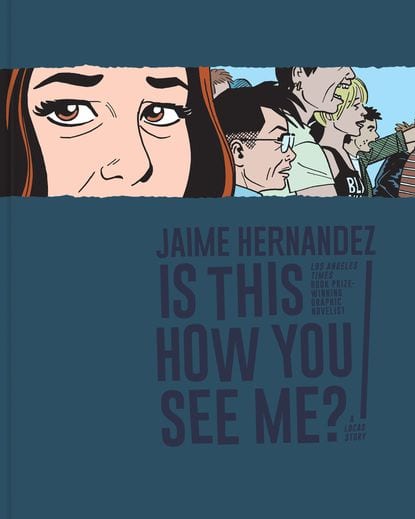
Is This How You See Me?

I've said it before and I'll say it again: Jaime Hernandez is one of my favorite comics makers ever, and I don't know how he keeps topping himself, but he's done it again. Is This How You See Me? is a book about a reunion. The Locas, characters Hernandez has been writing about since the early 1980s all convene 30 years later for a special concert of their old favorites and some of the new Turks who were inspired by them. It also features old friends and acquaintances coming back together, some happily and others not so much. What is phenomenal to me is just how vibrant and complex a quilt Hernandez weaves in a relatively short space in this book.

All of the major players here have aged, most have mellowed, and it is interesting to see how their lives have shifted over time. Of course, this book focuses much of the time on Maggie and Hopey, the on-again, off-again friends and lovers who were the primary focus of the classic Locas tales. Their adventures have always featured lots of personal drama and upheaval, and it is fascinating to see how that still plays out 30 years later.
This book features a lot of juxtaposition. It hops back in forth in time to show characters then and now. It shows what the folks at the reunion are up to while also showing what their significant others are doing while left at home. And although a few things remain relatively the same, it shows the ocean changes the exist between then and now. Perhaps most strikingly for me was the difference between the sorts of trouble Maggie and Hopey can get into to. Their past run-ins with punks and drug dealers seemed almost quaint and fun next to the two episodes of hate they run into in the present, which were full of menace and danger.

One of the strong points is just how iconic and potent the illustrations are. Hernandez has honed his craft over the decades to be able to capture an emotion or deliver a visual zinger in economical fashion. There were multiple times I found myself poring back over pages to admire his characters and how he brings them to life via his artwork.

Another of the strongest parts of this book for me was its dialogue. There are a number of big crowd scenes where people are watching shows, catching up, or hanging out late night in diners, and their conversations are mundane, silly, pointed, and sometimes poignant. I know that comics work best when there is a playful, intentional interplay between the images and the words, and Hernandez shows he is a maestro of drawing, writing, and also marrying the two.

I feel that I have a difficult time doing this book justice, because it does so much. It delivers quality slice-of-life type tales while also showing what happens across a lifespan. It is funny, sometimes sad, and very rewarding. There are lots of pay-offs for longtime Love & Rockets readers but also quite enough context to entertain and engage those new to this universe. I cannot recommend this book enough.

The reviews I have read of this book have been glowing. Edwin Turner wrote, "It's fascinating too to see how naturally Hernandez has realized the aging of his characters, as if they were not drawings on a page, but rather real people." In a starred review, Publishers Weekly concluded, "While longtime fans will discover extra levels of joy and regret in this installment, even those who pick this up as their introduction to the series will be moved by its tale of growing older without necessarily growing up." Hernandez speaks about his work on this book in this interview.

Is This How You See Me? was published by Fantagraphics, and they provide a preview and much more here. It features profanity, some violence, and sexual content, so it is recommended for readers mature enough to handle those things.

Wednesday, January 30, 2019

Can't We Talk About Something More Pleasant?

A National Book Award Finalist and New York Times Bestseller, Can't We Talk About Something More Pleasant? is a celebrated memoir by long-time New Yorker cartoonist Roz Chast, where she chronicles the final years of her parents' lives and how she came to care for them. Chast is very candid and frank about her relationships with both parents, and she was very eager to get out of their home as soon as she was able (going to college at age 16) and they seemed very much interested in maintaining their bubble. Her parents Elizabeth and George were married while in their 20s and lived in the same apartment for more than 40 years. Both were public school educators, and she was the more vocal and aggressive of the two, a vice-principal, while he was more introverted and docile, a French teacher. They were constant companions, taking care of each other and maintaining routines that masked their eventual aging and individual health declines.
Endearing, funny, and also eventually troubling.
Eventually, when they were in their 90s, life began catching up with them. When Elizabeth had a bad fall Chast realized that they needed assistance. At first, this entailed less invasive practices, like utilizing Meals on Wheels and regular check-ins. But eventually, matters grew more dire, and they had to enter into old age facilities that could offer medical and other services. Not only did Chast have to contend with her parents' aging but also their changing mental states, their growing medical needs, legal/financial concerns, and the costs of providing help without the benefit of insurance. This book is impressive in multiple ways: It is informative about the processes of taking care of older people, personal in how it portrays the Chast family and its dynamics, and darkly funny with Roz Chast's particularly witty and idiosyncratic voice. This book is a powerful read, simultaneously moving, heart-breaking, and eye-opening.

Roz Chast has a long career in cartooning and comics, with multiple collections of her New Yorker work available in book form as well as her latest graphic novel memoir Going Into Town. She speaks about her experiences and work on Can't We Talk About Something More Pleasant? in this interview.

This book is much lauded and has been heaped with praise and accolades. In its starred review Kirkus Reviews concluded, "A top-notch graphic memoir that adds a whole new dimension to readers’ appreciation of Chast and her work." In another starred review Publishers Weekly called it "a cartoon memoir to laugh and cry, and heal, with—Roz Chast’s masterpiece." Alex Witchel closed his review with these lines, "No one has perfect parents and no one can write a perfect book about her relationship to them. But Chast has come close."

Can't We Talk About Something More Pleasant? was published by Bloomsbury, and they offer a reading guide and more info about it here.

Saturday, December 15, 2018

I Am Young

I Am Young is a dazzling collection of short stories that use music as a springboard to explore people's relationships to others and themselves. It features one larger narrative that is broken up throughout the book. That story is about Miriam and George, who meet at a Beatles concert in the 1960s and fall in love. Their relationship does not really work out, though they do check in with each other from time to time over the span of decades, sort of When Harry Met Sally-style, but (SPOILER) without the happy ending. The Beatles are a backdrop to their interactions, as they check in after pivotal events such as John Lennon's assassination and George Harrison's death. The story is presented in black in white in a "big eye" cartoon style, and I love how these comics feature both characters' voices in letters to each other that appear on the top and bottom of each page. I think this format requires going back and looking at these pages multiple times, but I feel that it was very rewarding to do so.

Other stories in this book appear in color and in slightly different styles. They center on other characters and they music they listen to, but I feel thematically they are linked by issues of longing, searching for one's place in the world, and also exploring life in general. In "Baby Fat" a young woman named Roberta marries her friend Pepe in order to get him a draft deferment. For him, it involves no romance, but she wants something more out of it that does not deliver. For both, the relationship does not play out as expected.
"K.M. & R.P. & MCMLXXI (1971)" is about two young women in high school who bond over Tom Jones, Camus, and literature. Both strive to be novelists one day, but there are some strains and anxieties about life after school that drive a wedge into their friendship.
"Nana" depicts an exchange between two high school teenagers who are into The Carpenters. Even though they share a love for that group, they are divided by social status, as one girl is very popular and the other more marginalized. I loved how this story in particular represented how music can play a part in joining and dividing people.
"Alvin" is set in the 1980s and is about an African-American, teen-aged boy who is into Chuck Berry. He is able to intellectualize his fandom and speak against why it's not inherently nostalgic, but even though he is into rock-and-roll, he is still out of touch with his peers. The reasons why seem partly to lie in racial terms, and the complex ways that a person can find himself separated from others while employing a strong sense of identity are both fascinating to watch in terms of character and more social considerations.
I Am Young simultaneously does two things well: it made me think about people's situations and searches for identity, and it also moved me with their emotional states. I loved this book by M. Dean, and it is a strong and welcome introduction to her comics. She was the first recipient of the Creators for Creators grant, and she also created the webcomics The Girl Who Flew Away and Coming Soon: Regents Walk.

All the reviews I have read of this book have been positive. Publishers Weekly gave it a starred review that concluded, "This stunning debut pulls off the rare feat of drawing about music with authenticity and charm." John Seven wrote about its complexities, noting, "It’s not a depiction of the importance of music in young folks, but an examination of its place in young identity and relationships." Etelka Lehoczky was lukewarm about some of these stories but impressed with M. Dean's art and concluded, "This book about the past makes you wonder what its author will do next." Derek and I also discussed this book on a recent episode of the Comics Alternative podcast.

I Am Young was published by Fantagraphics, and they offer a preview and more here.

A preview copy was provided by the publisher.

Monday, August 10, 2015

Tim Ginger

I think if there is any question that we are living in a great age for graphic novels, Tim Ginger would settle it. This beautiful, spare, idiosyncratic  book is unlike other graphic novels I have read, with a pretty singular subject and wonderful execution. It focuses on the life of an ex-test pilot living out in the desert after being widowed. He leaves this sanctuary to go on a book signing tour where he encounters a persistent conspiracy theorist who keeps asking him questions and an old friend who brings back lots of buried feelings and remorse.
All of these interactions are prelude to contemplations of life, marriage, family, legacies, love, and keeping secrets. Additionally, his old friend is a potential old flame who has written a book of comics about people who decided to not have children, which is excerpted throughout, adding a meta-commentary to the proceedings. I feel the entire narrative is mature and nuanced, aided by expert storytelling that is effective at simultaneously being evocative and subtle while also incorporating some flights of fancy.

I feel that the artwork is appropriately stylized so that feelings are as muted as the coloring, and overall I was quite moved by what I read. I cannot see this book being of much interest to younger readers, but I feel that it is an excellent meditation on life, love, and finding one's place in the world.

Award winning artist Julian Hanshaw created this volume. He is from the UK and is known for his prior two graphic novels The Art of Pho (also available as a motion comic) and I'm Never Coming Back. Tim Ginger is his US debut, and he speaks at length about its creation in this article.

All of the reviews I have read about this book have been full of praise. Joe Gordon called it "a hugely satisfying, maturely emotional work, which gets under your skin in a quiet, calm, gentle manner." Neil Bason praised it as "deeply moving, brilliantly witty, and wonderfully written." Chris White wrote, "The story of Tim Ginger will stay with me for some time, thanks to the great writing and artwork—take a chance on this smart, funny and emotional indie comic and thank me later."

Tim Ginger was published by Top Shelf, and they provide a preview and more here.

Saturday, August 10, 2013

Mid-Life


Like We Can Fix It!, this book is also combines elements of fiction and autobiography. It stars Joe Ollmann, an art director and cartoonist who has published two prior books, Chewing on Tinfoil and This Will All End in Tears. He has also done a short series of autobiographical comics posted at The Comics Journal. He has a blog where he posts various drawings and news, and he also has a site for his new book Science Fiction. He speaks extensively about Mid-Life and his career in these interviews, one with the Comics Reporter, the other at Robot 6.

The realistic bits in this book are that Joe has two adult-age daughters and a young son from a second marriage to a younger woman. Also, he worked as an art director for a magazine for a number of years. The rest of the bits are fictional flights of fancy or grotesque caricature. Consider how the author appears in a photo on the book jacket


compared to how he depicts himself in the book's only splash page illustration
Hey ladies!
The fictional version of younger Joe is caustic, full of vinegar


And age has mellowed him some

But still, he finds himself missing something in his life. That something seems to appear in the form of Sherry Smalls, a singer/children's performer who acts as the book's second narrator.

Sherry has her own set of problems. They include:
a troubled ex-boyfriend/bandmate who threatens her record deal,
a ticking biological clock,
and some boundary issues, particularly when it comes to older men.
When Joe hears Sherry's music on a promo CD, he is enchanted and becomes obsessed with her, looking up her information and past works. Then an opportunity to meet her arises and he seizes it, and of course sparks fly between these two troubled souls. Joe misrepresents himself to Sherry, and he is wracked with guilt on the front end of his "will he"/"won't he" dilemma


I found Mid-Life to be full of great observational humor, well defined characters and situations, and also grotesquely wonderful and visceral art. Ollmann's cartooning captures very real human thoughts and emotions, and even when things veer close to stereotypes and stock scenes they retain their own unique qualities. I very much enjoyed seeing the struggles and experiences of these characters, because the narratives and characterizations were so compellingly presented.

Reviews I have read of this book have been very positive. J. Caleb Mozzocco called it a "great" graphic novel, "deserving of that often meaningless and misapplied term." The Comic Journal's Tom De Haven wrote that "Ollmann has made a huge leap forward as a stylist and as a storyteller," and added that "Mid-Life is a major and wonderful piece of work." Publishers Weekly gave it a starred review and concluded, "Readers of any age who pick up this gem will find it impossible to put down."

Mid-Life is published by Drawn & Quarterly, and they provide a preview here.