Showing posts with label geography. Show all posts

Sunday, August 30, 2026

Globetrotters: Nellie Bly and Elizabeth Bisland's World Tour

There are so many graphic novels published every year, and I sometimes have a hard time keeping track of what is out there. Lately, I have been checking out books (literally, from my local library) that have been nominated for awards. Globetrotters was nominated for the Eisner Award in the Best Reality Based Work category, and it is a fantastic look at a unique moment in US (and world) history. Looking for a news story, reporter Nellie Bly was sponsored by the New York World to try to travel round trip to beat the fictional journey of Jules Verne's Around the World in Eighty Days

Seeing their own opportunity to make a sensation, The Cosmopolitan sponsored literary writer Elizabeth Bisland to do the same, only traveling west. This books adapts both of their published travelogues that documented their much publicized and ballyhooed journeys. Both faced many obstacles, from traveling solo as women, which was frowned upon, to weather, to tight scheduling. I won't spoil things for people who do not know the history, but I will say that both arrived back in under 80 days. 

The pluses of this book are that it is very compelling in terms of the plot, gorgeously drawn, and full of interesting facts. I felt that the alternating looks at Bly and Bisland's journeys made for good competitive drama that reflected that being drummed up in the publications of the time. The artwork is obviously well-researched and detailed, and it is also dynamic and expressive in ways that highlight characters' actions and emotions. Lastly, there is a good amount of exposition that helps give more context to the places they visit, especially in terms of geography, which I found helpful. I enjoyed reading this exceptional book very much.

Globetrotters was a collaboration between writer Julian Voloj and artist Julie Rocheleau. Voloj has worked on a number of graphic novels, including the biographies BasquiatThe Story of Joe Shuster, and Ghetto Brother. Rocheleau has drawn the Eisner-nominated books Wrath of Fantomas and About Betty's Boob.

The reviews I was able to locate about this book have been positive. Ian Keogh called it "well told, intended to shock and surprise anyone unaware of the story." Robert Greenberger wrote "Julie Rocheleau’s limited color palette and cartoony expressiveness bring the pulse-pounding race to life, nicely capturing the look and feel of this bygone era."

Globetrotters was published by Abrams ComicArts, and they offer a preview and more information about it here.

Local libraries rule! 

Friday, November 20, 2015

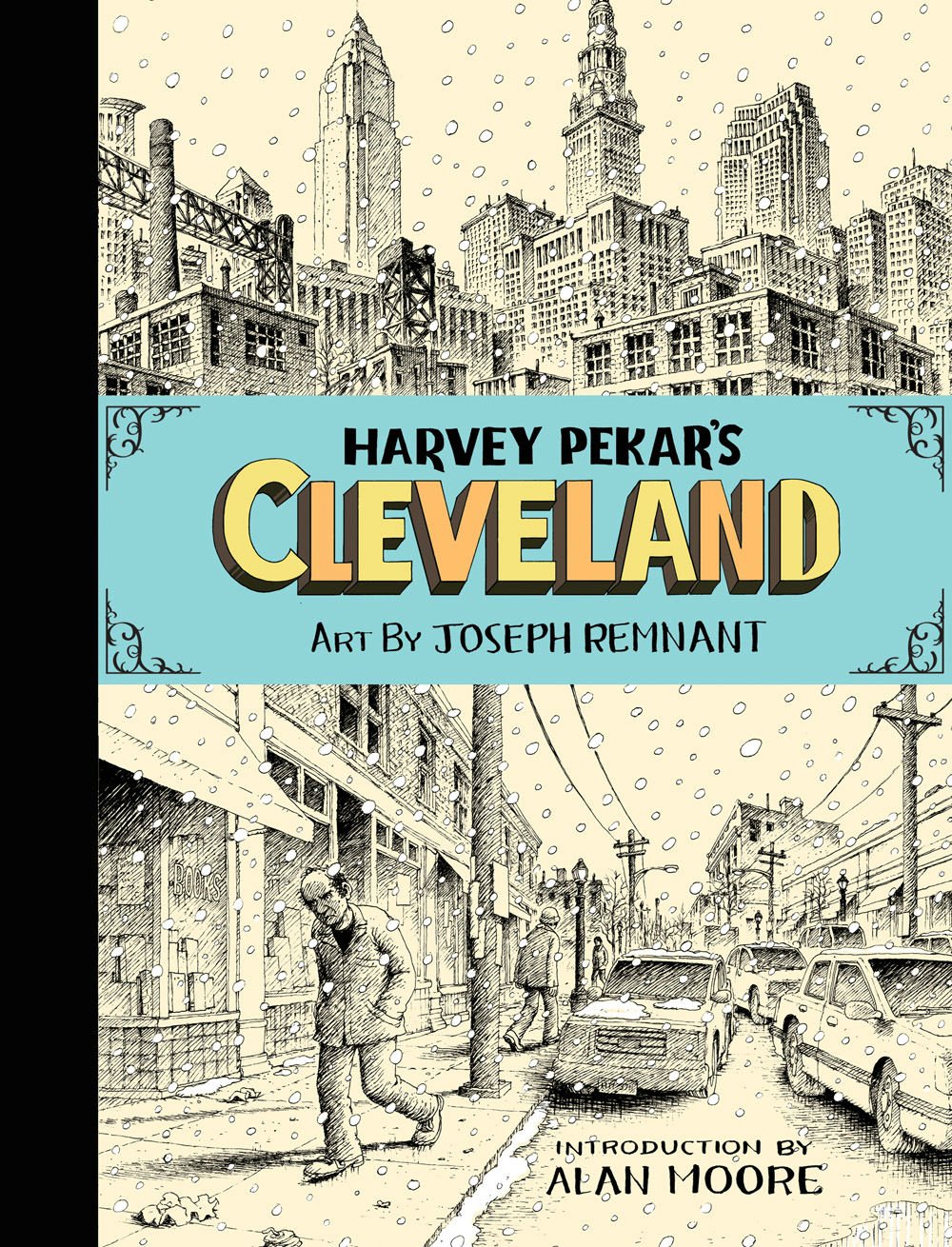
Harvey Pekar's Cleveland

Harvey Pekar was a pioneering colossus of autobiographical comics, and this was among his last books, a graphic history about the place that shaped him and his place in it. As a graphic novel, Harvey Pekar's Cleveland is not so much a novel as it is an epic tone poem that puts forth the personality of a city and a man. This is a pretty tough task to pull off, though I think that it does so with elan and economy.

I found this book very satisfying in terms of its methodical, informative text and illustrations. I sure learned a lot about Cleveland  in terms of its history, politicians, professional sports teams, notable figures, and architecture. Just check out the passage below. What can be seen as mundane or boring is elevated through the art to being more a celebration and elegy.
Elegies are about the dead, and although Cleveland is a hard luck sort of town with an inferiority complex, there seems to be a ray of hope for it here. Or maybe that is the personality projected on it by one of its more famous denizens, Pekar. He inserts his own story into that of the city, mingling his views of the its social and economic history with his own. What could have been a cold, academic look at an urban place then becomes an exploration of a personal relationship, in terms of economics, ethnicity, and race relations. And a place marked by failures occasionally has the opportunity to surprise and shine, like the 1948 Indians. Or as in the excerpt that follows, in enjoyng a little bit of heaven in the form of a chocolate malt:
The specific references and beats that this graphic novel hits give it a lot of heart and fodder for thought. Part of the reason for its success is the tone and tenor of the author, but much of it also lies at the feet of the artist Joseph Remnant. His artwork reminds me of Little Orphan Annie's Harold Gray crossed with the etchings of Albrecht Dürer. The artwork is realistic to a point, with a few cartoonish exaggerations, but the cross hatching and shadows cast the illustrations as little pieces of history or pageantry. I love how it makes some really ordinary scenes seem monumental or lends a sense of drama with a strategically rendered glance or furrowed brow.

All of the reviews I have read about this book have been full of praise. Publishers Weekly gave it a starred review and called it "a must-have volume." Kim Deitch referred to it as "a fabulous kaleidoscope of people, places and things, but never loses sight of its primary objective: to tell about and make a case for that much maligned city, Cleveland, Ohio."

Harvey Pekar's Cleveland was published by Top Shelf, and they have a preview and more information available here.

Friday, June 20, 2014

Shackleton: Antarctic Odyssey


Ernest Shackleton was a British explorer who made multiple forays to Antarctica during what was called The Heroic Age of Antarctic Exploration. Many of the journeys he was a part of were historically significant, and the one chronicled in this book, the Imperial Trans-Antarctica Expedition, is considered the final journey in that Heroic Age. It is a harrowing tale of survival, with men facing adversity and life-threatening conditions in the pursuit of traversing the southern continent. This book presents various episodes in the trek, some technical and others very personal. It is an excellent balance of human drama and historical documentary.
History + fart joke = Awesome
The artwork is expressive, informative, and extremely expert in terms of its storytelling. Sometimes the characters blend together, but just marvel at how much gets packed into this two-page spread that opens the book, summing up what has transpired before these events:


The full array of tools available to sequential artists and graphic novel readers are on display here.

Author/artist Nick Bertozzi is an accomplished graphic novelist who has created a number of excellent nonfiction works, including Houdini: The Handcuff King, Jerusalem, and Lewis & Clark. He also created the historical fantasy romp, The Salon, and recently published a collection of his webcomic, Persimmon Cup. He speaks more about his many works in this interview.

Reviews I have read have been very positive. Publishers Weekly summed up a starred review, "A must-read for history buffs and fans of cinema-quality visual storytelling alike." In another starred review, Kirkus Reviews called it "A top-shelf rendition of one of the greatest survival stories to come out of the Age of Exploration." Kendal Stegmann wrote, "Even though the illustrations are fairly simple and in black and white, they are able to tell a very interesting and intense story." Barbara Basbanes Richter added, "Bertozzi’s black and white illustrations overflow with visual detail while creating a solid and engaging story."

A preview and much more are available here from the publisher First Second.

Thank you, Gina, for the review copy!


Saturday, November 10, 2012

Burma Chronicles


This is the third travelogue from Guy Delisle, an illustrator and animator who travels the globe for work and also to accompany his wife who is involved in Doctors without Borders. Thus, he gets around to some very interesting places. He is a Canadian and his primary language, as you can tell from his blog, is French.

This is his most best, most insightful book to me, as it delves into the political milieu in Myanmar as it relates to Doctors without Borders much more than the others. There is much discussion about whether the organization can operate in this country independently in ways that treat those in need or if it is being turned into an instrument of the state that openly discriminates against those the dictatorial regime deems enemies. Added to this political dilemma is the fact that Delisle is for the first time in a country along with his infant son, placing him in everyday contexts and allowing him to see the social conditions as both a citizen and a parent.

Reviews I have read about the book have been very positive. The Guardian's Rory MacLean praised the book, calling it "the most enlightening and insightful book on Burma in years," and adding, "The key to its success are Delisle's whimsical, black-and-white drawings, as well as his endearingly naïve and humorous self-portrait. Together his honesty and minimal line disarm the reader, drawing him or her into Delisle's life, learning as he learns the truth about the struggle for survival under the generals." J. Caleb Mozzocco called Delisle's work "highly evocative minimalism," going on glowingly, "He’s spent a decade in animation, and it certainly shows in his command of the page, and the time and space the panels suggest upon it." Kirkus Reviews called the book an "insightful, illuminating memoir."

This book was published by Drawn and Quarterly. Some preview images and reference material for the book have been provided here by the author.

Friday, May 21, 2010

Shenzhen: A Travelogue from China

The second illustrated travelogue from Guy Delisle, Shenzhen is a record of the artist/animator's trip to the large Chinese city neighboring Hong Kong. Shenzhen is a growing metropolis that attracts many people looking for employment and opportunity, and Delisle was there for three months in the late 1990s to supervise a team of animators. Delisle's descriptions of the city are sometimes harsh, pointing out the filth and omnipresence of government propaganda, but they also include very human observations about local food, entertainment, and constant construction projects. One of the overwhelming feelings the reader gets from his accounts is that he felt pretty isolated and lonely in China.

As I noted in my entry on Pyongyang, Delisle is an illustrator and animator who travels the globe for his work and also to accompany his wife who is involved in Doctors without Borders, so he gets around to some very interesting places. He is a Canadian and his primary language, as you can tell from his blog, is French. This interview sheds some more light on Delisle's feelings on his trips to China and some of the decisions he made in creating this travelogue.

Shenzhen is generally well regarded, and it was nominated for a Wright Award for Best Book in 2007. Paul Karl Lukacs writes a thoughtful review of the book and also notes that he had very different experiences and that Shenzhen has undergone large changes since Delisle's time there. Renee, President and Publisher of Shen's Books, called it very realistic and felt Delisle's experiences were very similar to her own. Reviewer Danya David says that despite its flaws, Shenzhen is a "fast and interesting read" and suggests it may be a good addition to an 11th or 12th grade history or government class.

A preview is available from the publisher Drawn & Quarterly.

Monday, February 15, 2010

Pyongyang: A Journey in North Korea

Is creating a graphic novel worth getting blacklisted by an entire country? Guy Delisle might be a good person to ask. He is a French-Canadian animator who spent two months in 2001 (before 9/11) supervising animation work out-sourced to North Korea. While there, he took notes on what he saw and experienced; these became the basis for this graphic travelogue. Apparently the fruits of his labors are not much appreciated by the current regime.

This result may not be so surprising given that Delisle does not paint a positive picture of North Korea in general, and of its capital city Pyongyang specifically. His response may be best understood via his situation there. Sequestered in a lightly inhabited hotel with limited dining options, Delisle was not allowed to travel without an accompanying guide. When he did get to travel, he was constantly confronted by bleak, spare surroundings, omnipresent images of Kim Jong-il and his father Kim Sung-il, and propaganda praising North Korea and decrying its capitalist enemies.

So he paints a depressing national portrait. Most of the North Korean people are shown being fed a constant stream of propaganda through images, song, and film. They are fearful not to say or do anything to appear critical of the state. Stores are full of huge quantities of the exact same items, with hardly any buyers. Electric lights are scarce; fresh fruits and vegetables are only made available when foreign dignitaries are present; there are no traffic lights, and entire sections of the city are kept off-limits. Also, half finished construction projects, including the colossal, 2-decade-old shell of the Ryugyong Hotel and a largely unused opera house, abound.

Delisle has worked as an animator for more than a decade, working in a number of Asian countries. His wife is an administrator for Médecins Sans Frontières (known as Doctors Without Borders in the US), a job that has led to their family living in a number of different countries. Delisle has turned these experiences into other illustrated travel stories, including volumes about China and Burma. This news story from the National Post and this interview with TimeOut Hong Kong shed more light on his reasons for creating these works.

Reviews about this book are a bit mixed. Some reviewers, like Gary Butler see it as a work of activism, giving voice to a people who live in fear and cannot speak for themselves. Andrew D. Arnold speaks about how he is glad to see light shined on a country shrouded in secrecy while being disappointed that Delisle did not delve into how this experience changed him or add any particular constructive insight into the exchange between cultures. This range of reviews from Goodreads goes further with criticisms, with some reviewers calling Delisle racist and condescending to the North Korean people.

Pyongyang was originally written in French but was published in English by Drawn & Quarterly. They publish periodic news updates about his work here. They also have an 8 page preview available in pdf format here.