Showing posts with label Japanese mythology. Show all posts

Monday, July 5, 2021

Chibi Usagi: Attack of the Heebie Chibis

I have read a great many Usagi Yojimbo comics in the past, and consider it one of the modern masterpieces of the medium. Its creator Stan Sakai is one of the greats, who has been awarded pretty much every accolade a living cartoonist can receive, and here he and his wife Julie collaborate on a slightly different version of his classic character. Drawn in a cuter, more cartoony chibi art style, this version seems pitched at a younger audience, but it's still enjoyable for pretty much any age. The artwork is adorable but not juvenile and coupled with a well-crafted plot, which incorporates a number of story elements, including individual character moments, slapstick, quests, and battles. This book offers something for pretty much any reader. It does not talk down to its audience, and I got a big kick out of reading it.

The narrative here focuses on a trio of adventurers, Usagi, Gen, and Tomoe, who are out fishing for unagi (freshwater eels) when they rescue a creature in distress. The creature is an animated clay figure named Dogu, and it tells the trio that it has escaped from slave labor from the nefarious Salamander King. That villainous creature has captured Dogu's people and forced them to do his bidding, and of course our three heroes embark to free the village and defeat the Salamander King's army. This mission is fraught with peril, including shaky bridges, meandering forests, and the titular Heebie Chibis.

This story works well as a straight adventure story, but it also features strong characters who are almost instantly related to the readers as well as snappy dialogue. The situations themselves are based on traditional Japanese folklore, which are explained further in  the end sections of the book. It is fascinating to see how well the detailed fictional world depicted here matches up with real life creatures, creations, and beliefs. In addition, there is a short story at the end of the book where the usual version of Usagi Yojimbo meets the Chibi version, which not only works as a stand-alone tale but may also be a great gateway into the further adventures of the rabbit samurai.

This book is one of the best kids of all-ages fiction in the best sense of the world. I think its potential audience is a vast one, and I hope that this book sells bazillions of copies.

All of the reviews I have read of this book have been positive. Ingrid Lind-Jahn wrote, "It’s an adventure story that has plenty of danger without being overly scary and emphasizes positives like friendship by example rather than explanation." Pharaoh Miles called it "an exciting story that any fan of any age can get into" and "easily the most accessible story involving this enigmatic protagonist."

Chibi Usagi: Attack of the Heebie Chibis was published by IDW Publishing, and they offer more information about it here.

Monday, May 10, 2021

Tono Monogatari

The original version of Tono Monogatari was published in 1910 by folklorists Kunio Yanagita and Kizen Sasaki, recording a number of folk stories from the Tono region of Japan.These tales feature all sorts of creatures, including yōkai, unpredictable spirits that haunt the wilderness, and kami, which are minor deities that frequently wreak havoc on people's lives. These tales are also significant in that they are roughly the equivalent of the Brother Grimm's fairy tales, a record of the folklore of a particular country. 

The stories adapted here are often unsettling, creepy, and/or weird. Many of them have the flavor of a spooky campfire tale, and they often end abruptly without a moral or lesson. A couple also contain sexual imagery, so I would curate this book if I were using it with younger readers. The ones that stuck with me included a few accounts of women being kidnapped to be spirit brides, one where a fisherman murders a fox that was impersonating his wife, one where a man is blessed with a grinder that turns rice to gold, and another where a young woman is hounded by a yama haha, a spirit that resembles a large, old woman. In all there are 119 stories in this book, arranged thematically, so you can read them in bunches or take your time to enjoy them individually.

The artwork in this book is also a highlight. The backgrounds and landscapes are drawn in highly realistic fashion, and there are a few breath-taking double page spreads. The characters who inhabit these stories are more cartoonish and caricatures, especially the male ones. The various supernatural creatures are appropriately gruesome and fantastical. All in all, I think there is a great sense of joy and craftsmanship in this book. It seems a project completed in love.

This book's creator Shigeru Mizuki was an artist and historian best known for creating the series GeGeGe no Kitarō. It began in 1960 and starred a yōkai named Kitaro and told many supernaturally themed tales. It was wildly popular and has been adapted many times as anime and movies. In a fun, metafictional move, he inserts himself into the book as a character who is visiting the region, tracing the footsteps of his forbears and even having a ghostly conversation with original author Kunio Yanagita.

There are a few color pages among the B&W.

This book was translated into English by Zack Davisson, a translator, writer, lecturer, and scholar of manga, Japanese folklore, and ghosts. He has translated a number of Mizuki's works, including the Eisner Award-winning Showa: A History of Japan. He provides some prose to help contextualize the mythological and cultural features of these stories, which is a very helpful and informative feature.

All of the reviews I have read about this book have been positive. Alison Fincher called it "a culturally-important celebration of an enduring work of literature presented by one of Japan’s greatest popular artists." Rebecca Silverman wrote, "The art is beautiful, and as always makes use of Mizuki's trademark style of cartoony people on photorealistic backgrounds." Publishers Weekly concluded, "The acrobatic visuals lend these fables a giddy charm, and the inviting collection opens up Japanese history for a broader readership."

Tono Monogatari was published in the North America by Drawn & Quarterly, and they offer a preview and more here.

Tuesday, October 30, 2018

Usagi Yojimbo: Yokai

I wrote about my love of Usagi Yojimbo comics in the past, and I felt that this stand-alone graphic novel would be a great one to promote for reading around Halloween time. It was published to celebrate the 25th anniversary of Usagi's creation, and it tells a different kind of ghost story, one where the rabbit ronin finds himself in the middle of a forest and comes upon a weeping mother. Her child has been kidnapped by a fox spirit and she begs Usagi for help. Against his better judgment, he agrees to help, even though he knows his swords may be no help against a supernatural enemy.

It turns out that Usagi's instincts were spot on. This kidnapping is only one act in a series of appearances by yokai, Japanese spirits/monsters who are congregating in an evil plot to bring the witch queen into the human world. Usagi is certainly over his head here, but assistance arrives in his ally Sasuke the Demon Queller. However, both learn that dealing with these treacherous creatures is extremely hazardous, as they are incredibly underhanded and tricky.

This book's creator Stan Sakai is a multi-Eisner Award winning artist and letterer who is best known for creating Usagi Yojimbo as well as his work on the independent comic book series Groo. He speaks extensively about his career as well as his work on this graphic novel, which consists entirely of painted images, in this interview.

All the reviews I have read about this book sing its praises. Publishers Weekly gave it a starred review, calling it "a genuine pleasure for readers of all ages." The review in Rolling Stone India stated that the watercolors gave "the story a Miyazaki-esque feel that wows you right from the first page." The reviewer at Reading for Sanity wrote that it featured "a lovely blend of humor mixed with drama."

Usagi Yojimbo: Yokai was published by Dark Horse Comics, and they have a preview and more here.

Sunday, July 30, 2017

The Usagi Yojimbo Saga, Books 1 & 2

Today I am writing about two books that contain more than 600 pages of comics each following a creator-owned character that originated in 1984.
I have read the adventures of Usagi Yojimbo before, mostly because his creator Stan Sakai worked on a ton of Groo comic books I read when I was a kid. But it has been years since I have checked in on him. Luckily, Comixology Unlimited has the first two books of The Usagi Yojimbo Saga available to borrow, and I got to read a great many of these wonderful stories over the past few weeks.

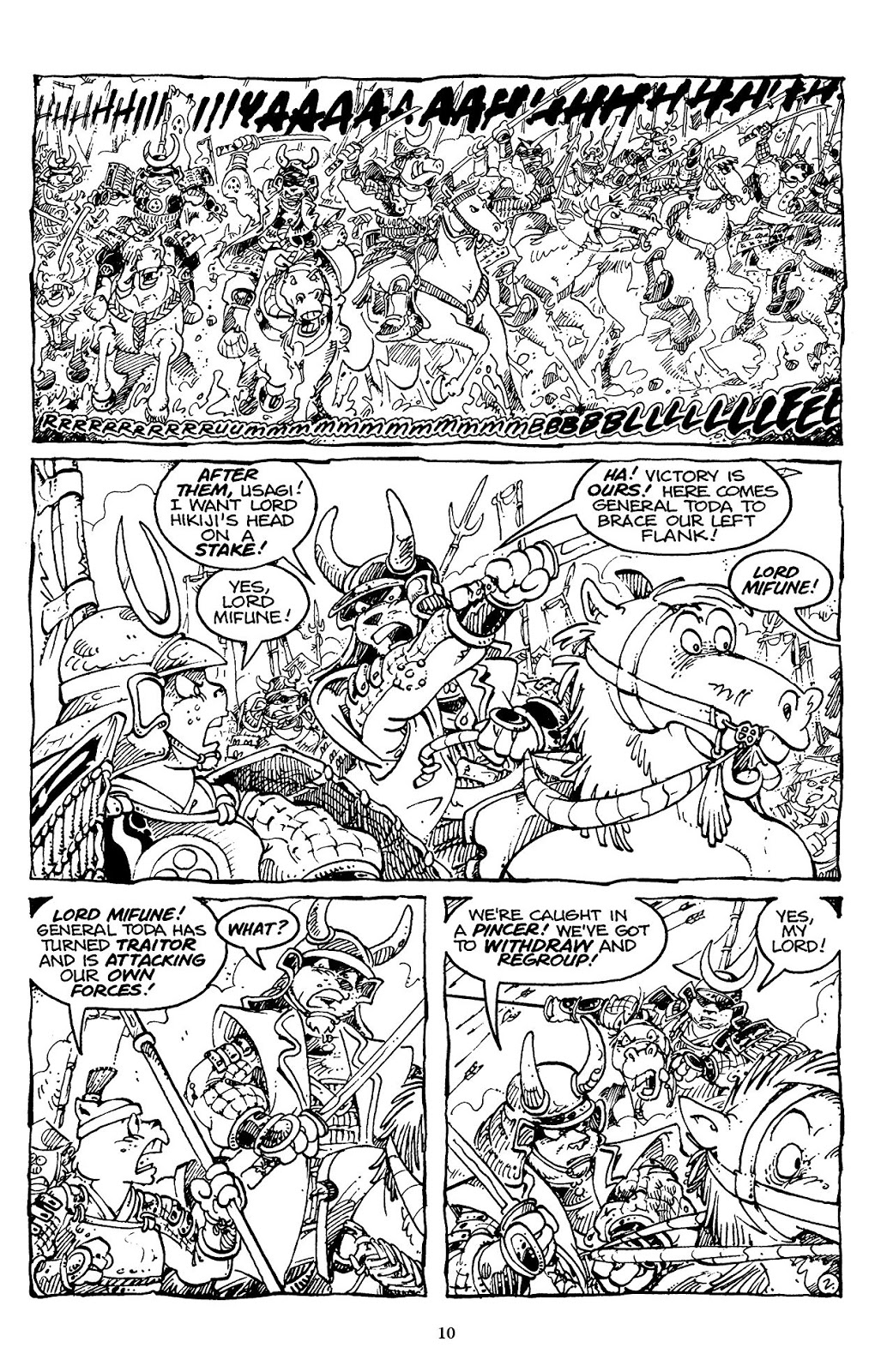
The plot mainly follows Miyamoto Usagi, a samurai living in 17th century Japan (during the Edo Period) who has lost his master and now wanders the road alone. He has a code of ethics, and he seeks to help those in need and often finds himself embroiled in interesting situations. What I find most impressive about this series, it features "funny animals" but they are some of the most human and evocative comics I have ever read. Sakai is masterful at creating tense situations and full characterizations in very short order. His artwork is impressively detailed and smooth, and the economy of his storytelling is superlative. He can portray small scenes of poignancy equally as well as large scale battles. Just check out this preview:


The tales in these books range from one-page gags to multi-page episodes to one multi-chapter epic (called "The Grasscutter"). I was shocked and amazed to see how much material was incorporated from all these disparate episodes into one long narrative in Book Two. The scope and scale of the world-building here is nothing short of remarkable. I feel that these books are masterpieces of comics, and what is more they are accessible for readers of almost any age. And apparently I am not in the minority here, as "The Grasscutter" stories won one of Sakai's five Eisner Awards. If you read comics and have never read Usagi Yojimbo, you should make time to do so immediately.

You'll be glad you did.
The Usagi Yojimbo Saga was published by Dark Horse, and they have a preview and more info about the series here.

Sunday, December 30, 2012

Ichiro


This is a tough book to explain because it has a lot going on. Ichiro is a young son of a Japanese woman and American GI who finds himself in Japan for his mom's job. Unbeknownst to him, the move may be permanent, which bothers this lifelong New Yorker. Dealing with the change in geography as well as his father's death, Ichiro is helped acclimate by his grandfather, who shares with him a great many stories about Japanese and Chinese history and legend as well as about his own family.

That's about half of the book. The rest involves a plot with a mischievous, shape-shifting raccoon who takes the form of a tea pot and traveling to the spirit world where Ichiro sees the results of an on-going struggle between legendary figures Amaterasu, Lord Yoritomo, Hachiman, and Susano. This fictional war has overtones that mesh with the events of World War II and also the Iraq War, where Ichiro's father was killed.

Apparent from all I have described is that this book has plots within plots, and that its mix of fictional and real world concerns makes for an interesting presentation. Themes of loss, loyalty, betrayal, war, pride, and identity undulate like waves throughout. I felt this was a complex, thoughtful book that left me perplexed in places but also willing and eager to reflect and reread. I am not sure all this material coalesces in a satisfying manner, but this is certainly a book that begs to be read more than once.

This book's creator Ryan Inzana is a designer and illustrator whose work has appeared in advertisements and magazines. He has also produced two other graphic novels, Johnny Jihad, a fictional account inspired by John Walker Lindh and the Columbine shootings, and an adaptation of Stud Terkel's Working, written by Harvey Pekar. I thought his artwork and storytelling in Ichiro was strong, with good use of color and line. The size, format, and excellent paper quality also added to its luster. Inzana speaks about his work on this book in these two interviews.

Reviews I have read about Ichiro have been mixed, commenting on its strengths and drawbacks. The reviewer at Literary Treats "applaud[ed] his creative approach at tackling such a disturbing, emotional subject matter" and also added that this is a "great graphic novel for anyone who wants to learn more about Japan, or about the Japanese side of World War II history." In a lukewarm review Infodad commented that this book "simply tries too hard to do too much – it has well-done moments but is not, as a whole, especially compelling."

Ichiro is published by Houghton Mifflin. There is a preview available at Amazon.