Showing posts with label surrealism. Show all posts

Friday, December 25, 2020

Eddie's Week

One of the highlights of every year for me has been the chance to go to HeroesCon in Charlotte to be a geek for a weekend, reconnect with friends, and check out a lot of excellent comics. Because of the birth of a child, I did not attend in 2019, and the 2020 con was cancelled because of COVID-19, so I have not been in a couple of years. But when I've been there I usually spend a good chunk of time hanging out with the author of Eddie's Week, Patrick Dean. Patrick lives near Athens, GA, and his strip Big Deal Comics was a fixture of the weekly Flagpole magazine. It was a weird, random, and hilarious comic where anything could and did happen, usually involving a ghost or a werewolf. During my time in Athens I got to know Patrick, too, through some mutual friends, and he is one of the kindest, sweetest, and funniest guys I know. His love for zany, old comics is palpable, as is his enthusiasm for making fun, inventive, and funny comics. Patrick was diagnosed with ALS in 2017, and he has not stopped drawing and fighting the good fight any way he can. His candor and dignity facing an impending decline has been inspirational and difficult to observe, though I admire his courage and marvel at the outpouring of love he has inspired from his friends and family.

Eddie's Week is the manifestation of all Patrick's attributes and abilities. Even ignoring the fact that the main character bears a strong resemblance to the author, reading this book feels like time well spent hanging out with my friend. This book's main character, Eddie Lubomir has a week off of work, which he intends to spend at home, watching cheesy movies and reading paperback novels. His plan gets complicated when he gets selected to take part in the Stay At Home Warden Project (S.A.H.W.P.) and has an inmate (complete with cell and nutritive food pellets) installed in his living room.

"The Backstabber" makes for interesting company, but Eddie's life becomes further complicated when he escapes. From there, Eddie runs into all sorts of strange characters, including a men's group who dress in bear suits, party magicians, a witch, vampire cops, and one very determined private investigator. The city of Tragoston is a weird and dark place. Every character in the book is vibrant and memorable, from the single-minded, oblivious head of S.A.H.W.P. to Eddie's ex-girlfriend Claire, who just can't seem to stay out of his business for too long.

What makes this book really work is its idiosyncratic sense of humor. This world is one parallel to ours, replete with a menagerie of supernatural characters that act in mundane, grounded ways. The surreal nature of the plot and characters has the net effect of a grim sort of humor, a world where magic is possible and always at war with the random caprice of bureaucracy. This book is unique, personal, and hilarious in parts, commenting on the stultifying aspects of the "real world" but finding solace in unexpected relationships. The situations that Eddie finds himself in are madcap but also realistic in their impact, which makes this comic a singular reading experience. I really felt for Eddie as he went through his travails, although I also found myself fascinated by and laughing at all the nutjobs in his life. This book is original, gripping, and invigorating.

The reviews I've read of this book have been celebratory. Publishers Weekly concluded, "Though the leap from oddball nightmare into straight magic takes proceedings in an unexpected direction, for the most part Dean delivers a winningly comedic scenario. The result runs like Kafka as interpreted by the Three Stooges." Eleanor Davis wrote, "I’ve laughed loud and hard every time I’ve read it, and I’ve read it four times – and I love how the big weird mess of a plot somehow, against all odds, brings all its threads together like some sort of magic trick." Patrick speaks more about his work on this book in this interview.

Eddie's Week was published by Birdcage Bottom Books, and they offer a preview and more here. 


Wednesday, August 5, 2020

Cankor

As you might can tell from the wordless cover, Cankor is an atypical book. It starts out in an auto-biographical mode, with the tale of a man (or mannish creature) going to a rock show, but then it goes into a very psychedelic direction. He has made some fan art to show the band but left it home, only to see it actually appear in the band's posters and merch.
Things only get stranger as the muscular fella on the cover, an android/cyborg named Cankor makes a ghostly appearance on the scene. Most of the rest of the book follows Cankor as he traverses worlds and dimensions, encountering beings large, small, and superheroic on his way. However, there are interspersed spaces where the autobiographical stories crop up. In all, this is a ethereal reading experience. Sort of like a contemporary version of 1970s Jim Starlin Marvel Comics like Adam Warlock. I won't say that they get so philosophical, but they do meld fantasy, fiction, and reality in interesting and compelling ways.
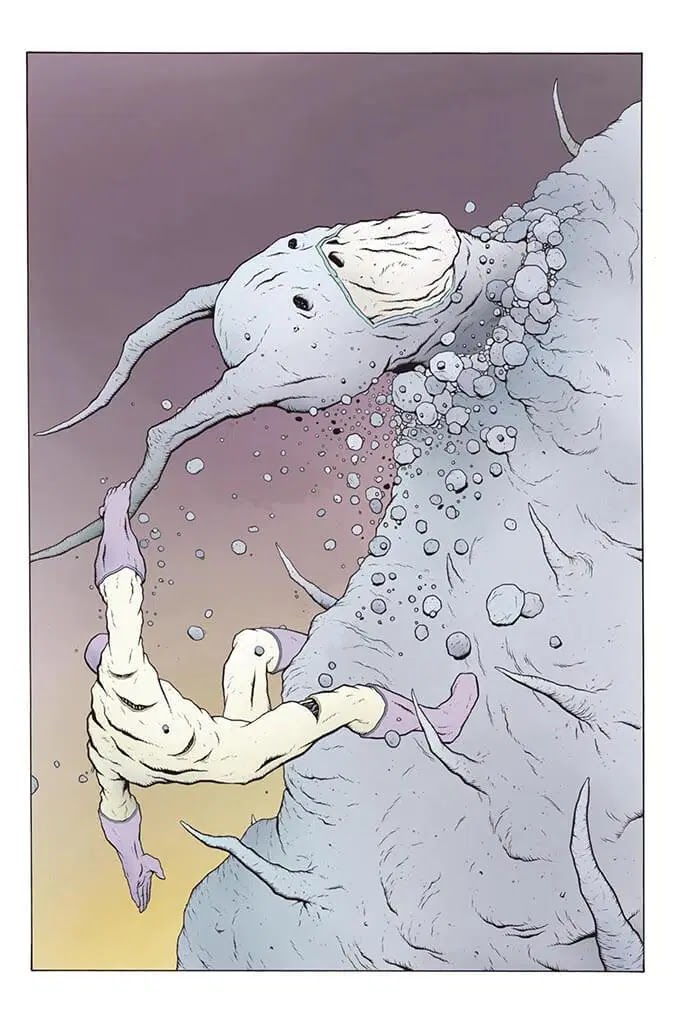
The artwork is a huge draw or this book. The minute details of circuitry and rock features are just part of what drew me into it. Too often I think I review books here and talk about their plots and characters, and I have been trying to focus more on the artwork and what it brings to the table. As you might can tell from my meandering description of the book's content in the first paragraph, this book is not so much plot driven as it is about sensory-perception and visuals. It is full of long sequences with no words, but the visual storytelling is utterly compelling and beguiling. The imagery is convoluted, complex, and as full of emotional energy as it is of enigmas.

I had not encountered artist Matthew Allison's work before now, but I will definitely be checking out some more of it after reading this book. As far as I can tell, he has largely been doing comics covers and self-publishing Cankor and a horror book called Sweet Sepulchre! I have really enjoyed checking out his Instagram feed for some of his commissions and other art. He speaks about his work on Cankor in this interview.

All of the reviews I have read of this book have been positive and mention its idiosyncrasies. Alisha Weinberger wrote, "The art of Cankor is deeply disturbing and nauseating. And I say this with love and admiration." David Charles Bitterbaum called it a "fantastically bizarre work." There are more reviews at Goodreads, where the book currently has a 4 (out of 5) star rating.

Cankor was published by Adhouse Books, and they offer a preview and more here. This book features some profanity and violence, so I suggest it for mature readers.

Thursday, July 30, 2020

Cryptoid

Cryptoid features some wonderfully weird comics presented in a stream-of-consciousness style. The stories begin with a looming figure that resembles a Celestial from Jack Kirby's The Eternals. As it surveys the Earth its gaze leads to the misadventures of the half-man, half-ankylosaurus Mankylosaurus (seen on the book cover) grazing at a salad bar, and later turn to a tangent on unknown species of bats that live among us.
Next comes a brief tale of a tortured man who is transformed into a gnome, followed by the adventures of The Resister, a woman/eagle creature who superheroicly fights for freedom, impaling Steve Bannon on a fence and vomiting fish guts at President Trump.
The enigmatic Nightsword's exploits then appear, with the heroic knightly figure slashing and dancing in reality-altering ways. Box, a robot, then comes on the scene to go shopping in a supermarket in his unique manner.
A giant monster then rises from the sea and begins crushing the Earth, when the Mankylosaurus and Celestial-looking being return and the story comes full-circle.

There is a surrealism I dig about these comics. None of the tales are very long, and some are played so seriously that they come off as silly, but they are all potent doses of comics goodness. I am not saying that this book is for everyone, but it boasts a great combination of artwork inspired by classic comics artists like Kirby and Wally Wood, a dash of contemporary social commentary, some good old fashioned ennui, monsters, strange juxtapositions, and frivolity. It's a memorable bit of inspired madness.

I am a big fan of this book's creator Eric Haven. His comics are memorable, leaving definite impressions with their powerful artwork and brevity. His stories do not wear out their welcomes. His narrative sensibilities and style remind me of Michael Kupperman's, though Haven is more action and genre oriented. He has a slew of comics under his belt, including Tales to Demolish and The Aviatrix (collected in Compulsive Comics) and his books Ur (nominated for an Eisner Award) and Vague Tales.

The reviews I have located about this book have been positive. Chris Gavaler called it "a hybrid graphic novella that belongs to no genre but his own." Ryan Carey wrote that "there’s no mistaking an Eric Haven comic for a comic made by anyone else, and even if his work largely amounts to variations on a theme, it’s a theme that stands up to constant and further exploration, definition, and expansion."

Cryptoid was published by Fantagraphics, and they provide a preview and more about it here.

Saturday, January 25, 2020

Giraffes on Horseback Salad

Today, I look at another book that is emblematic of the ways I feel Derek helped broaden my thinking and experiences with comics. Every month on the Comics Alternative, we would do an episode looking at the "back pages" of the Previews catalog, where the non-"Big 2" books were solicited. Now when we started, I had not read that catalog in a looooong time. I had relied on people with more intestinal fortitude than I (like Mike Sterling) to tell me about the highlights (or in his case, the "lowlights") that were listed. My unfamiliarity with the format of the catalog really showed. I wanted to talk about EVERYTHING that was in the book, even the resolicitations, because I did not readily catch on how it worked. That first show was very long as a result, and I think that Derek was very gracious about it even though I got from his tone that he must have been wondering what a newbie I was being.

Checking out the catalog on a regular basis really opened my eyes to the multiplicity of offerings and publishers out there. It also made me pretty aware of what was not listed, particularly as I also read a lot of comics and graphic novels from publishers in the book world that particularly cater to younger readers. Still, I really enjoyed doing my "homework" in poring over the catalog each month, and it was exciting to talk about books that caught our fancy, sort of like being a kid back in the day with a Sears catalog around the holidays.

Giraffes on Horseback Salad was one of the books that really leaped off the page for us when we saw it in Previews, as it hit on a few of our interests. It is a graphic novel based on a lost script by Salvador Dali (!) for a movie that was to star the Marx Brothers(!). A book from one of the great surrealist artists featuring comedic characters made famous in the early days of film seemed like one of the potentially perfect uses of comics, in my opinion. How else could something like this be created and communicated today? We were both really excited about this intriguing, unique book, gushing about it. Lo and behold a few months later, the publisher sent us review copies, one of the best benefits from doing our podcast. I was excited to talk about it with Derek, but, sadly, we never got the opportunity.
So, you might ask, does this amalgamation of ideas and artifacts work? Yes, and no. I have to say that it would be a tall order to pull off in the best of circumstances. Not every work translates well across media, and what is more collaborations between creators with larger-than-life personas don't always go well. What this book does well is tell the story in multiple aspects. There is an essay by Josh Stack about his research into the script and how he managed to locate drafts, scraps of artwork, and commentary that would be used to create this book. There are dramatized scenes of the meetings between Salvador Dali and Harpo Marx that base this work firmly in history and their biographies (bolstered by input and artifacts from Harpo's son Bill). Finally there is some insight into how the comedy scenes were fleshed out by contemporary comedian Tim Heidecker. This front matter is extremely rich, compelling, and intriguing, and I have to say that it forecasts a "movie" that is fun enough but does not live up to expectations (how could it though?).

In many ways, the story is a like a typical Marx Brothers movie, with clever quips, bad puns, and zany situations. In other ways, it is sort of academic with its conflict between a staid, soulless, and capitalistic type of living and a surreal lifestyle centered on art, experience, and sensation. The protagonist is a man named Jimmy, a stand-in for Dali but played by Harpo. He is a man of industry who works for the father of his beautiful but vapid and conniving fiancee Linda. He suddenly realizes that he is unfulfilled when he encounters the mysterious figure known as The Surreal Woman. She is malleable, made of various substances, exhibits different countenances, and apparently has the power to alter reality with her parties.
The effects of The Surreal Woman are one of the best features of the book, as they help highlight the abilities of artist Manuela Pertega. She is not so interested in depicting all of the characters realistically, but she makes sure we can tell who is who, and where she excels is in portraying scenes and layouts in ways that ape Dali's art. There are plenty of disembodied hands, viscous fluids, flaming giraffes, and serendipitous spatial arrangements. Seeing how she lays out pages and propels the reader through the narrative is a real treat. I may not have known what was going on all the time, but I sure enjoyed the ride.

I think what sort of hamstrung the book was mostly the main character, who was supposed to be played by Harpo, but seems like one of the least Harpo-characters I have ever seen. He seems too uptight and loquacious, and Harpo was more madcap and always silent. I just could not see this character take shape. Also, the story gets a little too metaphorical for my liking, and behind that is a saccharine ethos that I do not think really maps on well to a Marx Brothers movie, which is more about comedic chaos and mayhem. Still, it is an interesting experiment and a worthwhile read. Perhaps this "strangest movie never made" might not be the greatest graphic novel ever made, but it offers lots of great history and a fascinating diversion for fans of the surrealist artist and classic comedians.

This book was a collaboration between Josh Frank, Tim Heidecker, and Manuela Pertega. Frank is a producer and pop archaeologist who has written a few other books about popular culture and music. Heidecker is a comedian/writer/actor known for his various Tim and Eric collaborations. Pertega is an artist/illustrator, and this book is her first graphic novel. Frank speaks more about the work that went into making this book in this podcast round table.

The reviews I have read praise many parts of this book, even if they admit that as whole not utterly cohesive.  J. Caleb Mozzocco opined that "one needs some knowledge of, and at least some degree of affection for, the Marx Brothers and their film comedies to buttress the comic." Etelka Lehoczky wrote, "It may not be a good story, but Giraffes on Horseback Salad makes a good book." Marissa Moss stated, "The creative team behind this book have risen to the challenge and created something completely unique."

Giraffes on Horseback Salad was published by Quirk Books, and they offer more info about it here. There is also a website for the book, which features reviews, events, and lots of other goodies here.

The published provided a review copy.

Tuesday, July 25, 2017

Vague Tales

The joke is that there is nothing vague about Vague Tales. It's chock full of comics that will melt your face off. Actually, that is not true - it is more of a bunch of comics that comment about how such extreme experiences have become cliched and vacuous.

Much of Eric Haven's past work trucks with archetypal comic characters and settings, and this book is no different. The main narratives star a brooding, crystalline alien named Psylicon, an evil witch named Ruin, an apocalyptic barbarian named Pulsar, and a sorceress named Sorceress. And eventually, the stories all bleed into each other. Ruin attacks the Sorceress; Pulsar defends her; Pyslicon is mysteriously aloof but intercedes in an unexpected manner. The whole enterprise is reminiscent of old cartoons like Thundarr the Barbarian or Masters of the Universe, only skewed with a touch of absurd realism. Haven is obviously poking fun at these story and character conventions, but it is also apparent that he also enjoys them and takes great joy in casting his own stories using them.
 
Thinking, in the Mighty Marvel Manner!
And if this book were simply comprised of those adventures, I'd simply say it was some sort of parody or homage to that genre of comics. But there is also the hulking, angry blonde man featured on the cover, whose presence is almost entirely unrelated to the way-out adventures. This guy mostly stands or sits around his house, gazes out the window, or knocks back some drinks, until a weird thing happens toward the end of the book that places him directly in the action. I am not going to spoil it, but they change the tone of the story and make it more of a commentary on contemporary fandom and/or media.

In the end, I feel that this story is more an exploration of the constant drive for bigger, better, and more extreme experiences that abound in popular culture (in the USA anyhow). The culture is driven by more intricate and complex special effects, blockbuster movies, and innovative video games. The net result, I am extrapolating from Haven's tales here, is that each amped up moment in the end leaves people empty. Or maybe it is the nature of such escapism to leave people unfulfilled. Mostly, stuff gets blown up just for the hell of having a big explosion, narrative be damned. What is clear is that those grand moments lose any kind of nuance or impact, forgotten in short order. All is spectacle, and the chase for such experiences is ultimately fruitless. Or maybe that is the more intellectual way of looking at the book, and I should just appreciate it for being a bunch of fun, crazy stories and not look for anything deeper.

That I got this much out of a relatively short 75 pages is noteworthy in itself, speaking to the great craft that went into these various narratives. This book is beguiling, silly, confusing, thrilling, and fantastic. Like much of Haven's prior work, it is also impactful and unforgettable.

I have been a fan of Haven's for a while. I have read all of his works, including the series Tales to Demolish and his books The Aviatrix and Ur, which was nominated for an Eisner Award. His comics are short, distilled, potent pieces of storytelling. They are weird, provocative, and delightful. His art style here reminds me of a combination of Fletcher Hanks, Herr Seele, and Jim Starlin, full of wonder and weirdness. Also of note, aside from making comics he was a producer for the popular show Mythbusters, which may account for his relatively sparse publication record. Haven sheds much insight into his work in this interview.

I had a hard time locating any reviews of this book, but the one I did find was laudatory and thoughtful. Rob Clough wrote that these stories amount to "images of a man-child, and it seems that Haven is satirizing that tendency toward indulging this sort of infantile fantasy as much as he is celebrating it."

Vague Tales was published by Fantagraphics, and they have a preview and more information about it here.

Friday, January 20, 2017

Murder By Remote Control

Today I like to say that we are living in the "golden age of comics" because of the sheer volume of excellent material being published in so many genres and for so many different audiences. The key year in this transition (in the US at least)  is usually cited as 1986, when Watchmen, The Dark Knight Returns, and the first volume of Maus were published. The book I am reviewing today is an original graphic novel that predates those publications, and it had a difficult time finding a publisher in the US at the time. So I am glad to get to read and experience it today.

Murder By Remote Control may have been written more than 30 years ago, but it is still a fresh, interesting, and provocative book. The plot is about the murder of an oil tycoon in coastal Maine, an act perpetrated with a remote control airplane.
There are only four houses in the remote location, and the detective on the case, a trench coat-wearing Zen Buddhist named Jim Brady, employs some unorthodox tactics in his investigations. The suspects themselves are a motley bunch: a reclusive farmer, a former high-price call girl, a film star, and a gun-toting, paraplegic ex-criminal (pictured).
Far from progressing in a straight line, this investigation takes some weird turns into drug-trafficking, local corruption, as well as philosophical ponderings of America, sex, and popular culture. These narrative turns are also accompanied by beautiful and surreal splash pages full of portentous images that are just ripe for interpretation. I feel that all of it could easily go off the tracks, but the plot is well-paced and, more importantly, the artwork helps anchor the whole enterprise. Not only is it beautiful to behold, the style is realistic and done in the style of Wally Wood and Jim Steranko, two of the most revered and copped US comics artists.

Murder By Remote Control was created by Dutch writer Janwillem van de Wetering and US artist Paul Kirchner. Van de Wetering was a crime novelist whose work has often been called "off-beat." Kirchner has had a long career, drawing comics for Heavy Metal, multiple toy companies, and The Big Book of series. He also has been a toy designer and today works mainly in advertising. He speaks at length about this book in this interview. He speaks more about his career and specifically about this collaboration with van de Wetering in this interview.

The reviews I have read about this book have been positive. Win Wiacek called it "a delicious treat for the eyes and a therapeutic exercise for the mind." Gahan Wilson, in the original 1986 review, called it "an enjoyable entertainment that succeeds in demonstrating very effectively that this form of storytelling has a unique potential and can work a special kind of magic unavailable to any other medium."

This re-issue of Murder By Remote Control was published by Dover Publications, and they have more information about the book here. This book contains some nudity and sexual situations, so it is recommended for readers mature enough to handle both. This edition also has a couple of extra essays, one an introduction by Kirchner, the other an afterward by Steve Bissette, and I found both fun and informative to read.

Sunday, March 1, 2015

Happy Will Eisner Week, Day 1: Cochlea & Eustachia

This year's theme for Will Eisner Week is "Read a graphic novel." So in honor of this event, I am going to review a different graphic novel each day this week.

Will Eisner is credited with popularizing "graphic novel" as a term in his aim to publish (you can read more about the matter here). The legend is that he approached multiple publishers for his book A Contract with God and could not get his foot in the door saying he had a comic book for adults, so he shopped around a "graphic novel," and eventually he was successful. I am honoring his work to publish new forms with a look at a relatively new venue for publishing, webcomics. Cochlea and Eustachia is a author-produced work that was taken up and printed by a major alternative comics publisher, Fantagraphics.

Creator Hans Rickheit wrote on his website that this work "will be completely unencumbered by tempo, character development, plot, or logic." I would not go quite that far, but the adventures are pretty surreal, grotesque, and compelling. The book follows the exploits of two blonde females who wear domino masks, tops, and nothing else. Are they friends, sisters, or something else? I have no idea. But they are mischievous, not completely human, and they find themselves in mysterious circumstances. They are often pursued by weird creatures, like a mole-faced scientist or a giant chicken skeleton or a troublesome clone. The book has its own compelling logic, which thematically reminds me of a combination of Jim Woodring's dreamlike worlds and Phoebe Zeitgeist's random, titillating tribulations. 
 
 
Hans Rickheit is known for his prior work on the Xeric Award winning Chloe and his graphic novel, The Squirrel Machine. As you can see from the excerpt above, his art is full of clean lines and well rendered images. His balance of cartoon and reality makes his surreal stories even more affecting and disturbing.

The reviews of this book I have read tend to be on the positive side. Jason Sacks called it "a hauntingly lovely creation." Publishers Weekly summed up, "It’s deeply disturbing, and that’s just what was intended." Zack Hollwedel concluded his review, "The book won't be for everyone—in fact, it probably won't be for most—but this off-the-beaten-path tale fills a definite, albeit small, dark and fetishized niche."

This might not be a book for everyone, but its existence points to the grand result of Eisner's work, that today graphic novels of all sorts are being published. What was once a highly marginal text format now has much more status than ever before.

Cochlea and Eustachia continues as a webcomic. This edition was published by Fantagraphics, who have a preview and more here.