Showing posts with label fracking. Show all posts

Tuesday, April 20, 2021

Not A Place To Visit


Earth Day is coming up soon, and I could think of no better book to review at this time than this great collection of visual essays Not A Place To Visit. All of the works in these pages explore the environment and how people have transformed it (usually for the worse). All of these essays have some basis in the author's experiences, from his childhood in Colorado, when he lead a privileged life due to his parents both being employed by the petroleum industry.

To his later life when he takes on all sorts of jobs, including working on a paddlewheel cruise ship on the Columbia River, catering to wealthy tourists.

Among the many topics he covers in these essays are the effects of fracking, dams, earthquakes, and floods. He also looks at the impact of industry on the salmon population and California’s Salton Sea. The illustrations are straight-forward and bold, a combination of black & white and color images rendered in pencils. They suit the text passages very well, and both combine to convey a train of thought about how changes in the western United States reflect those in the entire country and also the world. 

All of these considerations have serious implications for the future of how people will have to adapt, but I also appreciated how the past is not shown to be simply "the good old days." Humans have always had some sort of impact on the Earth and its ecosystems, only that the affordances of contemporary technology have hastened and heightened these effects. Also, there are certain trajectories that are tied to capitalism, with those from lower SES groups feeling the brunt of pollution and environmental change. This book is not only informative, it is important for our potential future on Earth.

Not A Place to Visit was created by T. Edward Bak. He has created a number of comics over the past decades, with many appearing in prominent anthologies and sites like The Nib. He has also worked on a longer work, Wild Man, The Natural History of Georg Wilhelm Steller. He speaks about his many comics projects in this expansive interview.

The reviews I have read about this book have been positive. Publishers Weekly called it a "quiet but inspiring dispatch." John Seven wrote that he appreciated Bak's combination of commentary and science and opined that this book "is an excellent primer to where he might be headed and I hope he gets the chance to move further in that direction because I think comics could benefit from his voice." This book is currently rated 4.04 (out of 5) stars on Goodreads.

Not A Place To Visit was published by Floating World Comics, and they offer a preview and more info about it here. Bak also has a Patreon here.

Sunday, August 25, 2013

How to Fake a Moon Landing: The Truth Behind Science Denial


How to Fake a Moon Landing is a collection of essays about various topics having to do with scientific inquiry. It looks at issues of translating research into popular media and how conceptions and misconceptions are created. Lots of juicy topics are tackled, including climate change, the Apollo 11 moon landing, chiropractic, the MMR vaccine, fracking, and homeopathic cures. These essays are passionately argued, and well structured individually. The takedown of a certain Dr. Wakefield in regards to faulty research about connections between the MMR vaccine and autism is particularly thorough and eye-opening, but the rest are similarly compelling and well argued.

Still, after enjoying the author's last offering, Psychiatric Tales,so much, I felt let down by this book's lack of a framing sequence or explicit connections between essays save for two introductions. The former book was much more personal, and although this one is still well researched and presented, it smacks more of infotainment than it does of an aesthetic whole. As well argued as the essays are, they are separate entities that can be read entirely on their own. I would suggest taking one's time with this book and tackling each chapter over time, only because the topics vary and the essays do not hang together so well in a narrative sense. Still, the individual pieces are great examples of science reporting.

Author/illustrator Darryl Cunningham specializes in nonfiction comics, tackling diverse topics in his blog Darryl Cunningham Investigates. He primarily publishes online, but also has the aforementioned collection of his experiences as a health care assistant in a psychiatric facility. He speaks more about his work on this book in this interview with John Hogan as well as this one with Robot 6.

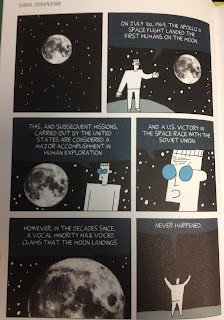
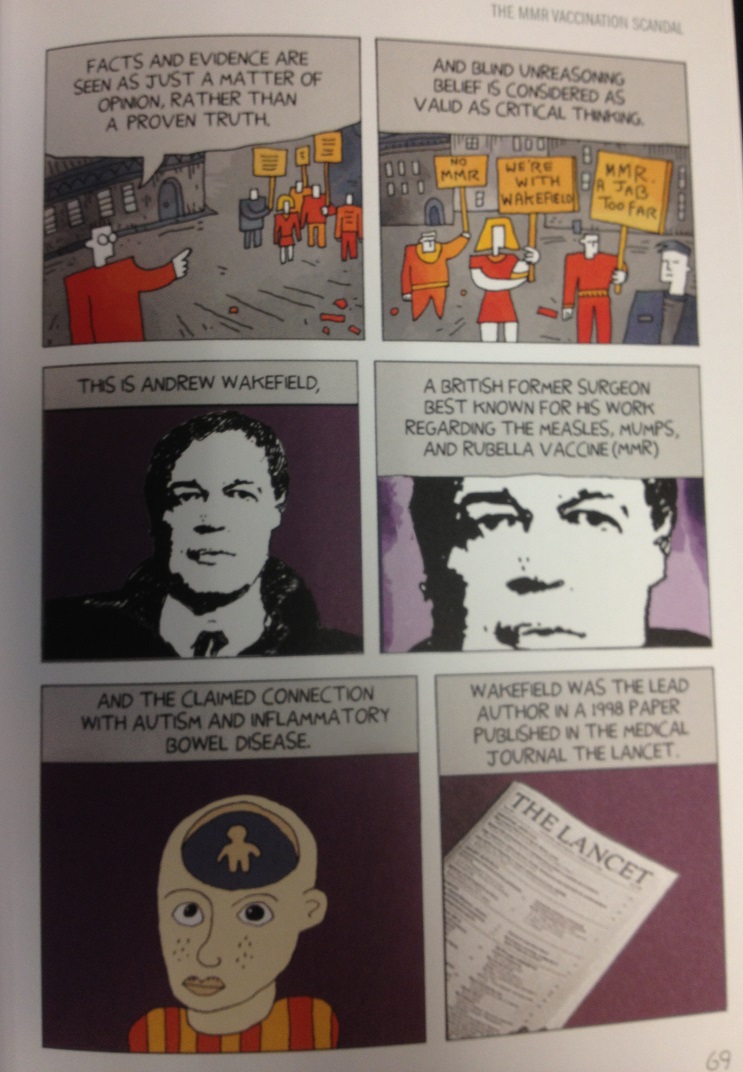
Cunningham's art is sturdy and straight-forward. I enjoyed his use of abstract stylized cartoons with occasional realistic, photographic drawings interspersed in the panels. His art is not flashy, but it does convey information and arguments in clear fashion. Here are a couple of different pages from the book that are characteristic of his style:

From the moon landing section.
From the MMR vaccine section.

Although it is certainly written from a particular point of view, the book is not overtly didactic in its intentions, pushing readers more to think for themselves than to accept simple accounts of events or situations. In these interests, Cunningham includes many sources for his essays in the back matter so readers can verify what he said or go off and do their own fact checking.

Reviews I have read of the book online range from positive to lukewarm. Robert Greenberger wrote, "Cunningham does a remarkable job with difficult material and for high school students, just opening their eyes to the world around them, this is a terrific primer." The reviewer at Geeks of Doom called it "fun and informative without being preachy." Nick Smith was slightly less enthusiastic, stating, "The artwork is cartoony, which may distract some readers from the serious nature of the information presented," but added,  "the book is readable by teens, if they’re interested in science."

How to Fake a Moon Landing is published by Abrams ComicArts. They offer a teaching guide and more here. Here is a short excerpt at Boing Boing.