Showing posts with label England. Show all posts

Thursday, October 20, 2022

Wake: The Hidden History of Women-Led Slave Revolts

Wake: The Hidden History of Women-Led Slave Revolts is a graphic novel that works on a number of levels, and I was gobsmacked by how much it affected it. One, it is a memoir by academic Rebecca Hall doing research for her dissertation projection. Two, it is an account of the facts of women's roles in slave revolts. Three, it contains a number of fictionalized accounts of the events concerning slave revolts, as very often there are no concrete records extent concerning women's involvement in them. Four, it is an exploration of how the institution of slavery still haunts and informs contemporary society. Five, it is enterprise that demonstrates how history gets defined and then redefined, and how this process has palpable effects on us all, whether acknowledged or not. It's a tour de force graphic novel that packs a wallop intellectually, aesthetically, and emotionally.

One especially affecting and effective trope in this book is a constant mirroring of the past and present in its imagery. A good part of the book takes place in New York City, and there are several panels and pages that show scenes from the 17th and 18th centuries and how they inform our present. Scenes of slave auctions push right up on images on contemporary Wall Street, juxtaposing the predominant business practices of both eras. The artwork by Hugo Martinez aptly emanates a rawness that highlights the horrific and dehumanizing social conditions depicted throughout the book. It is a difficult read in many ways, as it does not let anyone off the hook for their various roles in either perpetuating or trying to ignore grave injustices carried out over centuries. And the images touch many a nerve along the way.

In the end, I was amazed by the scope of this book. As an academic, I can appreciate the great effort and distress involved in doing this research and creating this account. As a reader, I was moved by the historical accounts and sheer horror of the depraved acts of slavery and racism. I was also moved by the bravery and perseverance of people who were enslaved and how they contended against their captors. As a citizen, I was distressed by how public institutions, including records clerks and companies like Lloyd's of London work to obscure and even protect past misdeeds. Additionally, I was struck by how Hall's background as a lawyer also informed insights into how the institution of slavery stripped people of basic humanity through legal codes. As a researcher, I can also appreciate just how frustrating it could be to delve into a topic where little to no historical record exists. This absence should be galling to us all in the present day.

Wake: The Hidden History of Women-Led Slave Revolts is an important, modern classic that belongs on library and classroom shelves as well as on syllabi. I am so glad that one of the students in the graphic novels class I am currently teaching selected it. I feel everyone should read it.

All of the reviews I have read of this book have been glowing. In a starred entry, Kirkus Reviews summed it up as "an urgent, brilliant work of historical excavation." Etelka Lehoczky called it a "remarkable blend of passion and fact, action and reflection," and added that "Wake sets a new standard for illustrating history." In a detailed and riveting review Jordan Alexander Stein wrote, "It pushes past the limits of what’s possible, to tell us a story that wasn’t but now can be."

Wake: The Hidden History of Women-Led Slave Revolts was published by Simon & Schuster, and they offer more information about it here.


Thursday, May 20, 2021

The Impending Blindness of Billie Scott

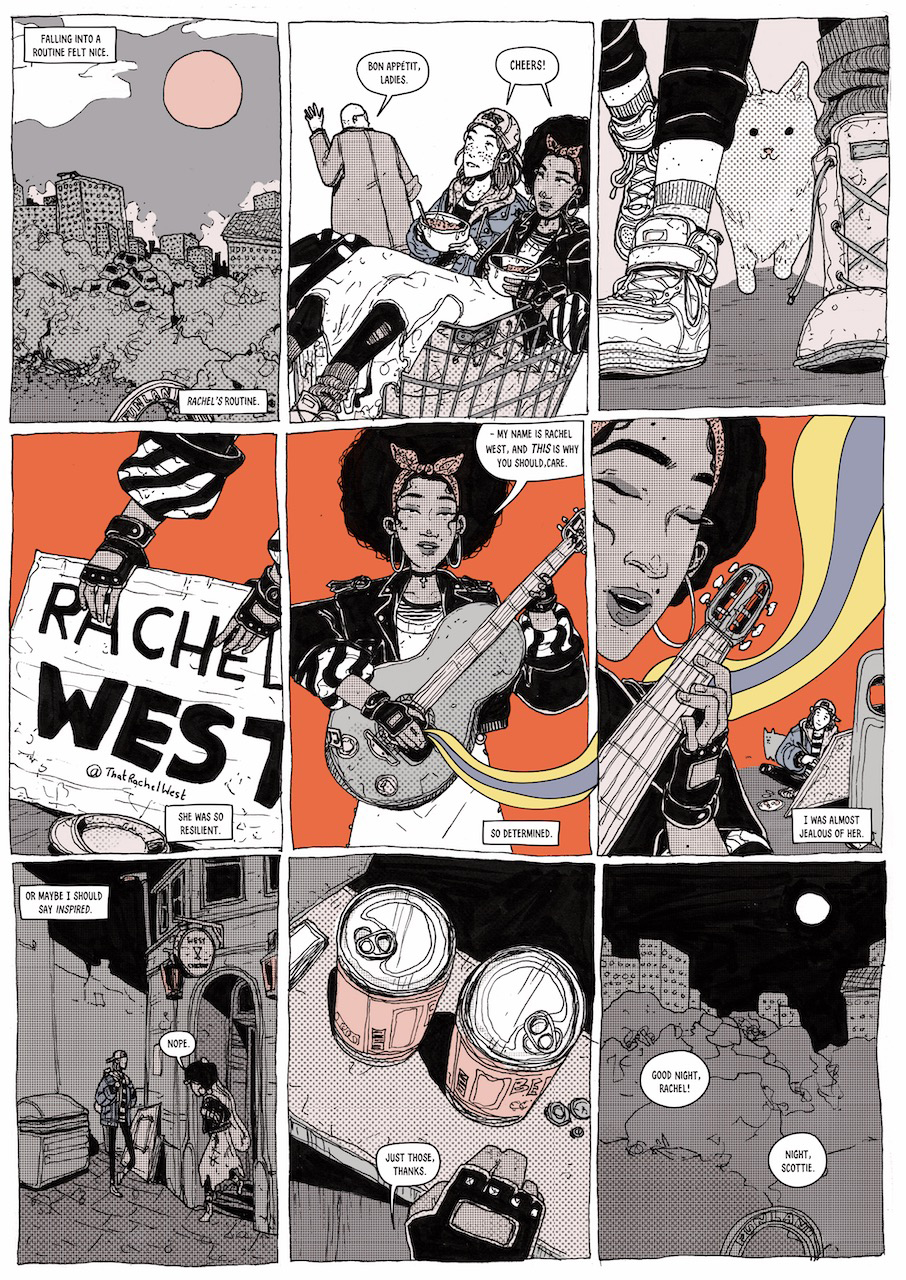
The title The Impending Blindness of Billie Scott gives away a lot of information about this book. It is about a young woman named Billie Scott, and she is indeed going blind. What it does not say is just how terrific this book is. Billie is an artist who has won a coveted spot to have a solo exhibition of her art as a prestigious gallery. Up until this book begins, she has totally isolated herself from her family and any would-be-friends, devoting herself entirely to her craft. However, through a random act of violence, she is struck and her retinas begin to detach. 

Given that she has about two weeks until she goes completely blind, she sets off to find 10 subjects to paint. She stops playing it safe and begins to actually socialize, beginning with her flatmates. Then she goes off to make acquaintances in all sorts of random places, including bachelorette parties, homeless shelters, youth hostels, and alleyways. She amasses a loose band of acquaintances but she also begins getting to know them all better. Given her circumstances, she develops more self-awareness. Also, the urgency of her project makes her much more direct and focused about her wants and needs. 

What I really ending up loving about this book was how people can unexpectedly find friendship and form relationships. Billie looks for people with interesting features so she can paint them, but she also hears their stories and gets to know them. Many of them are damaged in some way, but they exhibit strength and beauty in their own ways. Not everyone she meets is entirely friendly or trustworthy, but she does forge a number of friendships and cobbles together a sort of family. She even finds a special kinship with Rachel, a homeless musician and busker who keeps trying to score a gig at a specific local tavern. 

A story about a lonely, young woman who learns about herself and finds friends in unlikely places could come off as treacly or disingenuous, but the art, character work, and storytelling are strong enough to earn heartfelt, genuine reactions. I found this book utterly charming and uplifting. It is the real deal.

I'll be eager to see what else this book's creator Zoe Thorogood publishes. This book is her graphic novel debut, and she talks about comics, her background, and her work on Billie Scott in this interview.

All of the reviews I have read of this book sing its praises. Caitlin Rosberg called it "a touching exploration of what it means to make art and how to find your people, and why both things are important." Nicholas Burman wrote "that art represents how people are thinking, and it’s an impressive and positive sign as to the resilience of both an emerging generation and the artistic impulse that The Impending Blindness of Billie Scott presents a UK where all the stuff that matters still matters." John Seven commented positively about the tone of this book, highlighting the "fully-realized street-level world for Billie Scott to inhabit" as well as Thorogood's "scrappy art style."

The Impending Blindness of Billie Scott was published by Avery Hill Publishing, and they offer a preview an more about it here.

Wednesday, June 15, 2016

The Thrilling Adventures of Lovelace and Babbage: The (Mostly) True Story of the First Computer

Something I can reveal about this book, The Thrilling Adventures of Lovelace and Babbage: The (Mostly) True Story of the First Computer, is that the stories in here are for the most part not real but they are constructed from some excellent research, facts, and historical events. It follows the exploits of an unusual duo, countess/mathematician Ada Lovelace and mathematician/grump Charles Babbage. In reality, these two met and had a great friendship/collaboration that resulted in the invention of two machines, a difference engine and an analytical engine, precursors to what we now recognize as computers. But, neither machine was actually fully built in either of their lifetimes. What is more, Lovelace died pretty young, so their collaboration was rather short-lived.
 
From those bits of reality, this book follows a narrative into a pocket universe where Lovelace and Babbage's lives played out differently: they both live longer lives, build their machines, and use them for various adventures. Along the way they meet major figures of the day, including Queen Victoria, the Duke of Wellington, and author George Eliot. These episodes are full of wit, humor, and well explained footnotes. The artwork is very expressive and vital, and the entire enterprise bursts with personality and energy. This is probably one of the geekiest books I have ever read, and I rather enjoyed it. I don't know if this quite a book for every reader, but it would certainly be a hit for those who like Victorian era antics, computer science, and/or sophisticated humor.

Sydney Padua is an animator and illustrator who began working on this project as a webcomic, just for kicks. It clearly has grown into something much larger, a bonafide graphic novel. She speaks about her work on this webcomic and book in this interview.

This work has received two Eisner nominations, so it was no surprise that all of the reviews I have read about it have been very positive. Publishers Weekly gave it a starred review and made it a special selection, summing up, "Permeated by delightful illustrations, obsessive foot- and endnotes, and a spirit of genuine inventiveness, it’s an early candidate for the year’s best." Maria Popova called it "layered and wonderful in its totality." Dr. James Sumner wrote a more academic review, and he remarked that "Padua’s work is, in fact, rather better researched than certain more solemn texts on Lovelace and Babbage."

The Thrilling Adventures of Lovelace and Babbage was published by Pantheon Books, and they have more info about it here.

Monday, April 30, 2012

Baby's In Black


The Beatles are one of the most well known bands ever, with international hits that have been played now for  generations.This graphic novel chronicles a period between October, 1960 and April, 1962 when the band was in its formative years, playing shows in Hamburg, Germany and trying to establish themselves. Influenced by rock and rock artists, the lads from Liverpool went to Germany to cut their teeth in some pretty tough clubs. The band then consisted of singer John Lennon, 17-year-old guitarist George Harrison, guitarist Paul McCartney, drummer Pete Best, and bassist Stuart Sutcliffe.

The majority of this book focuses on Astrid Kirchherr, a German photographer who was responsible for shaping the band's early look and who went on to her own renown, and Sutcliffe, who ultimately left the band to pursue his art career. They have instant chemistry when they meet, and the ups and downs of the band's early career form the backdrop to their romance. This book seems an obvious labor of love, and there are copious historical footnotes in the back.

Appropriately, Baby's in Black gets its name from an early Beatles song. It was created by Arne Bellstorf, a German artist famous for his comic page for Der Tagesspiegel, a newspaper. He also co-edits an annual comics publication Orang. His homepage provides a link to many of his works. His career is relatively young, but Baby's in Black was a huge cross-over hit in Germany, attracting many readers who may not typically buy graphic novels.

Thus far, the reviews I have read about this book have been positive. The review at Publishers Weekly commented on how it was difficult to tell some of the characters apart but that "fans of the Beatles will certainly be interested in this little-told tale of their early years." Gavin Lees wrote that not only fans would like the book but that "it is obviously made with tremendous affection, but without ever becoming mawkish.  Even without the presence of The Beatles to give weight and import to its story, this is as touching and tragic a book as we’re likely to find this year." Gary Anderson called the art style "simple but evocative."

This edition was published in the US by First Second. Reviews and other links can be found here.

Thank you, Gina, for the review copy!

Saturday, March 5, 2011

The Professor's Daughter

Imhotep IV, the mummy reanimated in this book is unlike many of his undead brethren. He is not an unthinking zombie, nor does he yearn for flesh or blood. He just wants to fit into 18th century British society and resume his regal lifestyle. He is abetted in this task by Lillian, the mischievous daughter of the professor who discovered him and brought him to England to display. He is enamored with this woman because she resembles his dead wife, a point of contention between the two. Among the exciting and zany things that happen to this unlikely couple: Imhotep III is also remarkably alive and up to seeming no good; Scotland Yard is after him for murder and rounding up all the mummies in town as suspects, and the pair must contend with her father's attempts to reclaim his prime display artifact. Also in the course of the story, Queen Victoria gets kidnapped in the hopes of her providing a pardon. Talk about a star-crossed romance...

This fantastical graphic novel was produced by two of France's premier comics creators, Emmanuel Guibert and Joann Sfar. Guibert is an artist capable of many styles who has been involved in writing the Sardine in Outer Space series as well as drawing Didier Lefèvre's The Photographer. The prolific Sfar has written and drawn hundreds of comics and graphic novels, including the acclaimed The Rabbi's Cat and The Little Vampire series.

As might be expected when two high caliber talents collaborate, the critics I have read largely celebrate this book. Susan L. Carr draws attention to the many whimsical details the story exposes about Victorian England. Heidi Dolamore from the School Library Journal praised Guibert's art as the best part of this "enjoyable melodrama." Gina Ruiz highly recommends this "bizarre, well told and completely wonderful" tale. Perosnally, I found the book funny, surreal, and slightly dark at times.

A preview is available here from the book's publisher First Second.

Tuesday, October 5, 2010

Robin Hood: Outlaw of Sherwood Forest

Robin Hood is a well-known figure in the English speaking world, a legend whose story has been told in print, art, and movies. This version's hero is cut from the swashbuckling Errol Flynn/Cary Elwes cloth. There are five different stories within. The first shows how Robin Hood was tricked and had to become an outlaw. The second and third show how he meets Maid Marian and grows his band of Merry Men. The fourth and fifth stories follow his disputes with the Sheriff of Nottingham.

This book is another of the Graphic Universe graphic novels from the Lerner Publishing Group. It was written by Paul D. Storrie, a frequent contributor to the series about myths and legends, whose other titles include Hercules: The 12 Labors and Amaterasu: Return of the Sun. The art was provided by Thomas Yeates, a graduate of the Kubert School of Art who has had a long career illustrating a variety of comic books such as Swamp Thing, Tarzan, and Conan.

The School Library Journal's Joy Fleishacker reported that this book would be a good one for struggling or reluctant readers, especially because it"includes a map, glossary, and pronunciation guide, and list of print and web resources, [which] may encourage readers to delve more deeply into Robin’s adventures." A few more brief reviews are available at Goodreads.

The publisher's preview is available here.