Showing posts with label 1990s. Show all posts

Monday, June 30, 2025

Holler

Continuing with my haul of comics from HeroesCon, today I am sharing Holler by Jeremy Massie. One of the best parts of going to Charlotte is seeing friends and getting to talk, even if it is while they are manning their booths and selling their wares. I always make a point to check in with pals Henry Eudy and Eraklis Petmezas, who are typically tabled next to each other, and this year they were joined by Massie. I was very eager to get Holler, as I had gotten the first few issues that were published by It's Alive but had not had the chance to finish the series. Lucky for me, Jeremy had this book for sale, and I loved reading it.

It's a pretty specific book, but I am the target audience in a few ways, because of my age and musical tastes. And I should note that it's not quite autobiography, but it is based on some real events and people. It's set in the 1990s in a small, rural town in Appalachian Virginia. Its narrator and main character is Mark, a high school student who does not really excel at academics, but he is a talented enough artist and musician. He plays guitar and joins his friends in a band called Magnesium Mama that plays grunge rock covers and some original songs. This scene puts him at odds with his family in some ways, as well as with the religious figures that factor heavily in his life. 

It also puts him in a clique that is at odds with the local "rednecks" (as he calls them), which leads to conflicts, both verbal and physical. Over the course of the book, Mark deals with a lot of different situations. He gets his first girlfriend, then experiences his first break-up. He experiments with drugs. He plays a lot of gigs and gets involved in a few different battles of the bands. He switches churches, sort of dates the preacher's daughter, and has to navigate the complicated ways his parents and he practice religion. 

The stories here are all told in episodes, and I found them highly compelling and poignant. The artwork is well paced, and is particularly excellent at capturing people's expressions and emotional reactions, which works very well as this book is very character driven. This book touches on a lot of issues that young people contend with as they get older and start trying to carve out spaces in the world, and it does so in a way that is sometimes humorous, occasionally cringe-inducing, and always relatable and human. Holler is one of the best coming-of-age graphic novels I have read, and I highly recommend it.

This book's creator Jeremy Massie has made all sorts of comics in various genres, including the superhero tales Amazing Age, horror stories Blood-Drenched Creature Double Feature, and the more realistic, solo-authored book All My Ghosts. He speaks about his work on Holler in this interview.

I was not able to locate many reviews of this book, which is a shame, because I feel it should be more widely known and read, because it is so good. Publishers Weekly concluded their review, "This bittersweet blast from the past will strike a chord with recovering high school outcasts."

Holler was published by Dark Horse, and they offer more information about it here. Because it features some drug use, sexual situations, profanity, and adolescent shenanigans, I recommend it for readers mature enough to deal with those matters. 

Friday, November 20, 2020

Flamer

Flamer is a book about personal turmoil. The main character here is Aiden Navarro and he is wrestling with a lot in his life. He gets grief from people because he is part-Asian. He is anxious about his transition from parochial to public school, as he's decided to make that move as he is entering high school. 

He is also at summer camp, a place where he's sent partly to be active and lose some weight, which also weighs on his mind. He finds that he relates much easier to his female friends, so he feels isolated by the often toxic masculinity of his peers. He gets teased and taunted pretty consistently, and he finds solace with his bunk mate Elias, a football player who is actually a cool guy who is kind to him.

Aiden's relationship with Elias adds more confusion to his mental state and makes him question his sexuality. On one hand, he feels good to have a person who is actually friendly to him but on the other hand he has feelings that confound him. As a devout Catholic and altar boy, he reasons that he could not possibly have such feelings, because he has always been a "good" person. Aiden also has an affinity for X-Men comic books, and his favorite character is Jean Grey. He can relate to her shift from being a hero to the villainous Phoenix, and, in a sinister twist, he begins to wonder if he should do what she ultimately did in order to put matters to rest.

As you might tell from my synopsis, this book trucks in some major life themes. It is about a person's search for self, dealing with religion as well as social institutions that both define and restrict people. It is also a deeply thoughtful and personal book, and I found it very easy to relate to and feel for Aiden. The struggles of a middle/almost high schooler are palpable as well as his travails with bullying. Even so, I like how he's portrayed so that he's no saint, but trying very hard to make sense of some very disparate ideas and beliefs. His struggle is literally life and death, and I was gratified to see this all-too-common but hardly spoken-about conflict is given such thoughtful, relatable, and realistic treatment. 

The artwork, which is rendered in black and white for the most part, save for a number of instances where oranges, yellows, and red flash across the page to indicate or moments of heightened emotion, covey so much emotion and feeling through spare imagery. There is much to relate to or cringe from, from moments where Aiden recoils into himself because of casual cruelty or overt abuse to other scenes where he can find security through dark and self-deprecating humor.

In an afterword that follows the story, Mike Curato admits that some of this story is based on his own experiences. He has illustrated a number of picture books, most notably the highly popular and award-winning book Little Elliot, Big City (which both my oldest boy and I adore). He also won the Society of Illustrators Original Art Show Founder's Award in 2014. He speaks extensively about his work and inspirations behind Flamer in this interview as well as this one.

All of the reviews I have read of this book have been positive. In their starred review, Kirkus simply advised people, "Buy it. Read it. Share it." Publishers Weekly called it "emotional and raw." Juanita Giles wrote that this book "offers real hope - not just rainbows - to queer kids."

Flamer was published by Henry Holt and Co. BYR, and they offer a preview and more here.

Wednesday, July 15, 2020

Jack Kirby: The Epic Life of the King of Comics

Captain America. The X-Men. Hulk. Iron Man. The Avengers. The New Gods. Black Panther. These are only a few of the hundreds of characters that Jack Kirby either created or co-created. They are household names and properties that have generated billions (trillions?) of dollars for the corporations that control them. But he received close to none of such profits. In terms of industry folks, most artists and creators revere Kirby as one of the all-time greats, but non-comics people tend to not know who he was and attribute all of his creations to his frequent collaborator Stan Lee. Finally here, he is given a full biography, in graphic novel form.

Jack Kirby: The Epic Life of the King of Comics tells his whole life story, from his early days as a hard-scrabble New Yorker to his becoming an artist and taking part in the formative years of the comic book industry. He was friends/associates with many of the people who shaped American comics, like Bob Kane, Will Eisner, and Joe Simon. He bounced around several companies, enlisted and served in the Army during World War II, co-invented the genre of Romance Comics, co-created the Marvel Universe as we know it, and went on later in life to work in animation. His was an eventful life, and this book captures it in a mostly realistic, painterly style that evokes the spirit of Golden Age comics as well as documentaries. Also, the paper itself is colored to resemble yellowed newsprint, the material used to display Kirby's works.
I have to say that this book moves at breakneck speed, and it is packed full of his accomplishments. There is a part of me that wanted there to be more breaks, perhaps in the form of chapters or parts, but I also feel that the sort of compressed storytelling at play here is more emblematic of Kirby's work. So the medium very well matches its subject, though I also made myself pause at times to catch my breath and take in the story.

I also appreciated the way the book used Kirby as the primary narrator (using various interviews and articles as reference points) with occasional shifts of POV to his wife Roz and collaborator Stan Lee. I'd say it does a good job at capturing the spirit and voice of the man, and I liked how it treated him in very practical terms, with his speaking to the need to be productive and work not only in terms of expressing himself but also to put food on the table and support his growing family. Certainly Kirby was an impressive creator, but this books demystifies some of the origins of his most famous works, showing how he cobbled together his experiences, learning, and media consumption in spinning his fantastic stories and amazing characters. Kirby is impressively human.

This book also touches on the more controversial aspects of Kirby's life, namely how he was cheated out of his due as a creator and spent much of his life battling in vain to retain control of his stories, characters, and artwork. Surely there is lots of blame to assign for his treatment, and I felt this book captured well the conditions that led to it. It also has lots of source material behind it to help flesh out the proceedings well.

In seeing people's responses to this book online, the most glaring aspect people have latched onto is the depiction of Kirby himself, which you can see from the cover image. While everyone else is realistically drawn, Kirby is rendered in a cartoonish way, with a huge head and big eyes. I think this choice does two things: it draws attention to him in every way as an otherworldly presence, and it makes it clear who he is in every instance, making for smoother storytelling. Others have noted how this choice is related to how another comics titan Osamu Tezuka (the "God of Manga") drew himself in his own works, and I feel that there is a similar semiotic move made here, a marker of a similarly legendary figure. In reading the book, I have to say that I did not find the choice jarring in the least, and I was quickly drawn into the narrative flow of the story. Even though I was very familiar with many aspects of his life, I still found this book fresh and vibrant. And I feel it is extremely important now, especially as an introduction to those who are unaware of just how impactful Kirby's life was.

This book was created by long-time Jack Kirby fan Tom Scioli. His own works clearly owe debts to Kirby in terms of style, particularly his series Gødland and American Barbarian, not to mention his recent Fantastic Four: Grand Design limited series. He has also drawn a number of licensed properties, including Transformers Vs. G.I. Joe. Scioli speaks about his work on this book in this interview. For more about his entire career, check out this interview with TCJ.

All of the reviews I have read about this book have sung its praises. In a starred review Publishers Weekly called it "a must-read for Kirby fans, and beyond—it captures the mythos of the of the 20th century comic industry’s golden age."  Kirkus Reviews summed it up as "a fast-paced celebration of an underheralded legend within the comic-book industry." Steven Thompson wrote, "The public deserves to know Kirby’s story and Tom Scioli, the obsessive Kirby fan/writer/artist, tells it here in a way I can’t help but think the King himself would’ve liked, and in the medium Jack Kirby loved."

Jack Kirby: The Epic Life of the King of Comics was published by Ten Speed Press, and they offer a preview and more here.
Kirby's influence extends way beyond comics.

Thursday, April 30, 2020

Sincerely, Harriet

Today, I feature another nominee for the Excellence in Graphic Literature Awards. Sometimes you read a book that defies categorization in a wonderful way. Sincerely, Harriet was that sort of book for me, a very pleasant surprise that did unexpected things with its characters and plot. The main protagonist here is Harriet, a teenage girl living in a new apartment in Chicago during the 1990s. Because of her medical history, she has to stay isolated there, with only her mother and downstairs neighbor, an older African-American woman named Pearl, as company. Cursed with an overactive imagination and lots of free time, Harriet begins to create all sorts of sinister backstories.


Harriet is also a writer, and she sends off lots of postcards to her friends from summer camp but does not get replies. She finds writing as an outlet though, and even begins to learn more about and from Pearl that both fires her imagination and gets her to explore the more mysterious parts of the building and her own psyche. I am being rather vague with my description of this book, because I found that it defied my expectations so much that I took great joy in seeing how things unfolded and how the various characters revealed things about themselves and their pasts.

This book contains lots of strong emotions, from the loneliness of dealing with seclusion, to the dread of having to treat a serious illness, to the demands of maintaining family relationships under difficult conditions. Harriet herself is very fleshed out in terms of characterization, as complex a character I've encountered in a graphic novel. I also think that the artwork is delicate and nuanced so much that it conveys subtle emotional moments in brilliant fashion.

This book's creator is Sarah W. Searle, and she has made a number of other comics, including the Victorian-era graphic novel romance Sparks. She also did the Hedy Lamarr entry in the recent Noisemakers anthology I reviewed last month. She speaks more about her work on Sincerely, Harriet in this interview.

All of the reviews I have read about this book have been positive. In a starred review, Kirkus Reviews summed up, "Heartfelt and heartwarming, highlighting the power of story to both conceal and reveal." Johanna Draper Carlson wrote that it "isn’t a book to instantly fall in love with. It’s one that quietly paints a picture of an uncertain young woman whom many readers will sympathize with." Erin Partridge opined, "The story of Harriet & Pearl encourages us to think beyond our immediate family when seeking support for chronic or invisible illnesses. It also suggests several creative coping outlets that readers may find useful."

Sincerely, Harriet was published by Graphic Universe, and they offer a preview and more here.

Thursday, March 5, 2020

Holler #1

I have followed Jeremy Massie across a number of different works and genres. I dug his fun superhero book Amazing Age, the horror riff Blood-Drenched Creature Double Feature, and the more mundane, solo-authored book All My Ghosts, but I feel that Holler is his best to date. As a guy who teaches in Appalachia, I was intrigued to see this period piece, about an adolescent who gets into grunge music and forms a band in the 1990s.

It has a lot of pluses going for it. The characters, settings, and scenes are all well designed and staged. The storytelling is very clear, and even though there are moments of rock-out bombastic mayhem, there are a good many more quiet moments of well orchestrated personal drama. Even though I grew up in a much different context, this sweet, poignant set of accounts gave me a lot to relate to. I feel that it offers many experiences that transcend time and are relatable even today. For instance, the day when his church group discussed a band he was into:
Awkward...
The true-to-life experiences are communicated in clear fashion in ways that pack an emotional punch. I admired the way facial expressions, layouts, and pacing create many dramatic effects. From the visuals, I found it very easy to relate to these characters and share in their joys and pains. Certainly, it helps that I am roughly the same age as Massie, so I was familiar with a lot of the music and pop culture references, but but I also feel that these stories would resonate with younger readers. There is a universality to this tale of people who feel like outsiders in their own community.

Holler is published by Massie Makes Comics, and there is more info about it here (you can buy it there, too, for $0.99 - what a deal!). A print version will be available soon from It's Alive!.

Wednesday, January 25, 2017

Troop 142

Troop 142 is a slice of life tale, an account of a Boy Scout camping trip set in 1995. We get to see the goings-on and drama between camp counselors and adolescent boys as the latter try to win badges for completing specific tasks and classes. Along the way, they all learn about what it means to be a man, sometimes lessons that are sad and disappointing. And of course, there are lots of pranks, hi-jinks, sneaking out at night, horrible jokes, bodily odors, macho posturing, and homophobia happening all of the time.
What really stood out to me about this book was how well it captures a bunch of social dynamics, from dads who are uncomfortable around each other, to boys trying to fit in, to both who work to ostracize and torture those they find different. Some of the boys (and dads) are peacocks, others loners, and more than a few feel vulnerable and unsure of themselves. The personalities here are strong ones, and I feel that there are many alternatives for a reader to relate to, wonder about, mock, and/or revile.
The story also touches on a number of social issues. There are undercurrents of religious and sexual intolerance discussed, and it is clear that although being a Scout entails learning skills and striving for virtue it also involves some level of discrimination toward others. Being set in the past allows the author some distance from the topicality of these issues, and it seems more recently things in the Scouts are changing (or have changed to some extent). Still, these issues still affect many of our lives on a daily basis.

Troop 142's creator Mike Dawson has written and drawn a few graphic novels, including Freddie & Me, Angie Bongiolatti, and Rules for Dating My Daughter. I like his expressive drawing style, especially in how he depcits his characters' emotional responses. And I am not alone in my admiration for his work, as he was nominated in the Promising New Talent category of the Ignatz Awards in 2002. He speaks about his career and work extensively in this interview.

Originally published online, this book won the 2010 Ignatz Award for Outstanding Online Comic, and I found much praise in its reviews. Joseph Thompson summed up that "this graphic novel will sharply divide its readers in terms of personal taste but not quality."in ways that the best books do: ways that surprise, and trouble, and delight." Rob Clough called it "a comic that’s not about the monstrous nature of adolescence or even the less pleasant truths about masculinity in particular, but rather one that focuses on the fragility of ego, the demands of social and cultural mores, and the ways in which we all fear humiliation and vulnerability."

Troop 142 was published by Secret Acres, and they have a preview and more info about the book here. This books features crass, juvenile humor; sexual situations, and profanity, but I feel it is no worse than what I heard while I was a teenager myself. Still, those  offended by such things might want to steer clear.

Tuesday, July 15, 2014

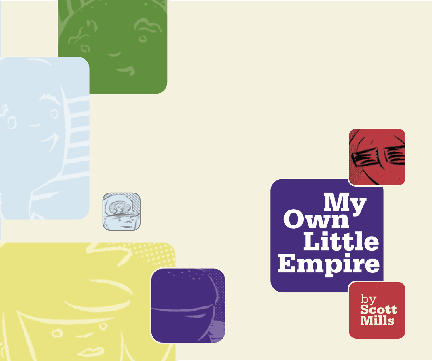
My Own Little Empire


My Own Little Empire is a comical, nostalgic look back at 1990, that I found very relatable, if a little cliched. The narrative follows a bunch of high school friends in Maryland as they rule their small town "empire," which means having crappy retail jobs, going to concerts, drinking, experimenting with drugs, and hanging out in an abandoned hospital that is said to be haunted.
The cast of characters
The bunch of characters in this book kind of ran together for me except for three: the main character Joe, who has a job and pines for Jacqueline, the only female who seems nice enough but dates Roop, who is a big dope who comes across as sort of a bully. This triangle gets explored some in the course of the book, but like the art the story is also pretty minimal. There are some funny bits as well, particularly those about Marty, the guy who walks around the mall in circles. However, except for the swearing and use of substances, I felt that most of this book was pretty sitcom-ish.
And because the story is about kids in 1990, there is a bunch of aimless driving around, drinking, and talking smack. The "verbal sparring" (mostly insulting) that happens between the characters was pretty realistic to me. I felt about this book that it was as if someone followed me and documented my high school years, only depicted them in snapshot fashion with little detail or development. I liked this book fine, but mostly in a hey-I-remember-that sort of way.
Zima! Do they even make that swill any more? Apparently not.

The art style here reminded me of the cartoon Ed, Edd, and Eddy, but even more minimal. Sometimes, I had difficulty figuring out who was who or what was happening, but for the most part I found the artwork pleasant and engaging. Writer/artist Scott Mills has done all kinds of comics over the years, including Zebediah the Hillbilly Zombie Redneck Bites the Dust, Big Clay Pot, and the Ignatz Award winning Trenches. He also makes all kinds of mini-comics, most notably the Xeric Award winning Cells. Mills speaks more about his comics works in this interview.

Reviews I have read about this book have been mixed. Tom Spurgeon wrote that it depicted "a recognizable and realistic youth experience" but also that it was "like eating pizza with a bunch of people you don't know and having them trade high school stories replete with personal shorthand and slang. You feel slightly sorry for the sheer tedium of their experiences, but mostly you just wish they'd change the subject." Whitey was more positive, but also admitted to being a big fan of Mills' work, writing, "His ear for dialogue is just about flawless and his art has gotten even more minimal (I mean that in the best possible way)." Matt Martin opined, "Mills’ artwork ranges from barely discernible to absolutely gorgeous, with the median quality falling somewhere on the more positive side of the scale, but his flair for realistic dialogue amongst high school seniors never fails to impress."
His ear for dialogue is just about flawless and his art has gotten even more minimal (I mean that in the best possible way). - See more at: http://www.opticalsloth.com/?tag=my-own-little-empire#sthash.mmGwr2Bz.dpuf

My Own Little Empire was published by Adhouse Books, naturally, and they provide a preview here.