Saturday, August 15, 2020

Mr. Butterchips: A Collection of Cantankerous Commentary

Mr. Butterchips is an interesting character, a monkey who aspires to be a stand-up comedian but who is largely relegated to make ends meet by partnering with an organ grinder. His job brings him into contact with a wide cross-section of people, making a sturdy platform for him to express his cantankerous views of social conditions, politics, popular culture, and all sorts of other matters. The first half of the book is episodic, in the vein of a weekly comic strip. And I was pretty amused to see how he tackles contemporary hypocrisy and injustice through comedic commentary, targeting things like "the war on Christmas," pro-lifers, big pharma, Comicsgate, and anti-vaxxers. 

The second half of the book is a single, sustained narrative about Mr. Butterchip's misadventure with controlled substances in the streets (and sewers) of San Francisco. This story is more surreal, reminiscent of underground comix, with the city and its denizens being the butt of the jokes. I have only been to SF once, so I might not get all of the "in" humor, but I was still entertained by the tale, which also has a few mild suspense elements. 

One of the best features of this book to me was seeing how the character, setting, and situations evolved over time. At first, the episodes are given to finding a tone and also establishing the character, which has it fits and starts with mundane things like girlfriend trouble and struggling to make rent. Over time, Mr. Butterchips develops more of a voice and the targets of its satire become more pronounced. By the time I got to the large story that ends the book, I felt a familiarity with things that made the plot hum. It was a lot like reading old volumes of comic strips and seeing how they grow into themselves. I'd be interested to see if there will be more adventures with this acerbic primate in the future.

These comics were created by Alex Schumacher, and most of them appeared monthly in Drunk Monkeys. He has completed a number of projects, including the webcomic Decades of (in)Experience and the self-published print collection Defiling The Literati. He speaks more about his work and career in this interview.

I was only able to find one review of this book, but it was very positive. Aaron Iara wrote, "Our news feeds and social media are chock-full of people arguing and discussing the issues of the day. However, hearing these arguments from a heated drunken monkey is so much more fun." He summed up by recommending "Mr. Butterchips to fans of political cartoons, boisterous stand-up comedians, and off-beat comic books."

Mr. Butterchips was published by SLG, and they offer more info about it here. This book features profanity, adult themes, drug use, and some sexual situations, so it is recommended for readers mature enough to handle those things.

Monday, August 10, 2020

A Fire Story

On Monday, October 9, 2017, Brian Fies and his wife Karen grabbed some things and got in their car for what they thought were precautionary measures because of wildfires. Hours later, they were homeless. 

The fires they escaped were some of the most destructive this country has ever seen, and they ravage Northern California. This book is an intimate look at lives forever changed, how people deal with large-scale destruction in terms of emotional reactions and the practical matters of dealing with relief agencies and other institutional entities. One of the parts that sticks most in my head is Fies dealing with the utilities company, whose representative keeps asking inane questions about whether workers would have clear access to the meter. "Unlimited access," he deadpanned, "but there's no gas meter there anymore." 

The wide array of emotions and somewhat surreal situations that accompany such loss make this book memorable. The personal tale packs a wallop, especially when it is accompanied by several other text pieces told from the perspective of others that the fires affected. As a whole, this book is a wonderfully detailed mosaic of the resilience of the survivors and how some begin to rebuild their lives. This book is moving and informative, giving great insight into how people cope with and survive a natural disaster.

This book's author, Brian Fies began this story as a 18-page comic he published on his blog, adapted it into a Emmy Award-winning animated short, and then expanded it into this graphic novel version. He speaks of the entire process in this video. He also speaks about sharing his story as a graphic novel in this interview. Fies is an Eisner Award winning creator who has created a couple of other graphic novels, the autobiographical Mom's Cancer and the nonfiction long-form essay Whatever Happened to the World of Tomorrow? I also had the honor of being on a panel with him at the 2019 Denver Pop Culture Con.

I was very moved and impressed by this book, but some of the reviews I have read have been more critical. Caitlin Rosberg opined, "It’s a heartfelt, emotional read that has just as much historical and social worth as it does personal value, and a reminder of the best and worst parts of what people can be." Alex Hoffman wrote, "The full book feels scattered, unable to hold the weight of Fies’ trauma." Josh Kramer thought that perhaps the book was rushed and called it "good memoir and inadequate journalism."

A Fire Story was published by Abrams, and they offer a preview and more about it here.

Wednesday, August 5, 2020

Cankor

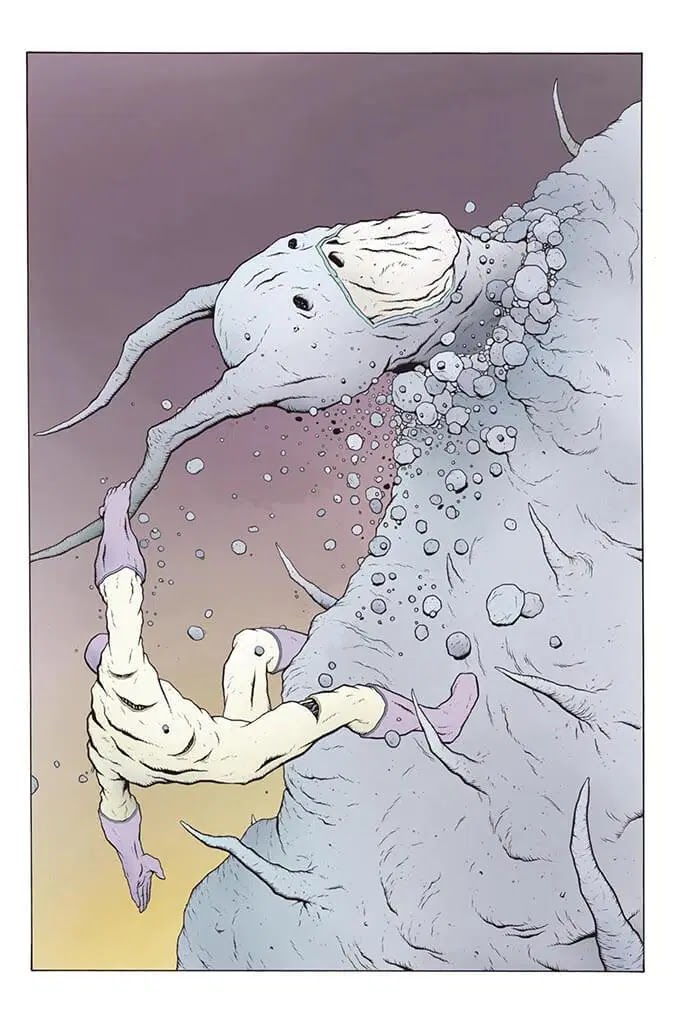
As you might can tell from the wordless cover, Cankor is an atypical book. It starts out in an auto-biographical mode, with the tale of a man (or mannish creature) going to a rock show, but then it goes into a very psychedelic direction. He has made some fan art to show the band but left it home, only to see it actually appear in the band's posters and merch.
Things only get stranger as the muscular fella on the cover, an android/cyborg named Cankor makes a ghostly appearance on the scene. Most of the rest of the book follows Cankor as he traverses worlds and dimensions, encountering beings large, small, and superheroic on his way. However, there are interspersed spaces where the autobiographical stories crop up. In all, this is a ethereal reading experience. Sort of like a contemporary version of 1970s Jim Starlin Marvel Comics like Adam Warlock. I won't say that they get so philosophical, but they do meld fantasy, fiction, and reality in interesting and compelling ways.
The artwork is a huge draw or this book. The minute details of circuitry and rock features are just part of what drew me into it. Too often I think I review books here and talk about their plots and characters, and I have been trying to focus more on the artwork and what it brings to the table. As you might can tell from my meandering description of the book's content in the first paragraph, this book is not so much plot driven as it is about sensory-perception and visuals. It is full of long sequences with no words, but the visual storytelling is utterly compelling and beguiling. The imagery is convoluted, complex, and as full of emotional energy as it is of enigmas.

I had not encountered artist Matthew Allison's work before now, but I will definitely be checking out some more of it after reading this book. As far as I can tell, he has largely been doing comics covers and self-publishing Cankor and a horror book called Sweet Sepulchre! I have really enjoyed checking out his Instagram feed for some of his commissions and other art. He speaks about his work on Cankor in this interview.

All of the reviews I have read of this book have been positive and mention its idiosyncrasies. Alisha Weinberger wrote, "The art of Cankor is deeply disturbing and nauseating. And I say this with love and admiration." David Charles Bitterbaum called it a "fantastically bizarre work." There are more reviews at Goodreads, where the book currently has a 4 (out of 5) star rating.

Cankor was published by Adhouse Books, and they offer a preview and more here. This book features some profanity and violence, so I suggest it for mature readers.

Thursday, July 30, 2020

Cryptoid

Cryptoid features some wonderfully weird comics presented in a stream-of-consciousness style. The stories begin with a looming figure that resembles a Celestial from Jack Kirby's The Eternals. As it surveys the Earth its gaze leads to the misadventures of the half-man, half-ankylosaurus Mankylosaurus (seen on the book cover) grazing at a salad bar, and later turn to a tangent on unknown species of bats that live among us.
Next comes a brief tale of a tortured man who is transformed into a gnome, followed by the adventures of The Resister, a woman/eagle creature who superheroicly fights for freedom, impaling Steve Bannon on a fence and vomiting fish guts at President Trump.
The enigmatic Nightsword's exploits then appear, with the heroic knightly figure slashing and dancing in reality-altering ways. Box, a robot, then comes on the scene to go shopping in a supermarket in his unique manner.
A giant monster then rises from the sea and begins crushing the Earth, when the Mankylosaurus and Celestial-looking being return and the story comes full-circle.

There is a surrealism I dig about these comics. None of the tales are very long, and some are played so seriously that they come off as silly, but they are all potent doses of comics goodness. I am not saying that this book is for everyone, but it boasts a great combination of artwork inspired by classic comics artists like Kirby and Wally Wood, a dash of contemporary social commentary, some good old fashioned ennui, monsters, strange juxtapositions, and frivolity. It's a memorable bit of inspired madness.

I am a big fan of this book's creator Eric Haven. His comics are memorable, leaving definite impressions with their powerful artwork and brevity. His stories do not wear out their welcomes. His narrative sensibilities and style remind me of Michael Kupperman's, though Haven is more action and genre oriented. He has a slew of comics under his belt, including Tales to Demolish and The Aviatrix (collected in Compulsive Comics) and his books Ur (nominated for an Eisner Award) and Vague Tales.

The reviews I have located about this book have been positive. Chris Gavaler called it "a hybrid graphic novella that belongs to no genre but his own." Ryan Carey wrote that "there’s no mistaking an Eric Haven comic for a comic made by anyone else, and even if his work largely amounts to variations on a theme, it’s a theme that stands up to constant and further exploration, definition, and expansion."

Cryptoid was published by Fantagraphics, and they provide a preview and more about it here.

Saturday, July 25, 2020

I Am Not Okay With This

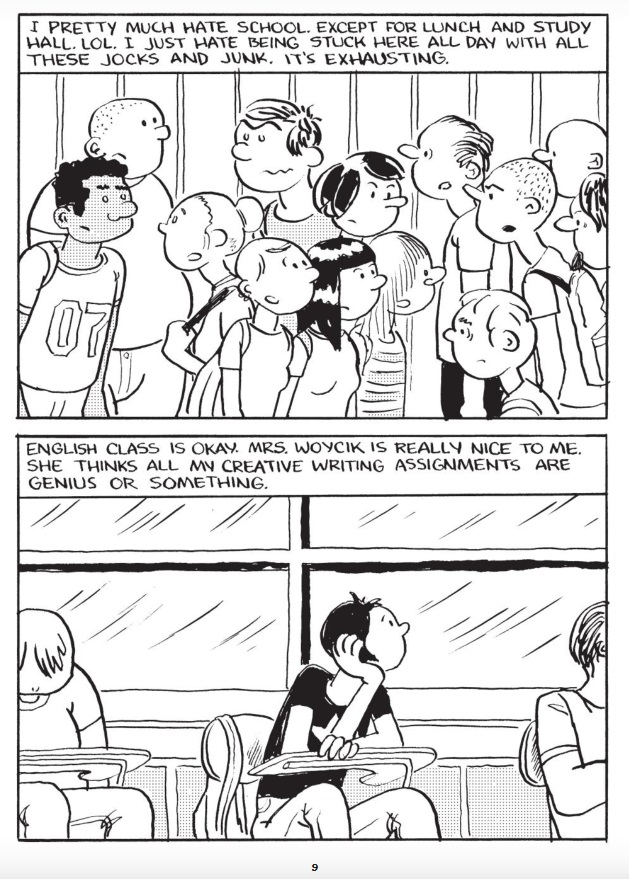
I am Not Okay With This follows the story of Sydney, a 15-year-old who has a lot on her mind. Her mother is frequently on her case. She has an annoying little brother. She is secretly in love with her best friend Dina. Dina is dating an abusive jerk named Brad. Her father was a veteran who died mysteriously. Also, she has telekinetic abilities that both empower and scare her.
As you can tell by the excerpt above, she spends a lot of time in her head, ruminating on things. This book is a long look at teenage isolation and despair, with insight into how people deal with trauma in their lives. It is a very direct, impactful story, and I have to admit I found it tough to read in the sense that Sydney's pain is so visceral and tough to manage. She attempts to medicate herself in various ways, but some aspects of her powers manifest when she loses too much control, so in the end she is a bunch of raw nerves that defy remedy. Finally, she sees only only way to find relief, and it is dark and horrifying.

The stark, simplistic drawings help convey this sense of pain and emptiness in effective manner. The fact that they look cartoonish, almost like a Bizarro version of a newspaper comic strip (with Sydney seeming like Olive Oyl) oddly makes things seem more relatable and realistic to me. Perhaps it's the notion Scott McCloud has talked about, where more iconographic drawings are open and invite people to see themselves, that plays a part in this feeling. However I think the lion's share of credit goes to strong character work, pacing, and plotting. I cannot recall feeling like I have been punched in the face (in a figurative sense) by a comic as much as I have with this one. It's a memorable book for sure.

I am a big fan of the creator of this comic, Charles Forsman, who is a graduate of The Center for Cartoon Studies and a three-time Ignatz Award winner. His comics tend to be genre pieces, including Revenger (a violent, sort of post-apocalyptic adventure tale), Celebrated Summer (a teen "comedy"), Slasher (a horror story), and The End of the Fucking World, which has been adapted into a Netflix Original Series. His newest serial is a sci-fi tale called AUTOMA. Forsman speaks about working on these various comics in this interview. IANOKWT has also been adapted into a Netflix series, and I have to say that I really liked it even though it has some definite deviations from the book.

All of the reviews I have read about this book have been positive. Tessa Strain wrote that Forsman's gift is "to convey the inner lives of teenagers whose emotions and troubles exceed their ability to express them." Caitlin Rosberg called it a book "filled with delicately balanced tensions stretched cover to cover." Publishers Weekly wrote that it was a "troubling yet poetic exploration of young adults working through their mental pain via its physical projection."

Originally self-published as a series of mini-comics, this collected version of I Am Not Okay With This was published by Fantagraphics Books, and they offer a preview and more information about it here. Because of its strong subject matter, I'd recommend this book for mature readers.

Monday, July 20, 2020

Big Ideas That Changed the World: Rocket to the Moon!

The first book in a new series Big Ideas That Changed the World, Rocket to the Moon chronicles the early days of space travel and ends with a long look at the Apollo 11 mission that landed on the Moon. It is narrated by Rodman Law, an obscure figure to be sure. He was a daredevil, parachutist, and stuntman in the silent film era of cinema.
One of his stunts was to launch himself in a rocket, which gives him insight into the efforts to propel objects and people from Earth. His inclusion is also emblematic of the sort of interesting facts, figures, and events included in this very accessible and engaging book. There is even one notable scene of an astronaut having to track down a stray piece of feces in a space capsule, which is gross and riveting. Try finding that tale in a textbook!

I think that this book does an excellent job of balancing information with entertainment. It certainly tells its story with verve and a sense of humor, but also does not steer away from revolting realities like the sexism evident in early space programs or the role that Nazis played in researching rocket flight. I think that the artwork is detailed and well-researched, and the pacing and story-telling allows ample space in some wordless sections for the narrative to breathe and the grandeur of the larger events to be highlighted.

This book's creator Don Brown has a sizable number of publications under his belt, focusing especially on nonfiction and biographies for school-aged readers. He is known for the Actual Times series as well as the graphic novel The Unwanted: Stories of the Syrian Refugees. He speaks extensively about his work on Rocket to the Moon! in this interview.

All of the reviews I have read of this book have been positive. In their starred review, Kirkus Reviews called it "a frank, often funny appreciation of our space program’s high-water mark." Publishers Weekly wrote, "Brown’s visual storytelling offers humor, vibrancy, and a wealth of historical insight." Esther Keller noted that "Brown creates his own sense of style that will appeal to middle grade readers."

Rocket to the Moon! was published by Amulet Books, and they offer a preview and more here. The second book in the series, about computers, was recently published.

Wednesday, July 15, 2020

Jack Kirby: The Epic Life of the King of Comics

Captain America. The X-Men. Hulk. Iron Man. The Avengers. The New Gods. Black Panther. These are only a few of the hundreds of characters that Jack Kirby either created or co-created. They are household names and properties that have generated billions (trillions?) of dollars for the corporations that control them. But he received close to none of such profits. In terms of industry folks, most artists and creators revere Kirby as one of the all-time greats, but non-comics people tend to not know who he was and attribute all of his creations to his frequent collaborator Stan Lee. Finally here, he is given a full biography, in graphic novel form.

Jack Kirby: The Epic Life of the King of Comics tells his whole life story, from his early days as a hard-scrabble New Yorker to his becoming an artist and taking part in the formative years of the comic book industry. He was friends/associates with many of the people who shaped American comics, like Bob Kane, Will Eisner, and Joe Simon. He bounced around several companies, enlisted and served in the Army during World War II, co-invented the genre of Romance Comics, co-created the Marvel Universe as we know it, and went on later in life to work in animation. His was an eventful life, and this book captures it in a mostly realistic, painterly style that evokes the spirit of Golden Age comics as well as documentaries. Also, the paper itself is colored to resemble yellowed newsprint, the material used to display Kirby's works.
I have to say that this book moves at breakneck speed, and it is packed full of his accomplishments. There is a part of me that wanted there to be more breaks, perhaps in the form of chapters or parts, but I also feel that the sort of compressed storytelling at play here is more emblematic of Kirby's work. So the medium very well matches its subject, though I also made myself pause at times to catch my breath and take in the story.

I also appreciated the way the book used Kirby as the primary narrator (using various interviews and articles as reference points) with occasional shifts of POV to his wife Roz and collaborator Stan Lee. I'd say it does a good job at capturing the spirit and voice of the man, and I liked how it treated him in very practical terms, with his speaking to the need to be productive and work not only in terms of expressing himself but also to put food on the table and support his growing family. Certainly Kirby was an impressive creator, but this books demystifies some of the origins of his most famous works, showing how he cobbled together his experiences, learning, and media consumption in spinning his fantastic stories and amazing characters. Kirby is impressively human.

This book also touches on the more controversial aspects of Kirby's life, namely how he was cheated out of his due as a creator and spent much of his life battling in vain to retain control of his stories, characters, and artwork. Surely there is lots of blame to assign for his treatment, and I felt this book captured well the conditions that led to it. It also has lots of source material behind it to help flesh out the proceedings well.

In seeing people's responses to this book online, the most glaring aspect people have latched onto is the depiction of Kirby himself, which you can see from the cover image. While everyone else is realistically drawn, Kirby is rendered in a cartoonish way, with a huge head and big eyes. I think this choice does two things: it draws attention to him in every way as an otherworldly presence, and it makes it clear who he is in every instance, making for smoother storytelling. Others have noted how this choice is related to how another comics titan Osamu Tezuka (the "God of Manga") drew himself in his own works, and I feel that there is a similar semiotic move made here, a marker of a similarly legendary figure. In reading the book, I have to say that I did not find the choice jarring in the least, and I was quickly drawn into the narrative flow of the story. Even though I was very familiar with many aspects of his life, I still found this book fresh and vibrant. And I feel it is extremely important now, especially as an introduction to those who are unaware of just how impactful Kirby's life was.

This book was created by long-time Jack Kirby fan Tom Scioli. His own works clearly owe debts to Kirby in terms of style, particularly his series Gødland and American Barbarian, not to mention his recent Fantastic Four: Grand Design limited series. He has also drawn a number of licensed properties, including Transformers Vs. G.I. Joe. Scioli speaks about his work on this book in this interview. For more about his entire career, check out this interview with TCJ.

All of the reviews I have read about this book have sung its praises. In a starred review Publishers Weekly called it "a must-read for Kirby fans, and beyond—it captures the mythos of the of the 20th century comic industry’s golden age."  Kirkus Reviews summed it up as "a fast-paced celebration of an underheralded legend within the comic-book industry." Steven Thompson wrote, "The public deserves to know Kirby’s story and Tom Scioli, the obsessive Kirby fan/writer/artist, tells it here in a way I can’t help but think the King himself would’ve liked, and in the medium Jack Kirby loved."

Jack Kirby: The Epic Life of the King of Comics was published by Ten Speed Press, and they offer a preview and more here.
Kirby's influence extends way beyond comics.