Showing posts with label Holocaust. Show all posts

Tuesday, February 10, 2026

The Girl Who Sang: A Holocaust Memoir of Hope and Survival

Holocaust survivors are growing older and fewer, and The Girl Who Sings is a graphic novel made to ensure their stories are preserved and told to future generations. It tells the tale of Estelle Nadel, who lived in Poland as a girl, and whose story is recorded and featured by the United States Holocaust Memorial Museum. It is divided into four parts, the first the lead-up to Nazi occupation, the second an account of her family hiding, the third a look at their liberation that brought new terrors, and the fourth the tale of how they finally arrived to America and struggled to make new lives.

What is powerful about this book is its first-hand account of the genocide and harrowing events of the period, ones that are being replicated in the present in multiple places despite a vow to "never again" abide such prejudice and hatred. People were labeled subhuman, detached from social structures like education, relegated to ghettos, and eventually sent to camps to either work or die. Others were killed with bullets and bombs in the course of war. I know there are those who would like to pretend none of this ever happened or even those who would like to replicate these events to perpetuate their own foul beliefs, and one of the strongest ways to combat them is to keep these stories visible. I was deeply moved by this book, more than I expected to be. It is a vital tale of survival and hope in the face of despair, and I feel it is an important story for others to see.

The Girl Who Sang is Estelle Nadel's story, but she died in 2023, and it was translated into graphic novel form here by editor Bethany Strout and artist Sammy Savos. Savos is a storyboard artist and cartoonist who has a strong sense of storytelling, character design, and emotional expression. Through the interaction of plot, words, and images the people and events depicted in this book seem palpable and alive.

 This book has received many accolades and has been very well reviewed. In a starred review from School Library Journal, Darby Wallace called it a "must have." In another starred review, Kirkus Reviews described it as "sweeping, stark, tragic, and triumphant." Emily Schneider wrote that the "metic­u­lous nar­ra­tion and insights, com­bined with Sam­my Savos’s com­pas­sion­ate artis­tic vision, ensure that this sto­ry will not be forgotten."

The Girl Who Sang was published by Roaring Brook Press, and they offer a preview and more here.

Monday, June 15, 2020

White Bird: A Wonder Story

White Bird was the big winner at this year's Excellence in Graphic Literature Awards, winning both the Best Middle Grades Literature and Book of The Year honors. It is set in the same universe as her hit YA novel Wonder, a best-seller about a young boy named August, born with a severe facial difference, who deals with bullying at school. It also was made into a major motion picture. There have been other works set in this world, including the short story collection Auggie and Me, where the main character of this book was introduced.
August's main antagonist, Julien, is a key figure in White Bird, as it is through a correspondence with his Grandmère (named Sara) that he gets to hear her story. When she was a girl, she lived in France during the Nazi occupation, and a family took her in and hid her away. She endures a whole spectrum of emotions and tribulations during this ordeal, and this graphic novel chronicles the many trials she endures as well as the peril that her host family put themselves in their quest to protect her. From the many actual holocaust accounts I have read or viewed, I can say that much of what transpires in this book hews very closely to reality. This book is a moving, harrowing account that lays bare the horrible reality that people endured in the past and that many people still have to contend with, a point hammered home with Julian's participation at a pro-immigration protest at the end of the book.

There is only one quibble that I have, and it has to do with a touch of magical realism that tinges the ending of Grandmère's story. I get the dramatic effect, but it also was a bit jarring to me given that so much of the rest of the book was deeply rooted in realism. It did not ruin things for me, but I felt it was a bit discordant with the rest of the narrative. Still, I feel that this book is a worthy addition to any classroom library, and it will be attractive to fans of other books by R.J. Palacio set in this world.

What is especially impressive to me about Palacio's work is that not only is she an accomplished writer, she is also a wonderful illustrator. She drew this book herself, adapting her own prose in very effective and impactful fashion. There may be a lot of "talking head" type layouts, but she captures character's gestures and emotions well, telling a tale full of drama and suspense. She has also designed book jackets and drawn a number of picture books, including Peter Pan: The Original Tale of Neverland and Ride, Baby, Ride. She speaks extensively about the evolution and inspirations of White Bird in this interview.

The reviews I have read about this book have been very polarized, either full of praise or offering major critiques in terms of tone and content. In a starred review, Kirkus Reviews called it "A must-read graphic novel that is both heart-rending and beautifully hopeful." Esther Keller praised the artwork, "There are moments of joy between Julien and Sara, and the artwork captures those moments in such a haunting way. Contrasted with the scary moments, the story will grab readers." Hillary Brown offered a contrasting take, writing "Preaching and hoping the message sinks in is basically just hoping for divine intervention, which is exactly what happens to Sara when she’s about to be caught, not just once but repeatedly." Boris Fishman concluded that it is "full of neat coincidences, grown-up clichés, sentimentality and stock portraiture. However, the story does end on the 'right' note with Julian inspired to engage in social activism of his own. Should that be enough?"

White Bird was published by KnopfBooks for Young Readers, and they offer more information about it here.

Sunday, March 10, 2019

Anne Frank's Diary: The Graphic Adaptation

The Diary of Anne Frank is one of the most read books in the world, which may beg the question of whether or not a graphic adaptation of it is necessary, but I have to say that I was blown away by this work. It is expressive, incorporates disparate pieces of artwork into the story, and creates a context for both exploring humanity and horror at the same time. Anne and her family spent years hiding from Nazis in an annex in Amsterdam during World War II. Along with some others they shared the cramped quarters, living in as quiet and unobtrusive fashion as possible. And all the while they listened for scraps of news and hope while hearing bombing and shooting all around them.
As if this atmosphere was not bad enough, Anne also had to deal with lots of other personal dynamics, including a rivalry with her older sister, a crush on a boy, and having to share her room with an adult man dentist. What I feel this book captures best about the work is 13-year-old Anne's sense of figuring out the world and her place in it, ironically at a time when she was sequestered and eventually taken out of it. This book is full of humanity, wisdom, and sadness, and the artwork only exemplifies the beauty and thoughtfulness of its prose.

As an educator, I often think of how to use a book like this, and I feel that it could be used in several ways. It could be read alone, in tandem with the original book that it excerpts, or it could also be excerpted itself to draw attention to particular passages. I was very impressed with this book, especially in how it uses various visual styles and formats to adapt the diary entries. Sometimes, it plays with a single image, often cribbed from a classical art source.
Sometimes, it uses straight forward comics, and others it features an illustration with an entire diary entry. I think that its creators were savvy in selecting which sections to summarize and adapt and which to present in more whole fashion. This adaptation is superlative, and it is prelude to an animated feature that is nearing the end of production. If it is anything like this book, it should be excellent.

This adapted book was a collaboration between Ari Folman and David Polonsky. Folman is an Orphir Award and Golden Globe Award winning director and screenwriter. Polonsky has worked as an art director, children's book illustrator, and animator. Both collaborated on the lauded animated film Waltz with Bashir. This interview sheds light on both creators' work on this book.

The reviews I have read about it have been largely positive. Ruth Franklin wrote, "Their book is brilliantly conceived and gorgeously realized." Publishers Weekly's starred review concluded, "The beauty of Anne’s life and the untarnished power of her legacy—here further elevated by Folman and Polonsky—are heartening reminders of the horror of her fate." Gene Ambaum called it "spacious, interpretive, and altogether wonderful."

Anne Frank's Diary was published by Pantheon, and they offer a preview and more here.

The publisher provided a review copy.

Thursday, March 30, 2017

My Favorite Thing is Monsters

Holy cow, how do I start reviewing this book? It's a masterpiece. One of the best books I have read. Period. It is full of beautiful emotional moments, pain, grief, wonder, and mystery. And perhaps, most amazingly, it is a debut graphic novel.

My Favorite Thing is Monsters is a huge book, about 400 pages long, and still only the first half of the whole narrative. The plot is set in the late 1960s. The main character is 10-year-old Karen Reyes, a curious, budding artist who lives in an apartment building with her mother and older brother Deeze in Chicago. Everything in this book is meant to be entries from her spiral-bound journal, and the artwork is exquisite. There are so many threads to follow in this book, but one of the main ones is an inquiry into the mysterious death of their upstairs neighbor, Anka Silverberg, who was a Holocaust survivor:
Karen and Anka's husband listen to audiotapes chronicling her life and experiences during World War II, including her imprisonment and escape from a concentration camp, an extremely heartbreaking, troubling, and riveting tale. Add to that narrative an extremely rich tapestry of characters in Karen's building, including her own superstitious mother, her creative and womanizing brother, a glass-eye wearing ventriloquist, and a mobster's wife, there is so much to take in. Another layer lies in Karen's own story and her depiction of herself as a young werewolf dressed like a private investigator. So much of this book is involved with her figuring out who she is, trying to deal with cruel classmates, making friends, and growing up.
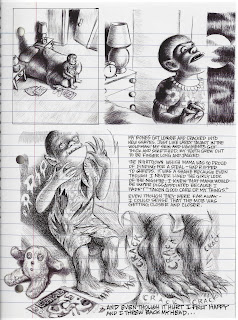
Another strong aspect of this book is in its relationship with art and artwork. Some of the art is more popular, such as the recreations of lurid monster magazine covers of the time period that act as markers between chapters. But "fine art" pieces from museums also appear, redrawn in Karen's hand throughout the book. Certainly, the theme of trying to puzzle out what life means is powerful in this book, and how art plays into such inquiry is fascinating and interesting.
I have touched on a few aspects of this book, and I don't want to get into much more, lest I spoil what goes on in it. Let me simply say that I was enthralled with this book. The characters are complex and intriguing, and the plot is multi-faceted. It took me a long time to read, not just because it is weighty but because I wanted to spend a long time pouring over the images and words laid out on the page. The layouts and storytelling are incredibly rich and rewarding throughout, and I feel it is a transcendent work that will be studied and analyzed for decades to come.

This book's creator is Emil Ferris, who has had a long and varied career in the arts. She has designed toys and worked in animation, and she has been working on this book for about 6 years because of a variety of circumstances. She speaks extensively about her career and work on MFTIM in this interview, and I highly recommend learning more about her.

There has been an avalanche of well-deserved praise following this graphic novel. Oliver Sava wrote, "It’s hard to think of a debut graphic novel in recent memory that has the visual splendor, narrative ingenuity, and emotional impact of this 413-page tome, and with this book, Ferris immediately establishes herself as one of the most exciting, provocative talents in the comics industry." Calvin Reid opined, "She’s found new ways to tell a powerfully literary visual story." John Powers raved that "this extraordinary book has instantly rocketed Ferris into the graphic novel elite." And I agree with Paul Tumey who summed up his review, "Currently, my favorite thing is My Favorite Thing is Monsters."

My Favorite Thing is Monsters was published by Fantagraphics Books, and they have lots more info about it here.

Saturday, April 5, 2014

Hidden


Hidden is a book about family and also about the Holocaust. It might be simplistically called Maus for middle schoolers, but that facile description detracts from this book's unique and powerful approach to depicting one girl's experiences and the effects of these events on her adulthood and role as a mother and grandmother.

The main narrative happens in France, and the main character is Dounia. We see the treatment of Jews through her young, naive eyes. Her parents try to shield her from the oppression and mistreatment, explaining that the Star of David she is obligated to wear is actually a symbol of her new job as sheriff. Little by little she sees through that facade to the injustices being done to her, her family, and her friends.
Eventually, she is separated from her family and has to pretend to be another couple's child. For her safety she is sent to life in the country, and she fears she will never see her parents again.
This tale is framed with sequences of Dounia as an old woman. She tells her story to her granddaughter Elsa, and it turns out that this is the first time she has said anything about her childhood to anyone in her family, including her own children. This revelation opens up some old wounds, and casts more light on the pain, suffering, and effects of this historical atrocity.

I found this book powerful and deceptively complex, an informative and evocative tale in the form of a child's account. It contains a combination of extremes that balance each other well, tempering its horrors with art that recalls Schulz's Peanuts with its aura of childhood, wisdom, and innocence. The story was direct, compelling, heartbreaking, redemptive, and full of suspense and drama. I really enjoyed reading it and was moved much more than I thought I would be.

This book is the product of a trio of French creators, writer Loic Davillier and artists Marc Lizano and Greg Salsedo (all their websites are in French).

Hidden does an excellent job explaining the realities of the Holocaust to a middle grades audience (any audience really), and it has received a number of very positive reviews. Terry Hong remarked that this book effectively tells a story that is horrible and relatable, stating that "the French creative team proves spectacularly adept in balancing the nightmare with moments of innocent humor (“pink shoes”), unexpected laughter (“‘Does Grandpa know you were in love with another boy?’”), and joyful discovery (“‘I did it! I did it!’”)." Publishers Weekly also stated that the book "balances the cruelty of the persecution she experiences with the miraculous generosity of her neighbors." There are a number of other reviews at Library Thing, and one called this book "Highly Recommended."

Hidden was published by First Second. They provide a preview and much more here.

Thank you, Gina, for the review copy!


Tuesday, March 2, 2010

Maus: A Survivor's Tale Volume 2: And Here My Troubles Began

In 1992, this volume won a Special Award Pulitzer Prize, marking it as one of the most celebrated graphic novels ever. Maus II continues the narrative began in Maus I, and nowadays both books are typically published together as a package. Here we see the continuing relationship of Art and his father Vladek as they alternately bicker, share moments, and work on this oral history. Vladek is getting older, and he is trying to put more of his life in order, but he is also being overwhelmed by powerful emotions. The bulk of Vladek's account here is his time spent in Auschwitz, the largest German concentration camp.

Spiegelman calls the place Mauschwitz here to keep with the thematic representation of his narrative, but the real place was the site of torturous labor and death for almost all who entered. This slideshow begins to show what conditions were actually like inside the camp. Today, many of the building still stand, as a dual museum/monument to past events. Through his resourcefulness and luck, Vladek manages to survive his horrible ordeal, and the moments where the prisoners win their freedom are almost more troubling as they are happy.

Reviews of Maus II are almost universally positive. Ty Burr at Entertainment Weekly gave it an A+. There are many 5-star ratings for it on Goodreads. Aside from the Pulitzer Prize, it received a National Book Critics Circle Nomination in 1991, and Spiegelman was awarded a Guggenheim Fellowship in 1990 to foster his artistic ventures.

Spiegelman has gone on from Maus to create a great number of other comix work, most notably of late, In the Shadow of No Towers, his account of the 9/11 tragedy and its aftermath.

Some preview pages are available here from the book's publisher, Pantheon.

Tuesday, January 26, 2010

Maus: A Survivor's Tale Volume 1: My Father Bleeds History

Originally published as individual chapters in RAW Magazine from 1980 until 1991, Maus is two parallel narratives. One is the story of the strained relationship between Art Spiegelman and his father Vladek. Art is a child of the 1960s, rebellious, troubled, and at-odds with his stubborn, parsimonious, and argumentative dad. The second story is the tale of how Vladek navigated life during Hitler's rise and rule in Europe. This volume covers much of his life before World War II, when he was coming up in the world, wooing women, and making a family of his own.

This volume contains the first 6 chapters of the tale. The story is framed in anthropomorphic terms, with Jews being mice and Germans being cats. The symbolism is immediately evident as a predator/prey relationship, a deadly serious version of a Tom and Jerry cartoon. For those interested in the symbolism, Spiegelman explains his artistic choices in this interview with J. Stephen Bolhafner.

A prolific artist with many works to his credit, Art Spiegelman began doing comics work in the 1970s at the tail end of the underground comix movement. Aside from creating anthologies such as Arcade and RAW, he also worked for Topps Bubble Gum for 20 years where he had a hand in creating such products as the Wacky Packages stickers and Garbage Pail Kids trading cards. He went on to draw a number of controversial covers for the New Yorker magazine in the 1990s and 2000s, and with his wife Françoise Mouly he currently runs a company that makes graphic books for children, TOON Books.

Maus is one of the most celebrated graphic novels ever. It is usually the example most used when people argue that comics and graphic novels have "grown up." It is also credited in large part for raising graphic novels into prominence as more than "just glorified comic books." This volume won a 1986 National Book Critics Circle Award and is generally held in high regard by readers, as seen in this range of reviews from Goodreads. Maus is commonly taught and read in high schools and universities as well.

Still, there is also backlash to the story. Some readers see Spiegelman exploiting his father's holocaust experiences for profit. Political cartoonist and controversy lightning rod Ted Rall criticized Spiegelman's work in Maus as facile and one-dimensional in this 1999 Village Voice article. Such criticisms may be few, but they are loud ones.

Some preview pages from this volume are available on this page from its current US publisher Pantheon, a division of Random House.