Showing posts with label propaganda. Show all posts

Thursday, October 5, 2023

The He-Man Effect: How American Toymakers Sold You Your Childhood

I am a big fan of Brian "Box" Brown, a comics artist who uses a clean, minimalist art style to tell many a nonfiction tale. Here, I expected to get a story about toys and toy companies, but I got so much more. This book touches on many aspects of the social studies, including history, government, and psychology in explaining the arcane and calculated strategies that have shaped modern generations. This book begins with a look at propaganda from World War I and then traces how the strategies used to sell war to a population were turned to selling goods to people, notably toys, comics, and cartoons to children. 

Box Brown goes way-back to the roots of the propaganda.

Along the path of this explanation, Brown touches on many issues, including the work of psychologist (and Sigmund Freud's Nephew) Edward Bernays, a pioneer in the field of public relations; the evolution of public domain; the importance of children engaging in imaginative play; the great toy boom set off by the popularity of Star Wars, and Ronald Reagan-era policies that deregulated the connections between advertising and children's programming. As you can see, if you are interested in tracing a great many social issues about nostalgia, marketing, and public consciousness, this is the book for you. It critiques our modern culture, delving deeply into what shaped it and what we might do differently in terms of being a literate person in the 21st century. What could have been a trifling book about playthings turned out to have much more gravity.

This book's author Box Brown has drawn a number of nonfiction graphic novels. including ones about Andre the Giant, Andy Kaufman, Tetris, and Cannabis. He also published the fictional biography Child Star. Of late he is publishing a web-comic about the state of Cannabis in the USA, Legalization Nation, and is the midst of Kickstarter campaign to fund a print compilation of those strips. He speaks about his work on The He-Man Effect as well as a number of his other works in this article.

All of the reviews I have read of this book have been positive. Kirkus Reviews summed it up as "a boffo cartoon history of the deliberate manipulation of children's minds." April Spisak called it "another clever, sharp, and well-researched graphic novel that explores a pop culture non-fiction topic in close detail." Timothy ONeil wrote, "It can sound hyperbolic to call this book important, but it really is... The way nostalgia and brands have been entrenched in our culture is only growing bigger, and it’s important to understand how we got here."

The He-Man Effect was published by First Second, and they have a preview and much more information here.

Monday, December 10, 2012

One Dead Spy


This first volume of Nathan Hale's Hazardous Tales, fittingly enough, tells the tale of Nathan Hale. It is also written and drawn by Nathan Hale. Hale was a Yankee spy during the American Revolutionary War who is probably best known for his famous last words. In this book, just before he is hanged, something magical happens, and he is given full view of American history. To stall his inevitable end he starts telling stories to a talkative hangman and a priggish British proctor, beginning here with his own. Those two make great foils for each other and for Hale as well. This situation sets up a sturdy storytelling engine, as Hale acts as Scheherezade, setting up a series of books. Its first sequel was released simultaneously, Big Bad Ironclad.

Adding to a narrative delivered in enjoyable fashion, Hale also provides copious back matter, including a reading list for future research. He also provides a section for fact-checking, run by babies(!) and a bonus story about Crispus Attucks. This book surely does not skimp on information about the people and events of this time period.

Creator Nathan Hale already has drawn two graphic novels, Rapunzel's Revenge and its sequel Calamity Jack. He has also drawn a variety of children's books, including Frankenstein: A Monstrous Parody and The Dinosaurs' Night Before Christmas. He shares his publications, news, and fun artwork via his blog.

Reviews I have read about this book thus far have been very positive. Travis from 100 Scope Notes gushed, "Full of thrilling moments, engaging historical information, and boundless creativity, this is what graphic novel nonfiction for kids should be." Kirkus Reviews called the book, "An innovative approach to history that will have young people reading with pleasure." Brett Schenker wrote that "it’s great to be able to read something that’s entertaining for both kids and adults (and educational)!" Mike Pawuk at the School Library Journal concluded, "With Nathan, the Hangman, and the British Soldier, the mix of humor, adventure, and historical facts makes this an engaging historical series, and I can’t recommend it high enough for all libraries."

One Dead Spy is published by Amulet Books. There is a preview available at Amazon.

Monday, January 30, 2012

Holy Terror

Originally pitched as Batman versus al Qaeda, Holy Terror is Frank Miller's response to the 9/11 attacks and the resulting conflicts since. It references events such as the World Trade Center bombings and the beheading of Daniel Pearl, and it caricatures major political figures. These depictions highlight a range of feelings about the situation, from denial to outrage to sheer horror to, most distressingly, a thirst for revenge. Miller makes disturbing moves, depicting the Arabs in the story as relics of the Middle Ages and questioning if they are even human because of their actions. I was disgusted by the cavalier racism and ethnic stereotyping.

Because he balked at having Batman involved in such an adventure, Miller transformed the main character into a generic superhero named The Fixer. He also had to shift his fighting partner from Catwoman to a slinky cat burglar named Natalie Stack. The story begins with The Fixer chasing Stack after a heist, as part of a frenetic and rough mating ritual. After their daliance is disturbed by a series of escalating bombings, the duo set out to stop the terrorists from obliterating Empire City.

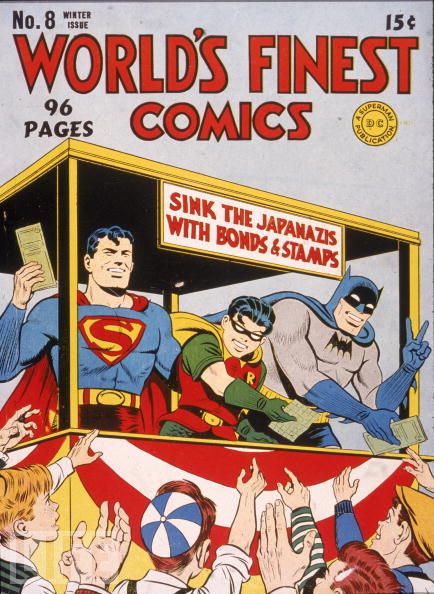
Placing superheroes into world events is nothing new. Captain America #1 famously showed Cap punching Hitler out, and Superman and others advertised for war bonds all throughout World War II. The Punisher was originally a Vietnam War veteran who was disillusioned with the US justice system. However, it is easy to see why DC would not have published this story with Batman in it. In the space of one night, the Fixer tortures a captive terrorist for information, shoots dozens of generic Arab terrorists, and detonates a weapon of mass destruction beneath Empire City. He behaves in thoughtless, vengeful, ultra-macho fashion. He does and takes whatever he wants, from sex with a cat burglar to bloody vengeance on the nameless terrorist fodder who fall in his path. Instead of a hero, The Fixer seems like a hyper-steroid version of the Abu Ghraib prison guards.

The book ends with an echo from his classic The Dark Knight Returns, focusing on the police commissioner. Only instead of a happy ending where he needlessly worries about his family who are ultimately safe, this time he experiences the real terror that comes from the vacuum left by their deaths. This possibly poignant scene seems forced after so many pages of mindless, macho violence. If this graphic novel is to be called successful in any way, it seems to be in capturing the maelstrom of sensations and emotions that terrorism evokes as well as the seeming futility in determining a feasible course of action.

It is difficult to believe that Miller would downplay the sacrifice of so many soldiers and civilians in the wake of 9/11, not to mention that long, hard hours actual people have worked to respond to countless conflicts, to elevate the insanely unrealistic actions of a superhero. Perhaps this book is a commentary on the ultimate inability for superhero narratives to deal with such serious and complex issues, but Miller seems to relish the action, sex, and violence too much for me to credit him that intention. He speaks about his intentions with this comic in this interview.

In terms of art, the book progresses from some dynamic and detailed layouts to increasingly sketchy and rushed artwork. It appears that Miller sacrificed the rendering to get the book finished, which seems strange for a book the publishers claim was "ten years in the making."

Most reviews I have seen are mixed at best, but some call the book terrible. David Brothers found much to dismay him in this graphic novel, summing up that Miller is "punching far below his weight class." Ryan K. Lindsay wrote that he found some parts stunning and that the book works well as a piece of propaganda but not always as a comic. Sean Kleefeld wrote that the book is full of what Miller does well "but none of it of any real substance." Johnny Destructo called it "Sloppy, arrogant work by an arrogant bastard." J. Caleb Mozzocco summed up his take on the book, "It’s beautiful artwork, in service of an ugly story and uglier still politics. I guess that’s what happens when a genius cartoonist gets terrorized, and puts pen to paper while still in a state of fear." In contrast to many of these reviews, Bob Temuka wrote about liking the art, the visceral thrills of the book, and its potential therapeutic value for Miller at least.

Holy Terror was published by Legendary Entertainment, which is owned by Warner Brothers, also the owners of DC Comics. They provide a video trailer here.

Thursday, January 5, 2012

Trotsky: A Graphic Biography

Before he famously died at the hands of an icepick-wielding assassin, Leon Trotsky became synonymous with communism,the rise of the Soviet Union, and the escalation of the Cold War. This graphic biography details his work as a propagandist, writer, revolutionary, and leader of the Red Army. It also chronicles Trotsky's often rocky relationship with Lenin and the long and bumpy road that led to the establishment and government of the Soviet Union. In the end, his presence offended and threatened Stalin, leading to his doom.

Trotsky is the creation of Rick Geary, a prolific, well regarded, and long working comics artist who has produced a good number of historical graphic novels, including a number of books about Victorian era murders. Considered a master by his peers, he received the 1980 Inkpot Award from the San Diego Comic Convention and the 1994 Book and Magazine Illustration Award from the National Cartoonists Society. Geary provides a level of historical and artistic accuracy that sets him apart from other graphic novelists.

Unlike the contentious figure Trotsky cut, most reviewers agree on the worth of this graphic biography. In the course of a longer review of literature on Trotsky, the International Socialist Review's Paul Le Blanc called this book "simple, slender, remarkable." Boing Boing's Cory Doctorow commented that although it cannot cover everything and it suffers from a lack of Trotsky's own writing, this book does his story and thinking "great justice." John Hogan wrote that it "works wonderfully" as an introduction to Trotsky, adding that Geary "stays mostly impartial, presenting just the facts of Trotsky’s life along with his layered artwork." The Comics Journal's Marc Sobel was more critical, noting that those looking for a quick read or great artwork would be well served, "but for readers interested in delving deeper and getting to know what kind of man Trotsky was, this graphic biography has little to offer."

Trotsky was published by Hill and Wang. I could not locate any excerpt online, but there are a couple of representative panels from the book in this review by Elizabeth Hewitt.