Showing posts with label Middle East. Show all posts

Saturday, April 25, 2026

Squire

Squire is a book I have had on my to-read shelf for too long, and I am so glad I finally got to it. It is about Aiza, a young woman who belongs to the Ornu people, who have been recently conquered and absorbed by the Bayt-Sajji Empire. Her people are looked at not even as citizens, and she resents their treatment as thieves and scoundrels. After persisting against her parents, she enlists in the squire training program in the Bayt-Sajji army. If she successfully completes the training to become a squire she will become a citizen and be on the pathway to become a knight, a storied and prominent position.

Looks glamorous, yeah?

As a recruit, she has to contend with harsh living conditions, highly competitive peers, and the difficult tasks set for them by military leadership. Aiza hides her identity as a Ornu from everyone, and over time she begins to learn more about the history of the conflict, the intentions of the military, and what being a citizen and a knight actually entails. These are some harsh realities, but she finds hope and encouragement from some unlikely allies, as well as a lot of prejudice and fear from her compatriots when they learn where she's from. 

This book is set in a fantasy version of Jordan and Turkey, and it touches upon many themes and issues that persist in the Middle East both past and present in terms of conflicts between different social groups and the mythologies perpetuated to enforce unity. The artwork is gorgeous and colorful, and the characters are vivid both in terms of their relationships, the plotting, and how they are drawn. I got very swept up by this book, and I found it nearly impossible to put down after I was about a quarter way through reading it. I feel it is exceptional and works on so many levels, as a fantasy tale, a modern parable, and a suspenseful action story. 

I should also add I really appreciated the final section of the book, which is full of story ideas, initial designs, and lots of information about the amount of research and design that went into this book. Making comics, let alone a graphic novel, is a lot of work. It's good to see more about the process so that younger readers can appreciate what it takes to be comics artists themselves. 

The two who put so much time and effort into making this book are writer Nadia Shammas and artist Sara Alfageeh. Shammas has written a number of graphic novels including the Ignyte Award-winning Where Black Stars Rise and Ms. Marvel: Stretched Thin. Alfageeh also has illustrated the picture book Not Yet: The Story of an Unstoppable Skater. Both collaborators speak extensively on their work on this book in this interview

Squire won the 2022 Harvey Award for Best Young Adult Book, and it has received many positive reviews. In their starred review, Publishers Weekly noted, "Alfageeh’s arresting visuals conjure a richly detailed, sun-drenched world in which impressive architecture fills open landscapes populated by visually diverse and complex characters." Kirkus Reviews called it "an engaging graphic novel that examines the nature of prejudice and the cost of imperial expansion." Helena Ramasroop wrote, " It was charming and unexpectedly humorous while also tackling important topics like prejudice, colonialism, justice, and the purpose of history."

Squire was published by Quill Tree Books, and they offer a preview and more here.

Wednesday, June 10, 2015

Mike's Place

Mike's Place is a gripping, heartfelt true story about a blues bar in Tel Aviv that was attacked by a suicide bomber in 2003. The events were also depicted in the 2004 documentary Blues by the Beach, and two of the filmmakers wrote this graphic novel. The documentary was in the works already, an attempt to capture the spirit of Mike's Place and why it was a place of joy amidst much turmoil. It turns out that terrorists targeted this establishment because it was such a center of joy and relief, and their true life narrative turned tragic.
What is impressive about this book to me is how much it tackles. It gives a human face to the "Mike's Place family," the people who worked and played at the bar, some who lost their lives and all who were victims of the violence.  Getting to know these folks endeared them to me and gives the final events more impact while putting a human face on these events.
The book also has the intrigue of a thriller with glimpses into how the bombing was planned and carried out. It clearly depicts the social and political circumstances in Israel at the time that bring about this horrible act as well as its resulting grief and aftermath.

Finally, this book is a critique of the use of violence by religious extremists, a point driven home by the use of quotations from the Qur'an that open each chapter of the book.


This graphic novel was written by Jack Baxter and Joshua Faudem, who are also characters in the story, and drawn by Koren Shadmi. Baxter was a producer of the 2004 documentary film and Faudem the director. Baxter speaks about the creation of this graphic novel in this interview. Shadmi is an artist who has worked on a webcomic The Abaddon as well as published a collection of short comics stories called In the Flesh. Here, his artwork leans toward realism, and he does very well in conveying emotions, personalities, and actions via journalistic black and white images.

All of the reviews I have read about this book describe a book that is powerful and moving. Brett called it "beautifully haunting." Bradley Campbell called it "a gripping read" that "shows you that people have the ability to heal; but it also shows how difficult, complicated and saddening the healing process can be." Joe Gordon wrote, "It’s funny, it’s sad, it’s upsetting, it’s inspiring, it has happy moments of laughter and dreadful troughs of despair, just like life, really, but through all of the events here remains that warm, human feeling of inclusion and family, perhaps our only real defence and hope against the hatred in the world."

Mike's Place was published by First Second, and they have a preview and more info available here.  There is also a video trailer of the book posted here.

A review copy was provided by the publisher. Thank you, Gina!

Monday, March 10, 2014

Persia Blues, Book 1: Leaving Home


Folks might remember me sharing the Kickstarter link for this work some time ago, and I finally got around to reading the physical book that I received after pledging my support and the project was funded. I am glad to report that the finished product is beautiful, unique, and quite compelling.

There are two narratives in play in this book, both starring Minoo Shirazi. The first occurs in the present in modern Iran, a strict, conservative, and oppressive country where being a free-thinking woman brings many frustrations and potential perils.
The other(?) Minoo lives in a fantastic world that melds history and legend into one. She is an adventurer in the vein of Conan, fighting the good fight against oppressors and evil magicians, contending against mythical beasts, and searching for meaning, shelter, and fortune.
The present day Minoo also has to deal with her family, mostly her overbearing father, who tries to encourage her intellectual pursuits, is just as frustrated at the current regime as she is, and wants to make sure his daughter is protected and prepared to deal with the realities of contemporary Iran. 
The conflicts of the past/present and East/West weave through both narratives, and they combine to paint a powerful picture of the many issues facing these individuals and the social systems in which they live. Certainly, this book touches upon many of the themes of  Persepolis and begs some comparison with its focus on coming up in a repressive society and also its explicit references to the ancient classical capital. Persia Blues is much more explicit with its symbolism and gives a sense of a past that is not simply utopian but also fraught with obstacles and oppression. Satrapi's book is slightly less nuanced, I'd argue, with regard to the past being set up clearly as the better alternative to the present, the good old days. The fantasy setting and lush painterly art style of the past in this book might convey that message as well, but that past is also presented as problematic in its own ways. In any case, I get the sense that these creators feel there are no easy solutions to these situations and that a simple return to an idyllic past is impossible.

In the end I cannot say for certain how the rest of this narrative will compare with that "modern classic." This book is part of an incomplete series, and  I seek more resolution. On one hand, this volume does not complete the narrative, and is the first of a proposed trilogy, and I am very intrigued to see how the parallel narratives play out and intersect or diverge in later volumes. On the other, the incomplete story makes me wonder where the creators are going and if all my theories about meaning are warranted. I have a difficult time not trusting them to stick the landing though, given how much nuance and meaning they have created thus far.

This book was created by writer Dara Naraghi and artist Brent Bowman. Naraghi self-publishes some of his work for Ferret Press, and he is also known for works from Dark Horse, Image, and DC Comics. I have met him at a comics convention and enjoyed his PANEL: Ferret Press anthologies. He is a friendly, talented, and thoughtful guy, and I wish him every success. Bowman is a freelance comics artist/illustrator, and you can view more of his non-comics art here. His dual art styles in this book are impressive, and I hope this book brings more attention to his artistic abilities. Both creators speak about their collaboration generally and specifically on this book in this interview. Naraghi speaks about the book and the process of using Kickstarter to fund it in this interview.

A 2014 YALSA Great Graphic Novels for Teens Nominee, Persia Blues has been well reviewed. John Hogan dubbed the book "a huge treat." CBR's Greg Burgas called it "a solid beginning with a lot of cool cultural tropes that we don’t usually see because we’re not reading comics about Iran." Win Wiacek summed up, "Engaging, rewarding and just plain refreshingly different, Persia Blues looks set to become a classic in years to come."

There are previews, author information, and a whole lot more at the book's official page. This first volume was published by NBM.


Thursday, April 25, 2013

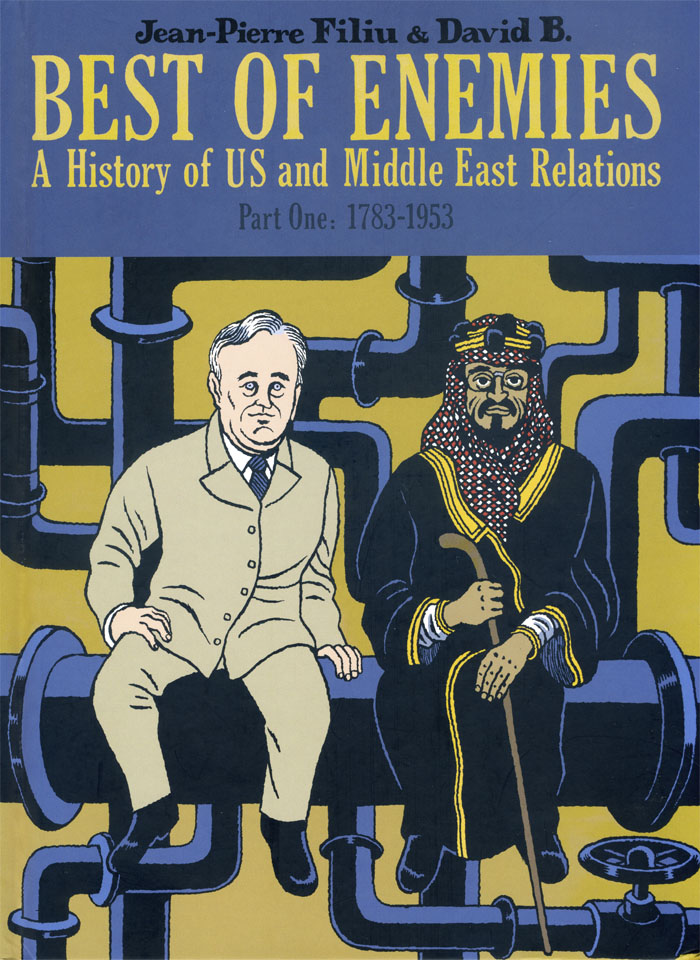
Best of Enemies: A History of US and Middle East Relations, Part One: 1783-1953


The best kind of educational books both engage and inform their readers, and I am happy to report that Best of Enemies is that kind of graphic novel. There was much in it that surprised me, including the fact that the Ottoman Empire was the first foreign entity the nascent US declared war against as well as the extremely sketchy roles FDR and Dwight Eisenhower had in post-colonial Iran and installing the shah into power. The book levels blame in many directions, and no one really emerges as a hero, not even the US. The narrative is complex and compelling, well detailed and documented by a prominent and respected scholar, Jean-Pierre Filiu. Certainly there is much here that is eye-opening and also shows that the conflicts we are still witness to are complicated and long-lived, going back centuries before oil was even a factor.

For me the highlight of this book was David B.'s art, which is bold, iconographic, and searingly beautiful. I found myself lingering over the physicality of his patterns and the etherealism of his imagery that simultaneously propel the story while commenting on it like the best kinds of editorial cartoons. His political views resonate through the narrative clearly, offering insights that take full advantage of the uniqueness of the sequential art medium. Also, a thread of icons that date back to the Sumerian king Gilgamesh is woven throughout, lending a legendary and historic quality while also tying events together thematically. After reading Best of Enemies, the current conflicts in the Middle East seem less like recent concoctions than long-building events predicated on a series of scuffles, backroom deals, and cash-grabs.

Both of this book's creators are distinguished in what they do. David B. is a respected, award-winning comics artist whose autobiographical graphic novel Epileptic is considered a modern classic. He has influenced many other artists as a founding member of the prominent French publishing house, L'Association, which is where Marjane Satrapi and Joann Sfar were first published. Dr. Filiu has been a political consultant in high-level capacities over the past three decades and is professor of Middle East Studies at Sciences Po, Paris School of International Affairs. He has also worked internationally at other prestigious schools like Georgetown and Columbia University.

Reviews I have read online have been very positive about this book. Bart Croonenborghs highly recommended it, writing "Jean-Pierre Filiu and David B. complement each other perfectly in crafting not only an important historical document but also a reflection on current times." Tucker Stone, who is not one to gush, gushed, "I'd recommend this book unreservedly to someone who wants to drink in some exciting art, I'd donate a thousand copies to school libraries throughout the world." Henry Chamberlain felt the book was very even-handed, stating "The approach of the book is refreshing in how the U.S. is placed among all the other players of geopolitics. There is no shining beacon on a hill, per se, and that goes for everyone."

This book is the first of a projected trilogy. It was published by Self Made Hero, and there is a preview at Amazon.com.

Saturday, April 20, 2013

Jerusalem: A Family Portrait


Jerusalem is an impressive graphic novel both in size and scope. It is set from 1940 to 1948, a time when the Jewish nation of Israel was being constituted. The main plot follows the Halaby family. Two brothers, Isak and Yakov have a long standing conflict of Biblical proportions and there is also financial drama between them. This conflict between Isak, a candy peddler, and his affluent brother devolves into debts, slights, and legal actions. This strife also affects their spouses and children, all of whom are trying to coexist in some manner.

Layered into that family drama are the political happenings of the day, and this book is as much about political machinations as it is familial ones. Complicating matters further, some family members are part of the anti-British and French occupation movements. We are privy to some of the children, especially Isak's defiantly outspoken son Motti, pushing back against the indoctrination happening in the schools. The older children are embroiled in various military forces and actions, and they are often divided along political lines. These conflicts are depicted in human and affecting ways, but the story is also chock full of historical information, and I felt that I was enlightened much more about the origins of Israel of a country.

Also, it is worth mentioning that this story does not shy away from the brutality and horrors of war, and is stunningly graphic concerning destruction and death. The art is not over the top regarding these depictions, and I think that the violence of war juxtaposed well with the emotional violence that occurred between a number of the characters. Prisoners are not taken on many fronts in this book.

This book was a collaboration between writer Boaz Yakin, a screen writer who has also written the graphic novel Marathon, and Nick Bertozzi, a prolific graphic novelist interested in historical work. Among his works are the Harvey and Ignatz Award winning series Rubber Necker as well as the graphic novels The Salon, Lewis and Clark, and Houdini: The Handcuff King.  I felt that his moody, atmospheric grays and brand of cartoon realism made for some very effective and evocative scenes. His art style perfectly balances the emotional and factual needs of the narrative. For those interested more in the narrative, this interview with Yakin casts more light on Jerusalem's inception and creation.

In regard to its critical reception, Booklist gave this book a starred review, but most reviews I have seen appear more measured. Hillary Brown opined that it was "reasonably compelling with its dynamic politics and wide scope, even if it tries to pack too much in." Henry Chamberlain praised that it "provides a rich and dense texture to a narrative that invites a thorough reading." April called it "immensely readable," even if she was not a big fan of the artwork. I admit that this book does have a lot packed into it, but I felt in the end that that memorable characters, dramatic situations, and ambiguous, impactful conclusion made this a powerful work.

A preview, reviews, and more are available here from the book's publisher First Second.

Thank you, Gina, for the review copy!

Wednesday, July 20, 2011

How to Understand Israel in 60 Days or Less

Sarah Glidden has received numerous awards and accolades for her work in minicomics, including the 2008 Ignatz Award for Promising New Talent. She is an American-born artist, and this book is her first major endeavor. These interviews with Douglas Wolk, Samuel J. Scott, and Michael Cavna shed more light on her life, politics, and work.

How to Understand Israel in 60 Days or Less is a mediation about the politics and reality of Israel in the face of constant conflict with Palestinians and surrounding Arab nations. Glidden visited Israel in 2007 for a ten-day "birthright tour." She comes in expecting to find much pro-Israeli propaganda, as she is more sympathetic to the Palestinian side of the conflict. Instead of a simple bully-versus-victim situation, she comes to see many aspects of the historical happenings and political realities. She wrestles with her beliefs often, in fictional scenes depicted as a fantastical courtroom. She visits a great many places on the tour, including Tel Aviv, Kinneret, the desert, Golan Heights, and Jerusalem, learning about their historical import as well as their current statuses. Afterward, she stays for some more time, trying to get a less filtered, more real view of Israel by visiting the West Bank, but still no clarity emerges.

This intriguing volume contains much material to debate about regarding the politics of Israel, and it acts as a treasure trove of information not only within the actual narrative but also in the helpful glossary and timeline at the end of the book. I felt that the story was a fine combination of nonfiction and fantastical elements that was dense at times, but appropriately so according to the subject matter. The reviewer at Jewlicious found the plot very compelling and read the book in one sitting. Jen Sorenson called the book "a particularly effective piece of graphic storytelling," noting that the fictional courtroom scenes helped her pull the story and arguments together well. Kelly Thompson does not know if she is any clearer about the Israeli/Palestinian situation after reading it but noted that she was moved by this well-crafted graphic novel.

This book is published by Vertigo, and a preview of it is available from TIME magazine's Techland.

Friday, October 15, 2010

Cartoon History of the Universe III: From the Rise of Arabia to the Renaissance

Cartoon History of the Universe Part 1 is here. Part 2 is here.

A lot of ground gets covered in this volume. It details the life of Muhammad and the rise and spread of Islam. It also touches on Asian and African history, follows the exploits of the Turks and other nomadic peoples, and covers medieval life in China, India, and Japan. Some other high points include "the Dark Ages," Muslim Spain, and the European Middle Ages from the Crusades to the Black Death. The book goes on to cover the Italian Renaissance and various naval expeditions to explore the world, concluding with Christopher Columbus's historic departure in 1492.

Larry Gonick wrote and drew this series of books, which has been coming out sporadically since 1978. This volume of the series won the 2003 Harvey Award for Best Graphic Album of Original Work, and has received many accolades. Reviewer Jerry Stratton raves that all the Cartoon History of the Universe books "should be on every bookshelf of the English-speaking world."

Some sample pages from the book are available here. Another preview is available from publisher W.W. Norton.

Monday, July 5, 2010

The Cartoon History of the Universe I: Volumes 1-7: From the BIG BANG to Alexander the Great

This book began as a series of comic books that started in 1977. It covers history from the Big Bang until the time of Alexander the Great (roughly 350 - 320 BCE) with well-researched facts, footnotes, citations, resources for further reading, and the timely infusion of humor. The author/illustrator Gonick plays the narrator, portraying himself with wild Einstein-style hair and amazing abilities to travel through time and space.

Volumes 1 through 7 cover a broad range of history, from the origins of the universe and life on Earth to the Ice Age and the rise of human civilizations. The high points include sections on Mesopotamia, Ancient Egypt, the Middle East via the Old Testament (or the Torah), Mycenaean Greece, and Athens. At the end of the book are pages dedicated to brief commentary on the references that inform the cartoons, which could also be read for further information.

Writer and artist Larry Gonick has been creating comics since the early 1970s, and he has made a cottage industry out of his Cartoon series of nonfiction. His works range in topic across chemistry, genetics, statistics, and sex. He has served as a Knight Science Journalism Fellow at MIT as well as a cartoonist for Discover and Muse magazines. He and his work have won a number of awards including a Harvey and an Inkpot. For those interested in his life and work, this interview with Richard Morris is quite informative. This interview with Chris Mautner at Robot 6 gives some insight into the Cartoon History of the Universe books, his magnum opus.

The Cartoon History of the Universe books have been very well received and have been translated into many languages and sold internationally. Reviews have been largely positive, and many of them point out that it was entertaining and effective to learn about history via comics. J. Stephen Bolhafner called it "a delight to read." Jerry Stratton stated that this book and the rest of the series "should be on every bookshelf of the English-speaking world." Gonick also catalogs a diverse range of reviews on his website.

Gonick offers a sample page on his website, but a lengthier preview can be found at Amazon.com.

Sunday, May 16, 2010

Palestine

Palestine is the first major collected work by Joe Sacco, a journalist who draws the events and people he encounters in different hot spots of the world. This books casts a spotlight on the people whose side we usually don't hear about in the US, telling the story of Palestinians who live in the West Bank and the Gaza Strip.

Sacco was there in December 1991 until January 1992, and his motive for creating this work was to add balance to the coverage of the events in this area of the world. He felt that all the news reports he saw were told from the Israeli point of view, and he wanted to see what the other side looked like and had to say. The people he met were largely hospitable, drank tea, and were not all monsters or terrorists. However, they did have many stories about the foul deeds perpetrated on them by Israeli forces. After reading these accounts, it seems that neither side is entirely in the right in this conflict, to say the very least.

Palestine was originally published as separate issues from 1992 on and collected in 1996. In 1996, the series also won an American Book Award. It was reissued in 2007 as a special edition with an introduction by noted international scholar Edward Said.

In general, this is a very well reviewed work. Josh Flanagan at iFanboy called it one of the best comics of the decade. The Observer's David Thompson offered the opinion that "Sacco's greatest achievement is to have so poignantly depicted contradiction, oppression and horror in a form that manages to be both disarming and disquieting." The Independent's Charles Shaar Murray wrote that "It's a powerful piece of work" but also noted there was a uniformity to the depictions and "few of his Palestinian interviewees emerge as 'characters.'"

A short preview is available from the book's publisher, Fantagraphics. A longer slide show preview of the special edition of the book is here.