Showing posts with label Civil War. Show all posts

Saturday, September 20, 2025

Big Jim and the White Boy: An American Classic Reimagined

The Adventures of Huckleberry Finn has been called "the best book we've had" (by Ernest Hemingway) and also been widely banned because of its copious use of the N-word. Here, this American classic is recast in a way where Jim becomes the central figure and Huck is more of a sidekick instead of vice versa. A big impetus for the switch is to bring dignity and humanity to a figure who is not given proper treatment in the original novel, but it is also made to explain some weirdness to the narrative, namely revealing why an escaped enslaved person would travel south instead of north to safety. Also, this book explains why Jim is so attached to Huck in the first place.

One major addition to this story is the revelation that Jim's family, who are referred to in the original but never named, have been illegally sold down the river by Huck's reprobate father Joe. So, Jim embarks on his odyssey to be reunited with them. Along the way, he is hunted, becomes a sort of racist bogeyman, assists with the Underground Railroad, joins the Union army, and has all sorts of adventures. He meets many people, telling all of them his story, and he becomes an almost mythic figure, an adventurer and beacon for freedom. 

What makes this narrative work is the fact that it is told across three different timelines. Some of the book focuses on the adventures from the book set in the 1850s, other portions show Jim and Huck as old men in the 1930s, telling tales of their adventures to Jim's grandchildren. The third storyline is set in 2022 and follows Jim's great-great-great-great-granddaughter Almena who is a history professor researching his life. The various viewpoints make for a rich, complex narrative, and the result is a grand epic. I cannot say enough good things about this book.

Big Jim and the White Boy was a collaboration between writer David F. Walker and artist Marcus Kwame Anderson, who previously produced the Eisner Award-winning graphic novel The Black Panther Party. Walker is a prolific author and is best known in comics for his work on the series Bitter Root, runs on Marvel Comics series such as Luke Cage and Power Man & Iron Fist, and the DC Comics series Naomi. He also wrote another nonfiction graphic biography of Frederick Douglass. Anderson also worked on his creator owned series Snow Daze. Walker and Anderson speak about their work on this book in this interview.

All of the reviews I have read about this book have been glowing. In a starred review, Publishers Weekly called it "a vital reconsideration of an American classic." Mike Rhode wrote that Walker and Anderson achieved what they "set out to do, providing readers with a work that strips away the minstrel mask that Twain placed on Jim and reveals reality." Carla Riemer declared that "this well-researched, well-written book belongs in all library collections."

Big Jim and the White Boy: An American Classic Reimagined was published by Ten Speed Graphic, and they offer a preview and more information about it here. There is also this 11-page preview available from Publishers Weekly.

Friday, October 20, 2023

The Civil War Diary of Freeman Colby, Volume 1: 1862

What seems like a million years ago now, I supported a Kickstarter campaign for volume 3 of The Civil War Diary of Freeman Colby, and I am so glad I did. I read the first book a long while ago, and so much of it stayed with me. It is a faithful, compelling, informative, moving, and often funny adaptation of a Civil War soldier's diary (just like the title says!). When the war broke out, this 21-year-old New Hampshirite was a teacher, but when his gung-ho little brother Newton enlisted in the Union Army, his parents entreated him also to join so he could look after the impetuous lad. 

What follows is a treasure trove of experiences, a primary account of what these soldiers did, where they stayed, what they endured, and what they ate. That last point especially looms large, as much of this book involves matters we mostly take for granted today, such as a regular diet, routine medical care, and a host of gastrointestinal plights that plagued these soldiers for various reasons. Things are not always so great for poor Freeman. Also, we get to see the not always brilliant machinations of military leadership as well as the events of the day as interpreted by a civilian.

This last point is one of the main features of this book that really makes it sing. I love how this book is all from the viewpoint of a person I had never heard of before, and mostly the soldiers in these pages are basically homesick kids. It really impresses a view of the war in a unique and memorable way, a truly invaluable view of history. 

The other main feature that really makes an impression is the highly expressive artwork. Sure, it looks simple, with its spare lines and almost stick-figure rendering, but this simplicity belies the use of reference materials, much craft, and thoughtfulness. The accounts here are imbued with so much movement and feeling that they are almost palpable. It may be a cliche to say that this book makes history come to life, but I'll dare say it anyway. This series of books is an excellent resource for anyone interested in or learning about the US Civil War. And to boot, Volume 1 of the series was named one of YALSA's Great Graphic Novels for Teens in 2017.

Artist/educator Marek Bennett created this book and also runs his Comic Workshop across New England. In addition to the Freeman Colby series, he has also collaborated with a host of creators on The Most Costly Journey/El Viaje Mรกs Caro, a graphic medicine/ethnographic look at migrant workers in Vermont. He speaks about his work on the Civil War Diary series in this interview.

The Civil War Diary of Freeman Colby was published by Comics Workshop, and they offer a preview and more info about it here. Thus far, there are three volumes in the series

Friday, December 20, 2019

Major Impossible

I love, love, love, LOVE the Nathan Hale Hazardous Tales books, and Major Impossible, the ninth(!) entry in the series focuses on John Wesley Powell. He was an abolitionist and aspiring scientist who served in the Civil War. He rose in the ranks to brevet lieutenant colonel, and also lost most of his right arm. In 1869, he gathered nine men, four boats, and provisions for ten months to explore the Colorado River and the Grand Canyon. Not everyone made it back, but those who did chronicled their arduous journey well with journals. Those primary sources offered lots of great material that appears in this book.

One of the best features of this book is its attention to those historical details and facts. I learned much about exploration of the American west over the course of this book, but the characters are made to be engaging and interesting, too. Also rewarding about this book is its meta-narrative that builds in elements from other books. Of course, we see more interactions between the narrator Nathan Hale, the hangman, and the proctor:


These pages introduce the book, and they reward longtime readers of the series but also offer a quick introduction to new readers. I just gave this book to my 11-year-old nephew, and he got into it quickly and did not want to put it down. The combination of facts, vivid characterization, and a good dose of humor make this another excellent entry in a consistently strong series.

If you have been reading my blog for any length of time, you likely know that I love Nathan Hale's comics and graphic novels. This nonfiction series Nathan Hale's Hazardous Tales is the gold standard for historical graphic novels, as far as I am concerned. I loved his takes on fairy tales and the southwest, Rapunzel's Revenge and Calamity Jack. And I really liked his original sci-fi graphic novel One Trick Pony as well as his scifi/horror tale Apocalypse Taco, also released this year.

I have not been able to find many reviews of this book online, but the ones I have read praise the book. Vic Sage wrote, "The greatest gift that Hale’s books give is not just knowledge but an entertaining education – there has not been a book yet where I didn’t find myself going down a rabbit hole trying to find out more about what I’ve read in a Hazardous Tales offering." You can see a selection of other reviews at Goodreads, where the book currently has a 4.19 (out of 5) star rating.

Major Impossible was published by Amulet Books, and they offer a preview and more info about it here.

Thursday, September 5, 2019

Stage Dreams

Having read and loved As the Crow Flies, I have been looking very forward to reading this book by the same creator. Stage Dreams is a fun piece of historical fiction that features two queer women trying to find their way in the Old West. The first, named Flor, is a Latinx bandit who robs stagecoaches under the sobriquet of The Ghost Hawk. During one escapade she kidnaps Grace, who happens to be a trans Civil War deserter from Georgia. Because getting any ransom for her is a moot point, Flor instead uses Grace in a plan to defraud some Confederate robber barons who have designs on the New Mexico Territory.
Over the course of the book it is fun to see the two characters bounce off each other in their scheme and also develop a romance. They begin to see what the other can do, and they also show just how resilient and resourceful they both are. They are vibrant characters who really come to life through the vivid facial expressions, excellent line work, and the unique art style done with colored pencils. Of course, their scheme brings complications and things do go off the rails, but all resolves relatively well. The ending is also very open-ended, and it begs for a sequel.

I am a big fan of of this book's creator Melanie Gillman, who also teaches in the Comics MFA Program at the California College of the Arts. They have been doing a webcomic named As The Crow Flies, a celebrated work, nominated for Eisner and Ignatz Awards, the recipient of a gold medal from the Society of Illustrators, and named Best Book in the Middle Grades category for the 2018 Excellence in Graphic Literature Awards. They speak more about the creation of Stage Dreams in this interview.

All of the reviews I have read about this book have been positive. Kirkus Reviews summed it up, "An engrossing escapade with a heart-stealing queer romance." Suzanne Krohn called it "a fun and thoughtful adventure romance."There are more reviews available on GoodReads, where it has a 3.87 star (out of 5) rating as of this review.

Stage Dreams was published by Graphic Universe, and they offer an excerpt and much more here.

Thursday, August 30, 2018

Strange Fruit Volume II: More Uncelebrated Narratives from Black History

I very much enjoyed the first Strange Fruit book, so much that I included it in a chapter in a book on children's literature in the classroom. I was pleased to see its follow-up on the shelf at one of my local bookstores, and I snapped it up quickly. I admire the author Joel Christian Gill's politics, art, and intentions with this project, and I am glad to help share some of those here.
Not only is this book well researched, it also incorporates actual text from its subjects when possible.

What I liked most about this book is that it covers a wide range of people I had never heard of, bringing to light truly "uncelebrated" people like: Jourdon Anderson, a freed slave who wrote a wry, pointed letter to his former owner; Stagecoach Mary Fields, a pioneering postal worker who was quick with a gun and her wits; Willie Kennard, who was made sheriff with the expectation that he would immediately be slaughtered; Cathay Williams, a woman who disguised herself as a man to serve as a soldier in the Civil War; Blind Tom Wiggins, a blind, autistic slave who became a highly accomplished musician; Millie and Christine McCoy, conjoined twins who toured the world as The Two-Headed Nightingale; Victor Green, the author of a guidebook for black people traveling across the US, and Eugene Bullard, a WWI fighter pilot who was celebrated in France but ignored in his homeland. These tales not only inform the reader about notable figures, but also the social conditions under which they lived and their contributions to our culture. Strange Fruit Volume II is exceptional work on an important, overlooked aspect of US history. Impressively, I feel it could be read and taught in multiple grade levels, from elementary to high school.

Additionally, more so than the first volume, this one is more uniform in terms of its story presentations. Each one has its own title and has space to breathe. The first book felt more like a collection of tales that may have appeared elsewhere, and had mixed formatting. This one seems much more intentional and measured, providing more coherence and polish and showing much more confidence and craft in its artwork and storytelling. This book is one of the few sequels that is better than its predecessor.

This book's creator Joel Christian Gill is the the Chair of Foundations at the New Hampshire Institute of Art. In addition to the Strange Fruit books, he has also published a couple of extended biographies of African-Americans in his Tales of the Talented Tenth series, on lawman Bass Reeves and motorcyclist Bessie Stringfield. He speaks more about his comics work in this interview.

I was not able to find many reviews online for this book, but what I did locate was positive. Terri Schlichenmeyer called it "a quick-to-read curiosity-satisfier is exactly what’s needed for home or school." For those interested in hearing Gill speak more about the need for sharing these uncelebrated narratives, you can listen to this interview .

Strange Fruit Volume II was published by Fulcrum Publishing, and they offer more info about it here.

Monday, February 20, 2017

The Hammer and the Anvil: Frederick Douglass, Abraham Lincoln, and the End of Slavery in America

The Hammer and the Anvil: Frederick Douglass, Abraham Lincoln, and the End of Slavery in America is an expertly researched and told nonfiction story of two massive historical figures and their effects on US history. In order to tell both stories, the book employs alternating narratives, indicating which is which via a simple color scheme. Douglass's story is told in blue:
And Lincoln's in red:
Both biographies begin with respective childhoods and formative experiences that would come into play later in their lives. Along the way, I learned much about each person and major players of the time period. Also, there are deftly told accounts about slavery, the Civil War, and other historical contexts. That the creators were able to chronicle so much information while spinning compelling narratives and characters is extremely impressive. One of the features I admired most about this book is that it does not overly lionize either Douglass or Lincoln. Certainly they are shown to be impressive and important people, but they are also shown to have their own problems and human moments. I especially appreciated how Lincoln was not simply canonized as the Great Emancipator but was shown to wrestle greatly with many social concerns and pragmatic thoughts that conflicted with his idealism.

The artwork was also a huge positive about this book. There are many detailed panels that represent the time period very well. Additionally, there are multiple scenes where characters' emotions and feelings come through very powerfully. This book is both masterfully plotted and illustrated. It definitely brings history to life.

This book's creators Dwight Jon Zimmerman and Wayne Vansant also collaborated on another graphic history, The Vietnam War. Zimmerman is the author of a number of other books on military history as well as a producer of TV shows on that topic. Vansant began drawing comics decades ago with Marvel Comics' Savage Tales and The 'Nam, and he has drawn a number of historically-themed graphic novels including one about the D-Day battle at Normandy.

Reviews and news I have read about the book have been positive. It was nominated for YALSA's 2013 Great Graphic Novels for Teens list. Hillary Brown concluded, "Anyone who doesn’t specialize in this material will learn something." Publishers Weekly summed it up as "a compelling look at two of the most important figures in American history." Viviane Crystal called it "a superb historical fiction story."

The Hammer and the Anvil was published by Hill & Wang, and there is a preview and more information available here.

Tuesday, September 15, 2015

The Underground Abductor

If you have been reading my blog and paying attention, you pretty much know that I think Nathan Hale's Hazardous Tales are some of the best historical graphic novels I have read EVER. This volume, The Underground Abductor, continues that tradition. It tells the story of Araminta Ross, better known to most of us as Harriet Tubman, a civil rights activist and conductor on the fugitive slave network called the Underground Railroad. The book spans her whole life, from her time as a young slave through her adulthood when she accomplished a great many brave and cunning deeds.
Aside from the expert storytelling and excellent artwork, which is full of affect, action, and meaning, there are two things I really admire about this book. One, it takes a very broad consideration, that of slavery, and puts a very human and personal face on it. Two, it has shown me that I pretty much knew nothing of this remarkable woman's life. It even has a couple of sizable digressions to give the tale more context, one about Frederick Douglass and the other about Nat Turner. A great book informs as well as entertains, and this is a great book, in my estimation.

In addition to creating the first four entries in this series, the prolific Nathan Hale also has drawn two other graphic novels, Rapunzel's Revenge and its sequel Calamity Jack. He has also worked on a variety of children's books, including Frankenstein: A Monstrous Parody and The Dinosaurs' Night Before Christmas. He shares a lot of fun artwork and news via his blog, and he speaks about his career in this interview.

The reviews I have read about this book have been very positive. Sarah wrote, "I learned so much about Tubman's life - I actually got chills while reading this story as I thought about what a truly exceptional woman she was." JediKermit praised how it "honors the pain and condemns the horrors of slavery, but is still appropriate for the target audience of 5th - 8th graders." Kellee called it her favorite in the series so far, "the most intense of his stories" of "one person’s resilience in the face of pure doom."

The Underground Abductor was published by Amulet Books, and they have a video preview, teaching guide, and more information available here.

Wednesday, July 15, 2015

The Divine

The Divine was inspired by God's Army, a group of Burmese dissidents led by twin 12-year-old boys, but it takes that seed of truth and spins it into a much broader and fantastic fiction that still manages to comment on contemporary issues. The plot follows Mark, an ex-military explosives expert from the US who is stuck in a crappy job, with a baby on the way and pressure to move on to better conditions. He gets contacted by his friend Jason to be a contractor on a lucrative mining job in the fictional southeast Asia country Quanlom. Soon, he finds himself surrounded by conflict and he is moved by the plight of the country's inhabitants, particularly the children who are caught up in the violence.

 
In this book, the dragons are both literal and figurative. Mark is astounded when he finds that two of these young soldiers he befriends can summon gigantic warriors and also control powerful, destructive supernatural forces. Jason is not so sympathetic, and much of this book is a debate/commentary on the nature of war and its consequences. Even though it is a work of fiction, it packs a powerful and realistic punch. There are a number of monsters in this book, and some of them are actually humans.

In discussing this interesting, gripping, and provocative tale, I have not even gotten to what I feel is the strongest part of this book, the artwork. Brothers Asaf and Tomer Hanuka have hit a home run with their expert depictions of human moments, frenetic action sequences, and broad vistas that call to mind classic Asian landscape paintings. The pages ripple with action, and I love how the coloring is used to convey mood with foreboding reds, soothing greens, and murky browns. As you can see in the splash page below, the art is wondrous to drink in.

Asaf is also known for his work on The Realist webcomic, and both brothers have impressive portfolios of commercial art work for major media outlets. Writer and filmmaker Boaz Lavie has written for many venues, and he is also known for his short film, The Lake. This interview with all the creators casts more light on their work on this book.

The reviews I have read of this book have been celebratory. Publishers Weekly called it "heady, hellacious, and phantasmagoric." Scott at the Open Book Society called it "one of the most perfect blends of word and pictures." Nathan Wilson called it "the latest installment in a catalog of award winning books."

The Divine was published by First Second, and they have a preview and much more available here. Because of occasional swearing and a few scenes of graphic violence, I would recommend this book for readers mature enough to handle both.

Thank you, Gina, for the review copy!

Saturday, September 20, 2014

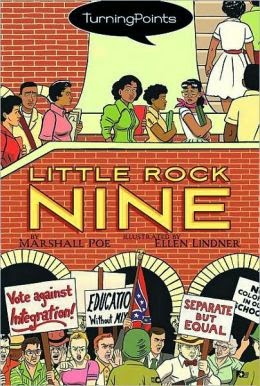
Turning Points: Little Rock Nine & Sons of Liberty & A House Divided

Turning Points is a series of graphic novels from Aladdin Paperbacks, that tell about important moments and events in US history. These books are portable and affordable, and I have had them on my "to read" pile for a while now, so there is no time like to present to see how good they are. All three of these books I review below were written by Marshall Poe, a writer and historian known for his work at The Atlantic and also as editor in chief of the New Books Network.

Little Rock Nine details the ongoing struggle in 1957 about integrating the public schools in Arkansas. Because of the Brown v. Board of Education Supreme Court decision, school integration was national law, but the state laws in Arkansas forbid it. This conflict is embodied by looking at two families, a common conceit in these books I found, which makes the issues both more pressing and personal. The two families, of course are black and white, and the main focus is on their children. Walter McNally, a 16 year old white boy, listens to his family squabbles over the integration. His father is a lawyer fighting for the rights of black people while his grandfather is the conservative foil who argues for keeping things as they are. Poe makes these characters somewhat sympathetic and human, but he also makes sure that they wear their views on their sleeves.
There is more nuance when looking at Thomas Johnson's family. He is a 15 year old black boy, and he took part in an attempt to integrate the schools the year prior. Of course, he wants to be treated equally, but he and his family have experienced the intense backlash from those who want to keep things as it was, and they are hesitant to deal with all the potential degradation and violence that came with social action. I appreciated that civil rights issues were here considered with more attention to the context, because I think for some students these matters are such cut and dried, facile decisions and I feel they should see how much of an actual struggle such change was.

All the reviews I have read about Little Rock Nine have been positive. Snow Wildsmith wrote, "Poe’s insistance [sic] on showing as many sides of a story as possible succeeds admirably here, resulting in two main character [sic] who are believable boys caught up in a storm they don’t quite understand and aren’t sure that they’re strong enough to face." The folks at the Historical Novel Society called it "exciting and historically accurate." Marya Jansen-Gruber offered this opinion, "This format will encourage young readers to ask questions about the civil rights movement, and the book will provide an excellent platform for a class segment about the Little Rock Nine."

The art in this volume is by Ellen Lindner. She is a cartoonist and illustrator known for her Ignatz Award nominated webcomic The Black Feather Falls and various other comics projects. Her artwork is somewhat cartoonish, but her storytelling is very clear. I also admire her ability to depict the emotions through her figures' faces and postures.

 
The artwork in the next two books is by Leland Purvis, whose other graphic novel works include the Resistance trilogy and a biography of Neils Bohr. His work in this volume is a combination of strong ink lines and sketch-like illustrations. I think he captures the historical flavor through costumes and backgrounds, though sometimes it is difficult to keep track of which character is which.

Sons of Liberty follows a period of US history from 1768-1776, a time of great change and a number of historical events leading up to the American Revolutionary War. The entryway into this story is Nathaniel Smithfield, a fictional apprentice to Paul Revere. He is ten years old when the book begins, and over time he meets a number of prominent patriots, including Sam Adams and John Hancock, and is witness to many events, such as the Boston Tea Party and combat in the battles of Lexington and Concord. Although this book is a piece of historical fiction and uses much original dialogue, there are a number of sections based in real accounts that feature first-hand descriptions of events.
Nathaniel throws a pretty mean rock.
The drama in this story is heightened by family tensions, with Nathaniel butting heads with his Loyalist father. In a clever way, this familial conflict mirrors the thought process of the colonists to rebel against England, and over time, the family dynamics shift and events cause people's minds to change. Even though I was pretty familiar with the actual events, I felt myself becoming concerned for the characters' lives. There is a lot to digest in the book, in terms of the sheer amount of facts, events, and characters, but I feel that the story is quite compelling and interesting.

The reviews I have read about Sons of Liberty are pretty mixed. Snow Wildsmith felt that this book was relatively weak, "mainly due to Poe attempting to cover too much time in too short of a book." The Historical Novel Society commented positively that it "gets to the heart of what it felt like to be a young boy in the middle of a thrilling period of history, with its conflicts, agreements and world-changing events." The Breed's Hill Institute summed it up as "an imperfect but interesting taste of history."
 
The third book in this series is A House Divided, set in the years leading up to the American Civil War.It follows a couple of brothers from the year 1856, Owen and Amos Bennington. They are close and very sympathetic to their parents' abolitionist rhetoric. After their parents deaths, they decide to take action and spread their message in the contentious soon-to-be state of Kansas. While there, they see just how violent and sneaky the pro-slavery contingents are, which leads them both to question how they can best help help the abolitionist cause. Younger brother Amos decides to join up with John Brown, because at least he is being proactive and taking the battle to those who would defend an unjust social system. Older brother Owen decides to go work for a politician he admires for his bold speeches, Abraham Lincoln.

The dual narratives shows two very different paths on the road to abolishing slavery, and there are a great many events enumerated in the storytelling. In addition, Purvis's artwork is less sketchy than in Sons of Liberty and includes more grey tones, which give it a more painterly sheen. The sum total of these features is an engaging set of tales that balance historical import with human emotion.

I was not able to find many reviews of A House Divided, but Snow Wildsmith praised it particularly because "one of the strongest points of this book (and of the series) is that Poe doesn’t neglect to tell both sides of a story as much as he can" and because "Purvis’ art is also stronger in this volume." I agree with her on both counts.

Previews and more information about all these Turning Points books can be found here from their publisher.

Friday, February 15, 2013

Big Bad Ironclad!


The second book in the series of Nathan Hale's Hazardous Tales, Big Bad Ironclad gives an account of the "Anaconda Plan" of General Winfield Scott to cut off the Confederacy's access to supplies and major water routes. This plans kicked off an arms race between North and South. In response to this move, the southern forces attempted to break blockades and were aided in their efforts by the creation of the first ironclad vessel the C.S.S. Virginia (formerly called the U.S.S. Merrimack), which could ram and destroy wooden ships. Faced with this new, devastating technology, the Union was forced to respond with its own upgraded vessels. Their first ironclad vessel, the U.S.S. Monitor, was commissioned into combat in order to turn the course of the naval conflict.

I really enjoyed this book. It and its precursor might just be the best Social Studies focused graphic novels I have ever read. One of the big surprises I got reading this one was just how much I did not know about the people involved in the American Civil War, particularly a complete ignorance of the exploits of William Barker Cushing. He was decorated for multiple acts of bravery on the Union side, for example, sinking an ironclad ship with a spar torpedo. Hale also did an excellent job portraying other notable figures such as Secretary of the Navy Gideon "Father Neptune" Welles, Confederate Navy Secretary Stephen Mallory, Assistant Secretary of the Navy Gustavus Fox, and the innovative Swedish inventor John Ericsson with memorable verve.

Another surprise I got reading this sequel to One Dead Spy was that it was actually completed before the ostensible first book of the series. Creator Nathan Hale also has drawn two other graphic novels, Rapunzel's Revenge and its sequel Calamity Jack, as well as a variety of children's books, including Frankenstein: A Monstrous Parody and The Dinosaurs' Night Before Christmas. He shares a lot of fun artwork and news via his blog.

Reviews I have read have been positive, commenting on the crisp art, humor, and well-researched information. Kirkus Reviews called it "livelier than the typical history textbook but sillier than the many outstanding works on the Civil War available for young readers," and added,  "this will appeal to both history buffs and graphic-novel enthusiasts." Degolar offered his opinion, "The book pulled me in and kept me eagerly engaged to the end. And, perhaps most importantly, when I finished I wanted to know more about the people and events depicted." Librarian Laura Given enjoyed the book, writing, "This book grabbed me from the first frame with its goofy hangman character who loves Children's Story Hour - all the way to the back matter where author Nathan Hale admits to outsourcing his research for the book to adorable babies."

Big Bad Ironclad! is published by Amulet Books. There is a preview available at Amazon.

Saturday, February 25, 2012

The Murder of Abraham Lincoln

Another entry in the Treasury of Victorian Murder series, The Murder of Abraham Lincoln details a 62 day period in US history, from March 4 to May 4, 1865. In that time, famed actor John Wilkes Booth would take part in a last gasp Confederate plot to kidnap the US president and turn the tide of the US Civil War. Because of circumstances, this plan changed quickly and he and his co-conspirators embarked on one of the most infamous assassinations ever. As with other books in this series, a meticulous sense of detail exists, from the maps of Washington DC, Wilkes' escape route, and Lincoln's funeral procession to quotations from major figures to the depictions of personality quirks. In particular, Mary Todd Lincoln's histrionics are not to be missed.

Rick Geary once again proves his artistic and story-telling chops in this volume. He packs an amazing number of historical references into this beautifully rendered tale while also making it compelling and suspenseful, even to readers familiar with the facts. This Inkpot Award and Book and Magazine Illustration Award winning creator is at the top of his game here.

The Murder of Abraham Lincoln has been a well received book. Mark S. wrote that the black and white illustrations perfectly suited the story in this "suspenseful, entertaining narrative." Elizabeth Kiem found that Geary "has done a fine job in turning out these villainous portraits." Nate Stearns praises the book and only find a slight fault concerning its mythologizing of Lincoln. If you scroll down this page, there are a number of other positive blurbs from prestigious publications like Publishers Weekly and the School Library Journal.

A preview is available from the book's publisher NBM.

Sunday, April 11, 2010

Booth

The name is Booth. John Wilkes Booth. While there are no moments where he takes a martini shaken not stirred, Booth is a complicated character. It would be mind-boggling today to have a successful actor from a prominent family with his star on the rise to suddenly become an infamous assassin who kills the president. Yet this mind-boggling scenario happened toward the end of the US Civil War when Booth became involved in a conspiratorial plot of Confederate sympathizers.

An avid lover and quoter of Shakespeare, Booth is charming, debonair, and also passionate about the Southern cause. His fall from grace from a popular, well-regarded actor in his day to being the villainous killer of Abraham Lincoln, one of the most well-regarded US presidents, is a compelling and amazing tale, tinged with pathos and hubris. Granted, the story here is told in a more even-handed way, as the historical context is shown as a period of greater ambivalence created by the war and debates over abolition and states' rights. These debates are embodied by how the Booth family is divided during this conflict.

Booth was written and drawn by experts from different fields. C.C. Colbert is a pen name for Catherine Clinton, a respected historian who holds a chair at Queens University Belfast. She has written a number of books, most notably of late a biography of Mary Todd Lincoln. She is also a frequent contributor to the History Channel. Tanitoc is a bande dessinรฉe artist. He is an active artist, writer, and lecturer who was a founder of the International Bande Dessinee Society.

Whereas Tanitoc is an experienced artist doing sequential art, Colbert is a novice in the medium. Reviews, while relatively positive, do point out some uneven features of the book. Kent Worcester thought the art tells a crisp story though in some sections footnotes could help the dense exposition. Tom Spurgeon opines that they do a better job with setting and mood than they do with characterization and motivation. Jared Gardner says that the story is fascinating yet told in a simplistic manner.

For folks interested in learning more about how the book was created, here is an informative article by Shaun Manning at Comic Book Resources.

A preview is available from the publisher First Second.

Big thanks to Gina Gagliano for the review copy!