Showing posts with label social studies. Show all posts

Saturday, August 30, 2025

Constitution Illustrated

Up until now, the US Constitution has proven to be a sturdy and adaptable document that has guided the country through troubled times by describing the rule of law as well as the basic rights afforded to Americans. Portions of it have been hotly contested and reinterpreted over centuries, and it has slowly been transformed through amendments. In Constitution Illustrated it gets further transformed with the addition of comics art to communicate the big ideas, making this landmark document more accessible in a time when folks should brush up on their rights.

I teach social studies teachers, and they seek ways to make difficult texts more approachable, and I love the way that the Constitution is parsed into manageable chunks in this book. Additionally, another scaffold is provided with the artwork, which can act as imagery to help recall the text or also extend it by adding another aspect for analysis and examination. These images run the gamut from classic works like Krazy Kat, Little Lulu, and superhero fare to more contemporary ones like Captain Underpants and Rick and Morty.

What I like about this book are the many ways you can approach reading it. A long-time comics reader, like me, can play "guess the pastiche" as I peruse the pages. One could also think of rationales for the pairings between sections and amendments and the comics style/artist/characters. Alternatively, a reader could also just be amused to see the juxtaposition of the governmental policies and comics artwork or, if nothing else, laugh at how the characters are rendered in colonial dress. I like the combination of humor and politics in this book, and I think it is an excellent way to get introduced to or just review the founding  document of the US government.

This book's creator, R. Sikoryak, teaches in the illustration department at Parsons The New School for Design. He has been making comics for decades, appearing in books such as Masterpiece Comics, in prominent publications like The New Yorker, and in anthologies like Raw. He speaks about his work adapting the Constitution in this interview.

All of the reviews I have read about this book have been positive. Ryan Carey called it "the most grand, ambitious, and relevant application of his unique skill set to date." Publishers Weekly wrote, "This pastiche of comics and politics is a cleverly educational and irresistible way to engage with this foundational text." Paul Buhle opines, "Wake up, reader. Look at the constitution with new eyes. Or else."

Constitution Illustrated was published by Drawn & Quarterly, and they offer more information about it here.

Know your rights!


Thursday, October 5, 2023

The He-Man Effect: How American Toymakers Sold You Your Childhood

I am a big fan of Brian "Box" Brown, a comics artist who uses a clean, minimalist art style to tell many a nonfiction tale. Here, I expected to get a story about toys and toy companies, but I got so much more. This book touches on many aspects of the social studies, including history, government, and psychology in explaining the arcane and calculated strategies that have shaped modern generations. This book begins with a look at propaganda from World War I and then traces how the strategies used to sell war to a population were turned to selling goods to people, notably toys, comics, and cartoons to children. 

Box Brown goes way-back to the roots of the propaganda.

Along the path of this explanation, Brown touches on many issues, including the work of psychologist (and Sigmund Freud's Nephew) Edward Bernays, a pioneer in the field of public relations; the evolution of public domain; the importance of children engaging in imaginative play; the great toy boom set off by the popularity of Star Wars, and Ronald Reagan-era policies that deregulated the connections between advertising and children's programming. As you can see, if you are interested in tracing a great many social issues about nostalgia, marketing, and public consciousness, this is the book for you. It critiques our modern culture, delving deeply into what shaped it and what we might do differently in terms of being a literate person in the 21st century. What could have been a trifling book about playthings turned out to have much more gravity.

This book's author Box Brown has drawn a number of nonfiction graphic novels. including ones about Andre the Giant, Andy Kaufman, Tetris, and Cannabis. He also published the fictional biography Child Star. Of late he is publishing a web-comic about the state of Cannabis in the USA, Legalization Nation, and is the midst of Kickstarter campaign to fund a print compilation of those strips. He speaks about his work on The He-Man Effect as well as a number of his other works in this article.

All of the reviews I have read of this book have been positive. Kirkus Reviews summed it up as "a boffo cartoon history of the deliberate manipulation of children's minds." April Spisak called it "another clever, sharp, and well-researched graphic novel that explores a pop culture non-fiction topic in close detail." Timothy ONeil wrote, "It can sound hyperbolic to call this book important, but it really is... The way nostalgia and brands have been entrenched in our culture is only growing bigger, and it’s important to understand how we got here."

The He-Man Effect was published by First Second, and they have a preview and much more information here.

Saturday, February 5, 2022

Montana Diary

Montana Diary is an interesting travelogue/mini-comic that melds history with current politics. It is about a road trip through "Big Sky Country" that delivers a history of the state, exploration of its national parks, sample of local culture, and reflection on contemporary politics and race relations. As a person in a mixed race marriage, Taylor shares her discomfort with social situations on her trip, admitting how she let her husband do the speaking, as she did not know how locals would react to them. She is also responding to the historical moment, living in the US after years of divisive hate becoming more and more pronounced. 

Thus, this book captures a few unique facets in its pages. It contains a response to a specific time, set in a particular place, and elucidating that place's history and geography. I think that the artwork is elegant and economical, depicting very human and occasionally humorous situations. It is alternately affecting, informative, and moving, portraying an intimate look into relationships and traveling. I think that it exemplifies the best characteristics of both diary writing and a travelogue, a compelling book that is surprisingly complex and enlightening in the short space of 32 pages. You will feel like you are there in the car with her, knocking back a huck shake while worrying about climate change.

Montana Diary is the work of Whit Taylor, who has been a very active cartoonist, editor, and contributor to multiple anthologies. She has won multiple Ignatz Awards, one for co-editing the anthology Comics for Choice and the other for outstanding series for Fizzle. She is also a contributing editor for The Nib.

The reviews I have read of this book have been positive. Rob Kirby wrote, "This thirty-two-page zine boasts a rich tapestry of content, more in fact, than many full-length graphic novels I’ve read of late. It’s an entertaining, genuinely rewarding read, created with equal parts heart and mind." Scott Cederlund opined, "It’s great to come away from a comic like this feeling like you’ve shared at least a part of the experience with the cartoonist and that’s what Taylor does in her cartooning."

Montana Diary was published by Silver Sprocket, and they offer a preview and more info here. You can also read the entire comic here, though I suggest you also buy a copy.

Friday, November 5, 2021

History Comics: The American Bison: The Buffalo's Survival Tale

I have been very impressed by the History Comics series of graphic novels, and this entry The American Bison pairs will thematically with one I reviewed earlier this year, The Wild Mustang. It traces the history of bison, which are also known as the American buffalo. These animals once numbered in the tens of millions across North America, until they were hunted near to extinction. This book is a treasure trove of information about them, with the graphics really enhancing the facts and history, as you can see in this excerpt:

One thing this book does well is detail the various relationships that the bison have had with different peoples and civilizations. A number of Native American people hunted and co-existed with them, and sometimes they even held them up for spiritual reasons. They were intimately linked with their way of life, for reasons of utility, nourishment, and spirituality. With the onset of white settlers, bison were cast in a different perspective, and with the proliferation of railroads, they became easy targets for recreational hunters who would pick them off with rifles as they crossed the nation.

Accounts of the efforts to both remember and preserve bison bookend this volume, providing insight into the nascent field of conservation as well as insights into the beginnings of national parks and nature preserves. The last third of the book especially chronicles the many people who worked to protect them, sometimes for altruistic reasons and sometimes for profit. This book impressively touches on matters of biology, history, government, and ecology, striking a great balance between informing and entertaining along the way. It's a fantastic nonfiction graphic novel.

The American Bison was written and drawn by Andy Hirsch, who has also created a bunch of entries in the Science Comics series of graphic novels, including  Dogs, Cats, Rocks and Minerals, and Trees.

The reviews I have read about this book have been positive. J. Caleb Mozzocco opined that this "story of the bison’s survival and gradual recovery isn’t just a good read, it is, perhaps, a necessary one." Brett called it "fascinating" and noted how it is a worthy entry in a great series of books.

The American Bison was published by First Second, and they offer a preview and much more here.

Thursday, September 30, 2021

Our Stories Carried Us Here

Our Stories Carried Us is a graphic anthology of first-person narratives told by immigrants to the US. They came from a variety of countries, including Somalia, Myanmar, Jamaica, Guatemala, Chad, Kazakhstan, Pakistan, Mexico, Vietnam, and Liberia. The reasons why they came are varied, and include the desire for freedom, safety, family, as well as economic and educational opportunities. Each tale is pretty journalistic in presentation, so they tell the facts in a fairly chronological way that is both accessible and moving. I learned a lot from reading this book, about global politics, immigration policy, and the lengths some people have to go through to protect themselves and their families. 

Illustration by Aziz Kamal, story by sunshine gao
Each story is illustrated by different artists, so they feature very different tones, styles, and coloring. They are all unique and interesting, and I love this book walking the walk and providing space to showcase a range of nationalities in terms of story and art. 

Illustration by Ana Hinojosa, story by Craig Moodie

As the child of immigrant parents, I found this book enlightening as to how people learn to deal with American culture. As an educator, I saw many opportunities for critical engagement with social issues. As a US citizen, I saw lots of information here that would enlighten others as to who wants to come to this country and why. I highly recommend this book.

This graphic anthology came from the work of Green Card Voices, a nonprofit organization the focuses on immigration and social justice issues and is based in Minnesota. To my knowledge none of the writers or artists have published graphic novels before. The book was edited by Tea Rozman Clark, Julie Vang, and Tom Kaczynski, and it features a cover by multiple award winner Nate Powell as well as a foreward by another multiple honor winner, Thi Bui.

I was not able to locate many reviews of this book, but the ones I have found have been positive. Brett at Graphic Policy said, "I'd love to see more of this," and offered potential avenues to expand on this project. It currently has a 4.58 (out of 5) star rating at Goodreads.

Our Stories Carried Us Here was published by Green Card Voices, and they offer a preview and more information about it here. The initial printing of this book was aided by a Kickstarter.

Tuesday, September 15, 2020

Action Presidents, Books 3 & 4

I reviewed the first two volumes in this series last year, but they have recently been re-issued in color, to coincide with these two new, full-color releases.

In that review, I wrote, "Not only do these books present distinct portraits of both men, it also situates their lives and actions in historical and governmental contexts. They are great resources for learning about the US government, policies, and laws, and I was very impressed by how many of the social studies they entailed. Also, there is also a good dose of humor throughout the volumes, embodied by the narrator, a pardoned turkey named Noah (the Historkey), and not a few fart jokes. Sometimes those instances felt a little like "sugar to make the medicine go down," but overall I feel the tone and content of these books was spot-on. I heartily recommend either (better, both!) volume to any class library."
 
I feel that the same words apply to these two new volumes in the series, but without fart jokes. But I am also more conflicted about these books, especially the fourth one, because I found some huge issues with representation, as you will read below.
As you can see, Book 3 is about Theodore Roosevelt, and it is framed by the Historkey meeting up with a couple of children who got lost on a camping expedition. The set-up helps get at some of the naturalistic aspects of the president's life. This book introduces TR as a privileged, if sickly, member of a rich and powerful family. It goes on to show how he was simultaneously an adventurer who got himself into some sticky situations (including being a rancher out west and soldier) and also accomplished a number of Progressive accomplishments, including breaking down monopolies, fighting government corruption, and establishing a number of pro-environmental policies. He also played a large part in shifting political powers to the presidency via executive orders, a legacy that lasts to present day.
There are also a number of other common stories in the mix, like the famous teddy bear episode as well as the Rough Riders and their role in battles in Cuba, which included quite a few more facts than I was familiar with. The teddy bear story ended up being a bit more gruesome than I remembered, and the Rough Riders' adventures were slightly less heroic also. So overall, I think that this portrait of TR is a fairly even-handed one, with him being cast as an unlikely hero who had some character flaws. My only quibble is a matter of representation of some peoples. I get that this books uses graphic shorthand to communicate, and I am not so sure of how well researched the garb of native peoples was, but it seemed stereotypical to me. More so with the representation of the Spanish government as a toreador.
Book 4 focuses on John F. Kennedy, and in contrast with TR, he came from a family of immigrants who fought hard to establish themselves in the USA in legal and illegal manner. The framing sequence here is of a couple of children (one apparently Pakistani and the other more a generically depicted Asian) who are isolated from the main group of children during a trip to the Kennedy Space Center because their lunches "smell weird." The theme of immigration and integration runs throughout the book, with the ethos of the USA being a place of opportunity for all being reinforced by JFK's story as a model for those two children. I don't know if I am being cynical or if I am being affected by the immense anti-immigrant agenda I see in the US government and society right now, but something about this message just seemed a bit too pat and color-blind. Like my colleague Dr. Laura Jimenez recently wrote, I expect a little more in this day and age. 
 
A lot of US history is affected by whiteness, which conveys the dominant narrative, and in hindsight I think that is a major blind-spot the books in this series books have, as well-meant as they are. Perhaps it is the perception that younger readers should be protected from these more complex, oppressive views of history, and maybe I am asking a lot of a series of books narrated by a talking turkey, but I still felt they came up short in the area of representation. 
 
This disparity really hit me in the JFK volume. The two children who are held up at the end of the book as the resilient hope for our future simply do not enjoy the same built-in advantages as the four Christian white men (Washington, Lincoln, TR, and JFK) spurring them on. I get the drive to extend from JFK's famous exhortation to "Ask not what your country can do for you...," but I also get that systemic racism goes well beyond children being mean to each other at lunchtime (though that may be a relatable and apparent symptom to younger people). This ending puts all the onus to adapt and effect change on the young people, and I think that is a huge burden that is not acknowledged. Also, it ignores the fact that it is the very system being celebrated that is doing the oppressing. Thus, the ending seems pat and disingenuous to me.
Oy.
Regarding the rest of the book, it is chock full of historical information. It offers a look at the many aspects of JFK's life and how it was affected by his father's drive to involve his children in politics, serving in Wold War II, dealing with the Cold War, getting elected to the Senate and then President, and the many conflicts he had to deal with, including those with Cuba and the Soviet Union. There is also a good bit about the Civil Rights movement of the time, with its accomplishments and accompanying violence. Ironically, all this work took place in the past and is not really explicitly tied to the present-day plight of the two children. This to me is a lost opportunity to make the connection to the ongoing battle for civil rights, implying that those battles were fought (and won) in the past. This book also gets into the Camelot period of his presidency, though it is not exalted as much as I have seen in other works. 

As you might tell by now, I was not as taken by this book as I was the others from this series. In terms of history and government, this book covers a lot of ground. In some ways, I think this left me a bit breathless, and I wonder how much context unfamiliar readers would need to deal with the text. It is an ambitious book, and perhaps that drive to do so much detracts from other areas, like the framing sequence where I feel perhaps the two children should have been a bit more fleshed out so as not to seem generic types that feed into the same sorts of stereotypes the book tries to transcend.

These books are the product of Fred Van Lente and Ryan Dunlavey, frequent collaborators who both have numerous comics credits for multiple publishers. They have collaborated on two prior historical comics projects, Action Philosophers! and The Comic Book History of Comics. Currently the duo are working on The Comic Book History of Animation, which I helped fund via their Kickstarter.

I have not been able to locate any reviews of these two books yet, but the TR one has a 3.67 (out of star rating on Goodreads, and the JFK one has a 3 star rating (as of this post).

Action Presidents! were published by Harper Collins, and there is more information about all the books in the series here.

Thursday, August 30, 2018

Strange Fruit Volume II: More Uncelebrated Narratives from Black History

I very much enjoyed the first Strange Fruit book, so much that I included it in a chapter in a book on children's literature in the classroom. I was pleased to see its follow-up on the shelf at one of my local bookstores, and I snapped it up quickly. I admire the author Joel Christian Gill's politics, art, and intentions with this project, and I am glad to help share some of those here.
Not only is this book well researched, it also incorporates actual text from its subjects when possible.

What I liked most about this book is that it covers a wide range of people I had never heard of, bringing to light truly "uncelebrated" people like: Jourdon Anderson, a freed slave who wrote a wry, pointed letter to his former owner; Stagecoach Mary Fields, a pioneering postal worker who was quick with a gun and her wits; Willie Kennard, who was made sheriff with the expectation that he would immediately be slaughtered; Cathay Williams, a woman who disguised herself as a man to serve as a soldier in the Civil War; Blind Tom Wiggins, a blind, autistic slave who became a highly accomplished musician; Millie and Christine McCoy, conjoined twins who toured the world as The Two-Headed Nightingale; Victor Green, the author of a guidebook for black people traveling across the US, and Eugene Bullard, a WWI fighter pilot who was celebrated in France but ignored in his homeland. These tales not only inform the reader about notable figures, but also the social conditions under which they lived and their contributions to our culture. Strange Fruit Volume II is exceptional work on an important, overlooked aspect of US history. Impressively, I feel it could be read and taught in multiple grade levels, from elementary to high school.

Additionally, more so than the first volume, this one is more uniform in terms of its story presentations. Each one has its own title and has space to breathe. The first book felt more like a collection of tales that may have appeared elsewhere, and had mixed formatting. This one seems much more intentional and measured, providing more coherence and polish and showing much more confidence and craft in its artwork and storytelling. This book is one of the few sequels that is better than its predecessor.

This book's creator Joel Christian Gill is the the Chair of Foundations at the New Hampshire Institute of Art. In addition to the Strange Fruit books, he has also published a couple of extended biographies of African-Americans in his Tales of the Talented Tenth series, on lawman Bass Reeves and motorcyclist Bessie Stringfield. He speaks more about his comics work in this interview.

I was not able to find many reviews online for this book, but what I did locate was positive. Terri Schlichenmeyer called it "a quick-to-read curiosity-satisfier is exactly what’s needed for home or school." For those interested in hearing Gill speak more about the need for sharing these uncelebrated narratives, you can listen to this interview .

Strange Fruit Volume II was published by Fulcrum Publishing, and they offer more info about it here.

Sunday, April 15, 2018

March: Book Three

I have been remiss in reading this book, especially since it won a National Book Award. I thought that the second book in the trilogy was better than the first one, and this third volume is just as excellent. Mostly it covers the events of the march from Selma to Montgomery, a pivotal event in US civil rights history and an impetus for the passing of a national Voting Rights Act.
 

As with the other books in this series, it is simply amazing just how much John Lewis was involved in during his life. This book covers much ground, giving light to a tumultuous and important era of US history, showing the brutality of racism, the courage of those involved in the movement, and the eventual positive effects of non-violent protest. This book is an emotional roller coaster, but it's not simply cheap drama. The events it chronicles are still vital to our present day circumstances, and I daresay it should be read by people young and old, in-school and out. It's an important tale, and it deserves as wide an audience as possible.

Congressman Lewis and his staffer Andrew Aydin penned the narrative, and it was illustrated by Nate Powell, a veteran and expert creator with a long list of praised works, including the graphic novels The Silence of Our Friends, Swallow Me Whole, and Any Empire. As you can see from the excepts, Powell's artwork is dynamic and energetic, and he makes excellent tonal use of black and white to tell riveting, moving, and powerful tales, even when people are simply speaking. All three creators speak about their work on the March trilogy in this interview.

Not surprisingly, all the reviews I have read about this book have been glowing. Michael Cavna concluded, "This is, flat out, some of the most immersive graphic-novel art I’ve experienced in years." Oliver Sava called it "an essential read in a turbulent political climate." In a starred review from the School Library Journal Mahnaz Dar summed up, "This essential addition to graphic novel shelves, history curricula, and memoir collections will resonate with teens and adults alike."

March, Book 3 was published by Top Shelf, and they have lots more info about it here. Its list of honors is historically impressive:

Friday, February 10, 2017

March: Book Two

The second book in a trilogy can feel padded out, like the author is laying the groundwork for the grand conclusion but still holding back on the "good stuff." I am happy to say that the second book of March does not fall into that trap, and I daresay it is even better than Book One. The framing sequence of Obama's 2009 Inauguration remains a constant, but the past events depicted left me breathless and astounded.
This book is a highly informative piece of nonfiction in terms of facts as well as emotions. So much is chronicled in this book, from the Freedom Riders to multiple sit-ins and protests in Nashville and Birmingham, to the March on Washington where co-author Congressman John Lewis was a prominent speaker and MLK delivered his "I Have a Dream" speech. And most impressively, the many people and events packed into this book are all briefly and deftly identified, which was no small feat to accomplish.
What sits with me the most after reading this book is just how much brutality and hatred Lewis and his stalwarts had to deal with. This book does not hold back in its depictions of those who opposed the civil rights movement, and their actions rightly are cast in terrible light. And although it does not cast its heroes solely in the glowing light of the entirely innocent, it does show just how much patience and perseverance they needed. It also shows just how much pain and misery they had to go through in terms of beatings and imprisonment. Certainly, the stories and travails portrayed here are essential reading for any informed US citizen. I know I am behind, and I will likely have to wait some right now, but I am eager to read Book Three.

Lewis and his staffer Andrew Aydin penned the narrative for this book, and it was illustrated by Nate Powell, a veteran and expert creator with a long list of praised works, including the graphic novels The Silence of Our Friends, Swallow Me Whole, and Any Empire. As you can see from the excepts, Powell's artwork is dynamic and energetic, and he makes excellent tonal use of black and white to tell riveting, moving, and powerful tales, even when people are simply speaking. You can watch all three creators talk about this book in this interview.

This book won an Eisner Award and has been lauded by many. Etelka Lehoczky wrote, "Speeches and meetings might seem like dull stuff for a comic book — or, at least, like the dull parts of a comic book — but award-winning artist Nate Powell doesn't let that happen." Michael Cavna called it "a must-read monument." Publishers Weekly gave it a starred review and remarked, "Lewis, Aydin, and Powell’s combined experiences combine to recreate scenes of incredible feeling."

March: Book Two was published by Top Shelf, and they have a preview and much more available here. Book Three recently won the National Book Award for Young People's Literature.

Wednesday, December 30, 2015

The Comic Book Story of Beer

First off, I love both comics and beer, so this book should be right up my alley. Second, even if I did not love both of those things I would have to admit that this book is impressive, both in its scope and execution. There are just so many things jam-packed in here about the history of human civilization:  the role beer probably played in the first agricultural settlements, literary allusions to the beverage from the epic Gilgamesh and beyond, and pointed historical analyses such as how Prohibition killed off all the small breweries and led to a few monolithic companies that controlled people's tastes. Just look at the excerpt below and notice how much they manage to fit in without overwhelming the reader:
As you can see, the artwork is clear, concise, and well paced while the writing is simultaneously dense and easily navigable. Also, interspersed in all of this history is some science in the form of the chemistry behind how beer is made:
as well as a few profiles on specific, historically significant styles of beer:
By far the prevalent type of beer made and sold internationally. Who knew? These guys!
I should have known from the onset that this would be an excellent book. It is by writer Aaron McConnell and artist Jonathan Hennessey, the two creators behind The United States Constitution: A Graphic Adaptation, one of my favorite nonfiction, historical graphic novels, as well as an adaptation of The Gettysburg Address, which I have not read. They are joined on this look at the history of beer by co-writer Mike Smith, former head brewer at Back East Brewery. This interview with all three creators sheds more light on their work on this book, as does this interview at CBR.

All of the reviews I have read about this book have been very positive. Publishers Weekly concluded, "The abundance of interesting little details in these illustrations pair well with the wealth of information that the authors provide." I was amused by this exchange in a forum at Beer Advocate (where, unsurprisingly, everyone seems to love this book) when one commenter called it the "'Beer Goggle History.' This consists of theories that credit beer with every major positive innovation" in western civilization. Emil Favila gushed that it was a book for anyone "whether you are a fan of beer, or just great storytelling." Matilo von Plume gave it an A+ and summed up, "This is a book that deserves a permanent place on one of your shelves; not only is it a fun and informative read, but the sheer wealth of beer style-specific portraits (easily located via TOC or index) makes this an invaluable resource for novice beer drinkers as well as those who want to broaden their tasting horizons."

You can see multiple previews and also learn a lot more about The Comic Book Story of Beer at its official website. It was published by Ten Speed Press.

Friday, November 20, 2015

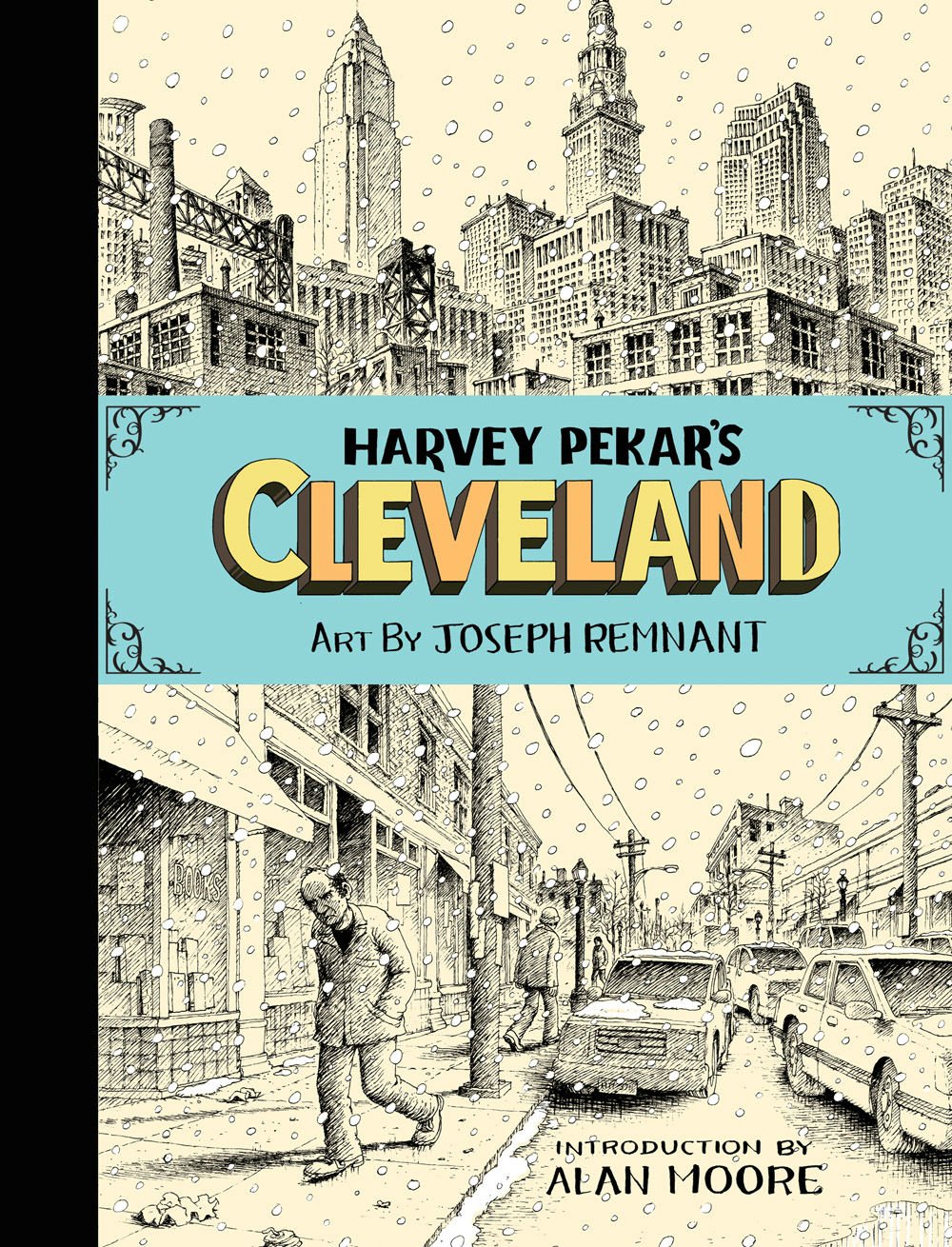
Harvey Pekar's Cleveland

Harvey Pekar was a pioneering colossus of autobiographical comics, and this was among his last books, a graphic history about the place that shaped him and his place in it. As a graphic novel, Harvey Pekar's Cleveland is not so much a novel as it is an epic tone poem that puts forth the personality of a city and a man. This is a pretty tough task to pull off, though I think that it does so with elan and economy.

I found this book very satisfying in terms of its methodical, informative text and illustrations. I sure learned a lot about Cleveland  in terms of its history, politicians, professional sports teams, notable figures, and architecture. Just check out the passage below. What can be seen as mundane or boring is elevated through the art to being more a celebration and elegy.
Elegies are about the dead, and although Cleveland is a hard luck sort of town with an inferiority complex, there seems to be a ray of hope for it here. Or maybe that is the personality projected on it by one of its more famous denizens, Pekar. He inserts his own story into that of the city, mingling his views of the its social and economic history with his own. What could have been a cold, academic look at an urban place then becomes an exploration of a personal relationship, in terms of economics, ethnicity, and race relations. And a place marked by failures occasionally has the opportunity to surprise and shine, like the 1948 Indians. Or as in the excerpt that follows, in enjoyng a little bit of heaven in the form of a chocolate malt:
The specific references and beats that this graphic novel hits give it a lot of heart and fodder for thought. Part of the reason for its success is the tone and tenor of the author, but much of it also lies at the feet of the artist Joseph Remnant. His artwork reminds me of Little Orphan Annie's Harold Gray crossed with the etchings of Albrecht Dürer. The artwork is realistic to a point, with a few cartoonish exaggerations, but the cross hatching and shadows cast the illustrations as little pieces of history or pageantry. I love how it makes some really ordinary scenes seem monumental or lends a sense of drama with a strategically rendered glance or furrowed brow.

All of the reviews I have read about this book have been full of praise. Publishers Weekly gave it a starred review and called it "a must-have volume." Kim Deitch referred to it as "a fabulous kaleidoscope of people, places and things, but never loses sight of its primary objective: to tell about and make a case for that much maligned city, Cleveland, Ohio."

Harvey Pekar's Cleveland was published by Top Shelf, and they have a preview and more information available here.

Tuesday, August 25, 2015

The Age of Selfishness: Ayn Rand, Morality, and the Financial Crisis

The Age of Selfishness is one of those books that makes me blanch that these things are called graphic "novels." This book is more of a graphic essay, told in three parts. The first is about Ayn Rand, a novelist who began a cultish group that resulted in the pseudo-philosophy called Objectivism where extreme selfishness is considered a virtue. Her life, which began in Russia, was marked by much heartbreak and some convoluted romantic situations. The author clearly has his take on her life, but much of what he posits seems firmly entrenched in facts.
The second section of the book is about how the world arrived at the great economic crash of 2008, with a look at finance, banks, mortgages, and a few key individuals, including Alan Greenspan, a long-standing Rand acolyte.
The third part looks at today's world by way of talking about libertarianism, conservatism, and liberalism. This book is certainly slanted in a particular point of view, but it is also well argued with much research and compelling facts, and it attempts to capture the pluses and minuses of these different political stances.

This book tackles much in terms of its content and arguments, and it could been have pretty dense. Some passages are require revisiting because of the complex concepts they cover, but overall the simple, clear illustrations make most concepts much more understandable. What is discussed here affects our world, and certainly will have an impact on the immediate future, and regardless of your political leanings I feel that this book is pretty much a "must-read."

Author/illustrator Darryl Cunningham specializes in nonfiction comics, tackling diverse topics in his blog Darryl Cunningham Investigates. He has also published two other graphic novels, one a collection of his experiences as a health care assistant in a psychiatric facility and the other about science denial. He speaks more about his work on this book in this interview.

All the reviews I have read about this book have been positive. Publishers Weekly gave it a starred review. John Yohe called it "a fascinating read" that "gives a really big picture of American (and British) economic history." Carla Sinclair called it "a well-researched, detail-packed book that I’ll need to read a few more times to fully digest." Andy and Derek from Comics Alternative found a lot of good in the book but wondered if it tried too hard to be balanced or if the arguments were consistent through the whole essay. Robert Kirby added, "This would be a challenging narrative to illustrate (hey, you try visualizing concepts like CDCs and derivatives), but Cunningham generally handles it with ease, clarifying complex financial terms and systems in easily comprehended visual language.

The Age of Selfishness was published by Abrams Books, and they have a preview and more here.

Tuesday, March 10, 2015

Reading with Pictures

Reading with Pictures is a non-profit organization started by comics creator Josh Elder, who is known for his work on Mail Order Ninja. He, like me, thinks that comics are very engaging and found comics to be a large part of his diet when he was learning to read. He is seeking to make connections between comics and learning standards, and one of his projects is to make a textbook composed entirely of comics, which is what we have here. This volume was funded in part via a Kickstarter campaign, and it contains a number of comics stories sorted by content area.

Being that I am an educator by trade, and that I am a reading education person to boot, I am pretty much inclined to like this book. I have to say though, I am not thrilled with the tagline, "Comics That Make Kids Smarter," pretty much for the argument Tim O'Neil made when talking about books. Reading itself does not make a person smarter, but it is the content of the material, whether it be stories, nonfiction descriptions, or otherwise, that engages people and helps them think and perhaps amass some background knowledge through the process. And some books are better than others at doing those things.

So, how did this book do, you ask? Well, let me start with the good parts.There are some top-notch creators involved in this book, including Roger Langridge, Fred Van Lente, Ryan Dunlavey, and Chris Schweiser. For the most part, the artwork in this book was attractive and vibrant. And there were a couple of excellent entries:

I am a sucker for Van Lente and Dunlavey's work in the past, and their "George Washington...Action-President!" entry was no disappointment. I felt it offered a measured look at a vastly important historical figure that offered a complex picture of the man, warts and all.
Additionally, I had never read Chris Schweiser's Crogan Adventures until "The Black Brigade" tale offered here, but I will need to dig into some more soon. His account of Colonel Tye and a brigade of freed slaves fighting during the Revolutionary War was absorbing, dramatic, and very well rendered.
I have to say I was excited to see a mathematics section, because there are so few engaging and informative graphic novels about math, but I felt let down by these entries. One of the big problems I had with the book is characterized in the math story "Probamon" by Geoffrey Golden and Nathan Pride. It is a parody of the formerly ubiquitous Pokemon, and the jokes are pretty juvenile, mostly puns and poking fun at the protagonists (and I am OK with those, given the audience). But the danger of popular culture references such as this one, and they are pretty frequent in this book, is that they become quickly dated. I actually was amused by this story and I found it likeable enough, but I wonder how students five years from now might take it, or if they would even get the references. The story relies on the assumption that the reader knows how the game works and also that the reader can relate the concept of probability to its rules. So if such connections are not made, I wonder how successful or potentially bewildering this story might be.
“Probamon,”

Other stories in this book were less successful, for a variety of reasons. Some I felt were uninteresting in how they presented information, like comics stories with information thrown in. Some felt very pedantic and leaden in their delivery, like boring lectures. I know this book is aimed at elementary readers, but they can handle relatively complex information if it is presented in interesting ways. In the end, I felt that there were a couple of really great, engaging, and informative stories mixed with a bunch of tales full of clunky exposition and a few I felt were a waste of time. The biggest problem with this book is the problem with most textbooks: it tries to do too much. There are some factual and editing errors; the content seems thin and forced in most stories; and overall the book is inconsistent. I love puns, academic knowledge, and comics, but I felt disappointed reading most of this book.

It was an ambitious undertaking, and I think that I would have a difficult time finding much worth in any book that tried to shoehorn all of language arts, math, science, and social studies into its pages. There are a few graphic novels that I think would work excellently as textbooks, but they have much more of a focused topic. Off the top of my head, I can think of these in biology, world history, US history/government, World War I, and economics.

The reviews I have read for this book have been, at best, very mixed. Kirkus Reviews summed the book up as "wildly uneven in execution." Nick Smith recommended the books for classrooms and libraries but also commented that "not every segment is a brilliant success." Gretchen Wagner wrote, "Most of the pieces I did find both engaging and informative, but others I felt took too much exposition to introduce characters and backstory before getting to the concept, and others I could not find the point at all (although they were fun to read)." Jacob Canfield eviscerated the book in his review, writing "Despite all the good intentions in the world, The Graphic Textbook is a waste of money and time. With only a couple exceptions, none of the comics in this book are worth reading for any reason, much less educational ones."
Despite all the good intentions in the world, The Graphic Textbook is a waste of money and time. With only a couple exceptions, none of the comics in this book are worth reading for any reason, much less educational ones. - See more at: http://www.hoodedutilitarian.com/2013/10/leave-those-kids-alone-the-graphic-textbook-reviewed/#sthash.NYVrNoKD.dpuf

A preview, teachers guide, and more information about Reading with Pictures is available here from its publisher Andrews McMeel.
Would elementary students get this reference? Bueller? Anyone?

Saturday, November 15, 2014

Treaties, Trenches, Mud, and Blood

If you have read my other reviews of books in this series, you may remember that I feel they may be the best historical graphic novels I have ever read. The facts and events are very well researched, but more importantly they are presented in a most readable and enjoyable way. Nathan Hale's Hazardous Tales are among the most engaging and interesting books I have ever read. So, does this book keep that spotless record intact?

In a word, YES. I thought that this book was most impressive, in that it packed a complete war account into a small space while also creating thrills, showing horrors, and cracking a couple of jokes. Here is the set-up:

And he is correct; this is not a pretty story. It's full of massive casualties, cruelties, and military mayhem. Although the artwork never gets explicit or shows gore, it does show just how brutal and unconscionable the destruction of World War I was. It also tells a very broad story, but not without some specific details included, like the story of Cher Ami, the carrier pigeon that saved 200 lives, and an account of the development of the tank, which was first used in this war to counter trench warfare.

Like I said, what is particularly marvelous to me about this book is how much ground it covers. Part of the reason it accomplishes this goal is the excellent and intelligent artwork. Hale chose to portray the combatants as animals, not only for metaphorical reasons but also because those depictions make it much clearer who is who in the conflict. Although the Executioner tries to play the animals for comic effect, they are not very funny (a few clever puns aside). Seeing a bunch of wolves, eagles, griffins, bulldogs, bunnies, and roosters (among others) engaged in war helps communicate situations almost instantly, in much quicker fashion than using elaborate explanation.
Spoiler: The war ends.
The great economy and efficiency of the artwork works like a combination of infographics and politic cartoons, as you can see in the page above. It is pregnant with ideas and implications about what happened at the end of this war and how it forecasted what would precipitate the next world war. That Hale accomplishes so much in such a short space, and for a wide audience of readers at that, is simply amazing.

In addition to creating the first three entries in this series, Nathan Hale also has drawn two other graphic novels, Rapunzel's Revenge and its sequel Calamity Jack. He has also worked on a variety of children's books, including Frankenstein: A Monstrous Parody and The Dinosaurs' Night Before Christmas. He shares a lot of fun artwork and news via his blog. He speaks much more about his career and work on this book in this interview.

All of the reviews I have read have been very positive. Kirkus Reviews called it "A neatly coherent account with tweaks that allow readers some emotional distance—but not enough to shrug off the war’s devastating cost and world-changing effects." Johanna Draper Carlson praised this entry in a "terrific series" and added, "I really appreciate Nathan Hale’s (the author, not the character, although that applies too) ability to streamline complicated historical events in such readable fashion." Miriam, Age 10 wrote, "This book was interesting and interestingly told, and very entertaining for a history book."

Treaties, Trenches, Mud, and Blood was published by Amulet Books. There is a preview available at Amazon. And if you are a fan of this series like I am, there is good news: a fifth book, The Underground Abductor, is on the way!