Showing posts with label government. Show all posts

Saturday, August 30, 2025

Constitution Illustrated

Up until now, the US Constitution has proven to be a sturdy and adaptable document that has guided the country through troubled times by describing the rule of law as well as the basic rights afforded to Americans. Portions of it have been hotly contested and reinterpreted over centuries, and it has slowly been transformed through amendments. In Constitution Illustrated it gets further transformed with the addition of comics art to communicate the big ideas, making this landmark document more accessible in a time when folks should brush up on their rights.

I teach social studies teachers, and they seek ways to make difficult texts more approachable, and I love the way that the Constitution is parsed into manageable chunks in this book. Additionally, another scaffold is provided with the artwork, which can act as imagery to help recall the text or also extend it by adding another aspect for analysis and examination. These images run the gamut from classic works like Krazy Kat, Little Lulu, and superhero fare to more contemporary ones like Captain Underpants and Rick and Morty.

What I like about this book are the many ways you can approach reading it. A long-time comics reader, like me, can play "guess the pastiche" as I peruse the pages. One could also think of rationales for the pairings between sections and amendments and the comics style/artist/characters. Alternatively, a reader could also just be amused to see the juxtaposition of the governmental policies and comics artwork or, if nothing else, laugh at how the characters are rendered in colonial dress. I like the combination of humor and politics in this book, and I think it is an excellent way to get introduced to or just review the founding  document of the US government.

This book's creator, R. Sikoryak, teaches in the illustration department at Parsons The New School for Design. He has been making comics for decades, appearing in books such as Masterpiece Comics, in prominent publications like The New Yorker, and in anthologies like Raw. He speaks about his work adapting the Constitution in this interview.

All of the reviews I have read about this book have been positive. Ryan Carey called it "the most grand, ambitious, and relevant application of his unique skill set to date." Publishers Weekly wrote, "This pastiche of comics and politics is a cleverly educational and irresistible way to engage with this foundational text." Paul Buhle opines, "Wake up, reader. Look at the constitution with new eyes. Or else."

Constitution Illustrated was published by Drawn & Quarterly, and they offer more information about it here.

Know your rights!


Thursday, October 5, 2023

The He-Man Effect: How American Toymakers Sold You Your Childhood

I am a big fan of Brian "Box" Brown, a comics artist who uses a clean, minimalist art style to tell many a nonfiction tale. Here, I expected to get a story about toys and toy companies, but I got so much more. This book touches on many aspects of the social studies, including history, government, and psychology in explaining the arcane and calculated strategies that have shaped modern generations. This book begins with a look at propaganda from World War I and then traces how the strategies used to sell war to a population were turned to selling goods to people, notably toys, comics, and cartoons to children. 

Box Brown goes way-back to the roots of the propaganda.

Along the path of this explanation, Brown touches on many issues, including the work of psychologist (and Sigmund Freud's Nephew) Edward Bernays, a pioneer in the field of public relations; the evolution of public domain; the importance of children engaging in imaginative play; the great toy boom set off by the popularity of Star Wars, and Ronald Reagan-era policies that deregulated the connections between advertising and children's programming. As you can see, if you are interested in tracing a great many social issues about nostalgia, marketing, and public consciousness, this is the book for you. It critiques our modern culture, delving deeply into what shaped it and what we might do differently in terms of being a literate person in the 21st century. What could have been a trifling book about playthings turned out to have much more gravity.

This book's author Box Brown has drawn a number of nonfiction graphic novels. including ones about Andre the Giant, Andy Kaufman, Tetris, and Cannabis. He also published the fictional biography Child Star. Of late he is publishing a web-comic about the state of Cannabis in the USA, Legalization Nation, and is the midst of Kickstarter campaign to fund a print compilation of those strips. He speaks about his work on The He-Man Effect as well as a number of his other works in this article.

All of the reviews I have read of this book have been positive. Kirkus Reviews summed it up as "a boffo cartoon history of the deliberate manipulation of children's minds." April Spisak called it "another clever, sharp, and well-researched graphic novel that explores a pop culture non-fiction topic in close detail." Timothy ONeil wrote, "It can sound hyperbolic to call this book important, but it really is... The way nostalgia and brands have been entrenched in our culture is only growing bigger, and it’s important to understand how we got here."

The He-Man Effect was published by First Second, and they have a preview and much more information here.

Monday, December 20, 2021

Billionaires: The Lives of the Rich and Powerful

Billionaires: The Lives of the Rich and Powerful is another well-researched, informative, and thought-provoking book by Darryl Cunningham. He is an author whose work I always try to check out, and I have reviewed a number of his other works, including his graphic novels about Ayn Rand and capitalism, science denial, and mental illness. In this book, he details three biographies, about media mogul Rupert Murdoch, petroleum tycoons Charles and David Koch, and Amazon founder Jeff Bezos, all super-rich individuals who have had a profound impact on modern life. 

With his journalistic writing, bleak humor, and spare art, Cunningham details their lives, political development, and effects on marketplaces, politicians and political movements, law-making, and media. One common thread is that as they amassed great wealth and used it to consolidate power. Usually, this consolidation involved buying up or creating prominent media outlets to spread their views and persuading others to act (and vote) in ways that tend to be conservative and/or libertarian. In many ways, they become more powerful and wield more clout than political leaders.

The analyses in this book come from a progressive point of view, and they critique what Cunningham sees as a new manifestation of the Gilded Age, but it is difficult to disagree with the profound influence these men have had on people's lives. The economic and political turns he chronicles are evident in our modern world, and I think it is essential that all can see their origins in the lives of these figures.

All of the reviews I have read have been positive. Kirkus Reviews summed up, "The rich really are different, as this lightly presented but utterly serious presentation proves beyond argument." Bruno Savill De Jong wrote, "Cunningham collects vast data and research into their lives and businesses, detailing how through bending their companies to collect additional revenue, they have also thrown society out of shape." Jeff Provine opined how Cunningham's drawings "add attentive details and sometimes humor while at some points instilling vignettes to show the drama of the scene words cannot fully capture."

Billionaires was published by Drawn & Quarterly, and they offer an excerpt and more here. Cunningham's next book, Putin's Russia, will be out in the February.

Friday, November 5, 2021

History Comics: The American Bison: The Buffalo's Survival Tale

I have been very impressed by the History Comics series of graphic novels, and this entry The American Bison pairs will thematically with one I reviewed earlier this year, The Wild Mustang. It traces the history of bison, which are also known as the American buffalo. These animals once numbered in the tens of millions across North America, until they were hunted near to extinction. This book is a treasure trove of information about them, with the graphics really enhancing the facts and history, as you can see in this excerpt:

One thing this book does well is detail the various relationships that the bison have had with different peoples and civilizations. A number of Native American people hunted and co-existed with them, and sometimes they even held them up for spiritual reasons. They were intimately linked with their way of life, for reasons of utility, nourishment, and spirituality. With the onset of white settlers, bison were cast in a different perspective, and with the proliferation of railroads, they became easy targets for recreational hunters who would pick them off with rifles as they crossed the nation.

Accounts of the efforts to both remember and preserve bison bookend this volume, providing insight into the nascent field of conservation as well as insights into the beginnings of national parks and nature preserves. The last third of the book especially chronicles the many people who worked to protect them, sometimes for altruistic reasons and sometimes for profit. This book impressively touches on matters of biology, history, government, and ecology, striking a great balance between informing and entertaining along the way. It's a fantastic nonfiction graphic novel.

The American Bison was written and drawn by Andy Hirsch, who has also created a bunch of entries in the Science Comics series of graphic novels, including  Dogs, Cats, Rocks and Minerals, and Trees.

The reviews I have read about this book have been positive. J. Caleb Mozzocco opined that this "story of the bison’s survival and gradual recovery isn’t just a good read, it is, perhaps, a necessary one." Brett called it "fascinating" and noted how it is a worthy entry in a great series of books.

The American Bison was published by First Second, and they offer a preview and much more here.

Thursday, September 30, 2021

Our Stories Carried Us Here

Our Stories Carried Us is a graphic anthology of first-person narratives told by immigrants to the US. They came from a variety of countries, including Somalia, Myanmar, Jamaica, Guatemala, Chad, Kazakhstan, Pakistan, Mexico, Vietnam, and Liberia. The reasons why they came are varied, and include the desire for freedom, safety, family, as well as economic and educational opportunities. Each tale is pretty journalistic in presentation, so they tell the facts in a fairly chronological way that is both accessible and moving. I learned a lot from reading this book, about global politics, immigration policy, and the lengths some people have to go through to protect themselves and their families. 

Illustration by Aziz Kamal, story by sunshine gao
Each story is illustrated by different artists, so they feature very different tones, styles, and coloring. They are all unique and interesting, and I love this book walking the walk and providing space to showcase a range of nationalities in terms of story and art. 

Illustration by Ana Hinojosa, story by Craig Moodie

As the child of immigrant parents, I found this book enlightening as to how people learn to deal with American culture. As an educator, I saw many opportunities for critical engagement with social issues. As a US citizen, I saw lots of information here that would enlighten others as to who wants to come to this country and why. I highly recommend this book.

This graphic anthology came from the work of Green Card Voices, a nonprofit organization the focuses on immigration and social justice issues and is based in Minnesota. To my knowledge none of the writers or artists have published graphic novels before. The book was edited by Tea Rozman Clark, Julie Vang, and Tom Kaczynski, and it features a cover by multiple award winner Nate Powell as well as a foreward by another multiple honor winner, Thi Bui.

I was not able to locate many reviews of this book, but the ones I have found have been positive. Brett at Graphic Policy said, "I'd love to see more of this," and offered potential avenues to expand on this project. It currently has a 4.58 (out of 5) star rating at Goodreads.

Our Stories Carried Us Here was published by Green Card Voices, and they offer a preview and more information about it here. The initial printing of this book was aided by a Kickstarter.

Wednesday, December 30, 2020

Kent State: Four Dead in Ohio

My Friend Dahmer is one of my all-time favorite graphic novels, a dark exploration of high school friendships and the many issues that underlie people's lives, which in the case of Jeffrey Dahmer resulted in horrific murder and mayhem. Derf Backderf's combination of autobiography and journalism made for a highly nuanced and haunting book that has stayed with me for years. Kent State: Four Dead in Ohio has a bit of autobiography at its beginning, when young Derf saw the National Guard rolling through his town on the way to Kent State, but its strength lies in its exhaustive research. This book focuses specifically on the four young people who died in the May 4 Massacre in 1970, putting a human face on history. Over the course of the book, I got to know these people, their friends, and their aspirations, and so when the gruesome events take place toward the end of the book, they feel even more tragic and pointless.

This book meticulously recounts the event that lead up to the massacre, and it is structured in four chapters to correspond to the first four days of that May. Piece by piece fall into place, from the "law and order" governor trying to show just how strong he is during an election year to the paranoid, draconian military leaders who headed the National Guard contingents to the exhausted and misinformed troops themselves. In hindsight, the massacre is made to look like a perfect storm, complete with misinformation, wild and untrue accusations made against the student protestors, and a culture war between liberal and conservation factions. The military action comes to be, ironically, as a result the fomenting protests against the increasingly unpopular and cruel military actions in Vietnam. 

What is most informative and distressing about this book is the role that manipulating media and casting political aspersions played in the National Guard's actions, which is mirrored by contemporary protests and police brutality in Portland and other places. Acerbating the situation, government agencies and police planted spies and moles to make the protestors appear much more violent and extremist, just like today. The violent factions within the protestors are a minority, and do not reflect the whole, but they are attributed all sorts of (non-existent) power and agency. Rampant rumors among the local population and military/community leadership paint the students as communists and radicals. They say that the students have snipers and stockpiles of weapons. They dehumanize the students and their demands. It is depressing to see how much things have not really changed and how short we have come in the 50 years since these events took place. 

Spoiler: The bad guys win and suffer no consequences.

I was impressed by just how much this book does. It portrays a set of individual portraits of the students, a history of the campus, and an account of the state of politics of the time on a city, state, and national level. There is a lot of information in this book, and most of it is presented in incredibly artful manner. There are a few pages that are text-heavy and more expository, but none of it is off-putting. And the pacing of the last chapter, where the shootings occur is paced to highlight its brutal, oppressive, and unjust aspects, is a clinic in storytelling an action sequence. The illustrations map not just the place but also the people and events in a visceral and incredibly moving fashion.

Reading this book, I could not help but also think of Big Black: Stand at Attica, which recounts events that happened at a prison uprising a year later, events referenced in this book's epilogue. Great books use history to illuminate the present, and that is exactly what Kent State does. Certainly it comes from a particular political viewpoint, but it is backed by a vast amount of research and personal accounts. And the facts (those that have not been obfuscated and lost) point to terrible and avoidable injustice and murder. Derf has crafted another masterpiece graphic novel.

In addition to the multiple award-winning My Friend Dahmer, Derf Backderf is also known for his long running alt-comic The City as well the graphic novel Trashed, about his time as a garbage collector. He speaks extensive about his work on Kent State in this interview.

All the reviews I have read of this book have praised it. It has received multiple starred reviews. The one from Publishers Weekly called it an "expertly crafted chronicle of this defining moment in U.S. history" that also "serves as a deeply moving elegy for the victims." The one from Kirkus Reviews concluded, "Backderf’s vivid, evocative book does a splendid job of keeping their memories alive." Leonard Pierce wrote, "By buying into the details so heavily, he makes a story that means something more today – and serves as a warning as we see the story repeated, again and again, every day, always as tragedy."

Kent State: Four Dead in Ohio was published by Abrams Books, and they offer a preview and more here.

Tuesday, September 15, 2020

Action Presidents, Books 3 & 4

I reviewed the first two volumes in this series last year, but they have recently been re-issued in color, to coincide with these two new, full-color releases.

In that review, I wrote, "Not only do these books present distinct portraits of both men, it also situates their lives and actions in historical and governmental contexts. They are great resources for learning about the US government, policies, and laws, and I was very impressed by how many of the social studies they entailed. Also, there is also a good dose of humor throughout the volumes, embodied by the narrator, a pardoned turkey named Noah (the Historkey), and not a few fart jokes. Sometimes those instances felt a little like "sugar to make the medicine go down," but overall I feel the tone and content of these books was spot-on. I heartily recommend either (better, both!) volume to any class library."
 
I feel that the same words apply to these two new volumes in the series, but without fart jokes. But I am also more conflicted about these books, especially the fourth one, because I found some huge issues with representation, as you will read below.
As you can see, Book 3 is about Theodore Roosevelt, and it is framed by the Historkey meeting up with a couple of children who got lost on a camping expedition. The set-up helps get at some of the naturalistic aspects of the president's life. This book introduces TR as a privileged, if sickly, member of a rich and powerful family. It goes on to show how he was simultaneously an adventurer who got himself into some sticky situations (including being a rancher out west and soldier) and also accomplished a number of Progressive accomplishments, including breaking down monopolies, fighting government corruption, and establishing a number of pro-environmental policies. He also played a large part in shifting political powers to the presidency via executive orders, a legacy that lasts to present day.
There are also a number of other common stories in the mix, like the famous teddy bear episode as well as the Rough Riders and their role in battles in Cuba, which included quite a few more facts than I was familiar with. The teddy bear story ended up being a bit more gruesome than I remembered, and the Rough Riders' adventures were slightly less heroic also. So overall, I think that this portrait of TR is a fairly even-handed one, with him being cast as an unlikely hero who had some character flaws. My only quibble is a matter of representation of some peoples. I get that this books uses graphic shorthand to communicate, and I am not so sure of how well researched the garb of native peoples was, but it seemed stereotypical to me. More so with the representation of the Spanish government as a toreador.
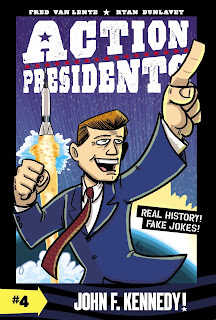
Book 4 focuses on John F. Kennedy, and in contrast with TR, he came from a family of immigrants who fought hard to establish themselves in the USA in legal and illegal manner. The framing sequence here is of a couple of children (one apparently Pakistani and the other more a generically depicted Asian) who are isolated from the main group of children during a trip to the Kennedy Space Center because their lunches "smell weird." The theme of immigration and integration runs throughout the book, with the ethos of the USA being a place of opportunity for all being reinforced by JFK's story as a model for those two children. I don't know if I am being cynical or if I am being affected by the immense anti-immigrant agenda I see in the US government and society right now, but something about this message just seemed a bit too pat and color-blind. Like my colleague Dr. Laura Jimenez recently wrote, I expect a little more in this day and age. 
 
A lot of US history is affected by whiteness, which conveys the dominant narrative, and in hindsight I think that is a major blind-spot the books in this series books have, as well-meant as they are. Perhaps it is the perception that younger readers should be protected from these more complex, oppressive views of history, and maybe I am asking a lot of a series of books narrated by a talking turkey, but I still felt they came up short in the area of representation. 
 
This disparity really hit me in the JFK volume. The two children who are held up at the end of the book as the resilient hope for our future simply do not enjoy the same built-in advantages as the four Christian white men (Washington, Lincoln, TR, and JFK) spurring them on. I get the drive to extend from JFK's famous exhortation to "Ask not what your country can do for you...," but I also get that systemic racism goes well beyond children being mean to each other at lunchtime (though that may be a relatable and apparent symptom to younger people). This ending puts all the onus to adapt and effect change on the young people, and I think that is a huge burden that is not acknowledged. Also, it ignores the fact that it is the very system being celebrated that is doing the oppressing. Thus, the ending seems pat and disingenuous to me.
Oy.
Regarding the rest of the book, it is chock full of historical information. It offers a look at the many aspects of JFK's life and how it was affected by his father's drive to involve his children in politics, serving in Wold War II, dealing with the Cold War, getting elected to the Senate and then President, and the many conflicts he had to deal with, including those with Cuba and the Soviet Union. There is also a good bit about the Civil Rights movement of the time, with its accomplishments and accompanying violence. Ironically, all this work took place in the past and is not really explicitly tied to the present-day plight of the two children. This to me is a lost opportunity to make the connection to the ongoing battle for civil rights, implying that those battles were fought (and won) in the past. This book also gets into the Camelot period of his presidency, though it is not exalted as much as I have seen in other works. 

As you might tell by now, I was not as taken by this book as I was the others from this series. In terms of history and government, this book covers a lot of ground. In some ways, I think this left me a bit breathless, and I wonder how much context unfamiliar readers would need to deal with the text. It is an ambitious book, and perhaps that drive to do so much detracts from other areas, like the framing sequence where I feel perhaps the two children should have been a bit more fleshed out so as not to seem generic types that feed into the same sorts of stereotypes the book tries to transcend.

These books are the product of Fred Van Lente and Ryan Dunlavey, frequent collaborators who both have numerous comics credits for multiple publishers. They have collaborated on two prior historical comics projects, Action Philosophers! and The Comic Book History of Comics. Currently the duo are working on The Comic Book History of Animation, which I helped fund via their Kickstarter.

I have not been able to locate any reviews of these two books yet, but the TR one has a 3.67 (out of star rating on Goodreads, and the JFK one has a 3 star rating (as of this post).

Action Presidents! were published by Harper Collins, and there is more information about all the books in the series here.

Monday, May 25, 2020

Woman World

Imagining a world where all the men have ceased to exist and women are left to run everything has been done in comics form before, but this book Woman World does it with a singular voice and a great sense of humor. The comics in this book were originally published online, originally on Instagram. They follow the adventures of a small band of women living in a future where all the men have died due to some genetic disease. They choose their town name and create a flag to feature the most empowering symbol they could think of: Beyoncé's Thighs. That choice should indicate just how this book mingles a feminist viewpoint with humor and a pop culture sensibility.

As the book progresses through a series of 2-3 page episodes we meet a number of this world's denizens. Among them there's Mayor Gaia who walks around naked because she likes the feel of the cool breeze on her underboob.
Told ya!

There is Emiko, who has grown up in a world without men, and upon seeing a dated movie, comes to think of Paul Blart: Mall Cop as the embodiment of masculinity. There is also Grandma, who remembers things as they used to be and finds people incredulous at what she describes.
Each woman has a distinct personality and role, and through their stories and brief episodes a larger tapestry of this world appears. It is a somewhat tragic place, where people are striving to keep civilization going on their own terms, but always tinged a sense of (dark) humor.

The artwork, as you can see in the excerpts, is spare but very expressive. I love how people's personalities and emotions are conveyed in straight-forward fashion. I also think that it juxtaposes well with all the verbal interactions and cultural references. The beats work just as well in human moments as they do in delivering laugh-out-loud gags.

This book is the creation of Aminder Dhaliwal, an animator who has worked for a number of major studios. Woman World is her graphic novel debut, and it was nominated for a 2019 Ignatz Award. She speaks about her work on WW in this interview. She still regularly publishes new comics on Instagram.

All of the reviews I have read of this book have been positive. Etelka Lehoczky called it "a remarkably sly and devastating critique of patriarchy. " Phillipe Leblanc wrote, "While the premise sounds depressing and bleak, the book is far from being a dark somber affair. Dhaliwal balances her dark premise with the precise amount of levity and wit to create wonderfully comedic situations." Publishers Weekly added, "Women’s creativity, sexuality, and fearlessness are unleashed by Dhaliwal’s end of days."

Woman World was published by Drawn & Quarterly, and they offer a preview and more here.

Friday, February 15, 2019

Action Presidents: Books 1 & 2


 Action Presidents is a nonfiction series aimed at upper elementary/middle school students. They are quite detailed and nuanced, pretty substantial texts that contain lots of information and insight into some prominent historical figures. George Washington and Abraham Lincoln have been the subjects of a myriad of biographies, and these books contain much of the relevant details about their lives, from their childhoods to their deaths, but what is most impressive to me about this series is how it also introduces counter-narratives into the proceedings.
It would be easy to simply present these books as pieces of hero worship, and certainly they do not skimp on celebrating the various accomplishments of both presidents. George Washington is praised for all he did to establish the United States, but also running throughout Book 1 are his ambiguous views and actions regarding slavery, a theme that also colors Book 2. Washington kept and profited from slaves, and only freed some at his death, and Abraham Lincoln himself did not so much oppose slavery as he opposed anything that would splinter the country. He is lauded for the lengths he went to preserve the Union, but his own contested views are not sugar-coated or glossed over. I loved how these books presented both, warts and all.

Not only do these books present distinct portraits of both men, it also situates their lives and actions in historical and governmental contexts. They are great resources for learning about the US government, policies, and laws, and I was very impressed by how many of the social studies they entailed. Also, there is also a good dose of humor throughout the volumes, embodied by the narrator, a pardoned turkey named Noah, and not a few fart jokes. Sometimes those instances felt a little like "sugar to make the medicine go down," but overall I feel the tone and content of these books was spot-on. I heartily recommend either (better, both!) volume to any class library.

These books are the product of the dynamic duo of Fred Van Lente and Ryan Dunlavey. Both have numerous comics credits for multiple publishers, and they have collaborated on two prior historical comics projects, Action Philosophers! and The Comic Book History of Comics.This interview sheds more light on the Action Presidents books and series.

The reviews I have read of these books have been positive. Johanna Draper Carlson applauded both for their "blend of action, humor, and meaningful points." Publishers Weekly wrote of Book 1, "Van Lente aims to contextualize historical figures who are often blindly lionized..., a goal that comes through clearly amid a flurry of gags and jokes." Kirkus Reviews summed up, "A light, comical approach to biography and history that makes it more palatable for those who find more traditional approaches hard to swallow," and added that the book contains maps, timeline, glossary, and a bibliography.

The Action Presidents series was published by Harper, and they offer a preview and more here. More books in the series have been proposed, and the next (announced at the end of Book 2) will be about Theodore Roosevelt. The fourth should be about JFK.

The publisher provided review copies.

Happy Presidents Day!

Saturday, March 10, 2018

Brazen: Rebel Ladies Who Rocked the World

I am a HUGE fan of Pénélope Bagieu's comics. California Dreamin' and Exquisite Corpse were two of my favorite graphic novels in recent years, and I feel that her artwork is ethereal and gorgeous to behold. So when I got the review copy of this book I was very excited to read it. I am pleased not only to report that it did not disappoint, but that I loved this book, and it gets my highest recommendation.

Brazen is a one-person anthology of stories about strong, impactful women from across history and cultures. It is a hefty volume containing 29 mini-biographies that range in length from 2 to 10 pages, via 9 panel grids. One thing I loved about it was that I could read it a few stories at a clip or simply laze over one and then come back to the book later. The stories themselves are condensed, colorfully illustrated, and very substantive. They are also told in a simultaneously respectful and cheeky manner that I found extremely engaging and informative. This book is the best combination of art and education, and I found I learned much from it while also being quite enchanted while reading.
The women profiled range from the well known, like investigative reporter Nellie Bly and Wicked Witch of the West actress Margaret Hamilton, to the more obscure (at least to me) like Giorgina Reid and Angolan Queen Nzinga. What I appreciated, even with the ones I knew something about, was that she included lots of detail about their accomplishments and contributions to society across history. Some folks know that Hedy Lamarr was a famous actress, but they do not know perhaps that she was also an important scientific inventor.

All of the reviews I have read about this book have been glowing, including starred reviews from Publishers Weekly and Kirkus. Rachel Cooke wrote, "This book already feels like a classic, one to be loved by every girl who reads it from now until the end of time." Michael Cavna wrote "that it belongs in most every girl’s — and boy’s — hands by middle school." Rosemary at Mom Read It called it a "a must-add to your collections." Oliver Sava highlighted the lovely representative spread that follows each entry, stating,  "After the waves of information in the preceding strips, these clever, bold illustrations give the reader moments to meditate on what they’ve just read, enriching each individual history."

Brazen was published by First Second, and they have more information and a reading guide for it here.

A review copy was provided by the publisher.

Wednesday, April 20, 2016

Founding Fathers Funnies

Peter Bagge is one of my all time favorite comics artists. He is an award winning artist with decades of comics to his credit, including the seminal alternative comics series Neat Stuff and Hate and his editorship of the underground comics holdover anthology Weirdo. He has also created a number of graphic novels, including Woman Rebel, Apocalypse NerdOther Lives, and Reset. More recently, he has been a frequent contributor to publications like Reason magazine (see his collection Everybody is Stupid Except for Me) and Vice Magazine (the Musical Urban Legends column).

Founding Fathers Funnies is a collection of previously published shorter pieces that together weave a rich and profane tapestry about the lives of famous colonial Americans. What I like best about these episodes, aside from the fact that they are hilarious, is that they are both factual and full of personality. Too often we get homogenized or puffed-up portraits of these figures, but Bagge takes all the air out of their sails while adding his voice to historical events and participants' mannerisms.
The result is a bunch of memorable and thoughtful pieces that made me ponder the circumstances of the American Revolutionary War. Certainly, these folks all had their various accomplishments, but I found it refreshing to read about an insular, contemptuous "Virginia mafia" (Jefferson, Madison, and Monroe), a caustic and carousing Ben Franklin, and an economical, pragmatic Paul Revere. Consequently, many of these guys (John Adams, Alexander Hamilton, and Thomas Paine) come off as really smart but also just plain unlikable. The lack of reverence really allows the reader to think about the actual people and events that took place, and I thought it cast a new light on some  well-tread material.

Finding reviews for this book proved to be quite a task, but the ones I did find were positive. Pat at Project-Nerd wrote, "The book’s cartooning and storytelling is excellent, but what I love most is that Bagge also writes an afterword featuring all of his footnotes throughout the collection." Chad called it "a brisk" and "rib tickling" collection.


Founding Fathers Funnies was published by Dark Horse, and they have a preview and much more available here. This book features profanity and some sexual situations, so it is suggested for readers mature enough to handle both.

Friday, October 30, 2015

Snowden

Ted Rall has been writing and drawing political comics and journalism for decades now. He has written critically about all stripes of politicians and leaders, including George W. Bush (Generallisimo El Busho) and Barak Obama (The Book of Obama). He has been an imbedded journalist in Afghanistan and a political cartoonist for a number of high profile publications, including the Los Angeles Times (who seem to have unjustly fired him). Rall's work can be something of an acquired taste, and he is infamous for his art style, which may generously be called primitive or raw but some find ugly or even incompetent. He also has a reputation for being a contrarian and gets into feuds (most famously a legal one with Danny Hellman). Whatever one feels about him politically or personally, I feel his work is an important counterpoint to much of the political rhetoric of our day.

With Snowden, I feel he has crafted a compelling book well worthy of attention. This biography of Edward Snowden begins with his childhood and moves through his childhood as a boy scout to his adulthood when he worked as a computer professional before working for the CIA and the NSA. Seeing what he felt was a corrupt system of surveillance and erosion of personal freedoms, he copied confidential files and leaked them to media sources.
He became persona non grata in the United States and has since sought asylum in multiple places, most recently Russia. Very recently, the European Union voted not to extradite him to the US, so his status might finally change. Not only does this book chronicle his deeds in heroic fashion, it also tries to situate them in the current context. Rall likens what is happening in terms of government to a devolution of society into the dystopian police state of 1984.
Clearly, this is a provocative book that wears its politics on its sleeve, and it pulls no punches. Rall provides plenty of references and footnotes to back up his thoughts and observations throughout the book. I feel it is a book that could be used with high school government or social studies classes for sure, and it will also be of interest to anyone who lives in the US, if even to get a view about some very serious matters that may be obscured by biased news coverage. It seems to me that a big part of this book is to flesh out Snowden's personality in contrast to the portrait currently painted in the US media. Rall explains more about why he chose to write Snowden in this article.

Most of the reviews I have read about this book have been positive. Jordan Minor called it "an entertaining, exhaustive, and approachable look at an incredibly important and relevant topic." Henry Chamberlain wrote that Rall lends a sense of warmth to Snowden, which makes this book "a most compelling read." James Helmsworth was more critical of the book's claims that we are living in a 1984 world but still concluded that it was "a fitting and functional portrait."

Snowden was published by Seven Stories Press, who have more information about it here.

Thank you for the review copy!

Tuesday, August 25, 2015

The Age of Selfishness: Ayn Rand, Morality, and the Financial Crisis

The Age of Selfishness is one of those books that makes me blanch that these things are called graphic "novels." This book is more of a graphic essay, told in three parts. The first is about Ayn Rand, a novelist who began a cultish group that resulted in the pseudo-philosophy called Objectivism where extreme selfishness is considered a virtue. Her life, which began in Russia, was marked by much heartbreak and some convoluted romantic situations. The author clearly has his take on her life, but much of what he posits seems firmly entrenched in facts.
The second section of the book is about how the world arrived at the great economic crash of 2008, with a look at finance, banks, mortgages, and a few key individuals, including Alan Greenspan, a long-standing Rand acolyte.
The third part looks at today's world by way of talking about libertarianism, conservatism, and liberalism. This book is certainly slanted in a particular point of view, but it is also well argued with much research and compelling facts, and it attempts to capture the pluses and minuses of these different political stances.

This book tackles much in terms of its content and arguments, and it could been have pretty dense. Some passages are require revisiting because of the complex concepts they cover, but overall the simple, clear illustrations make most concepts much more understandable. What is discussed here affects our world, and certainly will have an impact on the immediate future, and regardless of your political leanings I feel that this book is pretty much a "must-read."

Author/illustrator Darryl Cunningham specializes in nonfiction comics, tackling diverse topics in his blog Darryl Cunningham Investigates. He has also published two other graphic novels, one a collection of his experiences as a health care assistant in a psychiatric facility and the other about science denial. He speaks more about his work on this book in this interview.

All the reviews I have read about this book have been positive. Publishers Weekly gave it a starred review. John Yohe called it "a fascinating read" that "gives a really big picture of American (and British) economic history." Carla Sinclair called it "a well-researched, detail-packed book that I’ll need to read a few more times to fully digest." Andy and Derek from Comics Alternative found a lot of good in the book but wondered if it tried too hard to be balanced or if the arguments were consistent through the whole essay. Robert Kirby added, "This would be a challenging narrative to illustrate (hey, you try visualizing concepts like CDCs and derivatives), but Cunningham generally handles it with ease, clarifying complex financial terms and systems in easily comprehended visual language.

The Age of Selfishness was published by Abrams Books, and they have a preview and more here.

Saturday, March 1, 2014

The Trans-Pacific Partnership and "Free Trade"

I know I have not read or reviewed Economix (yet), but I wanted to share this new, topical comic from its creators Michael Goodwin and Dan E. Burr. It's about a treaty currently being discussed behind closed doors, and it will have a large impact on the US's and world's financial futures. I encourage you to check it out.

Also, if you like what you see and read you can also check out the duo's book here. I hear it's quite good, and I am eager to read it!


Thanks to James Bucky Carter for sharing this comic with me!

Tuesday, January 15, 2013

Veeps: Profiles in Insignificance


Top Shelf Month enters its second week with a "real" book.


I was a little bit surprised when I cracked open this little hardcover that it was not a graphic novel at all, but a book with illustrations added to spruce up each chapter. Along with a biting portrait of each vice president, from John Adams to Dick Cheney, is an occasional scene portraying a specific life event, but the majority of this book is words. It sort of reminded me of the Secret Lives series from Quirk Books, which I have enjoyed very much. Each entry has a short summary of each person's life followed by separate entries about notable accomplishments, dubious doings, calamitous events, and/or an interesting quotation. In all it was a very entertaining and informative read. After reading this book I can tell you:
What is striking about this book is just how random, uneven, and seemingly pointless the office has been historically. Some VPs are immensely talented while others just seem hopeless or inept. Some hardly knew who their running mate was, and some treated the office as a political death sentence. A select few had great accomplishments, though it seems that most simply held and office and lingered. I gained much insight into how insanely and arcanely politics often runs in the US after reading many of these passages.

It was difficult for me to find much information about this book's creators. Writer Bill Kelter is a businessman and contributes to sites like Politico. Artist Wayne Shellabarger does not have a lot of comics credits, but he is known for having drawn an array of rock posters in the past. The duo speak more about their collaboration on this book in this interview.

All the reviews I have seen online about this book have been glowing. Curt Holman called the book "playful" and added that its worth comes in how well it "illuminates the flaws and foibles in a political system that manages to elevate unworthy candidates while letting talent go to waste." Anthony Bergen gushed, "Veeps is a great read.  I loved it, and couldn’t put it down until it was finished.  It’s also a great-looking book, with fantastic art and a sweet design." Boing Boing's Cory Doctorow wrote that the book was "a snarky, thorough look at the foibles and missteps of the vice presidency," and added, "I had no idea how completely comic the office has been through the years."

There is a lot of information about this book, including a movie version, at its official site. Here is a preview and much more from the publisher.

Saturday, November 10, 2012

Burma Chronicles


This is the third travelogue from Guy Delisle, an illustrator and animator who travels the globe for work and also to accompany his wife who is involved in Doctors without Borders. Thus, he gets around to some very interesting places. He is a Canadian and his primary language, as you can tell from his blog, is French.

This is his most best, most insightful book to me, as it delves into the political milieu in Myanmar as it relates to Doctors without Borders much more than the others. There is much discussion about whether the organization can operate in this country independently in ways that treat those in need or if it is being turned into an instrument of the state that openly discriminates against those the dictatorial regime deems enemies. Added to this political dilemma is the fact that Delisle is for the first time in a country along with his infant son, placing him in everyday contexts and allowing him to see the social conditions as both a citizen and a parent.

Reviews I have read about the book have been very positive. The Guardian's Rory MacLean praised the book, calling it "the most enlightening and insightful book on Burma in years," and adding, "The key to its success are Delisle's whimsical, black-and-white drawings, as well as his endearingly naïve and humorous self-portrait. Together his honesty and minimal line disarm the reader, drawing him or her into Delisle's life, learning as he learns the truth about the struggle for survival under the generals." J. Caleb Mozzocco called Delisle's work "highly evocative minimalism," going on glowingly, "He’s spent a decade in animation, and it certainly shows in his command of the page, and the time and space the panels suggest upon it." Kirkus Reviews called the book an "insightful, illuminating memoir."

This book was published by Drawn and Quarterly. Some preview images and reference material for the book have been provided here by the author.