Showing posts with label adaptation. Show all posts

Wednesday, October 15, 2025

Nathan Hale's Hazardous Tales: Bones and Berserkers

The 13th book in one of my favorite graphic novel series, Bones and Berserkers changes up the format in that it features a collection of 13 tales rather than one overarching narrative. Still, all the major players are still here, and the range of horrific stories run a gamut of genres. There are folk tales like the Demon Cat, an adaptation of Edgar Allan Poe's "Hop-Frog," the real-life misadventures of pro-golfer Eben Myers with medicinal radium, and the terrible murders and arson at Frank Lloyd Wright's home/studio Taliesin. I felt that in some ways this book was a bit more documentary in places, like history mixed with true crime writing, which worked well.

This book is dedicated to Alvin Schwartz and Stephen Gammell, and it shares a real kinship to their Scary Stories to Tell in the Dark. It features some pretty graphic scenes, including a human head stripped bare by cancer treatments, a bunch of men dressed as orangutans who are set on fire, and butts being chopped off of people's bodies, so it is pitched toward an older audience than earlier volumes in the series. Still, there are moments of grim humor that punctuate the proceedings much like the Crypt-Keeper did in Tales From the Crypt. It's not a book for the squeamish, and I found it to be wonderfully gruesome and fun. This book is a treasure trove of horror for fans of both fiction and nonfiction.  

The Jersey Devil!
Bones and Berserkers was made by Nathan Hale (not related to the Revolutionary War spy), a highly accomplished graphic novelist. I love his work so much that I named one of my annual favorites list categories after him. Aside from his great success with this series, he has also published the fictional graphic novels The Mighty Bite,  One Trick Pony and Apocalypse Taco. He has also drawn a few others, including Rapunzel's Revenge and Calamity Jack. I learned some more about Hale's work on this book and his upcoming projects in this article.

The reviews I have read of this book have been positive. Kirkus Reviews summed it up, "Not all true, but truly nightmarish." Susan Harari wrote that it would be "perfect for reluctant readers in middle or even high school who are brave enough to handle both fictional and factual horror stories."

Nathan Hale's Hazardous Tales: Bones and Berserkers was published by Abrams Fanfare, and they offer more information about it here.

Wednesday, September 10, 2025

I Survived the Shark Attacks of 1916

This book has been super-popular in my house of late, with two of my kids reading and re-reading it and asking for more books in the series. So, naturally, I read it to see what the hubbub was about. I Survived the Shark Attacks of 1916 is an adaptation of Lauren Tarshis's novel written for elementary and middle school readers. It is a fictionalized version of the actual Jersey Shore shark attacks of 1916. Before then, people largely believed that sharks were harmless, skittish creatures, but that summer between July 1st and 12th, five people were attacked and 4 died of their wounds. This story became national news and kicked off the widespread fear and even hatred people have toward sharks today.

You should always listen to the grizzled sea captain in these stories...

Making history come alive, this story is told through the eyes of Chet, a young teenager whose parents have left him to live (and work) with his diner-running Uncle Jerry for a summer while they chase their own fortunes. As a new kid in town, Chet has a hard time making friends, and the ones he does make are into pranks, which leads to lots of drama surrounding the local creek they swim in. The recent shark attacks have some people on edge, and the kids take the chance to test their friends' bravery through hijinks. Little do they know what is coming upstream.

I really enjoyed reading this book, and I can see why it is such a crowd-pleaser. The artwork is clear and expressive, and the first-person narrative makes for some great eyewitness storytelling. That there is the added element of shark attacks and blood puts things over the top. This book will be popular with younger readers looking for some compelling historical fiction that teaches about disasters both natural and man-made, with backmatter that explains more about sharks and the actual events. It also, mercifully, includes helpful tips for avoiding shark attacks.

Translating Tarshis's novel into graphic novel format are writer Georgia Ball and the art collective Haus Studio, a group of self-publishers from Argentina. Ball has published more than 30 books, many of them of the licensed property variety, including ones about Strawberry Shortcake and My Little Pony, and has also written more in the I Survived graphic novel series. This book was penciled by Gervasio, inked by Jok and Carlos Aรณn, colored by Lara Lee, and includes an art assist by Dario Brabo. 

The reviews I have read about this book have been positive. Pharaoh Miles summed it up as "a great book that melds slice of life with history." BlackRaven called it "fun and educational."

I Survived the Shark Attacks of 1916 was published by Scholastic Graphix, and they offer a preview and more info about it here. 

Saturday, August 30, 2025

Constitution Illustrated

Up until now, the US Constitution has proven to be a sturdy and adaptable document that has guided the country through troubled times by describing the rule of law as well as the basic rights afforded to Americans. Portions of it have been hotly contested and reinterpreted over centuries, and it has slowly been transformed through amendments. In Constitution Illustrated it gets further transformed with the addition of comics art to communicate the big ideas, making this landmark document more accessible in a time when folks should brush up on their rights.

I teach social studies teachers, and they seek ways to make difficult texts more approachable, and I love the way that the Constitution is parsed into manageable chunks in this book. Additionally, another scaffold is provided with the artwork, which can act as imagery to help recall the text or also extend it by adding another aspect for analysis and examination. These images run the gamut from classic works like Krazy Kat, Little Lulu, and superhero fare to more contemporary ones like Captain Underpants and Rick and Morty.

What I like about this book are the many ways you can approach reading it. A long-time comics reader, like me, can play "guess the pastiche" as I peruse the pages. One could also think of rationales for the pairings between sections and amendments and the comics style/artist/characters. Alternatively, a reader could also just be amused to see the juxtaposition of the governmental policies and comics artwork or, if nothing else, laugh at how the characters are rendered in colonial dress. I like the combination of humor and politics in this book, and I think it is an excellent way to get introduced to or just review the founding  document of the US government.

This book's creator, R. Sikoryak, teaches in the illustration department at Parsons The New School for Design. He has been making comics for decades, appearing in books such as Masterpiece Comics, in prominent publications like The New Yorker, and in anthologies like Raw. He speaks about his work adapting the Constitution in this interview.

All of the reviews I have read about this book have been positive. Ryan Carey called it "the most grand, ambitious, and relevant application of his unique skill set to date." Publishers Weekly wrote, "This pastiche of comics and politics is a cleverly educational and irresistible way to engage with this foundational text." Paul Buhle opines, "Wake up, reader. Look at the constitution with new eyes. Or else."

Constitution Illustrated was published by Drawn & Quarterly, and they offer more information about it here.

Know your rights!


Sunday, June 15, 2025

Roxanne Dunbar-Ortiz's Indigenous Peoples' History of the United States: A Graphic Interpretation

I got this book for Fathers Day this year, and reading it has been a moving ordeal. I have not read the source material for this adaptation, but this graphic interpretation is structured in a way that features its author, scholar and activist Roxanne Dunbar-Ortiz, as its narrator delivering a grand lecture. As lectures go, this one is engaging and chock full of information. It runs from a time 10,000 years ago when agricultural communities were being established around corn until protests and political actions very near our present day. In between is a vast channel of history, from the governmental and social structures of various tribes in North America to the ruling principles of European countries that eventually crossed the ocean in search of trade routes and treasures, only to conquer, enslave, and slaughter the people who already lived here.

This book is encyclopedic with historical figures such as Tecumseh and Andrew Jackson, events such as the Wounded Knee Massacre and the Trail of Tears, and (sadly) influential publications such as Last of the Mohicans. But this is no dry account, and what I appreciate about it most is how it explores historical concepts and expounds on how specific ideologies were formed and propagated and how large-scale murder and theft were made to look heroic and just. It covers the idea of Manifest Destiny and how a campaign of mass genocide was pitched as a moral crusade, and it also touches on how policies such as the Homestead Acts and economic happenings like the California gold rush mightily and swiftly led to native peoples losing land and rights. There is much to think about here that pertains to current events, propaganda, and modern history, questions and critiques that are worth pursuing to make a more equitable and just world. This book is the best sort, one that leaves the reader changed after putting it down.

One critique I do have is that the book features many large blocks of text, which can be dense, but I feel that it also scaffolds them well with detailed artwork that conveys not only images of the past but also a good amount of emotion and drama. The artwork well suits the prose, providing much needed context that supports and promotes comprehension of the big ideas within.

Pulling off the large feat of adapting this book was Paul Peart-Smith. He is a British artist who has been making comics for over three decades, drawing stories for 2000 AD and many other publishers, including a graphic adaptation of W.E.B. Du Bois's The Souls of Black Folks. Both he and Dunbar-Ortiz speak about this adaptation of Indigenous Peoples' History of the United States in this interview.

I was not able to find many reviews of this book online, but I very much agree with Brian Cronin who wrote, "This is a book that is very worth reading for anyone who wants to challenge what they think about American history."

Roxanne Dunbar-Ortiz's Indigenous Peoples' History of the United States was published by Beacon Press, and they offer more information about it here.

Friday, October 20, 2023

The Civil War Diary of Freeman Colby, Volume 1: 1862

What seems like a million years ago now, I supported a Kickstarter campaign for volume 3 of The Civil War Diary of Freeman Colby, and I am so glad I did. I read the first book a long while ago, and so much of it stayed with me. It is a faithful, compelling, informative, moving, and often funny adaptation of a Civil War soldier's diary (just like the title says!). When the war broke out, this 21-year-old New Hampshirite was a teacher, but when his gung-ho little brother Newton enlisted in the Union Army, his parents entreated him also to join so he could look after the impetuous lad. 

What follows is a treasure trove of experiences, a primary account of what these soldiers did, where they stayed, what they endured, and what they ate. That last point especially looms large, as much of this book involves matters we mostly take for granted today, such as a regular diet, routine medical care, and a host of gastrointestinal plights that plagued these soldiers for various reasons. Things are not always so great for poor Freeman. Also, we get to see the not always brilliant machinations of military leadership as well as the events of the day as interpreted by a civilian.

This last point is one of the main features of this book that really makes it sing. I love how this book is all from the viewpoint of a person I had never heard of before, and mostly the soldiers in these pages are basically homesick kids. It really impresses a view of the war in a unique and memorable way, a truly invaluable view of history. 

The other main feature that really makes an impression is the highly expressive artwork. Sure, it looks simple, with its spare lines and almost stick-figure rendering, but this simplicity belies the use of reference materials, much craft, and thoughtfulness. The accounts here are imbued with so much movement and feeling that they are almost palpable. It may be a cliche to say that this book makes history come to life, but I'll dare say it anyway. This series of books is an excellent resource for anyone interested in or learning about the US Civil War. And to boot, Volume 1 of the series was named one of YALSA's Great Graphic Novels for Teens in 2017.

Artist/educator Marek Bennett created this book and also runs his Comic Workshop across New England. In addition to the Freeman Colby series, he has also collaborated with a host of creators on The Most Costly Journey/El Viaje Mรกs Caro, a graphic medicine/ethnographic look at migrant workers in Vermont. He speaks about his work on the Civil War Diary series in this interview.

The Civil War Diary of Freeman Colby was published by Comics Workshop, and they offer a preview and more info about it here. Thus far, there are three volumes in the series

Monday, May 10, 2021

Tono Monogatari

The original version of Tono Monogatari was published in 1910 by folklorists Kunio Yanagita and Kizen Sasaki, recording a number of folk stories from the Tono region of Japan.These tales feature all sorts of creatures, including yลkai, unpredictable spirits that haunt the wilderness, and kami, which are minor deities that frequently wreak havoc on people's lives. These tales are also significant in that they are roughly the equivalent of the Brother Grimm's fairy tales, a record of the folklore of a particular country. 

The stories adapted here are often unsettling, creepy, and/or weird. Many of them have the flavor of a spooky campfire tale, and they often end abruptly without a moral or lesson. A couple also contain sexual imagery, so I would curate this book if I were using it with younger readers. The ones that stuck with me included a few accounts of women being kidnapped to be spirit brides, one where a fisherman murders a fox that was impersonating his wife, one where a man is blessed with a grinder that turns rice to gold, and another where a young woman is hounded by a yama haha, a spirit that resembles a large, old woman. In all there are 119 stories in this book, arranged thematically, so you can read them in bunches or take your time to enjoy them individually.

The artwork in this book is also a highlight. The backgrounds and landscapes are drawn in highly realistic fashion, and there are a few breath-taking double page spreads. The characters who inhabit these stories are more cartoonish and caricatures, especially the male ones. The various supernatural creatures are appropriately gruesome and fantastical. All in all, I think there is a great sense of joy and craftsmanship in this book. It seems a project completed in love.

This book's creator Shigeru Mizuki was an artist and historian best known for creating the series GeGeGe no Kitarล. It began in 1960 and starred a yลkai named Kitaro and told many supernaturally themed tales. It was wildly popular and has been adapted many times as anime and movies. In a fun, metafictional move, he inserts himself into the book as a character who is visiting the region, tracing the footsteps of his forbears and even having a ghostly conversation with original author Kunio Yanagita.

There are a few color pages among the B&W.

This book was translated into English by Zack Davisson, a translator, writer, lecturer, and scholar of manga, Japanese folklore, and ghosts. He has translated a number of Mizuki's works, including the Eisner Award-winning Showa: A History of Japan. He provides some prose to help contextualize the mythological and cultural features of these stories, which is a very helpful and informative feature.

All of the reviews I have read about this book have been positive. Alison Fincher called it "a culturally-important celebration of an enduring work of literature presented by one of Japan’s greatest popular artists." Rebecca Silverman wrote, "The art is beautiful, and as always makes use of Mizuki's trademark style of cartoony people on photorealistic backgrounds." Publishers Weekly concluded, "The acrobatic visuals lend these fables a giddy charm, and the inviting collection opens up Japanese history for a broader readership."

Tono Monogatari was published in the North America by Drawn & Quarterly, and they offer a preview and more here.

Monday, March 15, 2021

Speak: The Graphic Novel


Speak is a landmark book in terms of YA literature, about Melinda Sordino, an incoming freshman who is shunned because she called the police who busted an end-of-summer high school party. As a result, she keeps to herself and lives in her head, which is not a very safe place, because what nobody knows is that she called for help because she was raped. What follows is a horror story, where her former friends and current schoolmates bully or shun her. Her former best friend Rachel won't speak to her, and worse yet, starts dating Andy, the boy who attacked her. At home, her parents are very unhappy in their own relationship, and they pay little attention to her, except to punish her for her increasingly poor grades.

This story is a powerfully charged one, and it exposes a system where victims are blamed and aggressors' actions are ignored or even encouraged. It also provides a realistic portrait of a suffering teen, along with all the signs of how her trauma manifests in multiple ways, even as she strives to simply dismiss it. I was also struck by how much the atmosphere of the school, complete with its array of various teachers, do and do not contribute to her being able to cope and find help.

I think it is fitting that the art style brings out a sense of dread and horror that suits the narrative. The black, white, and grey tones set a stark tone, and there are multiple images that are so striking that they will linger with me. So much of the visceral aspects and physical violence come through via the imagery, and this book does an excellent job making the reader empathize with Melinda's situation.

I feel that the message of this book is both necessary and also still controversial, evidenced by how often Speak frequently appears on banned book lists even 20 years after its original publication. I have never read the original novel, so I cannot compare how well the adaptation works in that sense, but I was profoundly moved by this graphic novel. I feel that it is still an important book, one that might be a buoy for someone struggling with pain from abuse or a helpful signpost to someone who might recognize similar suffering and be an ally.

This book is based on the original novel by Laurie Halse Anderson, and was adapted by Emily Carroll. Anderson is a best-selling author and two-time National Book Award Finalist, and some of her other works include the books Shout and Fever 1793. Carroll is an Eisner and an Ignatz Award winning artist who is known for her graphic novels Through the Woods and When I Arrived at the Castle. Both creators speak about their work on this adaptation in this interview.

All of the reviews I have read about this book have been glowing. Andrea Ayres wrote, "This graphic novel stands distinctly on its own, making its mark in the world of young adult literature and bringing its powerful message of resiliency to a brand new generation." In a starred review, Kirkus Reviews summed it up as "powerful, necessary, and essential." In another starred review, Kelley Gile opined that "it is amazing how closely this version evokes the style and feeling of the original."

Speak: The Graphic Novel was published by Farrar, Straus and Giroux, and they offer a preview and more here.

Thursday, February 25, 2021

Kindred: A Graphic Novel Adaptation

I have never read the novel Kindred, so I cannot really compare this version to the original, but I can say that after reading this adaptation I really want to check it out. The story focuses on Dana, a black woman from 1976 who is suddenly, mysteriously thrown into the past where she rescues a little red-headed, white boy named Rufus from drowning.

It turn out Rufus is actually one of her ancestors, the son of a slave-owner and a future slave-owner himself, and somehow her fate is tied to his. Stuck in the early 1800s in rural Maryland, Dana finds that she has to make a lot of compromises in order to survive in a place where slavery is not only legal but the guiding force of society. Dana ends up returning to the present, but she bounces back and forth in time a few times over the course of the story, finding that months spent in the past only add up to hours or days in the present. Each time brings different revelations, emotions, violence, and consequences.

What makes this book especially powerful for me is how it engages with the conflicting views of the past and present. Having to make do in the past, Dana learns the absolute horrors and terrors of slavery. She sees firsthand how ugly and dehumanizing it was, and she also sees just how strong and stoic many of her forebears had to be in order to survive. Her modern sensibilities are profoundly affected by her sojourns into the past. This book is a harrowing and traumatizing one, and not one I will soon forget. I think that the illustrations and pacing make for compelling reading, and they also capture the horrible aspects of slavery and racism in visceral ways. It was riveting and also repulsive, a work that is challenging in the best sense of the word.

This book is based on an original text by Octavia Butler, a Hugo and Nebula Award winning writer who was inducted into the Science Fiction Hall of Fame. This adaptation won the 2018 Eisner Comics Award for Best Adaptation From Another Medium, and it was created by writer Damian Duffy and artist John Jennings. These frequent collaborators also have adapted another Butler novel Parable of the Sower into graphic novel form. Both creators weigh in on their work on the Kindred adaptation in this interview.

All the reviews I have read of this book have been positive. Shawn Taylor gushed, "Not only is this one of the very best adaptations of an existing work, ever, but one of the best graphic novels in twenty years." John Denardo opined "Duffy's adaptation perfectly captures the horrific situations forced on the lives of black people in the pre-Civil War South and conveys the emotional impact of Butler's work." Publishers Weekly wrote, "It’s an effective recap, clearly produced with great love and respect, but the book remains the gold standard."

Kindred was published by Abrams ComicArts, and they offer more info about it here. It's also currently available on Comixology Unlimited, which is where I read it.

Saturday, February 20, 2021

Long Way Down: The Graphic Novel

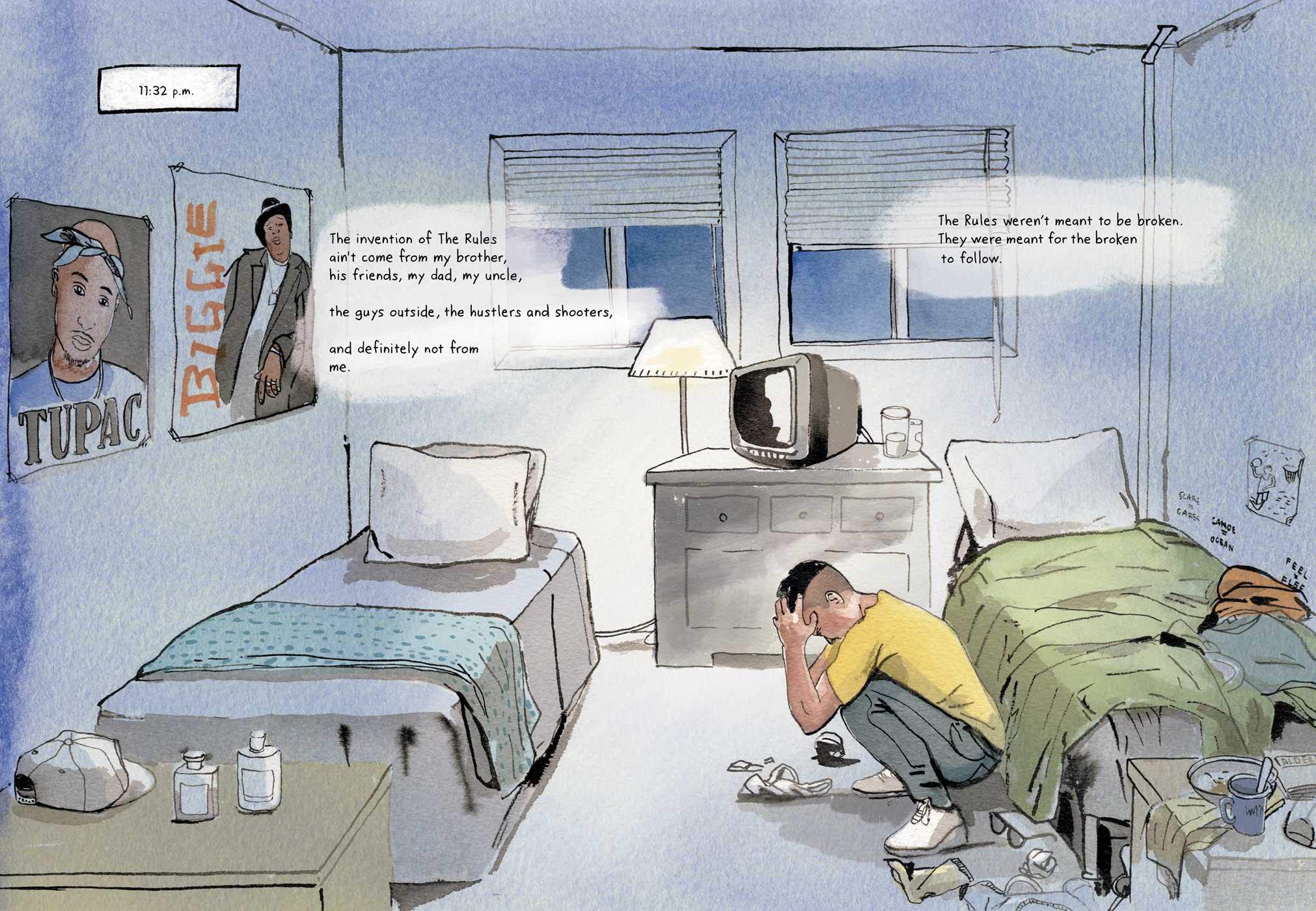
Long Way Down was originally published as a verse novel, and it has received multiple awards and honors. It is about a young man named Will whose brother Shawn was murdered and his vow to avenge his death. In his life he has been indoctrinated to follow three rules: No crying. No snitching. Revenge. As he rides down the elevator in his building, armed with a gun, he is visited in ways that make him more aware of his life, his surroundings, and the cycle of violence that affects both. It is a powerful tale that examines the very real circumstances many young people, and all of us, face in our lives.

Adapting a novel into a graphic novel is a tricky enterprise, and I feel that in order for it to be successful the images really need to bring something to the table. I think that is exactly the case here, as the water-colored paintings enhanced the delivery of the lyrical text, bringing feelings and events into sharper relief. I feel that the overall pacing of this book, as well as the evocative drawings that add elements of mystery, pathos, and uncertainty to the narrative, contribute to make a very powerful impact. This book is riveting and provocative, and aptly ends in a way that settles none of the complicated issues that it confronts. I know that ambivalent endings can be maddening for some readers, but here it seems not only appropriate but necessary.

Long Way Down: The Graphic Novel was written by Jason Reynolds and drawn by Danica Novgorodoff. Reynolds is a bestselling author of many novels, including All American Boys, the Track series, For Everyone, and Miles Morales: Spider-man. Novgorodoff is a designer/artist who has drawn multiple picture books and graphic novels, including The Undertaking of Lily Chen and Refresh Refresh. Both creators speak about their work on this adaptation in this interview.

This book has received many rave reviews, including the three starred entries here: Kirkus Reviews called it "a moving rendition that stands on its own." In School Library Journal Alea Perez concluded, "Reynolds’s words paint pictures of their own in this tragic yet poignant illustrated tale that offers no answers to the seemingly impossible choices some communities face." Sarah Hunter wrote in Booklist that "Novgorodoff’s iteration powerfully cultivates the tone and mood of its source material, demonstrating just how effective and artful comics can be."

Long Way Down: The Graphic Novel was published by Atheneum, and they have a preview and more info about it here.

Thursday, November 5, 2020

Slaughterhouse-Five: A Graphic Novel Adaptation

I should preface this review by stating that Kurt Vonnegut is one of my favorite authors ever. I have read every one of his novels, checked out many of his nonfiction essays, and laughed at his cameo in Back to School countless times. One of the high points of my college career was getting to hear him speak my freshman year. So, to say that I have high expectations for this book is a bit of an understatement. Beyond my own background, some of the weight of my expectations also lay in this book partly being adapted by writer Ryan North, a brilliant comics creator/humorist responsible for some of my favorite works, namely Dinosaur Comics, Jughead, and The Unbeatable Squirrel Girl. 

For those who have not read the original novel, Slaughterhouse-Five is about a man named Billy Pilgrim who becomes "unstuck in time."  Throughout the novel he bounces back and forth across his own timeline, witnessing his death, marriage, experiences in World War II, abduction by aliens who placed him in an interstellar zoo, and meetings with literary hero Kilgore Trout, among other things. As a result, he takes a unique view of humanity, forming opinions about the capriciousness of war and societal values.

As you can see from the excerpt above, which opens the book, this adaptation takes advantage of its medium in ways that enrich this reading experience. The tweaks firmly entrench the book in its own historical context as well as the medium of comics, and they are done in very smart ways. This book uses some of the unique features of comics to recast and retell portions of the novel to convey its spirit without being a strictly literal adaptation. For instance, using panels to play with time and imagination:

Or changing into a newspaper comics format to give short bursts of back story:

As you can see, it is almost as if this story was originally conceived to work as a graphic novel. Like its source material, this book is full of pathos, laughs, and dark observations about humanity. It's a witty, fantastically moving, and trenchant book. This adaptation is one of the best I've seen, in any medium, as much a classic as its source material. Perhaps this is faint praise, because most graphic novel adaptations do not take advantage of the affordances the medium allows. I wish I was not so surprised that reading an adaptation of a novel that hinges on continual shifts in time and space in a medium (comics) that constantly manipulates time and space is an excellent experience as this one. I feel that many creators, certainly not most literary adapters, do not take as much advantage as the medium as these ones do.

That the creators of this book have many years of comics experience under their belts should come as no surprise. North has won multiple Eisner and Harvey Awards for his work on Adventure Time comics, The Unbeatable Squirrel Girl, and Jughead. Artist Albert Monteys was art director of the Spanish satirical magazine El Jueves from 2006-2011 and also created the Eisner Award nominated science fiction series Universe! Both creators speak about their work on this adaptation in this interview, and Monteys shares his take in this interview.

All of the reviews I have read about this book have been raves. In a starred review from Library Journal Tom Batten praised it as "the best, and most effective, graphic novel adaptation of a literary novel in recent memory." In another starred review, Publishers Weekly called it "a rare graphic adaptation that enriches a literary classic." David Weber called it "a perfect graphic novel adaptation" as well as "an absolute joy to read."

Slaughterhouse-Five was published by Archaia, and they offer more info about it here.

Monday, June 15, 2020

White Bird: A Wonder Story

White Bird was the big winner at this year's Excellence in Graphic Literature Awards, winning both the Best Middle Grades Literature and Book of The Year honors. It is set in the same universe as her hit YA novel Wonder, a best-seller about a young boy named August, born with a severe facial difference, who deals with bullying at school. It also was made into a major motion picture. There have been other works set in this world, including the short story collection Auggie and Me, where the main character of this book was introduced.
August's main antagonist, Julien, is a key figure in White Bird, as it is through a correspondence with his Grandmรจre (named Sara) that he gets to hear her story. When she was a girl, she lived in France during the Nazi occupation, and a family took her in and hid her away. She endures a whole spectrum of emotions and tribulations during this ordeal, and this graphic novel chronicles the many trials she endures as well as the peril that her host family put themselves in their quest to protect her. From the many actual holocaust accounts I have read or viewed, I can say that much of what transpires in this book hews very closely to reality. This book is a moving, harrowing account that lays bare the horrible reality that people endured in the past and that many people still have to contend with, a point hammered home with Julian's participation at a pro-immigration protest at the end of the book.

There is only one quibble that I have, and it has to do with a touch of magical realism that tinges the ending of Grandmรจre's story. I get the dramatic effect, but it also was a bit jarring to me given that so much of the rest of the book was deeply rooted in realism. It did not ruin things for me, but I felt it was a bit discordant with the rest of the narrative. Still, I feel that this book is a worthy addition to any classroom library, and it will be attractive to fans of other books by R.J. Palacio set in this world.

What is especially impressive to me about Palacio's work is that not only is she an accomplished writer, she is also a wonderful illustrator. She drew this book herself, adapting her own prose in very effective and impactful fashion. There may be a lot of "talking head" type layouts, but she captures character's gestures and emotions well, telling a tale full of drama and suspense. She has also designed book jackets and drawn a number of picture books, including Peter Pan: The Original Tale of Neverland and Ride, Baby, Ride. She speaks extensively about the evolution and inspirations of White Bird in this interview.

The reviews I have read about this book have been very polarized, either full of praise or offering major critiques in terms of tone and content. In a starred review, Kirkus Reviews called it "A must-read graphic novel that is both heart-rending and beautifully hopeful." Esther Keller praised the artwork, "There are moments of joy between Julien and Sara, and the artwork captures those moments in such a haunting way. Contrasted with the scary moments, the story will grab readers." Hillary Brown offered a contrasting take, writing "Preaching and hoping the message sinks in is basically just hoping for divine intervention, which is exactly what happens to Sara when she’s about to be caught, not just once but repeatedly." Boris Fishman concluded that it is "full of neat coincidences, grown-up clichรฉs, sentimentality and stock portraiture. However, the story does end on the 'right' note with Julian inspired to engage in social activism of his own. Should that be enough?"

White Bird was published by KnopfBooks for Young Readers, and they offer more information about it here.

Friday, April 10, 2020

The Crossover

This book is an adaptation of the 2015 Newbery Award-winning novel, and it relies heavily on text language. Most likely this is due to preserving the verse from the source material, but I still feel it is a very engaging and moving book. Its main character is 12-year-old Josh Bell, the star basketball player on his junior high basketball team. He is very confident and flashy, wearing his hair in dreads. He revels in the attention he gets from his athletic prowess. He is also influenced heavily by hip-hop culture, and his voice is full of flavor and verve, as you can see from how he introduces himself in this book.
Josh plays along with his twin brother Jordan (JB), and the two of them are very close until a new student (whom he calls "Miss Sweet Tea") complicates their relationship. He seeks advice on how to deal from his dad, a former professional basketball player, and less so from his mom, who is the vice-principal at their school. All of these relationships have there own tensions, which make for all sorts of drama and intrigue that get heaped on top of the ups and downs of individual games and the competitive season.

I found this book to be very engrossing and affecting. The artwork was very expressive, and I loved its interplay with text. The expressions and actions are very clear, and the storytelling is able to go between the bombastic aspects of athletic competition as well as more quiet moments of reflection or emotional responses. Sometimes adaptations of novels can be done in a loose or quick fashion, but I this one is very thoughtful and successful. I have not read the source material, but this book really left an impression on me as I could not put it down.

This book was written by Kwame Alexander and illustrated by Dawud Anyabwile. Alexander is a best-selling author of over 30 books, including Booked and Out of Wonder. Anyabwile is a veteran artist who is best known for the Brotherman series of graphic novels.

All of the reviews I have read of this book have been positive. Marissa Moss concluded, "This is a graphic novel for people who don't like graphic novels, a sports book for readers who don't like sports books. It's a strong story that breaks through genres, well told through a magical combination of words and pictures." In a starred entry, Kirkus Reviews summed up, "Flashy and engaging with emotional depth—a slam-dunk thrill." Esther Keller wrote, "I think that visual learners will absolutely love this adaptation, and I will be highly recommending it to students — even if I can’t categorize it as standard."

The Crossover was published by Houghton Mifflin Harcourt, and they offer a video preview and more info about it here.

For those interested in hearing more of the novel, author Kwame Alexander read the book aloud during this time of self-quarantine and "shelter in place," and you can find each update on his Twitter feed.

Sunday, September 15, 2019

Meg, Jo, Beth, and Amy: A Graphic Novel

Funnily enough, I have never read the book this adaptation is based on, but I have now read two graphic novel retellings this year. Little Women turned 150 recently, and Meg, Jo, Beth, and Amy takes that classic tale and gives it a modern spin. The four March sisters are here part of a biracial, mixed family, where their father is a soldier deployed in the Middle East. Meg is the oldest, and she works as a babysitter/tutor for some rich kids and dreams of marrying into wealth. Jo is next oldest, and she strives to be an author. Beth is rather quiet and is an excellent musician. Amy is the youngest and most boisterous of the group. The sisters may not have much in terms of material possessions, but they love and support each other through a variety of hardships and obstacles.
They have to deal with troubles with friends and at school. They also try to navigate various romantic situations, and one of the sisters contends with issues dealing with her sexuality. A series of major life events, including a major illness and a grave injury to their father further challenge their lives. It being the 21st century, the medical drama plays out differently than  it did in the original, which I found refreshing. There are a few other touches that smack of both old and new, such as the text and email exchanges that resemble classic epistolary storytelling. That aspect in particular helps bring many of the character's inner thoughts into focus.

Although I have never read the original, I really enjoyed what I read here. The characters are well written, and I love the designs of their distinctive looks. This modern take on a classic seems a marked improvement from what have turned into the sexist conventions ingrained in the original. Who knows, and I am sure that readers 150 years from now may find it problematic in ways we've not conceived, but I feel that this adaptation is a great one for this day and age.

The creative team behind this book are writer Rey Terciero and artist Bre Indigo, and Meg, Jo, Beth, and Amy is the first graphic novel for both of them. Terciero has been an editor and writer that has worked for many different publishers as Rex Ogle. Indigo creates webcomics, including one named Jamie. They originally started publishing this book online at a site called Tapas, and Indigo speaks about her role in creating it here. Both creators speak about the book here as well.

All of the reviews I have read of this book have been positive. Kirkus Reviews concluded, "Sticking to the original storyline, this tale offers a contemporary vision of sisterhood that will appeal to a diverse audience." Publishers Weekly called it "smart and thoughtfully rendered," and added, "this modern retelling will resonate with today’s readers. Mombian called it a "must-read."

Meg, Jo, Beth, and Amy was published by Little, Brown Young Readers, and they offer more info here.

The publisher provided a review copy.

Monday, July 15, 2019

Little Women

Good things sometimes come on small packages, and I am not making a joke about this book's title. It is a relatively slim volume, but it brought me great joy. It is not a strict adaptation of Louisa May Alcott's classic book Little Women, as I had expected, but half comic strips that show the highlights in a humorous light, half biography of her dad Bronson Alcott, AKA "the worst father in history." As you might can tell from the cover, this book takes a few liberties in heightening characters' responses to the plot. It also offers a smart meta-commentary on the book. It is funny and clever, and I feel that those who have read the original would really enjoy it. Heck, I've never read the original, and I enjoyed it immensely.
The second half of the book is a biography of the transcendentalist Bronson Alcott, Louisa May's father. He was an interesting fellow who dragged his family into all sorts of situations based on his beliefs. His specific views about how to live the perfect life led to several attempts at communal living, poverty, and veganism.

I just met this book's illustrator Ryan Dunlavey at the Denver Pop Culture Con in June, and he told me that there will be future entries in this series, only they will be mostly comic strip adaptations without the historical commentary. I am very much looking forward to checking out those volumes.

This book was drawn by Ryan Dunlavey and written by Grady Hendrix. Dunlavey's work typically combined humor with nonfiction and he is known for drawing the series Action Presidents!, Action Philosophers! and The Comic Book History of Comics. Hendrix is an author with an interesting and varied list of credits that touch on popular culture, horror, novels, and cookbooks.

I was not able to locate many reviews of this book, though it currently has a 4.33 (out of 5) star rating on Goodreads.

Little Women was published by Evil Twin Comics, and they offer more info about it here.

Friday, May 10, 2019

The Iliad

One of my favorite graphic novel adaptations is Gareth Hinds's The Odyssey, which is colorful, vibrant, and captures so much of the spirit of the epic poem. Here, he did things a little in reverse and adapted that work's predecessor, The Iliad, which chronicles the tenth year of the Trojan War. Personally, I prefer the poem The Odyssey to the poem The Iliad, mostly because the latter has a lot more battle scenes that read more as info dumps. I was curious how this poem would read as a graphic novel, because of those sections, but I feel that Hinds has made the whole enterprise work. Certainly, the moments where the days' casualties are noted and listed stand somewhat in contrast to the rest of the soldier/leader/gods drama, but Hinds does the work to make them feel integrated into the whole narrative. Also, their deaths are intimately tied into the machinations of others.
Of course, the banner plot of the book involves the conflict between King Agamemnon and Achilles, his best fighter, over Briseis, a concubine who is treated as a spoil of war. And there is much interaction between the gods and goddesses, with Athena and Hera (and by extension Zeus) on one side and Aphrodite, Ares, Apollo, and Artemis on the other. Clearly, there are many characters, plots, and moving parts, but I feel that Hinds weaves them all into a cohesive, artful whole. I love how he uses symbols and color to differentiate characters that might otherwise be confused, and also how he grounds the tale in reality through maps and front-pieces identifying the characters.
Although I must admit it was not as enjoyable as The Odyssey to me, it was not for lack of effort or craft. I just like the one story better. Both graphic novels are masterpieces that stand well together.

Hinds is no stranger as an adapter of classic works into graphic novels. Already he has created a number of them like The Merchant of Venice, Beowulf, and King Lear. He speaks more about the process of creating his adaptation of The Iliad here and in this interview. He speaks about his work in general in this interview.

The reviews I have read about this book have been very positive. Publishers Weekly gave it a starred review that concluded, "Hinds’s relatively plain language retains just enough meter to hint at the cadences of the work, and, together with the dynamic art, creates an accessible entrรฉe to an enduring classic." Dominic Umile called it "magnificently realized." Kirkus Reviews summed up, "An expertly crafted rendition and a welcome invitation to younger readers to immerse themselves in the ancient past."

The Iliad was published by Candlewick Press, and they offer a preview and more here.

The publisher provided a preview copy.

Friday, March 15, 2019

To Kill A Mockingbird

It is dissertation defense season, and my plate has been full lately, so I apologize for slacking off here. I have been trying to read this book for weeks now, and I am glad I finally did. To Kill A Mockingbird is one of the most read and also most challenged books in the USA. It is a novel I have read a few times, and there was at least one point in my life when I would have said it was my favorite book ever. I have to admit, there were moments of nostalgia that tweaked me here and there in reading this very faithful and well rendered adaptation. It hews to the original, in its well researched illustrations as well as use of original language from the book (Yes, the n-word is in there, and they provide a justification for its inclusion in the endnotes).

All of this to say that the potential problems people have with the novel also exist for those who would read this graphic novel. The "white savior" narrative is still pervasive, but in this go-through I also noticed how much it highlights feminism and the role of women in this community, something I do not see given as much attention when discussing this book. The family dynamics also touched on my heartstrings, and I admit I did get misty eyed at the last pages of the book. It is very well paced as an adaptation, top notch work all around.
Still, there is a part of me that wonders why this adaptation exists. TKAM is one of the most-read and taught books in the country. There are millions upon millions of copies of it in libraries, classrooms, and in people's hands already. I guess having a graphic version of this book makes it available to some readers who might not want to tackle the novel, but I I have to say that I still found this version to be a time-consuming read. It is text-heavy for a graphic novel, with the text mainly displayed in caption boxes. It is not "easy reading, " which is often the rationale for making a graphic novel version. I get why some of the other adaptations I have recently reviewed exist: The Giver is pitched at YA audiences and graphic novels have proven a popular format for that age group; Anne Frank's Diary carries of the weight of not only being a literary text but also one tasked with preserving people's memories of the Holocaust. I guess it is a good commercial decision to adapt TKAM, as I imagine libraries and schools will snap up this version. But as much as I liked it, I still ended up asking myself if it was necessary. Perhaps as an answer to my question I can say that reading this book has dredged up all kinds of contrary and ambiguous thoughts, which I feel in many ways is the hallmark of a powerful book. In that way, I say this graphic version is successful. 

Harper Lee, of course, wrote the original novel on which this adaptation is based. For it she was awarded a Pulitzer Prize and a Presidential Medal of Freedom, which is remarkable given this was the only novel she published in her lifetime. Fred Fordham adapted the book here, and he has another graphic adaption, of Phillip Pullman's The Adventures of John Blake, to his credit. He has also created an original graphic novel Nightfall, which is currently available in French. He speaks about his work in adapting TKAM in this video.

All of the reviews I have read about this book have been positive. Esther Keller wrote, "The color on the artwork is what struck me most. I expected black and white pencil drawings, which would evoke the Gregory Peck movie. Instead, bright, soft colors are used. It works. It’s beautiful." Publishers Weekly called it a "thoughtfully crafted interpretation" and summed it up, "More loving remake than revelation, Fordham’s adaptation may be scrutinized by Lee’s fans, but does sufficient justice to her portrait of injustice." CJ Lyons declared it "a worthy partner to the original, providing a clarion call for civility, equality, and justice for all."

To Kill A Mockingbird was published by Harper Collins, and they offer more info here.

The publisher provided a review copy.