Showing posts with label civil rights. Show all posts

Wednesday, February 25, 2026

Run, Book One

The March trilogy of graphic novels is a modern classic, a multi-award-winning set of books that chronicle the life of John Lewis during the first part of his life. This book, Run, was proposed as the first in another series, but Lewis died just as the final edits were made to it, and it is up in the air if it will ever continue. Still, it is a worthy and fascinating book well worth reading and revisiting.

This volume takes place after the first push of civil rights victories, and it shows how even that segregation was legal and voting rights cleared that equality was far from the norm. This book opens with a white congregation refusing to allow blacks to enter their church and worship, and shows more examples of how entrenched power structures made it difficult for true justice to be practiced. I think it is important to see just how much struggle existed and continues to exist, even after "progress" was made. We are still fighting some of these same battles now, sadly.

This book also features much detail about the workings and politics of the Student Nonviolent Coordinating Committee that Lewis headed, and how it morphed into a different sort of movement that eventually gave rise to the Black Panther Party. 

It also chronicles several contemporary events, such as the Vietnam War and Watts riots, and how they all contributed to the political atmosphere of the times. This book ends with Lewis deciding to run for office, and even if it ends in an open-ended manner that may never be resolved, readers would know that Lewis was elected and served for decades as a US Representative. And I feel that what makes this book relevant and moving is how it shows the friction and effort necessary with any political action. 

Like the March trilogy, this book was written by Lewis and Andrew Aydin, with art by L. Fury, in her graphic novel debut, with some assists by Nate Powell. Fury has been at work on her own graphic novel project, Condemned, and Powell has a long list of credits, including the March books, an adaptation of Lies My Teacher Told Me, and his own works like Fall Through.

This book has received many accolades and glowing reviews. Publishers Weekly concluded their starred review, "Lewis’s stunning American story and legacy lives on in these pages." In another starred entry, Kirkus Reviews called it "an intimate, powerfully revealing look at a crucial, complex time, through the eyes of a true American hero." In a third starred review, Eric Carpenter wrote that it was "as informative and essential an addition to the nonfiction comic canon as its much-lauded predecessors."

Run, Book One was published by Abrams ComicArts, and they offer a preview, a teaching guide, and more information about it here.

Friday, February 20, 2026

History Comics: Rosa Parks & Claudette Colvin: Civil Rights Heroes

I have to admit I went into reading this book, Rosa Parks & Claudette Colvin: Civil Rights Heroes, with a bit of trepidation, because I know that Parks's story is often-told and also incorrectly, as if she was just some tired woman who happened into the situation, which could not be further from the truth. However, there was so much in this book that I either did not know or appreciate, and it was truly eye-opening. If I have a quibble with it, it would be that the title should be reversed, because its narrator and main focal point is Claudette Colvin, who just died this year and should be known by many more people. She was arrested nine months before Rosa Parks was, also for not giving up her seat to a white person in Montgomery, Alabama. The difference was that Colvin made for a poorer test case for litigation, as she was younger, unmarried, and pregnant at the time of the proceedings. It was not until later that Parks became the subject of that test case to argue against and finally end segregation (legally, at least). 

What this book does an excellent job of is telling things like it was, not sugar-coating language, events, or how some people ended up getting more credit than others for the civil rights work. It shows the long, laborious process it took to get justice, from the arrest to trial and later appeals. It shows how these events affected both women and their families, highlighting how they lost friends and jobs and also feared for their lives because of the stands they took. This book also situates these events with other contemporary happenings, like the murder of Emmett Till, to give a clear context of the times. It makes these people real, not just grand figures from history to be studied.

Reading this book the same day that I learned the Reverend Jesse Jackson died, and revisiting the 1984 skit "The Question is Moot" from Saturday Night Live, it strikes me that even after decades we are still dealing with the same issues of disparity, violent authorities, hateful legislation, and misinformation. It's shameful that some of us have hoodwinked by illusions of progress, when the same old things just happen under different guises. Having access to stories like these is vital for people to realize that these struggles are ongoing, difficult, and necessary.

Rosa Parks & Claudette Colvin was written by Tracey Baptiste and drawn by Shauna J. Grant. Baptiste has many books to her credit, including Kid X and Super Goat Girl. Grant has created her own series of Mimi graphic novels as well as a couple of entries in the Baby-Sitter Little Sister series.

All of the reviews I have read of this book have been positive. Kirkus Reviews called it "a valuable addition to the growing swath of graphic novels drawing attention to civil rights history." Johanna Draper Carlson wrote, "The narrator and the open, friendly art style make History Comics: Rosa Parks & Claudette Colvin an enlightening read with something new to say."

Rosa Parks & Claudette Colvin: Civil Rights Heroes was published by First Second, and they offer a preview and more information about it here. This book is suggested for readers age 8 and up, and it features some hateful language and references to sexual violence.

Friday, May 5, 2023

Swim Team

Swim Team focuses on Bree, an African-American middle school student who recently moved to Florida from New York with her father. 

She is anxious about starting life in a new place and in a new school, and she really does not want to do anything that involves swimming. However, she ends up having to face her fears and learn to swim because it is literally the only elective that fits her schedule. It turns out, she's got of lot of potential and even makes her swim team, the Mighty Manatees.

The middle school she attends is under-funded and in danger of losing its swimming facilities, but the community values competitive swimming highly, which opens a year-long competition with the dominant private school in order to save their pool and program. Not just a typical underdog story, though it does have many of the positive components of the genre, this book also touches on friendship, family relationships, as well as the history of race and class relations in the community. It is a multi-faceted, complex story that I found both moving and touching. It also features a lot of heart and a good sense of humor. This is a superlative graphic novel for middle school students.

This book is the creation of Johnnie Christmas, who has created a number of other graphic novels for both adults as well as younger readers, including Firebug and the Angel Catbird series. He spoke about his work on Swim Team in this interview.

A Coretta Scott King Honor Title and a National Book Award Finalist, Swim Team has received many glowing reviews. In their starred review Kirkus Reviews called it "deeply smart and inspiring story." In another starred review Publishers Weekly wrote, "Challenging the idea that 'Black people aren’t good at swimming,' this middle grade debut from Christmas (the Angel Catbird series, for adults) details segregation’s generational impact through a warmhearted story of community, Black diasporic identity, and learning, all portrayed in kinetic contemporary art." Esther Keller opined, "The bright artwork with vivid sunny colors and fine details in each panel, brings the story to life."

Swim Team was published by Harper Alley, and they offer a preview and more here.

Thursday, October 20, 2022

Wake: The Hidden History of Women-Led Slave Revolts

Wake: The Hidden History of Women-Led Slave Revolts is a graphic novel that works on a number of levels, and I was gobsmacked by how much it affected it. One, it is a memoir by academic Rebecca Hall doing research for her dissertation projection. Two, it is an account of the facts of women's roles in slave revolts. Three, it contains a number of fictionalized accounts of the events concerning slave revolts, as very often there are no concrete records extent concerning women's involvement in them. Four, it is an exploration of how the institution of slavery still haunts and informs contemporary society. Five, it is enterprise that demonstrates how history gets defined and then redefined, and how this process has palpable effects on us all, whether acknowledged or not. It's a tour de force graphic novel that packs a wallop intellectually, aesthetically, and emotionally.

One especially affecting and effective trope in this book is a constant mirroring of the past and present in its imagery. A good part of the book takes place in New York City, and there are several panels and pages that show scenes from the 17th and 18th centuries and how they inform our present. Scenes of slave auctions push right up on images on contemporary Wall Street, juxtaposing the predominant business practices of both eras. The artwork by Hugo Martinez aptly emanates a rawness that highlights the horrific and dehumanizing social conditions depicted throughout the book. It is a difficult read in many ways, as it does not let anyone off the hook for their various roles in either perpetuating or trying to ignore grave injustices carried out over centuries. And the images touch many a nerve along the way.

In the end, I was amazed by the scope of this book. As an academic, I can appreciate the great effort and distress involved in doing this research and creating this account. As a reader, I was moved by the historical accounts and sheer horror of the depraved acts of slavery and racism. I was also moved by the bravery and perseverance of people who were enslaved and how they contended against their captors. As a citizen, I was distressed by how public institutions, including records clerks and companies like Lloyd's of London work to obscure and even protect past misdeeds. Additionally, I was struck by how Hall's background as a lawyer also informed insights into how the institution of slavery stripped people of basic humanity through legal codes. As a researcher, I can also appreciate just how frustrating it could be to delve into a topic where little to no historical record exists. This absence should be galling to us all in the present day.

Wake: The Hidden History of Women-Led Slave Revolts is an important, modern classic that belongs on library and classroom shelves as well as on syllabi. I am so glad that one of the students in the graphic novels class I am currently teaching selected it. I feel everyone should read it.

All of the reviews I have read of this book have been glowing. In a starred entry, Kirkus Reviews summed it up as "an urgent, brilliant work of historical excavation." Etelka Lehoczky called it a "remarkable blend of passion and fact, action and reflection," and added that "Wake sets a new standard for illustrating history." In a detailed and riveting review Jordan Alexander Stein wrote, "It pushes past the limits of what’s possible, to tell us a story that wasn’t but now can be."

Wake: The Hidden History of Women-Led Slave Revolts was published by Simon & Schuster, and they offer more information about it here.


Saturday, October 15, 2022

Good On Both Sides: A (Th)Ink Anthology

Good on Both Sides is a collection of political and historical comics strips by Keith Knight, who has been publishing regular comic strips such as the K Chronicles since the early 1990s. Knight's work here is contemporary, commenting not only on current events but also the current state of our country. I love his point of view, acerbic sense of humor, and his insights. 

Note: I got images from Knight's website. The book is in black and white.

The general issue with collections like this is that the humor often gets lost as time goes by and people forget the contemporary references that make the jokes work. I think Knight smartly protects against this by including many historical portraits that add their own context. By including several celebrations of and quotations from historic figures like Thurgood Marshall and Edna Lewis he provides a long view on how long certain struggles have been going on. Many of the issues we deal with today in terms of civil rights and race have been fomenting for a long time. 

Reading over what I have written above, I am making this book of comic strips sound like a textbook, which is entirely not the case. Knight's artwork is a delight, offering lots of energy and character with seemingly simple and streamlined line-work. Good On Both Sides made me laugh several times. It is funny, insightful, and provocative, and I very much enjoyed catching up on strips that I had not seen.

As I mentioned above, gentleman cartoonist Keith Knight has been a fixture in the alt-comics scene for decades now, and he has also received added exposure by having his life/works used to make the Hulu series Woke. He has won a number of accolades, including a Harvey Award for his strip K Chronicles, multiple Glyph Awards, an Inkpot Award for his career achievements, and an NAACP History Maker Honor. He spoke about the current state of his life and work in this interview.

I was not able to find many reviews of this book online, but the one I found was positive. Joel Oliphint wrote that although "the subject matter in Knight’s cartoons...can be heavy, he uses humor to help the medicine go down."

Good On Both Sides was published by Keith Knight Publications, and you can find more info about it here. You can also support Knight on Patreon here.

Thank you to the author/publisher for providing me with a review copy!

Wednesday, June 15, 2022

History Comics: The Stonewall Riots: Making a Stand for LGBTQ Rights


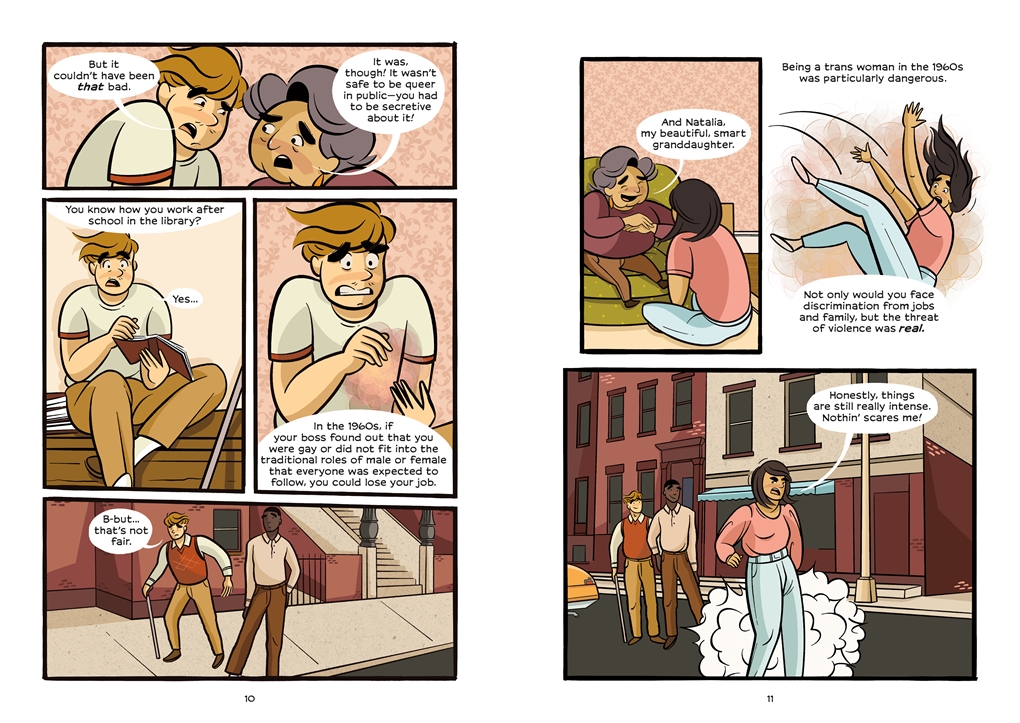
History is a tough thing to conceive of for some learners, as it's difficult to remove oneself from one place in time and try to imagine themselves in another. This volume of History Comics, The Stonewall Riots: Making a Stand for LGBTQ Rights, tackles this issue by literally having its protagonists, a trio of adolescents named Natalia, Jax, and Rashad, who are diverse in terms of gender and sexuality, go back in time (without their cell phones, the horror!). Then and there, they are witness to the actual events leading up to the Stonewall Uprising, and they get to know some of its major players. 

This graphic novel is more about getting to know a tone and people than it is about presenting specific facts and dates to memorize, and I think where it excels is in contextualizing what led to this series of protests that gave momentum to a significant push for LGBTQ rights. The artwork is full of personality and depicts characters in stark, energetic fashion, pairing well with the plot to make this book have a very human focus. The characters and readers both get well acquainted with the people who made history.

Significantly, this book also does not sugar-coat the people or events, nor does it conclude that the struggle is over in the present day. In fact, it points out how much work still needs to be done and also provides a slew of resources for how young people can also get involved in various organizations today. It is a fantastic resource for learning about history as well as for encouraging contemporary activism, and I think it is a much-needed book for classroom and school libraries.

The Stonewall Riots was co-created by writer Archie Bongiovanni and artist A. Andrews. Bongiovanni has co-created comics in all sorts of formats, from graphic novels like A Quick & Easy Guide to They/Them Pronouns to webcomics like Grease Bats and other shorter ones published at The Nib. Andrews also has created a number of different sorts of comics including A Quick & Easy Guide to Sex and Disability.

All of the reviews I have read of this book have been positive. Brett at Graphic Policy stated that it is a great primer that "captures the moment," "the feel," and "the build-up of it all." Krystal Moore and Felix Whetsel called it "a timely introduction to the history of the LGBTQ community, and the people who fought to get us where we are now." Kirkus Reviews summed up, "Engaging account that invites young people to continue to advocate for equality now."

The Stonewall Riots: Making a Stand for LGBTQ Rights was published by First Second, and they offer a preview and much more here.

Monday, May 30, 2022

Piece By Piece: The Story of Nisrin's Hijab

Piece By Piece: The Story of Nisrin's Hijab is a complex, harrowing, and compelling graphic novel that tackles some difficult subject matter, namely prejudice and violence directed toward Muslims in the United States. This book is set in 2002 in Portland, Oregon, and it stars Nisrin, a young woman who embraces Islam and traditional garb, despite her parents' views. They still recall the violence in Bangladesh becoming independent from Pakistan in 1971, and their scars color their views differently.

Her wearing a head scarf marks Nisrin as an outsider in school and her community, and one day she and an African-American friend find themselves targeted by a crazed individual spewing anti-Muslim hate. Both girls are beaten badly, and face long recoveries. Nisrin in particular suffers from instances of PTSD, and she finds it difficult to deal with her new surroundings in high school, where she finds herself bullied by some students and shunned by some teachers. She finds it hard to make friends, though eventually she does hit it off with a girl named Veronica.

Reading this book is bracing, because it depicts serious subject matter in a frank manner. However, I appreciated the experience of reading it, because it is engrossing, and I feel that I learned much more about Bangladeshi culture and history. Also, the vivid painted imagery is powerful and atmospheric, drawing the reader into this work in direct and impactful fashion. Its imagery and narrative are both haunting and enlightening, showing the horrors that victims of hate crimes suffer as well as how some immigrants experience life in the US.

This book's creator Priya Huq is a Bangladeshi artist, and this is her debut graphic novel. She publishes work with Radiator Comics, and she speaks more about her life and how it affected the making of this book in this interview.

All the reviews I have read about this book have sung its praises. Kirkus Reviews concluded, "Remarkable storytelling presents a multilayered struggle around identity and power in an anti-Muslim climate." Amanda MacGregor wrote, "This is a very emotional and powerful read, with the assault and resulting trauma coloring much of the story." Mahasin A. Aleem called it "A solid addition to collections of all types and a welcome exploration of what it means to navigate the complexities of Muslim identity in the United States."

Piece By Piece: The Story of Nisrin's Hijab was published by Amulet Books, and they offer more information about it here.

Sunday, February 20, 2022

Turner Family Stories: From Enslavement in Virginia to Freedom in Vermont

Turner Family Stories is one of the most unique and interesting books I have read in recent times. It is a collection of comics that adapt an oral history recounted by 100-year-old Daisy Turner in 1983. These stories explored her family history, from her ancestors being abducted from Africa to her parents being slaves who eventually found freedom, as well as their way to New England, to her own struggles with equality throughout her life.

Of particular note, she spoke extensively of her legal battle with a white man who had promised to marry her but reneged and tried to destroy her life and reputation. Such first-hand accounts of history are powerful enough on their own, but here are made even more potent by translating them into comics.

As a collection of stories, this book employs a number of artists. I was highly engaged by the framing narrative, about two youth who speak to Daisy, leading to  separate accounts about her and her family, including the tale of how her parents made their way to Vermont, an adventure where her dad showed off his prodigious strength, and a supernatural episode when her mother needed help. The varying art styles, some more cartoonish and others more realistic, complement each other, lending a wide arrange of expression to the book. I think this collection is an excellent book as a teaching tool or for a fan of US or civil rights history. I hope that it is read far and wide.

Turner Family Stories was edited by Jane Beck and Andy Kolovos and features comics by Marek Bennett, Francis Bordeleau, Lillie Harris, Joel Christian Gill, and Ezra Veitch. The cover was drawn by Robyn Smith. It also couched well in history, with a foreward by Gretchen Holbrook Gerzina, introduction by Julian Chambliss, and preface by Jane Beck. There are interviews with artists Bordeleau, Harris, and Veitch about their work on this volume here.

I was not able to locate any reviews of this book online, though it did have a 5 (out of 5) star rating on Goodreads as of this writing. This superb book certainly deserves more attention!

Turner Family Stories was published by Vermont Folklife Center, and they offer previews and much more about it here.

Wednesday, June 30, 2021

Cyclopedia Exotica

Cyclopedia Exotica is an amazing graphic novel that explores issues of identity in an intriguing way. The book starts off as a series of encyclopedia entries on cyclopes, their biology, and their history as a race. However, once it touches on the life of Etna, a model who became a sensation when she posed nude for a men's magazine, the book becomes an immersive look into the lives of contemporary cyclopes and all that they entail. After reading this book, I was struck by just how deft it is in creating a parallel world based on a fantastic premise and then immediately normalizing that premise. It makes the cyclopes so human and relatable that they actually seem a real ethnic group, and also acts like an extended metaphor for Orientalism.

What I find most charming and provocative about this book is how subtly it tells a long form narrative through a series of short episodes that read like an amalgamation of gag strips and short stories. Each one is finely crafted, sometimes resulting in a chuckle but more often in a poignant moment or insight into being a frequently fetishized minority. This book operates almost like a pointillist painting, with each tiny detail contributing to an artful, moving portrait of a people.

Ostensibly a book about mythological creatures, it actually has lots of insight into modern humanity and the many choices we face. Over the course of the book, I got to know each character and how they cope with the world. Some, become twin artists who make plenty of conceptual pieces that cast an interesting light on the ways cyclopes are and are not incorporated into human society. Others are trying to make their way in the world with romantic relationships, either with cyclopes or humans. Some of the characters try to do things to "pass," from having elective surgery to become a "two-eye" to wearing special clothing that shapes their bodies to be more ideally human. And one cyclop woman has to make some hard choices between being a parent and re-entering the work force. 

I loved getting to know the world and characters in this book, and the slight consolation I had when it ended were the very informative entries about each character, why they were named as they were, and the author's intentions with their plots and sub-plots. This book is so fully realized and thoughtful, and it calls to mind poet Marianne Moore's line about "imaginary gardens with real toads in them" with how much the artful fiction evokes reality.

Cyclopedia Exotica is the creation of Aminder Dhaliwal, an animator who has worked for a number of major studios. Her debut graphic novel, Woman World was nominated for a 2019 Ignatz Award. She also has published the graphic novella Dead End Jobs for Ghosts. The coloring of this book was done by Nikolas Ilic, a production artist who specializes in character design. Dhaliwal speaks about her work on the book in this interview.

All of the reviews I have read of this book sing its praises. Carmen Maria Machado wrote that "the characters in Dhaliwal’s stories sparkle. They’re tenderly rendered and their problems are real." Oliver Sava was impressed by how she tackled "complicated subject matter with empathy and humor, offering ample social critique while keeping the focus on how these characters connect with each other—and learn how to love themselves." Jeff Provine opined, "The emotional touches with the engaging characters brings the reader along through quick comic stories, always wanting more even after the final page."

Cyclopedia Exotica was published by Drawn & Quarterly, and they offer a preview and much more here.

Wednesday, February 10, 2021

The Black Panther Party: A Graphic Novel History


Reading this book showed me how little I actually knew about the Black Panther Party. The Black Panther Party: A Graphic Novel History is not a long book, but it is substantive and comprehensive. It touches on every major figure associated with the BPP, and heavily focuses on the pivotal years of 1967 - 1969. There are spotlights on people like Huey P. Newton, Bobby Seale, Fred Hampton, and Angela Davis as well as gripping, suspenseful portrayals of major events in the formation and social actions taken by the Black Panthers.

As you can see from the excerpt above, this book is about detailing the history of this group and also placing it in the broader context of US and civil rights history. It is one of the more information-rich graphic novels I have read, but it balances exposition with dramatic action scenes. It utilizes dynamic, iconic artwork full of bold imagery. I appreciated how well it captures both realistic depictions of the participants as well as a sense of the propaganda/visual messages broadcast by the BPP. Even in the passages that are more text heavy and dense, the images are vibrant and realistic, adding much context to the proceedings. 

As a common theme with other books I've read recently, like Big Black: Stand at Attica and Kent State, this book shows how US society has not progressed as much as we would like. The Panthers arose in a response to the racial violence being perpetrated by police forces. Their militaristic response was to show that they could not simply be intimidated and pushed around any more. This arm of the movement was coupled with more charitable ones I did not really know about, such as establishing a school and a program for feeding the hungry, though those aspects are largely overlooked today.

A sizable amount of the book is also devoted to J. Edgar Hoover and the FBI's many incredibly shady and illegal methods of infiltrating the BPP, sowing discord, and outright murdering some of its leadership. I know that not everyone approved of the methods for seeking equality, even within the various civil rights movements of the day, but the level of subterfuge and sabotage accounted here is shocking. I think this book is the perfect introduction for someone who knows nothing about the Black Panther Party, and an excellent resource for any US history, government, or language arts class studying African-American history or civil rights.

This book was created by writer David F. Walker and artist Marcus Kwame Anderson. Walker is a prolific author and is best known in comics for his work on the Eisner Award winning series Bitter Root, runs on Marvel series such as Luke Cage and Power Man & Iron Fist, and the DC Comics series Naomi. He has also written another nonfiction graphic novel, a biography of Frederick Douglass. Anderson is best known for his creator owned series Snow Daze and has also illustrated a number of projects for Action Lab.

All of the reviews I have read of this book have been very positive. In their starred review, Publishers Weekly concluded, "This concise yet in-depth guide offers a timely resource for activists, history buffs, and students alike." Ed Park called it "ambitious and informative." In a rollicking review, S.W. Sondheimer wrote, "I learned more from this 98-page graphic novel history than I did from Chernow’s 818 page biography of Hamilton or anything I had to read for my college course on the WWII Pacific theater."

The Black Panther Party was published by Ten Speed Press, and they provide a preview and more here.

Wednesday, December 30, 2020

Kent State: Four Dead in Ohio

My Friend Dahmer is one of my all-time favorite graphic novels, a dark exploration of high school friendships and the many issues that underlie people's lives, which in the case of Jeffrey Dahmer resulted in horrific murder and mayhem. Derf Backderf's combination of autobiography and journalism made for a highly nuanced and haunting book that has stayed with me for years. Kent State: Four Dead in Ohio has a bit of autobiography at its beginning, when young Derf saw the National Guard rolling through his town on the way to Kent State, but its strength lies in its exhaustive research. This book focuses specifically on the four young people who died in the May 4 Massacre in 1970, putting a human face on history. Over the course of the book, I got to know these people, their friends, and their aspirations, and so when the gruesome events take place toward the end of the book, they feel even more tragic and pointless.

This book meticulously recounts the event that lead up to the massacre, and it is structured in four chapters to correspond to the first four days of that May. Piece by piece fall into place, from the "law and order" governor trying to show just how strong he is during an election year to the paranoid, draconian military leaders who headed the National Guard contingents to the exhausted and misinformed troops themselves. In hindsight, the massacre is made to look like a perfect storm, complete with misinformation, wild and untrue accusations made against the student protestors, and a culture war between liberal and conservation factions. The military action comes to be, ironically, as a result the fomenting protests against the increasingly unpopular and cruel military actions in Vietnam. 

What is most informative and distressing about this book is the role that manipulating media and casting political aspersions played in the National Guard's actions, which is mirrored by contemporary protests and police brutality in Portland and other places. Acerbating the situation, government agencies and police planted spies and moles to make the protestors appear much more violent and extremist, just like today. The violent factions within the protestors are a minority, and do not reflect the whole, but they are attributed all sorts of (non-existent) power and agency. Rampant rumors among the local population and military/community leadership paint the students as communists and radicals. They say that the students have snipers and stockpiles of weapons. They dehumanize the students and their demands. It is depressing to see how much things have not really changed and how short we have come in the 50 years since these events took place. 

Spoiler: The bad guys win and suffer no consequences.

I was impressed by just how much this book does. It portrays a set of individual portraits of the students, a history of the campus, and an account of the state of politics of the time on a city, state, and national level. There is a lot of information in this book, and most of it is presented in incredibly artful manner. There are a few pages that are text-heavy and more expository, but none of it is off-putting. And the pacing of the last chapter, where the shootings occur is paced to highlight its brutal, oppressive, and unjust aspects, is a clinic in storytelling an action sequence. The illustrations map not just the place but also the people and events in a visceral and incredibly moving fashion.

Reading this book, I could not help but also think of Big Black: Stand at Attica, which recounts events that happened at a prison uprising a year later, events referenced in this book's epilogue. Great books use history to illuminate the present, and that is exactly what Kent State does. Certainly it comes from a particular political viewpoint, but it is backed by a vast amount of research and personal accounts. And the facts (those that have not been obfuscated and lost) point to terrible and avoidable injustice and murder. Derf has crafted another masterpiece graphic novel.

In addition to the multiple award-winning My Friend Dahmer, Derf Backderf is also known for his long running alt-comic The City as well the graphic novel Trashed, about his time as a garbage collector. He speaks extensive about his work on Kent State in this interview.

All the reviews I have read of this book have praised it. It has received multiple starred reviews. The one from Publishers Weekly called it an "expertly crafted chronicle of this defining moment in U.S. history" that also "serves as a deeply moving elegy for the victims." The one from Kirkus Reviews concluded, "Backderf’s vivid, evocative book does a splendid job of keeping their memories alive." Leonard Pierce wrote, "By buying into the details so heavily, he makes a story that means something more today – and serves as a warning as we see the story repeated, again and again, every day, always as tragedy."

Kent State: Four Dead in Ohio was published by Abrams Books, and they offer a preview and more here.

Tuesday, December 15, 2020

Big Black: Stand at Attica

Sometimes I read a book and think about how much life has changed in a span of time. Other times, like when I read this book Big Black: Stand at Attica, I am disheartened and frustrated to see just how much some injustices still persist. This book is an account of a prison uprising in 1971, a moment that exposed just how racist and exploitative the prison system was. Also, it was an event that showed just how ruthless and uncaring the prevailing governmental structure was, when a wealthy governor with grand political aspirations authorized the slaughter of black men to show just how tough and "law and order" he was.

What makes this book work so well is to things. One, it is based on a real account and is clearly well researched. There are many details about the workings of the political and prison systems as well as background on all the major players in this drama. Two, the artwork is mainly journalistic or documentary in its presentation. It makes you feel like you are witnessing actual events, and the storytelling hits in a visceral way. In contrast, each chapter heading has a superhero comic book quality to it that heightens the events further, drawing attention to some of the major themes of the book.

The net effect is that the reader gets to know a good number of these people in quick fashion, and it is difficult not to be affected when all attempts to work toward justice and compromise are met with brute, military force and wholesale destruction. Also worth noting, this book highlights just how much the government manipulated public opinion through misinforming and misleading media accounts of what was going on. Today, there is so much talk about media literacy and "fake news," and seeing just how far back these concepts go was eye-opening.

In actuality, the inmates did not torture/kill any of their hostages.

The uprising (the less sympathetic called it a riot) was a flashpoint event that revealed much about the racism and classism of the US, and I am sad to realize it took me this long in my life to learn about the facts. Up until recently, I really only knew about it via that one scene where Al Pacino leads a chant of "Attica, Attica" in Dog Day Afternoon, but I was largely ignorant of the actual events. Given how contemporary the issues at play in this book are, it is shocking that they are not really part of US history curriculum. 

I realize that this book is biased, certainly meant as a form of activism, but it's tough to take the side of those who brushed aside any sort of negotiation and went in guns blazing, to the effect of 43 people (including 10 guards who were being held hostage) dead. This graphic novel tackles issues that still plague the US today, namely the looming presences of racism and the (now even larger and more industrialized) prison system, and it does so in gut-punching and moving fashion.

This book was created by author/actor/educator/activist Jared Reinmuth and artist Améziane, based on personal interviews with Frank "Big Black" Smith. "Big Black" was a central figure in these events, and he was later tortured by guards for his role as head of security during the revolt. Améziane has also drawn biographies of Muhammed Ali and Angela Davis, an account of the 1989 Tianamen Square protests/massacre, and fiction in the series Cash Cowboys. Reinmuth speaks more in this interview/panel. 

All of the reviews I have read have praised this book. In a starred review, Publishers Weekly concluded, "This penetrating portrait of a broken correctional system and a flawed man focuses on his legacy of courage, which towers over the forces stacked against him." Mikkel Snyder wrote, "If you have an interest in history, memoir, social justice, or just the life of a good man in an extraordinary circumstance, you should track down a copy and experience the story directly." Rhea Rollmann wrote that it "does a marvelous and respectful job of telling this harrowing story." Ally Russell Shields also noted that the "decision to include more mature content makes the graphic novel feel more authentic and relevant, yet may prevent it from reaching a younger, school-aged audience which might otherwise benefit from its timely message."

Big Black: Stand at Attica was published by Archaia, and they offer more about it here. This book portrays racist abuse, torture scenes, profanity, and graphic violence, so it is recommended for mature readers.

Sunday, December 15, 2019

The Hard Tomorrow

Imagine it's 2022, and Mark Zuckerberg is president. That's the premise of The Hard Tomorrow, the latest book from Eleanor Davis, one of the best comics artists going right now. The book's main character is Hannah, a young woman who works as an in-home caretaker for an elderly woman and who lives in a truck with Johnny. Johnny is working on building them a house, but he spends a lot of his alone time smoking pot and hanging out with their dog Tinker. Also, the two of them are trying to get pregnant.
When she's not at work, Hannah is involved in Humans Against All Violence, a group working for positive social action. She also hangs spends much of her time with her friend Gabby. Johnny spends his free time with Tyler, a reclusive survivalist who has many guns. Hannah is not a big fan of Tyler's, obviously, but the near future makes for some interesting bedfellows.

As much as this book is a commentary on the present day, and how it might become even worse, it is also a book about humanity and hope. Although things are tough, and in the course of the book several heartbreaking things happen, it casts a wide light on the complex and nuanced characters contained in its pages. Some of them are disappointments, while others come through in the clutch. Some are utterly wrong, and some who are easy to doubt end up being right. No one in this book is completely a saint or a sinner (except for faceless, fascist police and the POTUS), and the exploration of humanity under duress is both fascinating and moving. Most impressively, this feat is achieved via the plot and the pictures, as Davis's artwork breathes life into the pages. The Hard Tomorrow is both provocative and poignant, containing moments both jarring and subtle. Not many books move me as much as this one did, and the ending had me covered in goosebumps.
This book's creator is Eleanor Davis. She has racked up quite a few accolades, including the Russ Manning Most Promising Newcomer Award, and she has created a number of books that can appeal to adults (How to Be Happy and Why Art?), younger readers (Stinky), and adolescents (The Secret Science Alliance). You, a Bike, & A Road was one of my favorite books of 2017, and it won an Ignatz Award for Outstanding Anthology or Collection. She speaks about her work on The Hard Tomorrow in this interview. I'd be shocked if this book does not win at least a few major awards in the coming year, as it highlights just how spectacular a writer and artist she is.

All of the reviews I have read of this book have been glowing. Publishers Weekly opined that "Davis seems to argue that any life is rich and complicated enough to merit its own book—and she convinces the reader she is right." Leonard Pierce wrote, "All told, this is a book that finds that razor’s edge between irrelevance (sic?) and datedness and balances there with the expertise of a gymnast." Oliver Sava called it a graphic novel that "looks at a bleak and very familiar near-future to tell a story about activism, empathy, and believing in a better world."

The Hard Tomorrow was published by Drawn & Quarterly, and they offer a preview and more here.

Friday, November 15, 2019

Superman Smashes the Klan #1

I usually don't review monthly periodicals here, but in this case I'll make an exception. For one reason, it's a larger than usual issue, and second it's written by Gene Luen Yang, former National Ambassador for Young People's Literature. Superman Smashes the Klan is a comics series based on a series from The Adventures of Superman radio serial based on a real story. The story is set in 1946 and follows the Lee family, who are Chinese and Chinese-American and moving to Metropolis from Chinatown. As they are settling into their new environs, they encounter prejudice both subtly (from neighbors) and extremely visibly from the local chapter of the Clan of the Fiery Cross (a thinly veiled Ku Klux Klan). As the Lees live across the street from cub reporter Jimmy Olsen, their situation comes to the attention of star reporters Clark Kent and Lois Lane. And of course, Superman also intervenes.

Notably, in this story Superman recounts the tale of how he began to learn about his Kryptonian roots and encounters the substance Kryptonite for the first time. So in a clever way, Superman's immigrant status comes to bear in fantastical terms on the more terrestrial concerns of the main narrative.

Although this tale is fictional, and it contains its share of superhero tropes, it is the very human and insightful supporting characters who steal the show. The Lees are a collection of distinct individuals: the mother clinging to her old ways and wanting to speak Mandarin, the father trying his best to do right by his family but also assimilate into US culture, the headstrong older son Tommy tries to use his athletic ability to win friends, while younger sister Roberta is more tentative and suspicious. I enjoyed getting to know them in short order, and it is easy to be moved by the events that envelop them. And I also find it fascinating to see a tale originally told in 1946 is still sadly relevant and applicable to events of today.
This book's author Gene Leun Yang is one of the premier comics creators working today. He was awarded a MacArthur Fellowship and has also won the Printz Award for his graphic novel American Born Chinese. He has explored themes of immigration, belief, identity, and growing up in his many works, including The Eternal Smile, Level Up, The Shadow Hero, the twin volumes Boxers & Saints, and New Superman. It was drawn by Gurihiru, a duo of Japanese artists named Chifuyu Sasaki and Naoko Kawano who have been drawing lots of American comic books over the past decade. Most of their notable works have been for Marvel Comics, but they also have drawn a number of books in the Avatar series. Their style is clean and crisp, telling the story and introducing the characters in vibrant fashion. Yang speaks more about the inspirations behind this series in this interview.

All of the reviews I have read about this book have been glowing. Ray Goldfield called it "one of the most engaging first issues that I can remember out of DC, and I expect that the final product is going to be a modern classic." Alexander Cole wrote, "It does a fantastic job adapting the historic radio drama that helped destroy the reputation of the Ku Klux Klan in America and it’s as heartfelt and entertaining as a comic can really be." Lizzy Garcia opined that it is "an excellent Superman story and a reminder of why I adore the character so much." My pal Paul Lai also has some insightful things to say about it in his podcast.

Superman Smashes the Klan #1 was published by DC Comics, and they offer more info about it here. There will be three issues in the series.

Tuesday, October 15, 2019

Bitter Root, Volume 1: Family Business

Bitter Root is a breath-taking piece of historical fiction/horror. It takes place during the Harlem Renaissance of the 1920's and stars the Sangeryes family, the world's greatest monster hunters. They are a motley bunch, including the hulking Berg, his diminutive cousin Cullen, elder stateswoman Ma Etta, and the disgruntled Blink, who feels she is being held back because she is a woman. There are other members of the family, too, and they are memorable both for their personalities and the unique roles they play in the family and the family business.
 

When humans become corrupted by fear and hate they devolve into creatures called Jinoo, and the Sangeryes specialize in battling and curing these monsters. However, in the course of this book they learn that there are things worse than Jinoos out there, things even more crafty and evil, and that is where much of the action and intrigue derive. This book contains the first five issues of the series, and I could not read it fast enough. Each chapter is a page turner, and each one ends with a compelling cliffhanger.

However, this book is multi-faceted. Not only does it feature superb action and plotting, it also provides a strong dose of scholarship. It contains bevy of historical analyses and essays from scholars in diverse discipline that give much context to the goings-on in the book. It offers much material to visit and revisit upon further readings, both in terms of an excellent story and its supplementary essays.

Bitter Root was written by David F. Walker and Chuck Brown with art by Sanford Greene and Rico Renzi. Walker is known for his work on multiple comic books series from different publishers, though I am partial to his runs on Power Man & Iron Fist and Luke Cage. Brown has been self-publishing comics for years now, and he also has worked for major publishers like Marvel and IDW. Greene has done lots of covers for Marvel Comics and has collaborated with Walker on the Power Man and Iron Fist series and with Brown on a webcomic called 1000. Renzi has worked as a colorist on a ton of comics series, most notably Spider-Gwen. Brown and Walker both share their thoughts on the Bitter Root series in this interview.

All of the reviews I have read have been glowing. Publishers Weekly concluded, "Comics fans will look forward to future volumes of this energetic dark fantasy that effectively mixes thrills and scares." Thomas Maluck wrote that the story "explodes off each page with thoughtful plotting, unique character designs, thematic color palettes, and shape-shifting lettering that always fits the bombastic and gentle moments alike." Tonya Pennington commented that "the characters won me over with their personalities, personal strengths, and weaknesses."

Bitter Root was published by Image Comics, and they offer more information about this trade paperback here. The series is ongoing, with a summer special already published and a sequel series promised to drop soon. Also, the series has been optioned for motion picture rights by Legendary Pictures.

The series does feature monsters, blood, and some gore, so I suggest it for readers mature enough to handle them.

Friday, March 15, 2019

To Kill A Mockingbird

It is dissertation defense season, and my plate has been full lately, so I apologize for slacking off here. I have been trying to read this book for weeks now, and I am glad I finally did. To Kill A Mockingbird is one of the most read and also most challenged books in the USA. It is a novel I have read a few times, and there was at least one point in my life when I would have said it was my favorite book ever. I have to admit, there were moments of nostalgia that tweaked me here and there in reading this very faithful and well rendered adaptation. It hews to the original, in its well researched illustrations as well as use of original language from the book (Yes, the n-word is in there, and they provide a justification for its inclusion in the endnotes).

All of this to say that the potential problems people have with the novel also exist for those who would read this graphic novel. The "white savior" narrative is still pervasive, but in this go-through I also noticed how much it highlights feminism and the role of women in this community, something I do not see given as much attention when discussing this book. The family dynamics also touched on my heartstrings, and I admit I did get misty eyed at the last pages of the book. It is very well paced as an adaptation, top notch work all around.
Still, there is a part of me that wonders why this adaptation exists. TKAM is one of the most-read and taught books in the country. There are millions upon millions of copies of it in libraries, classrooms, and in people's hands already. I guess having a graphic version of this book makes it available to some readers who might not want to tackle the novel, but I I have to say that I still found this version to be a time-consuming read. It is text-heavy for a graphic novel, with the text mainly displayed in caption boxes. It is not "easy reading, " which is often the rationale for making a graphic novel version. I get why some of the other adaptations I have recently reviewed exist: The Giver is pitched at YA audiences and graphic novels have proven a popular format for that age group; Anne Frank's Diary carries of the weight of not only being a literary text but also one tasked with preserving people's memories of the Holocaust. I guess it is a good commercial decision to adapt TKAM, as I imagine libraries and schools will snap up this version. But as much as I liked it, I still ended up asking myself if it was necessary. Perhaps as an answer to my question I can say that reading this book has dredged up all kinds of contrary and ambiguous thoughts, which I feel in many ways is the hallmark of a powerful book. In that way, I say this graphic version is successful. 

Harper Lee, of course, wrote the original novel on which this adaptation is based. For it she was awarded a Pulitzer Prize and a Presidential Medal of Freedom, which is remarkable given this was the only novel she published in her lifetime. Fred Fordham adapted the book here, and he has another graphic adaption, of Phillip Pullman's The Adventures of John Blake, to his credit. He has also created an original graphic novel Nightfall, which is currently available in French. He speaks about his work in adapting TKAM in this video.

All of the reviews I have read about this book have been positive. Esther Keller wrote, "The color on the artwork is what struck me most. I expected black and white pencil drawings, which would evoke the Gregory Peck movie. Instead, bright, soft colors are used. It works. It’s beautiful." Publishers Weekly called it a "thoughtfully crafted interpretation" and summed it up, "More loving remake than revelation, Fordham’s adaptation may be scrutinized by Lee’s fans, but does sufficient justice to her portrait of injustice." CJ Lyons declared it "a worthy partner to the original, providing a clarion call for civility, equality, and justice for all."

To Kill A Mockingbird was published by Harper Collins, and they offer more info here.

The publisher provided a review copy.