Showing posts with label poetry. Show all posts

Friday, June 20, 2025

The Poet Color Comics Spectacular

This weekend I got the chance to attend my favorite comics convention, HeroesCon in Charlotte, NC. It is my favorite for multiple reasons: I get to see good friends like Jason DeHart, dive into back issue bins, catch up with some of my favorite comics creators, and, maybe best of all, get introduced to new comics and comics makers. In a twofer, my friend Jason introduced me to Todd Webb and his comic The Poet, and I bought this Color Comics Spectacular. I was enchanted by the comics here, and I will definitely be seeking out more. And next time I see him at a con, I will most certainly take him up on his $1 to draw me in crayon (even if the price goes up!). 

The Poet is a spare comic, full of observational humor, and contemplative moments. Mainly, the interplay is between three characters: the poet, the pigeon, and the park bench, which occasionally communicates via thought balloons(!). As you can see from the excerpt above, the strip is witty and features smart wordplay. The poet is more serene and thoughtful and the pigeon a bit more caustic and indulgent. Their differences make for interesting dynamics and exchanges, and I love how these comics bounce between philosophical and mundane matters with amusing, often poignant, results. 

In addition to drawing The Poet and various other comics that appeared in Nickelodeon Magazine, Todd Webb also records music under the moniker Seamonster. You can learn more about Webb's work on The Poet in this interview.

All of the reviews I have read of this comic have been positive. Warren Craghead wrote, "Webb whittles and peels back layers to find more and more in these spare but vast strips. A man, a bench, a pigeon; THE WORLD. They hang out up the street from Charlie Brown and in the wake of Thoreau, Bushmiller and Cage." Henry Chamberlain reviews The Poet in a thoughtful way that puts it in context of classic comic strips.

The Poet Color Comics Spectacular was published by Second House. They have several compilations of these comics, mainly in black and white and also varying in length. You can also view them for free on Instagram or, for even more, subscribe to The Poet here.

Tuesday, May 25, 2021

The Man Without Talent

The Man Without Talent is a landmark manga book, a collection of semi-autobiographical stories by a classic creator who has not published a comic since 1987. The six chapters in this book follow the travails of Sukezō Sukegawa, a middle-aged man who is married and has a son but little direction to his life. He used to draw manga but now he is casting about for a vocation. Mainly, he tries to sell river rocks, but his improvised stand does not attract any customers and the rocks he collects impress no one. He is more successful in restoring and selling vintage cameras, but when he runs out of cameras to refurbish his prospects trickle out. I'd say that he was suffering from a mid-life crisis but it seems more like he struggles to find his place in a capitalist system. He was only good at one thing, creating manga, but he does not want to do that anymore.

His life is a disappointment to his wife, whose face is barely seen as she can't bear to look at him. And even though he shown to be a good father to his little boy, the family struggles financially and emotionally. Sukezō's melancholic state of mind manifests in many musings, concluding in a prolonged meditation on the life and works of Seigetsu, a wandering, derelict haiku poet, which closes this book. I won't call this ending hopeful, but it does comment on the potential of creating art that lives beyond its creators. Although there is no broad action in this book, what it does extremely well is present a portrait of a desperate, frustrated man and his inner thoughts. This work is more philosophical and literary, but it is nonetheless still beautiful, captivating, and impressive.

The stories here are considered classics in manga that established the tradition of I-stories, which focus more on literary matters than genre conventions. This book's creator Yoshiharu Tsuge is an important figure in Japanese comics because of the conventions he established with his various works. He has not been active in publishing for decades now, but his works and life have been adapted into a number of movies. He speaks about the recent revival of his works in English here. After a long-standing opposition he had to have his works translated into other languages, The Man Without Talent is his first book to be published in the US. It was translated and includes a great informative essay by scholar Ryan Holmberg.

All of the reviews I have read of this book have been glowing. Brian Nicholson wrote that "it resonate[s] on a deeper level than simply being relatable." Morgana Santilli called it "an excellent read for anyone who wants to know more about early underground/art manga history." In a starred entry, Kirkus Reviews concluded, "Humanity stunningly observed—a treasure."

The Man Without Talent was published by New York Review Books, and they provide a preview and more information about it here.

Saturday, February 20, 2021

Long Way Down: The Graphic Novel

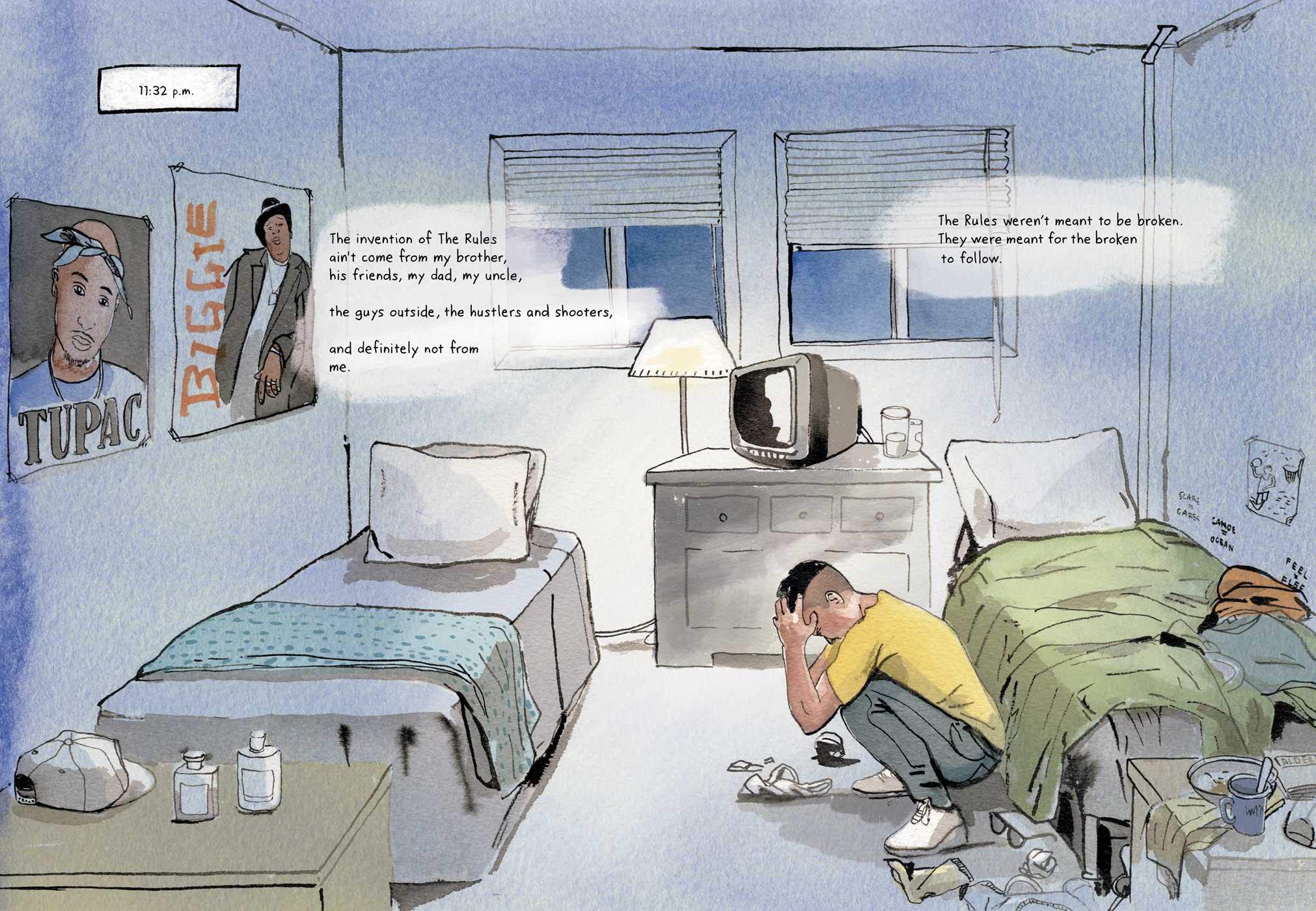
Long Way Down was originally published as a verse novel, and it has received multiple awards and honors. It is about a young man named Will whose brother Shawn was murdered and his vow to avenge his death. In his life he has been indoctrinated to follow three rules: No crying. No snitching. Revenge. As he rides down the elevator in his building, armed with a gun, he is visited in ways that make him more aware of his life, his surroundings, and the cycle of violence that affects both. It is a powerful tale that examines the very real circumstances many young people, and all of us, face in our lives.

Adapting a novel into a graphic novel is a tricky enterprise, and I feel that in order for it to be successful the images really need to bring something to the table. I think that is exactly the case here, as the water-colored paintings enhanced the delivery of the lyrical text, bringing feelings and events into sharper relief. I feel that the overall pacing of this book, as well as the evocative drawings that add elements of mystery, pathos, and uncertainty to the narrative, contribute to make a very powerful impact. This book is riveting and provocative, and aptly ends in a way that settles none of the complicated issues that it confronts. I know that ambivalent endings can be maddening for some readers, but here it seems not only appropriate but necessary.

Long Way Down: The Graphic Novel was written by Jason Reynolds and drawn by Danica Novgorodoff. Reynolds is a bestselling author of many novels, including All American Boys, the Track series, For Everyone, and Miles Morales: Spider-man. Novgorodoff is a designer/artist who has drawn multiple picture books and graphic novels, including The Undertaking of Lily Chen and Refresh Refresh. Both creators speak about their work on this adaptation in this interview.

This book has received many rave reviews, including the three starred entries here: Kirkus Reviews called it "a moving rendition that stands on its own." In School Library Journal Alea Perez concluded, "Reynolds’s words paint pictures of their own in this tragic yet poignant illustrated tale that offers no answers to the seemingly impossible choices some communities face." Sarah Hunter wrote in Booklist that "Novgorodoff’s iteration powerfully cultivates the tone and mood of its source material, demonstrating just how effective and artful comics can be."

Long Way Down: The Graphic Novel was published by Atheneum, and they have a preview and more info about it here.

Friday, April 10, 2020

The Crossover

This book is an adaptation of the 2015 Newbery Award-winning novel, and it relies heavily on text language. Most likely this is due to preserving the verse from the source material, but I still feel it is a very engaging and moving book. Its main character is 12-year-old Josh Bell, the star basketball player on his junior high basketball team. He is very confident and flashy, wearing his hair in dreads. He revels in the attention he gets from his athletic prowess. He is also influenced heavily by hip-hop culture, and his voice is full of flavor and verve, as you can see from how he introduces himself in this book.
Josh plays along with his twin brother Jordan (JB), and the two of them are very close until a new student (whom he calls "Miss Sweet Tea") complicates their relationship. He seeks advice on how to deal from his dad, a former professional basketball player, and less so from his mom, who is the vice-principal at their school. All of these relationships have there own tensions, which make for all sorts of drama and intrigue that get heaped on top of the ups and downs of individual games and the competitive season.

I found this book to be very engrossing and affecting. The artwork was very expressive, and I loved its interplay with text. The expressions and actions are very clear, and the storytelling is able to go between the bombastic aspects of athletic competition as well as more quiet moments of reflection or emotional responses. Sometimes adaptations of novels can be done in a loose or quick fashion, but I this one is very thoughtful and successful. I have not read the source material, but this book really left an impression on me as I could not put it down.

This book was written by Kwame Alexander and illustrated by Dawud Anyabwile. Alexander is a best-selling author of over 30 books, including Booked and Out of Wonder. Anyabwile is a veteran artist who is best known for the Brotherman series of graphic novels.

All of the reviews I have read of this book have been positive. Marissa Moss concluded, "This is a graphic novel for people who don't like graphic novels, a sports book for readers who don't like sports books. It's a strong story that breaks through genres, well told through a magical combination of words and pictures." In a starred entry, Kirkus Reviews summed up, "Flashy and engaging with emotional depth—a slam-dunk thrill." Esther Keller wrote, "I think that visual learners will absolutely love this adaptation, and I will be highly recommending it to students — even if I can’t categorize it as standard."

The Crossover was published by Houghton Mifflin Harcourt, and they offer a video preview and more info about it here.

For those interested in hearing more of the novel, author Kwame Alexander read the book aloud during this time of self-quarantine and "shelter in place," and you can find each update on his Twitter feed.

Friday, November 30, 2018

Kafkaesque

In case you had not noticed, last month I reviewed books with a horror bent, as we approached Halloween. Today's book is more in the vein of existential horror as it is a collection of adaptations of works by Franz Kafka, but it is also tinged with dark humor. The introduction to this book is a short essay about Kafka's multiple translations and how perhaps knowingly histrionic his prose was. I was unfamiliar with the vast majority of these stories, but I have to admit there is a dark sort of zaniness to a number of them, at least how they are presented here.

Two longer works, "The Burrow" and "In the Penal Colony," have been included in this collection, and they are substantive and moody explorations of political control and paranoia. "The Burrow" reads like a sick version of a Dr. Seuss tale, with a rodent constructing an elaborate series of tunnels to hoard its food, guard against intruders, and also hide from predators. "In the Penal Colony" is a sort of horror history with a nameless officer trying to convince a traveler about the utility of an elaborate and bloody public execution machine.

Otherwise, most of the tales in this book are relatively short, about 5-6 pages in length. They show people in various strained situations, often isolated or alienated by the powers-that-be. These powers are often capricious and draconian, resulting in injustice and unhappiness. For instance, in "The Helmsman" the man steering a ship is overcome and overthrown by a larger man who then assumes control of the boat. He attempts to assemble the rest of the passengers to address the situation and retake his place as pilot, but they don't care. They just accept the new helmsman without any resistance.
As you can see, the art for this story is an excellent complement  to the narrative. It was done with a scratchboard technique, so it resembles a woodcut done in an Expressionistic style. This type of art was a movement contemporary with Kafka, and the entire enterprise really captures the zeitgeist of the moment and I would also venture, of today, when it seems to many that the world is spiraling into discord and anxiety. I think of this book mostly as a series of tone poems expressing discomfort with the modern condition, and I think it would also be interesting to compare these adaptations to the source texts. They also stand by themselves very well.

Peter Kuper, the artist who has adapted these works is no stranger to Kafka, having done a graphic adaption of The Metamorphosis. He also published a few of these Kafka tales in his 1995 collection Give it Up! And Other Short Stories. Kuper has long had an interest in political causes and drawing socially charged cartoons. He co-founded the political comix magazine World War 3 Illustrated in 1980 and has also adapted the muckraking classic The Jungle by Upton Sinclair. A successful commercial artist, Kuper also has published work in a number of high profile magazines and currently draws the Spy Vs. Spy feature in Mad Magazine. He speaks about his work on Kafkaesque in this interview.

All of the reviews I have read have praised the book. Kirkus Reviews summed up, "A richly innovative interpretation that honors the source while expanding the material." Publishers Weekly concluded, "Kafka’s timeless work has never hit so hard, nor more artfully." Rich Barrett wrote, "Kuper creates an accessible gateway for Kafka amateurs and a varied sampling that may surprise you and possibly expand your own definition of what constitutes something as being 'Kafkaesque.'"

Kafkaesque was published by W.W. Norton & Company, Inc., and they offer more info about it here.

The publisher provided a review copy.

Friday, December 15, 2017

The Hunting Accident: A True Story of Crime and Poetry

The Hunting Accident is a complex series of tales that are surprisingly true. Overall, it tells a series of stories about fathers and their sons, and the main narrative pertains to Charlie Rizzo and his father Matt. After the death of his mother, Charlie has to live with his dad, who is blind and lives in Chicago. Charlie did not know much about his father, but over time he learned of how he lost his sight in a hunting accident when he was a teen. He also begins to help his father in editing literary reviews and commentaries, primarily about the medieval Italian poet Dante.

Life in Illinois is much different than life in California, and over time Charlie falls in with an unsavory crowd. When he is implicated in a crime, he learns much about his father's murky past, including the real reason he went blind and also that he served time in prison. Of course, these revelations cause quite a stir. But the accounts of the truth that come from this discord are full of surprises and unexpected turns, including the strange fact that part of Matt's redemption in prison came from the circumstance that his cellmate was Nathan Leopold, a thrill killer whose exploits were once termed "the crime of the century."
Overall, this graphic novel is one that makes me appreciate reading comics. The story is full of twists and turns as well as plenty of emotion and the artwork is exceptional, with dark flourishes and nightmarish imagery, both combining to make a narrative that could only really be told via comics. I read a lot of graphic novels, and this one is impressively well crafted.

The Hunting Accident is the first graphic novel by both writer David L. Carlson and artist Landis Blair. The duo originally produced a limited run of a slightly different version of this book with a Kickstarter campaign. Carlson is a Renaissance man, and Blair is a painter and illustrator who has also illustrated the book From Here to Eternity by writer Caitlin Doughty. Carlson speaks more about his work on the book in this interview.

All of the reviews I have read of this book have been very positive. In a starred review, Publishers Weekly called it an "ambitious debut graphic novel" and added, "Blair’s exceptional pen-and-ink work, which mixes the tangible world with the psychological, brings all the strands together seamlessly and powerfully." Seth T. Hahne elaborated that this tale could have been very dry but that Carlson "twists it into something ranging and delicious, a complexity revealed by pieces and parts through visions and allusions." Oliver Sava called it a "gorgeous nonfiction tale" that "is filled with innovative layouts and stunning rendering."

The Hunting Accident was published by First Second, and they have a preview and more information about it here. There is also a separate official website devoted especially to the book here.

Saturday, April 25, 2015

Nursery Rhyme Comics

Nursery Rhyme Comics follows the formula used by editor Chris Duffy in Fairy Tale Comics and Above the Dreamless Dead, start with some classic source material and get an all-star team of talent to illustrate those classics. I am glad to say that like those two aforementioned books, this one is also quite excellent. It features a bevy of talented artists, 50 in all, many of them well celebrated like Jules Feiffer, Roz Chast, Raina Telgemeier, Kate Beaton, Gahan Wilson, and Gilbert Hernandez.

The artwork is gorgeous and varied in superb manner. I love the multiple styles in here, and also that these nursery rhymes are depicted in punchy, one or two page spreads for the most part. Some of these adaptations are pretty literal:
A rare non-Love and Rockets Jaime Hernandez piece.
Others are set in exotic locales:
This picture just makes me smile.
Others rely on playful re-interpretation:
Dave Roman rules!
And a handful are funny, clever meta-commentaries on nursery rhymes:
Not going to lie. I laughed out loud at this one.
Taken together, this book is a treasure trove of fun, expertly crafted comics. I think it is best savored in small chunks, so that the reader can experience each nursery rhyme on its own terms without creating a blur by binging on these short tales.

All of the reviews I have read about this book have gushed as much as I have here. Kirkus Reviews gave it a starred review and summed up, "As much as the visual styles may vary, the high levels of wit and invention never falter." Elizabeth Bird wrote that this book "gives kids everywhere a new way of encountering some essential cultural touchstones." Stumptown Trade Review called it "a fun and unexpected delight."

Nursery Rhyme Comics was published by First Second, and they provide a preview and much more here.
I can't stop posting preview pages!

Wednesday, August 20, 2014

Above the Dreamless Dead: World War I in Poetry and Comics


Above the Dreamless Dead was published to commemorate the 100 year anniversary of the start of World War I. It contains a multitude of Trench Poetry by a long list of poets: Rupert Brooke, Wilfrid Wilson Gibson, Robert Graves, Thomas Hardy, Rudyard Kipling, Francis Edward Ledwidge, Patrick Macgill, Wilfred Owen, Issac Rosenberg, Siegfried Sassoon, Osbert Sitwell, Charles Sorley and Edward Thomas. These poems capture high art, the horrors of war, and also some of the profane responses from a number of soldiers. Very helpfully, the back matter of the book gives more information about their individual lives as well as a separate section that describes the context of their poems.

The poets are paired with a number of equally diverse and talented artists, including Hannah Berry, Stephen R. Bissette, Eddie Campbell, Lilli Carre, Liesbeth De Stercke, Hunt Emerson, Garth Ennis, Simon Gane, Sarah Glidden, Isabel Greenberg, Sammy Harkham, David Hitchcock, Kevin Huizenga, Kathryn Immonen, Stuart Immonen, Peter Kuper, James Lloyd, Pat Mills, Anders Nilsen, Danica Novgorodoff, Luke Pearson, George Pratt, Carol Tyler and Phil Winslade.

The poem adaptations are split into three sections: The Call to War, In the Trenches, and Aftermath.
From Thomas Hardy and Luke Pearson's "Channel Firing"
From Isaac Rosenberg and Peter Kuper's "The Immortals"

From Osbert Sitwell and Simon Gane's "The Next War"
The results are a wide range of powerful and provocative images. I really like the use of black and white to highlight the dark lines and contrasts, as well as the alternations between realistic and cartoony styles. These poems do not shy away from grim realities, loss of faith, or any type of politeness. The Great War, with its bloody and brutal combat, stripped away a lot of veneer and nicety of society and left those who fought it reeling and forever changed. Those are the kinds of sensibilities exposed throughout this volume, with some interspersed bursts of raunchy humor contained in the war songs that lighten matters up.
This is one of the tamer parts of the songs.
I would not say this is a book for young students, but it is a record of the time and a compilation of many works that would be excellent for high school students to contend with.

Chris Duffy edited this literary volume of comics. He also edited Fairy Tale Comics, one of my favorite books for younger readers. Duffy is a veteran in the field who edited Nickolodeon Comics for 13 years, as well as the Bizarro Comics anthology for DC Comics and Spongebob Squarepants comics for Bongo Comics.

All I have read about this book contains great praise. In a starred review Publishers Weekly wrote that "the real strength of the anthology comes both from the poems selected for it and the variety of visual approaches." Paul Gravett remarked that it provided great evidence that "the marriage of poetry and comics is a deeply fruitful combination." Rob McMonigal recounted his favorite entries from the book and concluded that it was "a great anthology series and well worth picking up."

Above the Dreamless Dead was published by First Second, and they provide a preview and much more here.

And a great, big thank you to Gina for the review copy!


Sunday, June 15, 2014

The Beats: A Graphic History


The Beats covers a lot of ground in terms of a historical movement and its constituents. The Beat Generation monicker is applied to a group of writers whose works appeared post-World War Two and were a precursor to the hippie counterculture of the 1960s. Most of this book covers a triumvirate of Beat writers, Jack Kerouac, Allen Ginsberg, and William S. Burroughs. It is unflinching in its portrayals of their drug use, sexual activities, and various other activities, though it only documents profane activities and does not depict them. It also chronicles their major works, career achievements, and the arcs of their lifetimes. It is at once highly informative
as well as entertaining enough, full of interesting tidbits and good stories.
After attending to the "big three" Beats, the rest of the book contains many shorter pieces about less well known poets and writers, like Lawrence Ferlinghetti and Kenneth Rexroth. I found these succinct pieces more desirable and informative.They certainly cast a larger view of the movement and these authors that went beyond the hard-drinking, hard-living, and largely misogynistic portraits of Kerouac, Burroughs, and, to a lesser extent, Ginsberg.

Although I am a big fan of much of Harvey Pekar's comics work, overall this set of stories is a little stiff, perhaps too journalistic, and overly celebratory for me. Additionally, I am a big fan of Ed Piskor's work, but this effort is more a story with graphics than it is a graphic narrative. I think he has grown exponentially as a comics creator, and his more recent efforts on Wizzywig and Hip Hop Family Tree are more fleshed out, vibrant, and exciting. More to my liking among the Beat poets stories were some of the shorter stories in the back of the book, especially the ones about Gary Snyder drawn by Peter Kuper and Diane di Prima illustrated by Mary Fleener. I was also enthralled by Trina Robbins and Anne Timmons' tale of painter Joy DeFeo creating The Rose, and the final piece in the book by Jeffrey Lewis on poet/anarchist/pacifist Tuli Kupferberg and his band The Fugs, which excellently portrays the transition from Beats to hippies.

Perhaps the best part of this book was a piece written by Joyce Brabner and drawn by Summer McClinton about beatnik women. This visual essay provides a strong counterpoint to the rest of the book, acknowledging and transcending the sexism and cruder parts of the beatnik movement. It is a smartly written and well flowing look at a largely overlooked set of writers and thinkers who deserve more credit for their accomplishments.

The reviews I have read have taken this history to task for various matters. The New York Times' John Leland called the book "plainly celebratory" and added that it glosses over some history and is somewhat self-promoting. Pádraig Ó Méalóid, a fan of Pekar's earlier work, did not enjoy this book, stating "that the writing and art often seemed terribly static and undynamic." Gerald Nicosia felt that the beginning of the book was a "disaster" and fraught with errors, but that the latter parts focusing on beatnik women and more minor poets saved it. He summed up that it was "notable for the completeness of its portrait of that magical era - an achievement that, whether in comics or literary biographies, is as impressive as it is rare."

The Beats: A Graphic History was published by Hill and Wang.