Thursday, February 25, 2021

Kindred: A Graphic Novel Adaptation

I have never read the novel Kindred, so I cannot really compare this version to the original, but I can say that after reading this adaptation I really want to check it out. The story focuses on Dana, a black woman from 1976 who is suddenly, mysteriously thrown into the past where she rescues a little red-headed, white boy named Rufus from drowning.

It turn out Rufus is actually one of her ancestors, the son of a slave-owner and a future slave-owner himself, and somehow her fate is tied to his. Stuck in the early 1800s in rural Maryland, Dana finds that she has to make a lot of compromises in order to survive in a place where slavery is not only legal but the guiding force of society. Dana ends up returning to the present, but she bounces back and forth in time a few times over the course of the story, finding that months spent in the past only add up to hours or days in the present. Each time brings different revelations, emotions, violence, and consequences.

What makes this book especially powerful for me is how it engages with the conflicting views of the past and present. Having to make do in the past, Dana learns the absolute horrors and terrors of slavery. She sees firsthand how ugly and dehumanizing it was, and she also sees just how strong and stoic many of her forebears had to be in order to survive. Her modern sensibilities are profoundly affected by her sojourns into the past. This book is a harrowing and traumatizing one, and not one I will soon forget. I think that the illustrations and pacing make for compelling reading, and they also capture the horrible aspects of slavery and racism in visceral ways. It was riveting and also repulsive, a work that is challenging in the best sense of the word.

This book is based on an original text by Octavia Butler, a Hugo and Nebula Award winning writer who was inducted into the Science Fiction Hall of Fame. This adaptation won the 2018 Eisner Comics Award for Best Adaptation From Another Medium, and it was created by writer Damian Duffy and artist John Jennings. These frequent collaborators also have adapted another Butler novel Parable of the Sower into graphic novel form. Both creators weigh in on their work on the Kindred adaptation in this interview.

All the reviews I have read of this book have been positive. Shawn Taylor gushed, "Not only is this one of the very best adaptations of an existing work, ever, but one of the best graphic novels in twenty years." John Denardo opined "Duffy's adaptation perfectly captures the horrific situations forced on the lives of black people in the pre-Civil War South and conveys the emotional impact of Butler's work." Publishers Weekly wrote, "It’s an effective recap, clearly produced with great love and respect, but the book remains the gold standard."

Kindred was published by Abrams ComicArts, and they offer more info about it here. It's also currently available on Comixology Unlimited, which is where I read it.

Saturday, February 20, 2021

Long Way Down: The Graphic Novel

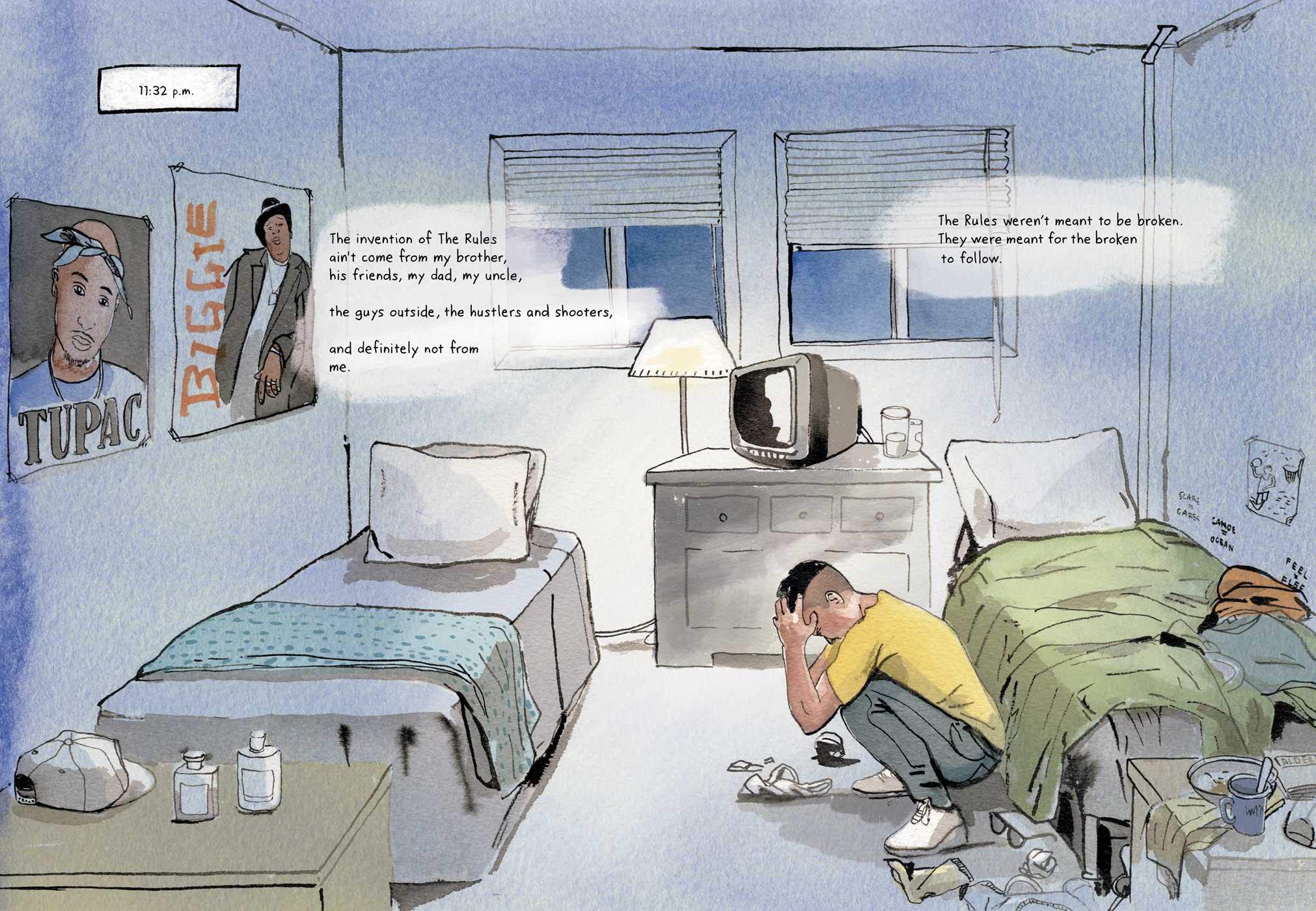
Long Way Down was originally published as a verse novel, and it has received multiple awards and honors. It is about a young man named Will whose brother Shawn was murdered and his vow to avenge his death. In his life he has been indoctrinated to follow three rules: No crying. No snitching. Revenge. As he rides down the elevator in his building, armed with a gun, he is visited in ways that make him more aware of his life, his surroundings, and the cycle of violence that affects both. It is a powerful tale that examines the very real circumstances many young people, and all of us, face in our lives.

Adapting a novel into a graphic novel is a tricky enterprise, and I feel that in order for it to be successful the images really need to bring something to the table. I think that is exactly the case here, as the water-colored paintings enhanced the delivery of the lyrical text, bringing feelings and events into sharper relief. I feel that the overall pacing of this book, as well as the evocative drawings that add elements of mystery, pathos, and uncertainty to the narrative, contribute to make a very powerful impact. This book is riveting and provocative, and aptly ends in a way that settles none of the complicated issues that it confronts. I know that ambivalent endings can be maddening for some readers, but here it seems not only appropriate but necessary.

Long Way Down: The Graphic Novel was written by Jason Reynolds and drawn by Danica Novgorodoff. Reynolds is a bestselling author of many novels, including All American Boys, the Track series, For Everyone, and Miles Morales: Spider-man. Novgorodoff is a designer/artist who has drawn multiple picture books and graphic novels, including The Undertaking of Lily Chen and Refresh Refresh. Both creators speak about their work on this adaptation in this interview.

This book has received many rave reviews, including the three starred entries here: Kirkus Reviews called it "a moving rendition that stands on its own." In School Library Journal Alea Perez concluded, "Reynolds’s words paint pictures of their own in this tragic yet poignant illustrated tale that offers no answers to the seemingly impossible choices some communities face." Sarah Hunter wrote in Booklist that "Novgorodoff’s iteration powerfully cultivates the tone and mood of its source material, demonstrating just how effective and artful comics can be."

Long Way Down: The Graphic Novel was published by Atheneum, and they have a preview and more info about it here.

Monday, February 15, 2021

BTTM FDRS

BTTM FDRS is a complicated, thought-provoking, and entertaining book that melds social issues with a horror story. Its protagonist is a young black woman named Darla, who has graduated art school and is trying to break into the fashion industry. She moves into a building in "the Bottomyards," a fictional section of Chicago that was once a thriving community but is now a burnt out shell of dilapidated buildings and poverty. It's the perfect place for bohemian, artsy lofts, and when Darla moves in she is accompanied by her opportunistic, trendy, white friend Cynthia. While in this building, they meet a Latinx DJ named Julio, who ironically dresses up and performs as a pilgrim under the name Plymouth Rock. Darla also encounters a worker from the electrical company who is paranoid about an invasion of reptile people and also bent on solving the mystery of why the building manages to power and heat itself without drawing on any outside utilities. That's when they discover what lives in the plumbing/walls, and the whole enterprise turns into a sci-fi/horror show.

It only gets worse :)

My description of this book does it no justice, because it's got so many disparate aspects going into the plot. What does stand out to me are a few things: 1) The genre aspects of horror and sci-fi play out in suspenseful and delightfully gruesome ways. 2) There is plenty of overt and subtle exploration of how multiple identities are employed, exploited, and co-opted in terms of popular and everyday culture. 3) The characters are complex and interesting. 4) The artwork highlights the horror with detailed, grotesque creatures and unreal coloring. 5) After about 50 pages in and some basics were established, this book turned into a page-turner I could not put down.

BTTM FDRS is an excellent book that can be read as an action-thriller, but it's also a smart commentary on contemporary racial, gender, and class issues. It's the best kind of sci-fi: a fantastically entertaining work that makes you look at the world from different angles.

This book is the creation of writer Ezra Claytan Daniels and artist Ben Passmore. Daniels has worked in multiple media and is probably best known in comics for his Dwayne McDuffie Award for Diversity in Comics-winning Upgrade Soul. Passmore is known for the Ignatz Award-winning comic Your Black Friend, as well as Sports is Hell, DAYGLOAHOLE, and his regular contributions to The Nib. Both creators speak about their collaboration on BTTM FDRS in this interview.

All of the reviews I have read about this book have been positive. Philippe Leblanc declared it "one of the best graphic novels I read in 2019... a thoughtful meditation on not just gentrification, but inequality." Alex Hoffman wrote, "With its biting social commentary and fascinating worldbuilding, plus Passmore’s vibrant illustration and otherworldly colors, BTTM FDRS is the book of the summer. An absolute must read." Austin Price called it "a delightfully and rightly angry polemic," though he was disappointed by its lack of scope.

BTTM FDRS was published by Fantagraphics, and they offer a preview and more here. It is also available on Comixology Unlimited, which is how I read it. It features mature themes, violence, and horror scenes, so it is recommended for mature readers.

Wednesday, February 10, 2021

The Black Panther Party: A Graphic Novel History


Reading this book showed me how little I actually knew about the Black Panther Party. The Black Panther Party: A Graphic Novel History is not a long book, but it is substantive and comprehensive. It touches on every major figure associated with the BPP, and heavily focuses on the pivotal years of 1967 - 1969. There are spotlights on people like Huey P. Newton, Bobby Seale, Fred Hampton, and Angela Davis as well as gripping, suspenseful portrayals of major events in the formation and social actions taken by the Black Panthers.

As you can see from the excerpt above, this book is about detailing the history of this group and also placing it in the broader context of US and civil rights history. It is one of the more information-rich graphic novels I have read, but it balances exposition with dramatic action scenes. It utilizes dynamic, iconic artwork full of bold imagery. I appreciated how well it captures both realistic depictions of the participants as well as a sense of the propaganda/visual messages broadcast by the BPP. Even in the passages that are more text heavy and dense, the images are vibrant and realistic, adding much context to the proceedings. 

As a common theme with other books I've read recently, like Big Black: Stand at Attica and Kent State, this book shows how US society has not progressed as much as we would like. The Panthers arose in a response to the racial violence being perpetrated by police forces. Their militaristic response was to show that they could not simply be intimidated and pushed around any more. This arm of the movement was coupled with more charitable ones I did not really know about, such as establishing a school and a program for feeding the hungry, though those aspects are largely overlooked today.

A sizable amount of the book is also devoted to J. Edgar Hoover and the FBI's many incredibly shady and illegal methods of infiltrating the BPP, sowing discord, and outright murdering some of its leadership. I know that not everyone approved of the methods for seeking equality, even within the various civil rights movements of the day, but the level of subterfuge and sabotage accounted here is shocking. I think this book is the perfect introduction for someone who knows nothing about the Black Panther Party, and an excellent resource for any US history, government, or language arts class studying African-American history or civil rights.

This book was created by writer David F. Walker and artist Marcus Kwame Anderson. Walker is a prolific author and is best known in comics for his work on the Eisner Award winning series Bitter Root, runs on Marvel series such as Luke Cage and Power Man & Iron Fist, and the DC Comics series Naomi. He has also written another nonfiction graphic novel, a biography of Frederick Douglass. Anderson is best known for his creator owned series Snow Daze and has also illustrated a number of projects for Action Lab.

All of the reviews I have read of this book have been very positive. In their starred review, Publishers Weekly concluded, "This concise yet in-depth guide offers a timely resource for activists, history buffs, and students alike." Ed Park called it "ambitious and informative." In a rollicking review, S.W. Sondheimer wrote, "I learned more from this 98-page graphic novel history than I did from Chernow’s 818 page biography of Hamilton or anything I had to read for my college course on the WWII Pacific theater."

The Black Panther Party was published by Ten Speed Press, and they provide a preview and more here.

Friday, February 5, 2021

When Stars Are Scattered


A finalist for the 2020 National Book Award for Young People's Literature, When Stars Are Scattered is the story of Omar Mohamed and his younger brother Hassan, two refugees from Somalia. Uprooted by war and separated from their parents, they walked a long, treacherous way to be eventually resettled in the Dadaab Refugee Camp in Kenya. They are placed in the care of a foster mother, Fatuma, an older Somalian woman whose four sons were killed. 

While in the camp, they are safe from imminent danger, but they have to deal with a number of other obstacles, like a scarcity of food, meager housing, opportunistic older kids, and a lot of waiting. They are also on a constant search for their mother, who told them to run for safety as she would follow them. In many ways they feel like they are in a prison, even though they are supposed to be free. They spend a lot of time wishing for their names to be placed on a list for interviews so they can be relocated to places like the US, Canada, or Australia, but their situation seems hopeless. Add to the mix that Hassan suffers from seizures and can only say one word ("Hooyo"), and Omar has much on his plate taking care of himself and his brother.

Omar finds refuge from many of his worries in education, and going to school is a welcome escape from his daily troubles and boredom. Encouraged by a couple of UN caseworkers, he begins to focus on his learning as a possible escape from his circumstances. Still, all of this takes a very long time, and over the years, Omar becomes frustrated and occasionally angry at his plight. 

Even from the above description, I have left out so much from this book. For instance, it also touches on many political realities like the need to educate female students and the stretched resources of the UN. It is a very well detailed account of this refugee experience, replete with lots of heartache, longing, and frustration. The characters here are fully realized, complicated people who display a range of emotions and beliefs. I can see why this book has been as honored as it has, because it is profoundly moving. I cannot recommend it highly enough.

Omar Mohamed shared his story with multi-award winning graphic novelist Victoria Jamieson, who adapted it here. He is the founder of the humanitarian organization Refugee Strong. Jamieson is a picture book creator and YA graphic novel rock star known for her books Roller Girl and All's Faire in Middle School. Both creators speak about When Stars Are Scattered in this interview.

All of the reviews I have read about this book has been glowing. Kirkus Reviews concluded their starred review, "This engaging, heartwarming story does everything one can ask of a book, and then some." Esther Keller called it "a window to a world far away" that "will allow readers to view their own lives in a very different light and hopefully allow them to understand the sorrow and heartache that are experienced all over the world." In another starred review, Publishers Weekly wrote that it is "a personal and poignant entry point for young readers trying to understand an unfair world."

When Stars Are Scattered was published by Dial Books for Young Readers, and they offer a preview and more here.

Saturday, January 30, 2021

Meeting Comics

There are plenty of comics set in workplaces, but none, for my money, is as funny or consistently excellent as Meeting Comics. These comics are published three times a week online, originally on Instagram, but now exclusively via Patreon. They are collected bi-monthly into mini-comics/PDFs, and they are currently up to #17. This book collects the first six issues, a whole bunch of comics that show the progress of the series. At first it is more sketchy with each comic literally drawn over a lunch break, but later entries are more more polished and feature recurring characters.

Over time, we come to know Kevin, the radical guy in that cartoon above, and he is sort of the moral center of the book. Other characters include the human resources robot (literally) Rob, the office queen/diva Val, aged boss Don (who once starred in a sci-fi/action TV series Namdroid as a younger man), and Thomas, who seems milquetoast but leads a double life as the vigilante known as Ribbon Cutter. They are a diverse cast, in multiple sense of the word, and watching them play off of each other is a delight.

The humor in this series is random, sometimes topical, sometimes political, and often laugh-out-loud funny. I love how over time the characters grow and we learn about their quite complex and surprising back-stories. Along with the workplace humor, there is also a healthy dose of mature themes, including sex, drugs, and profanity, but I feel all of it contributes to making these bombastic, silly characters all the more human and relatable. Like all good comic strips, this one features real life dialed up to the extreme, but it has a lot of heart, and it's easy to fall in love with these folx.

Meeting Comics are written and drawn by Andrew Neal, former comic shop employee/owner and current comics creator. He speaks extensively about his work on Meeting Comics in this interview (with my friend, Craig Fischer. Hi Craig!).

I have not be able to find many reviews of this book, which is a criminal shame. The ones I have seen have been extremely positive though. Chris from Zine Cuisine called it a "personal fave." Goodreads currently has it rated 4.5 (out of 5) stars.

Meeting Comics was published by Adhouse Books, and they offer a preview and more here. You can check out the further adventures of these characters via the official page or by subscribing to Neal's Patreon (like I do!). Some of the later strips are also serialized in SOLRAD.

Monday, January 25, 2021

Woods

Woods is a book I picked up from the same Kickstarter campaign I got Eddie's Week. I had really enjoyed the author's prior book Monkey Chef, and I was eager to see what his new work was like. Whereas that book, and most of Mike Freiheit's other comics work has been autobiographical, this book is a work of fiction. Woods is one of the creepier books I have read of late, and I mean that as a compliment. It's a subtle horror story that combines current events with mental health concerns, mixed with some basic archetypes of scary fiction.

The main characters in this book are Jason and Beth. Beth experiences a mental break after the presidential election of 2016, paranoid about the state of the world and the hate/misogyny she sees everywhere. After convalescing, she and her husband Jason decide to sublet their apartment and move to a cabin in the woods. Jason has a dark complexion (and is meant to be African-American, I think, though it's not explicitly stated), which brings him unwanted attention from the rural locals. They make "jokes," but they also seem menacing. 

All of these aspects coalesce into a terrible scenario. Jason begins to suspect slight instances of sabotage to their land. Beth may or may not be taking her meds faithfully, or perhaps they are not effective. Add to this mix a cold winter, a faulty generator, and an unreliable truck, and what you have is a horrific scene. 

What I admired most about this book was how it establishes a tone of unease and terror through it's raw-feeling artwork and small cracks in the veneer. Beth's descent into paranoia is at once slow and then sudden, and the clues have been dotted along all the while. The artwork indicates these shifts with its use of black and white and a spectrum of lines that run from relatively smooth to more frenetic and jarring. The ways that the local animals are depicted in the background, environment, and also interacting with the main characters add nuance and menace. Overall, I think this book is very effective in creating an ominous tone that touches on horror both in contemporary and classic ways.

The reviews I have read about this book have been positive. Publishers Weekly wrote that he "achieves a claustrophobic sense of threats from both inside and out. Freiheit disconcertingly draws readers into paranoia in this cooped-up cabin fever–dream." John Seven stated, "Freiheit’s artwork in Woods mirrors the frantic nature of the situation the couple is in — stark black and white, sometimes scratchy as if the sanity of the panels are fraying along with Beth and Jason’s perception of the world around them." Ryan C. wrote that "this book excels at making you think. About where we are as a society, how we got here, how or even if we can possibly get out."

 Woods was published by Birdcage Bottom Books, and they offer a preview and more here.