Wednesday, October 31, 2012

Love and Rockets Month Coda


Thanks for reading my ramblings about Love and Rockets this month, and thank you also for bearing with me when I fell behind and was not posting as regularly as I would like. It has been a difficult yet rewarding experience for me, and I have a new-found respect for those who review comics on a regular, daily basis. This endeavor is way harder than it looks, and I hope that I have given you something to think about, enjoy, or look into.

I realize that I have presented the first volume of this series in the order they were originally collected, but today they are available in a different format. Those books are detailed in this helpful guide How to Read Love and Rockets by Fantagraphics, the fine folks who have published this series for the past three decades. I truly feel that the Hernandez brothers have created some of the best works available in graphic novel form. They are well worth checking out, if you have not already.


Happy anniversary, Gilbert, Jaime, and Mario! Thank you for all the great comics!

Tuesday, October 30, 2012

Love and Rockets Volumes 13-15

Love and Rockets month comes to a thrilling conclusion today as I post about the last three volumes in the original run of the series. Enjoy!

 
Chester Square

This book ranges far and wide with its plot. For the most part it follows Maggie as she wanders about, trying to make sense of all the upheaval and loss in her life. For stretches of the story, she is stranded at a bus station in Chester Square, where she has to contend with lonely guys, a surly prostitute named Ruby, suspicious business owners, and local law enforcement. Alternatively, she also ends up on the road with professional wrestlers, and she muddies the waters of her personal and professional relationships along the way. All the while, she encounters conflict and decisions about who she should be and who she should associate with.

Names are a big deal in this book, and it seems that Maggie goes through many in the course of growing up. Not really a cipher, she is more a lost soul casting about looking for an identity and fulfillment, only to be deterred by bad relationships, tragedies, or just plain poor planning. Her journey feels like some sort of allegory or morality tale, with the elements of a cowboy western, Jack Kirby's Fourth World (a couple of characters look a little too much like Oberon and Highfather to be coincidental), Lee and Ditko's Spider-Man,and a Twilight Zone episode. Maggie is a wanderer in search of meaning, a sort of woman-with-no-name. Or rather, a woman-with-many-names.

Jaime's artful weaving of stories and characters evokes so many emotions and touchstones that this book feels monument, a meaningful highpoint in the Locas narrative and also in comics in general. The ending is a thing of beauty, sweet but not treacly. Jaime would eventually return to this series and these characters, but there is a sense of closure here and a rare moment of happiness after much drama and travail. Reading this book was a rewarding and moving experience for me.

My Rating: A masterpiece. Probably my favorite book from this first series.


Luba Conquers the World

Gilbert has long juggled a huge cast in his Palomar stories, and with this book he pushes his limits even further. Luba's past and present collide here, as she has grown older, settled down some, and moved to the United States. We get to see how life has treated her and also how a large number of the other characters have aged and established their own lives. We see them in America working as entertainers, entrepreneurs, and menial workers. They cover a gamut of sensations and fates.

Add to all these happenings flashbacks to Luba's childhood as well as Maria's (Luba's mother) life, including her involvement with criminals, violence, and her various children. It turns out Luba has two long-lost sisters, Petra and Fritz, who have their own stories and relations to account.

All of these ingredients combine into a huge story motor that has many moving parts. At times, scenes burst forth with emotion, energy, and intrigue. It is easy to get lost in all of these interconnected narratives, but certain themes and images appear again and again. The mysterious nature of family relations are examined, as well as the cycles that generations may follow. The characters frequently try to raise themselves up and strive for the best things in life, but they spend much time in the grime and grit of life. Still, Gilbert exposes the positive that can come from glorying in those places. Wallowing in the mud might be undesirable in the long run, but it is where many people get their starts and there are joys in these visceral experiences.

Life here is depicted as striving to reach for something better, something brighter, something maybe out of reach. Luba's version of conquering the world, like Gilbert's work in general I could contend, is humble, humbling, and amazing.

My Rating:There is so much packed in this volume, and it left me breathless, exhausted, and mostly fulfilled.


Hernandez Satyricon

This volume is a sort of catch-all, collecting various and sundry tales from all three Hernandez brothers. The stories are frenetic, full of crazy energy, and they are frequently profane, playful, and shocking. I can't say anything really stands out as particularly memorable beyond shock value, but the half of this book that contains promotional drawings, calendar panels, alternative covers, and poster art is full of crazy, beautiful ideas and gorgeous imagery.

I think this is more a book for long-standing fans who want to see rarities from the series.

My Rating: Mostly for L&R completists.

Thursday, October 25, 2012

Love and Rockets Volumes 10-12

As we speed toward the exciting conclusion of Love and Rockets month, I will tackle the last 6 books three at a time. Starting with:

Love and Rockets X

Often described as a Nashville for the 90s, Love and Rockets X is ostensibly about music scenes, with quotations from all kinds of contemporary songs, from rap to more alternative bands, but it is also about racial tensions. These tensions crop up in competing musicians, rival clubs, and lots of macho posturing by people in the streets. Reading that last sentence, readers might just think that Gilbert is treading on Jaime's turf, and this book is partly concerned with capturing the spirit of the day much like Jaime's early work was concerned with capturing the voice of punk rock.

But it also busts out in surprising ways that connect to Gilbert's Palomar stories. We see lots of people who used to live there and who have immigrated over to the US, and their presence casts a different light on the story. More than just capturing the feel of a music scene, this book is also about a diverse cast of characters trying to make their way in a world and the problems that arise from miscommunication and variety. This story is not about a melting pot, but about how various people retain their flavors, sometimes turning out well and sometimes turning toward unrest, strife, or violence.

I think this book could almost be relegated to period piece status, but the presence of those Palomar characters rescues it from that fate. Gilbert's musician characters just don't do much for me. The opening and closing sequences that bookend the story seek to make this story seem universal, but to me they come off a little forced and cliched. Still, there are some great moments to be found in this book.

My Rating: Maybe my least favorite L&R book. Still well above the Mendoza Line.


Wig Wam Bam

Named after a Sweet song, this volume shows that Jaime's cast is older, though not necessarily wiser. The song reference harkens back to a childhood revelation. This backward glance is nostalgic in a way, but perhaps more wistful, as the characters are all caught up in all kinds of intricacies and relationships and there is little hope of returning to those youthful concerns.

So many things happen in this volume that I am not even going to attempt to summarize, but I will say that it also covers so much emotional ground that it boggles the mind. And the ending is brutal and devastating. This book is dense with action, symbolism, and deft character work. To top things off, the story and the art suit each other so well that the whole operation appears seamless. If I had to choose one word to describe Jaime's work it would be economy. Not a line or panel seems wasted in his delivery of an impactful story.

My Rating: Out of the park. A home run.


Poison River

I cannot tell a lie. This book really impressed me, but it was something I had to read in chunks.

Poison River is a series of stories that span time and space. It tells about Luba, her life before she came to Palomar, and a tangled web of crime, deceit, and longing. Each character gets the spotlight for a story, highlighting a particular event or series of events in their lives. What complicates reading this book is that they all step in and out of each tale, and sometimes they look very different as the time-jumping means they are different ages in different stories.

Reading this book, I was struck by its emotional directness as well as its frank regard for sexuality. It deals with complex issues of determining sexual preferences, including choosing same-sex partners as well as confronting matters of obsession and incest. People's relationships drive their lives, and the complicated webs they weave ensnare the reader in a voyeuristic sense but they also seize the characters themselves as if they are doomed to certain fates all along.

This volume is an ambitious work, a life history done kaleidoscope-style, with constantly shifting main characters. This book is complex, and somewhat bewildering because the reader is constantly trying to reorient at the start of each tale. But, by golly, when you start making connections and realizations, it is a revelation akin to staring at one of those Magic Eye posters and suddenly seeing the image. In the end, there is a sense of the complete picture, even if there is not a single narrative thread that unifies the book. Still, there are plenty of shocking moments, secrets revealed, and emotions tweaked to make this a fine reading experience. I just don't recommend reading it all at once.

Full of crescendos and valleys, Poison River may disappoint some because it does not follow convention narrative patterns, but I feel it offers a rewarding reading experience. Moreover, this book just begs to be re-read.

My Rating:  The opposite of The Death of Speedy, this book is a window that has been shattered. Still, there are many pretty pieces to admire.


Saturday, October 20, 2012

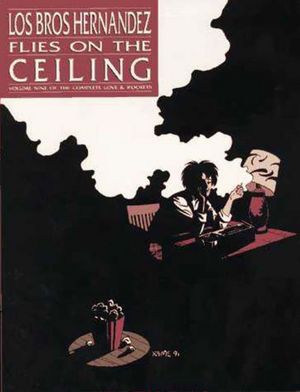
Flies on the Ceiling


Flies on the Ceiling

"Flies on the Ceiling" is a mature, masterful story about a breakdown. It is a dreamlike and horrific, as reality is melded with fantasy when Izzy has to deal with a choice that haunts her. She cannot run away from her thoughts, even though she runs far and wide to escape. She does find some relief in the form of a surrogate family, but ultimately that does not last. In the end we view this character who had largely been seen as quirky, strange, and sometimes ridiculous as a more realized, though damaged woman. This is a complicated and troubling tale: some see it as hackneyed with blatant symbolism while others view it as the intersection of grief, religiosity, and recovery.

The other Locas characters are well-represented in the rest of the stories. We learn more about Ray's life and childhood; we see how unhinged and needy Penny Century is as she tries to sabotage Maggie and Ray so to promote Maggie and Hopey.  We also glimpse into Doyle's life and see how he began on the path of violence, grifting, and drifting. He is a pathetic character who seems capable of so much more, but he continually gets beaten down by life events. When I heard Jaime talk about his work this summer at HeroesCon, he spoke of his proclivity to act as a villain who tortures his characters. That vibe comes through in this volume loud and clear.

Gilbert does not have much work in this volume, but his impressionistic, dreamlike bio of artist Frida Kahlo is so full of admiration, craft, and daring imagery that it holds its own with the title tale. The rest of his entries read like experiments in form and surreality.

My Rating: Like the movie said, "There are a million stories in the naked city." Jaime is determined to tell them all, and tell them well. A couple of throwaway tales detract from the book as a whole.


Thursday, October 18, 2012

Blood of Palomar

Blood of Palomar

Yesterday, I reviewed Jaime's first masterpiece, The Death of Speedy, and today I am writing about the first solo Gilbert book in the series. As good as this book is I do not really count it as his first masterpiece because of the punch of his first "Heartbreak Soup" story. Still, there are a million serial killer stories out there, but "Human Diastrophism" stands out from the rest because of its small town context, human characters, and political overtones.

The book starts with three short stories and they are remarkable for their brevity, soul, and emotional impact. The drawings of young Pipo's pout and Vicente's sly smile from the first tale "Sugar -n- Spikes" are brilliant and striking, and they contribute to the excellent pacing and stagecraft. This great sense of the theatrical carries over into the main story, a huge saga of political and romantic intrigue as well as murder.

The story captures the zeitgeist of late Cold War paranoia, where people feared atomic conflagration. Tonantzin is probably most symbolic of this feeling, at first the comely barbosa vendor who inspires many men to lust becomes suddenly politicized, speaking out against the overbearing influence of the US and USSR superpowers, even in their small corner of the world. She becomes a protester and advocate, alienating some and firing up others.

The townsfolk are concerned with ridding themselves of bands of marauding monkeys who are scouring their land and creating havoc. The brutality of slaughtering these beasts is juxtaposed by the actions of a monster in their midst, someone who is killing random townsfolk. Additionally, the sense of paranoia that seizes the people in town is palpable.

As someone is killing random people in town, there is a witness who is paralyzed from speaking, though he does try to communicate his knowledge through art. This Cassandra-like figure adds a mythic, philosophical aspect to the proceedings. His interludes comment as much on the power and function of art as much as how people respond to incredible and horrific situations.

Perhaps this story is some statement about the price of advancement or progress. That is not for me to say definitively, but what matters is that there are so many images, symbols, and situations here ripe with meaning that makes many such analyses possible.

I will not ruin the ending, but I will say that it is one of the most powerful fictional conclusions I have experienced, shocking, horrible, and sweetly sorrowful.

My Rating: A heart-rending, impressive classic. Gilbert's ability to manage a huge cast is exceptional.

Wednesday, October 17, 2012

The Death of Speedy


The Death of Speedy


This book is the first of these volumes to contain work from only one brother. Jaime's work here ends up on all kinds of "best of comics" lists. People love it, and it is easy to see why. A lot happens: Hopey goes on tour with her band La Llorana. Izzy's little brother Speedy and his boys are running in some tough circles. Maggie is left to her own devices and begins a relationship with Ray, an artist who is a decent guy and in many ways a stand-on for Jaime Hernandez. Hopey keeps missing opportunities to contact and reconnect with Maggie. After some band drama, she ends up spending two weeks in a huge mansion with Penny Century having casual sex with a large musician named Texas. Aunt Vicki gives Maggie a job and keeps sweeping her off on wrestling road trips.

Not only does much happen, there is also a gamut of emotions. The drama of macho posturing and the random danger that comes from armed young men revenging perceived disrespect. The pettiness of young couples trying to get back at one another for small slights. The pathos when Speedy tells Maggie he loves her and only her and she just cannot deal. The sad release of Speedy telling Izzy not to worry about him any more. The alternate monotony and random mayhem that happens during life on the road. The giddiness of the first days of a love affair.

For a person like me who did not take Jaime's work as seriously or with as much regard as his brother's, reading this book is a revelation. All the details and small goings-on from prior stories in these characters' lives suddenly cohere in this monumental work. Speedy, who up until this book was a relatively two-dimensional background character, steps into more prominence, and we see realize he is of more substance. Jaime's artfulness and incredibly subtle craftsmanship appears in full relief here, coalescing into a popular culture masterpiece that elevates the mundane, elucidates people's everyday lives, and portrays a complex array of emotions and relationships.

This book will make you laugh, cry, and want to go to a loud spectacle. It will also make you fall in love with all these people, which makes it hard to let some of them go.

My Rating: All the little pieces add up to a great, big, beautiful stained glass window of stories.

Tuesday, October 16, 2012

Duck Feet

Duck Feet

So far, I am learning how difficult it is to review these early volumes that are more anthologies of stories from both brothers. I am going the bullet points and brief commentary route again:

Gilbert's stories:
  • "The Mystery Wen"- A simple story about the cerebral Heraclio being a hypochondriac who fears going to the doctor. 
  • "The Way Things Are Going" - A walk on the dingy streets that some of the characters find themselves on when they leave Palomar looking for work. It reads like a short, noirish comic written by Bukowski. That's a good thing.
  • "Duck Feet" - A creepy witch story that touches on the town's superstitions, kooky children, haunted trees, indigenous people, the law, and the mundane goings on in Palomar. Surreal, surprising, and suspenseful.
  • "Bullnecks and Bracelets" - I am not even going to try to sum up all that happens in this story. It is far-ranging, sheds light into the lives and romances of a great many Palomar characters, and just plain amazing in its scope. This is the first of Gilbert's forays into making a Nashville-like story. Think of it as a short, magical history of Palomar, told with pinache and punch.
  • "For the Love of Carmen" - The very first Love and Rockets story I read (in an anthology), and it knocked my socks off. A look at two very different characters that make for a contentious, complimentary, and loving couple. I just marvel at Carmen's combination of bluster and vulnerability. This story may seem sappy to some, but I love how it all comes together.
Jaime's stories:

  • "The Adventures of Rocky and Fumble" - By now you know I really like these stories and wish there were more of them. This one is part Huck Finn, part Andy Griffith Show, part Good Times, with a robot. I like the mix of comedy, dread, and whistfulness.
  • "Locas" & "Locas versus Locos" & "Secrets of Life and Death"- Maggie ruminates about her weight and catches up with Rand Race. This short, sitcom-ish story kicks off a series of glimpses into various parts of a day in the lives of our heroines. Teresa wants to date Hopey. Hopey wants to date Maggie. A few other folks want to date Maggie, too. There is a whole lot of maneuvering, canoodling, and coach surfing here. Doyle is my favorite.
  • Mojado Power" - A "boys will be boys" story with swearing, posturing, and arguing over the relative merits of Barbara Streisand. Just what you expect to find in a Love and Rockets book.
  • "Rena" - A brief 2-page look into the former wrestling queen's life in Zymbodia. Mostly involves bickering with Duke and Bernie.
  • "Rocket Rhodes" - A sad coda to the Rocky and Fumble stories. Rocky is grown up, stranded on an alien planet, and without much contact or hope of returning to Earth. A weird mix of hopefulness that devolves into adult disillusionment. Jaime can be cruel to his characters sometimes.

My Rating: Contains some of my favorite stories, but it is more uneven than some of my favorite volumes.