Thursday, September 10, 2020

Science Comics: Crows: Genius Birds

I never would think that a graphic novel about crows would have me completely rapt, but this book Crows: Genius Birds is exceptionally good. I've read almost all the books in the Science Comics series and this one is easily one of the best. It has a fun framing sequence and is chock full of interesting facts about corvids. The framing sequence involves the smartest crow in the world recruiting a dog named Buddy to help him dump over receptacles on garbage day so they can both feast. Along the way, the crow regales Buddy on all sorts of crow facts, including how they can learn to identify people's faces, imitate bird calls and human voices, and even use tools.

What is most fascinating about this book to me is how well it uses the framing narrative to present science facts. It works in almost seamless fashion to both entertain and inform. I was fascinated to read about the various experiments people have done to learn about crow's behaviors, including seeing how they use specific tools, solve problems, and even learn to complete complex tasks. The fact that they have uniquely shaped brains gives them the ability to perform in ways that match the intelligence of small children. Their abilities to adapt and learn are part of why they come into conflict with people, because they are constantly figuring out ways to circumvent whatever obstacles they encounter. This book really calls into question the simple way of thinking of crows as mere pests, and I think that books that can change people's thinking in this way are rare and noteworthy.

The artwork in this volume is very clear and colorful. I admire how it switches back and forth from propelling the plot and elucidating information or explaining an experiment. It is one of the most accessible and engaging science books I have read, and I think it would be attractive and useful for a wide array of readers.

I am very impressed by what I think is the graphic novel debut of Kyla Vanderklugt. She is not a novice comics creator, and in the past she has contributed to a number of comics anthologies, including Flight and Spera.

I have not seen many reviews of this book, but the ones I've read have been very positive. Johanna Draper Carlson wrote that it "is one of the best of this series. It’s everything a non-fiction graphic novel should be: informative, attractive, well-drawn, and fun to read!" Jonathan H. Liu concluded, "If you like crows and want to learn more about them, this book is a great resource." It currently has a 4.53 (out of 5) star rating on Goodreads.

Crows: Genius Birds was published by First Second, and they offer a preview and much more here.

Saturday, September 5, 2020

History Comics

Apparently, the fine folks at First Second have found a lot of success in their Science Comics series and have branched out into other areas. That series has been of overall high quality, and I have high expectations for whatever they publish. Their first other series is Maker Comics, which is sort of a practical extension of the SC series, with titles about fixing cars, baking, and building robots. I reviewed one title here, and I was pretty impressed with it. More recently, they also branched out with a series aimed at social studies topics, History Comics. They have two titles out so far, and I review them below.

The first book I read was The Great Chicago Fire: Rising from the Ashes, which is about the huge 1871 blaze that destroyed a huge section of The Windy City. This book makes the events here very personal, following a couple of siblings Franny and J.P. who live nearby where the fire started and have to traverse the city in order to avoid the flames. They are great point-of-view characters who both narrate historical/geographic information and also put a human face on the goings-on.


This book gets into all sorts of issues, including the prejudice against immigrants and how the legend was created that blamed Mrs. O'Leary (and her cow) as the cause of the fire. Attention is also paid to the urban planning (or lack thereof) at the time and how the city was rebuilt in the aftermath of the fire, with the advent of skyscrapers and other technological innovations. All of these were showcased 22 years later at the 1893 World's Colombian Exposition.

The end of the book is rounded out with some nifty features, like a timeline of events, a list of facts about the Chicago Fire, and a map of relevant historical sites to visit today. I really enjoyed reading this book, and I feel it's a good, highly accessible introduction to the series.

It was written by Kate Hannigan, a former journalist who has written a number of middle grades and picture books, including the multiple award-winning The Detective's Assistant. It was illustrated by Alexandra Gaudins, who also drew The Brain entry of Science Comics as well as a number of digital and webcomics.

All the reviews I have read of this book have been positive. Esther Keller wrote, "The fast-paced read is highlighted with superb artwork that evokes the time period and gives readers the feeling of chaos that ensued in Chicago." Kirkus Reviews concluded, "A fictive plotline adds a strong “you are there” feel to this informative account."

The second book I read was The Roanoke Colony: America's First Mystery, which is about the first attempts of the British to establish a permanent colony in North America. It is narrated by Wanchese and Manteo, two indigenous leaders that the English encountered. They offer a good contrast with their viewpoints, as in reality Wanchese was more weary of the British and their intentions. Both also traveled to England, and Manteo was the first Native American to be baptized into the Church of England


This book is more packed with information, and it gives a broad context to the times and geography. It tells of the various indigenous nations that were active in the area, along with their political structures, homes, and tools. It sheds extensive light on the British politics of the day, with particular attention to Queen Elizabeth I (who brushed her teeth with honey-!!!), "debonair hot boy" Sir Walter Raleigh, and pilot/pirate Simon Fernandes. It chronicles conflicts with rival European nations and also pirates. The failure of this colony lie in a great number of factors, including colonial cluelessness, skirmishes with local peoples, lack of supplies, improper training of colonists, needlessly cruel leadership, and privileging capitalist interests over people's general safety. I was impressed by how much nuance and detail is packed into this book with it still being so accessible and engaging.

This book does not have the same features that concluded The Great Chicago Fire, but I also feel that it covers lot more content in terms of historical context and complexity. Instead it ends with possible solutions to the mystery of what happened to this "lost colony" that was left to its own devices for months. These final pages offer a number of possibilities, starting with the evidence that they literally left a note on a tree that they had gone to the island of Croatoan (where Manteo was from) but storms complicated any search efforts. Among these possible endings are that the colonists may have been slaughtered by any number of factions, including natives or the Spanish, abducted by aliens(!), or assimilated into local nations. Reading this book, it is easy to see why this mystery is still so compelling, especially when presented in such a well-researched manner.

The creator behind this book is Chris Schweizer, who also made the volume of Maker Comics I just reviewed. Like I wrote then, he is a comics Renaissance man who has created a few series like the Crogan's Adventures and The Creeps. He has a bent toward historical works and is one of the best artists working right now, IMHO.

I have not found as many reviews of this book online, but the ones I have read have been full of praise. Carin Siegfried wrote that it "was a lot of fun, really informative, and I especially liked how the story was told from the perspectives of the Native Americans." As of this writing, it has a 4.14 (out of 5) star rating at Goodreads.

Both of these volumes of History Comics were published by First Second, and they offer more info about them and future volumes in the series here.

Sunday, August 30, 2020

Maker Comics: Fix a Car!

The Science Comics series of graphic novels has been one of my favorites, and certainly one of the easiest ones for me to recommend to STEM teachers. Their publisher, First Second, has recently branched off into another series with a similar bent, Maker Comics, that encourage readers to bake, create comics, make robots, and do other practical tasks. I can see lots of connections with these books and the "special" subject areas, like family and consumer science, art, and in the case of the book I am looking at here, either auto shop or driver's education.

Fix a Car! follows a group of teenagers and their weekly car club, as they learn about how to care for their vehicles. The teens in this book are all very onto cars and constitute a motley but relatable crew. Some of them have driver's licenses; some are into tricking out their rides with fancy details, and others are into restoring older cars. Over the course of this book, under the guidance of their teacher/advisor Ms. Gritt, they learn how to assemble a tool kit, do routine maintenance, and perform roadside actions like fixing a flat tire or jump-starting an engine. 
Like the Science Comics books, this one has lots of details about how the various systems and parts in a car. It tells about how an engine, transmission, and climate system works. It shows how to change windshield wipers, adjust a drive belt, and switch out a burnt-out tail-light. It also shows how to take care of a battery, maintain proper fluid levels, and properly wash the exterior without ruining the paint job. And what is more, it emphasizes auto safety and delivers all of this information in a very engaging way that does not overwhelm while also maintaining a sense of humor.

This balance between informing and engaging was struck by Chris Schweizer, a comics Renaissance man who has created a few series like the Crogan's Adventures and The Creeps. He has a bent toward historical works, including The Roanoke Colony, one of the inaugural books from the new History Comics series, which (spoiler) I'll be reviewing in the near future. He sheds some insight into his work on Fix a Car! in this interview.

I was not able to find many reviews of this book, but the ones I have seen have been very positive. Sharona Ginsberg wrote that it provided "a more accessible way to approach learning a new skill than advanced technical documentation, textbooks, or manuals" and suggested it "for older readers—beginning around high school—especially as teenagers who may have their licenses and even own cars will find the information more helpful and relevant." Tony Dillard called it "A must for anyone who wants to share the experience of working on cars with a special youngster in their life!"

Fix a Car! was published by First Second, and they offer a preview and more information about it here.

Tuesday, August 25, 2020

Frogcatchers


Frogcatchers is a brief but memorable book about memory, aging, and second chances. It begins with an older man waking up in a strange room, attached to medical equipment. As he gets untangled and disconnected he begins to wander; then he finds he is in a strange hotel building. When he goes outside, he finds himself in a tunnel where a young boy is hunting for frogs. As he gets his bearings, he finds more mysterious items and learns about the ominous being known as the Frog King, who runs the place. 

I don't want to describe much more about the plot of this book, because of spoilers but also because it is more based on tone and sensation than narrative. There are extended passages without words, where the scratchy images establish context or feelings. Sometimes the imagery also complicates to the overall enigma that is this place and setting. I know that it does not always look polished, but I feel that is what makes it exceptional. The lines are expressive and capture so much feeling with their kinetic energy. 

When I called this book brief I meant that it goes by quickly, but it also invites multiple re-readings and opportunities to suss out just what happened. It is a quiet, introspective book that offers interesting insights into what makes a life worth living.

This book's author Jeff Lemire is one of the most prolific comics creators in the field today. He has a huge list of comics credits and has won a few major awards along the way to boot. He is best known for The Essex County Trilogy, Black Hammer, and Sweet Tooth. He speaks about his work on Frogcatchers in this interview.

All the reviews I have read about this book have been raves. Irene Velentzas called it "a visually and narratively rich tale that suggests the key to navigating life and the self is to remain amphibious, to see under the surface of things, to grasp at opportunities, and to remain open to the constant change found within life’s current." John Seven commended the emotional work in this book, opining that it is "more like a visual poem than a character drama." Kevin Apgar gushed, "Unlike so many other graphic novels that sometimes overstay their welcome, I didn’t want Frogcatchers to end. Ever."

Frogcatchers was published by Gallery 13, and they offer more information about it here.

Thursday, August 20, 2020

Eve Stranger

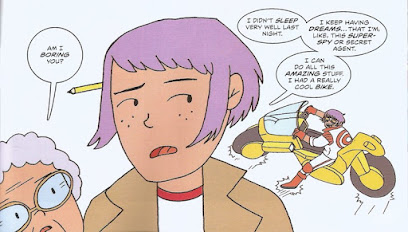
Eve Stranger is a book totally up my alley. It tells the tale of a young woman named Eve Stranger who wakes up once every week alone in a hotel room. She has no memory of the recent past and is surrounded by a used syringe, a gun, a stuffed animal, a notebook where she explains to herself some basic facts, a package containing some assignment, and unlimited credit. If and when anything untoward happens, when she tries to report it to the police she finds the scene completely cleaned up with no evidence of her presence. When she goes to the doctor to give blood, it eats a hole through the beaker. Put simply, this book contains all sort of mysteries to unravel.

Getting to the bottom of her existence and mysterious employers is only part of the fun of this book. It is well plotted, with lots of clues along the way that add up to a satisfying solution. But her missions, which include fast motorcycles, a jet-pack, running with the bulls in Pamplona, contending with a twenty-foot-tall gorilla, and assassinating a potential future tyrant are all fast-paced, madcap adventures full of hand-to-hand combat, chases, and interesting twists. 
 
Finally, I love the artwork done by two of my favorite artists. The main narrative was rendered by Philip Bond, whose work I have been following since I was a teenager on vacation in Greece, reading translated British comics. His style is cool, full of stylish, stylistically unique people and tiny details that pop and also crack me up. He does great spreads that feature action and battle scenes in excellent fashion. 
https://blogger.googleusercontent.com/img/b/R29vZ2xl/AVvXsEjCUi9Ftxf84SVUU8PCt_4C7EiIWT4HUG3MMAFHUt1-8GlcKEF4XhpuNA9PqbaLq34LS_cMsiATSweSH1R0I8bfFqJLiaeRvddl_V2QDjqAcij0W9jkah4JWC4pNBlDuo5ig8NBXhWi2oC7/s1600/Mundane.jpeg

The second feature in each chapter (or issue, as this book originally appeared as a five-issue limited series) is a sort of comic strip by Liz Prince, where Eve is an intrepid girl reporter. These stories are more frivolous and surreal but also contain more clues about her identity that comment on the main narrative. Combined, the two strands make for intriguing, fascinating storytelling.

My biggest criticism of this book is that I feel it was a fun, wild ride that ended too quickly. Certainly, it ends in a way that seems to beg for a sequel, but unfortunately this is the last book published under the Black Crown imprint. I hope it does well enough to get picked up elsewhere, because I'd love to read more Eve Stranger adventures from this creative team.

Joining Bond and Prince in this collaboration is writer David Barnett. He is a novelist who has also written a number of comics for DC and IDW, notably the series Punk's Not Dead. Bond is known for his work with Deadline and the Vertigo Imprint, especially for the one-shot Kill Your Boyfriend. I have read and reviewed lots of Prince's books, including Tomboy and Be Your Own Backing Band.

All of the reviews I have read about this book have been positive. Clyde Hall wrote in his spoiler-filled review that there is a "bright Britpop..spirit" that "buoys Eve Stranger above mere Noir." Bruno Savill De Jong called it "a satisfying and exhilarating read that is worth remembering." Max Beaulieu called it a "fun series," adding that Eve is "a mix of vulnerable and badass, childlike and mature, driven and yet romantic."

Eve Stranger was published by Black Crown, and they offer previews and more about the series here.

Saturday, August 15, 2020

Mr. Butterchips: A Collection of Cantankerous Commentary

Mr. Butterchips is an interesting character, a monkey who aspires to be a stand-up comedian but who is largely relegated to make ends meet by partnering with an organ grinder. His job brings him into contact with a wide cross-section of people, making a sturdy platform for him to express his cantankerous views of social conditions, politics, popular culture, and all sorts of other matters. The first half of the book is episodic, in the vein of a weekly comic strip. And I was pretty amused to see how he tackles contemporary hypocrisy and injustice through comedic commentary, targeting things like "the war on Christmas," pro-lifers, big pharma, Comicsgate, and anti-vaxxers. 

The second half of the book is a single, sustained narrative about Mr. Butterchip's misadventure with controlled substances in the streets (and sewers) of San Francisco. This story is more surreal, reminiscent of underground comix, with the city and its denizens being the butt of the jokes. I have only been to SF once, so I might not get all of the "in" humor, but I was still entertained by the tale, which also has a few mild suspense elements. 

One of the best features of this book to me was seeing how the character, setting, and situations evolved over time. At first, the episodes are given to finding a tone and also establishing the character, which has it fits and starts with mundane things like girlfriend trouble and struggling to make rent. Over time, Mr. Butterchips develops more of a voice and the targets of its satire become more pronounced. By the time I got to the large story that ends the book, I felt a familiarity with things that made the plot hum. It was a lot like reading old volumes of comic strips and seeing how they grow into themselves. I'd be interested to see if there will be more adventures with this acerbic primate in the future.

These comics were created by Alex Schumacher, and most of them appeared monthly in Drunk Monkeys. He has completed a number of projects, including the webcomic Decades of (in)Experience and the self-published print collection Defiling The Literati. He speaks more about his work and career in this interview.

I was only able to find one review of this book, but it was very positive. Aaron Iara wrote, "Our news feeds and social media are chock-full of people arguing and discussing the issues of the day. However, hearing these arguments from a heated drunken monkey is so much more fun." He summed up by recommending "Mr. Butterchips to fans of political cartoons, boisterous stand-up comedians, and off-beat comic books."

Mr. Butterchips was published by SLG, and they offer more info about it here. This book features profanity, adult themes, drug use, and some sexual situations, so it is recommended for readers mature enough to handle those things.

Monday, August 10, 2020

A Fire Story

On Monday, October 9, 2017, Brian Fies and his wife Karen grabbed some things and got in their car for what they thought were precautionary measures because of wildfires. Hours later, they were homeless. 

The fires they escaped were some of the most destructive this country has ever seen, and they ravage Northern California. This book is an intimate look at lives forever changed, how people deal with large-scale destruction in terms of emotional reactions and the practical matters of dealing with relief agencies and other institutional entities. One of the parts that sticks most in my head is Fies dealing with the utilities company, whose representative keeps asking inane questions about whether workers would have clear access to the meter. "Unlimited access," he deadpanned, "but there's no gas meter there anymore." 

The wide array of emotions and somewhat surreal situations that accompany such loss make this book memorable. The personal tale packs a wallop, especially when it is accompanied by several other text pieces told from the perspective of others that the fires affected. As a whole, this book is a wonderfully detailed mosaic of the resilience of the survivors and how some begin to rebuild their lives. This book is moving and informative, giving great insight into how people cope with and survive a natural disaster.

This book's author, Brian Fies began this story as a 18-page comic he published on his blog, adapted it into a Emmy Award-winning animated short, and then expanded it into this graphic novel version. He speaks of the entire process in this video. He also speaks about sharing his story as a graphic novel in this interview. Fies is an Eisner Award winning creator who has created a couple of other graphic novels, the autobiographical Mom's Cancer and the nonfiction long-form essay Whatever Happened to the World of Tomorrow? I also had the honor of being on a panel with him at the 2019 Denver Pop Culture Con.

I was very moved and impressed by this book, but some of the reviews I have read have been more critical. Caitlin Rosberg opined, "It’s a heartfelt, emotional read that has just as much historical and social worth as it does personal value, and a reminder of the best and worst parts of what people can be." Alex Hoffman wrote, "The full book feels scattered, unable to hold the weight of Fies’ trauma." Josh Kramer thought that perhaps the book was rushed and called it "good memoir and inadequate journalism."

A Fire Story was published by Abrams, and they offer a preview and more about it here.