Thursday, December 10, 2020

The Magic Fish

The Magic Fish is a gorgeous and touching book that melds together contemporary life with fairy tales. Its main character is Tiến, a teenage boy who struggles with a number of identity issues. His parents are Vietnamese, immigrants who fled a tyrannical situation and who have been separated from their family.

Tiến tries to bridge a language gap with them (particularly his mother) by sharing stories, fairy tales that transcend culture.  Over the course of this book, there are three tales told, versions of Cinderella, the Little Mermaid, and the Magic Fish, and they are told by three different people, which speaks to how people use story to both communicate and cope with difficult circumstances.

At school, Tiến tries to fit in with his friends and wants nice clothes to go to a school dance, but he also knows that his family's financial circumstances mean that he has to make do with his mom's sewing. Also, he's gay and is looking for ways to come out to his friends and family. He is horrified when he does research and learns that there is no word in Vietnamese for gay, imaging the cultural implications of that idea. And matters are further complicated when a teacher tries to help him by referring him to a priest.

This book works in so many ways because it beautifully plugs readers into immediate experiences. Tiến is drawn to seem small and vulnerable, with his large, round eyeglasses, but he proves to be strong and resilient over the course of the book. When fairy tales are recounted, the drawings and colors become colorful and grandiose. There are exquisite gowns, stars, and sparkles that make things appropriately otherworldly. 

But in between this space of vulnerability/pain and magic/wonder, the characters communicate profound ideas and share feelings in a spectacular and unexpected fashion. This book is beautiful to behold in terms of artwork, but its plot is also splendidly moving, a tribute to the redemptive power of narrative. Its ending left me tingling.

This book's creator Trung Le Nguyen is also known as Trungles. The Magic Fish is his debut graphic novel, but he has drawn a number of fairy tale and romance comics for anthologies published by Oni Press, Boom! Studios, and Image Comics. He speaks about his work in this interview.

All the reviews I've read of this book have been glowing. Avery Kaplan wrote, "The Magic Fish is a book that exists between two points: fairy tales and personal experiences, Vietnam and the United States, mother and child, words and pictures, signifier and signified. It incorporates all of these elements into its whole, and rather than diminish any of them, the ultimate effect is to amplify them all." Kirkus Reviews gave it a starred review that concluded, "Beautifully illustrates how sharing old stories can be the best way to learn how to share new ones." Amanda MacGregor called it "beautiful and moving," adding, "this book will stick with me."

The Magic Fish was published by Random House Graphic, and they offer more info about it here.

Saturday, December 5, 2020

The Banks

Way back when the COVID-19 pandemic took hold of the country, the comic book industry shut down for a couple of months. In that time, the publisher TKO ran an initiative to both sell their books and also pay a portion from each sale to local comic book stores. That's when I got this book. 
 
I am sucker for a well-done heist story, and The Banks is exactly that, with an intriguing twist. The thieves in this story are a grandmother/mother/daughter team who operate in Chicago, three generations brought together by the family business. This is not to say that all goes smoothly. The youngest and oldest members of the team especially rub each other the wrong way, with constant posturing and calling into question each others' integrity/commitment to the task at hand. 
The Banks themselves are some interesting characters, and much of this book works because they are so compelling. The oldest member of the team, Clara, got her start in the early 1970s, and the flashbacks into her past are great period pieces that look cool and also inform the plot/characters in definite ways. In the present, these women are very selective of their jobs, and they only work with lots of planning and an intention to act as modern-day Robin Hoods. 
The granddaughter, Celia, lives the high-stress and privileged life of an investment banker (a legitimate sort of thief), but when she gets a lead on a high-roller who seems a great target she presents the case to her mom and grandmother. While they are doing their homework, they find they might have the opportunity to avenge Clara's husband, Melvin Banks, which makes this job inevitable for them. In addition to all these goings-on, there is also a hotshot detective who is onto the team of thieves, and she would just love to make her career by taking them down.

As I said, the characters make this book unique, but what makes it work so well is taut plotting replete with great twists and a huge cliffhanger at the end of each chapter. The action is excellently paced and plotted. I just had to finish reading this book once I got started. The artwork is very lively, especially in the flashbacks, conveying emotion and affect even in its more dialogue-heavy sections. I highly recommend this book for any fans of heist/noir stories.

This book was a collaboration between high-profile, accomplished creators, including best-selling author Roxane Gay, illustrator Ming Doyle, and colorist Jordie Bellaire. Gay is best known for her novel Hunger, and has a slew of other publications. Doyle is best known for her work on the series Mara and The Kitchen. Bellaire is a multiple Eisner Award winner with too many credits for me to list here.

All of the reviews I've read about this book have been positive. Caitlin Rosberg called it "an engrossing, interesting read and would pair perfectly with last year’s film Widows for a celebration of unexpectedly emotional female-focused heists." Matt O'Keefe wrote, "Unlike most heist stories, the plot isn’t the central element, the characters are. The comic will ultimately be remembered for its three leading ladies, the lessons they learned, and what readers themselves can take away from the series." LaNeysha Campbell called it "a great graphic novel that also makes a refreshing addition to the heist genre."

The Banks was published by TKO, and they have a preview and much more available here. There is some profanity, violence, and sexuality in this book, so it is recommended for more mature readers. A film adaptation is in the works.

Monday, November 30, 2020

Blades of Freedom: A Tale of Haiti, Napoleon, and the Louisiana Purchase

I have a lot of books on my to-read list, but I got this one in the mail the other day and it jumped to the top of the heap. I have reviewed every volume of Nathan Hale's Hazardous Tales on this blog (click the link and see!), because I think it's the best nonfiction history series available in graphic novel form. Each book has been excellent, full of well researched facts and events and told in a highly engaging, sometimes humorous way. It's one of the series I recommend most to tween and adolescent readers who have an interest in nonfiction. Blades of Freedom is the tenth book in the series, and it is phenomenal.

Bookended with a look at the Louisiana Purchase, it runs far and wide filling in the context for that pivotal happening. Over the course of this book, I read about how mosquitoes spread Yellow Fever, Columbus decimated the Taino people, vodou arose as a religion, Napoleon rose from being a Corsican to the Emperor of France, and Haiti became the first country in the Americas to abolish slavery. It's a book about the politics of the day, moving from monarchies to revolutionary times, using the French Revolution as a backdrop for much of went on. It explains how the slave trade work in gruesome detail, focusing on the value of sugar cane as a product of the Caribbean islands. It also focuses on major figures involved, including Napoleon, legendary insurgent Mackandal, rebel general Toussaint L'Ouverture, Emperor of Haiti Jean-Jacques Dessalines, and eventual US President James Monroe


It manages to cover so many topics with a clever conceit: the narrator Nathan Hale has a wheel he spins to jump from topic to topic. This set-up keeps the narrative moving at a brisk pace without being overwhelming. It also sets up a context for building so much of the background necessary to understand these historical events. Personally, I knew little about the Haitian Revolution before I read this book, and after having read it I felt ashamed not to have known more about this landmark struggle. It was the largest and most successful slave revolt ever, and one of the big pluses of this book that it sheds light on a topic that I think gets short-shrift in terms of learning about history in the US. I think the lack of coverage is racist, with the long-held use of the Haitian Revolution being used as a specter to scare white people about the potential savagery of free black people. Having this matter being portrayed in such a popular series will mean that it won't be as arcane a topic going forward, I hope.

This book's author, Nathan Hale, who is not related to the Revolutionary War spy, is a highly accomplished graphic novelist. Aside from his great success with this series, he has also published a couple of fictional graphic novels One Trick Pony and Apocalypse Taco. He has also drawn a few others, including Rapunzel's Revenge and Calamity Jack.

Thus far, I have not been able to locate many reviews of this book, but the ones I've seen have been positive. Marissa Moss wrote, "This is the kind of history that will excite young readers and show them how disparate events, far from each other in time and space, can have major impacts on each other." Lori Henderson listed it as a weekly pick for Good Comics for Kids.

Blades of Freedom was published by Amulet Books, and they offer a preview and more here.

Wednesday, November 25, 2020

Marge's Little Lulu: The Fuzzythingus Poopi

During this time of year (in the US), many of us stop to ponder what we're thankful for. This year, for me, one of them is finally taking time to read Little Lulu. It began as a classic one-panel comic strip, then became a cartoon and later a comic book, drawn by John Stanley. His stories are considered one of the gold standards in comics, and I can see why. I picked up a copy of the Free Comic Book Day floppy offered this year at my local comic shop, and my 5-year-old was very interested in checking it out. Long story short, those four stories really grabbed him and became a regular part of his bedtime story rotation. These are some fun, substantial, and engaging stories that are fun to read aloud, too.

The title character Lulu is feisty, confident, and smart. Over the course of the book she finds herself in lots of familiar situations, like being stuck home on a rainy day, wanting to buy a specific toy, or being caught in the fray of a snowball fight. She has to deal with her parents' rules but finds ways to subvert them. She also often contends with the local "boys club" and their strong anti-girl sentiment, coming out on top with subterfuge and guile. She is frenemies with one of those boys, Tubby, and the two of them embark on a series of adventures, most notably with Tubby being a detective. It is that constant combining of genres that help make this series so great. Sometimes, when Lulu tells stories to her pesky younger neighbor Alvin, the narrative delves into fairy tales and more fantastical adventures. There are the detective tales I mentioned above, and also gag and humor tales like the titular one, where a local man thinks that Lulu has come upon a rare species of flower and tries his best to swindle her. So much of this book is amazingly inventive and imaginative.

That these various stories work with this cast of characters speaks highly of their strong personalities and almost instant relatability. The superbly rendered artwork, full of emotion and powerfully clear storytelling, is a testament to the range and scope that comics can achieve as a narrative medium. The format of this book, which is a thick volume with nice paper and vibrant coloring, showcases these comics in fine fashion. And to top everything off, these stories are done with a robust sense of humor. Both of my boys think they are hilarious. I don't think I can say that they are universal, but these tales stand up to reading and rereading decades after they were originally published.

This collection has received rave reviews.  Lindsay Pereira wrote, "Her behaviour, undeniably subversive for her time, is still refreshing." Jeff Provine called it "an excellent read at any age. The stories are as wholesome as they are packed with action, making it a difficult book to put down."

The Fuzzythingus Poopi was published by Drawn & Quarterly, and they offer a preview and much more here.

Friday, November 20, 2020

Flamer

Flamer is a book about personal turmoil. The main character here is Aiden Navarro and he is wrestling with a lot in his life. He gets grief from people because he is part-Asian. He is anxious about his transition from parochial to public school, as he's decided to make that move as he is entering high school. 

He is also at summer camp, a place where he's sent partly to be active and lose some weight, which also weighs on his mind. He finds that he relates much easier to his female friends, so he feels isolated by the often toxic masculinity of his peers. He gets teased and taunted pretty consistently, and he finds solace with his bunk mate Elias, a football player who is actually a cool guy who is kind to him.

Aiden's relationship with Elias adds more confusion to his mental state and makes him question his sexuality. On one hand, he feels good to have a person who is actually friendly to him but on the other hand he has feelings that confound him. As a devout Catholic and altar boy, he reasons that he could not possibly have such feelings, because he has always been a "good" person. Aiden also has an affinity for X-Men comic books, and his favorite character is Jean Grey. He can relate to her shift from being a hero to the villainous Phoenix, and, in a sinister twist, he begins to wonder if he should do what she ultimately did in order to put matters to rest.

As you might tell from my synopsis, this book trucks in some major life themes. It is about a person's search for self, dealing with religion as well as social institutions that both define and restrict people. It is also a deeply thoughtful and personal book, and I found it very easy to relate to and feel for Aiden. The struggles of a middle/almost high schooler are palpable as well as his travails with bullying. Even so, I like how he's portrayed so that he's no saint, but trying very hard to make sense of some very disparate ideas and beliefs. His struggle is literally life and death, and I was gratified to see this all-too-common but hardly spoken-about conflict is given such thoughtful, relatable, and realistic treatment. 

The artwork, which is rendered in black and white for the most part, save for a number of instances where oranges, yellows, and red flash across the page to indicate or moments of heightened emotion, covey so much emotion and feeling through spare imagery. There is much to relate to or cringe from, from moments where Aiden recoils into himself because of casual cruelty or overt abuse to other scenes where he can find security through dark and self-deprecating humor.

In an afterword that follows the story, Mike Curato admits that some of this story is based on his own experiences. He has illustrated a number of picture books, most notably the highly popular and award-winning book Little Elliot, Big City (which both my oldest boy and I adore). He also won the Society of Illustrators Original Art Show Founder's Award in 2014. He speaks extensively about his work and inspirations behind Flamer in this interview as well as this one.

All of the reviews I have read of this book have been positive. In their starred review, Kirkus simply advised people, "Buy it. Read it. Share it." Publishers Weekly called it "emotional and raw." Juanita Giles wrote that this book "offers real hope - not just rainbows - to queer kids."

Flamer was published by Henry Holt and Co. BYR, and they offer a preview and more here.

Sunday, November 15, 2020

Maids

Maids is a crime tale based on the Papin sisters, Christine and Léa, who worked together as maids until they murdered their employer's wife and daughter. This is a slow burn of a book, only six chapters long, with the first five establishing background and subtly ramping up tension. The events occur mostly in the Lancelin residence, where Christine began work as a maids. She advocated for her younger sister Léa to be hired on as  cook, and the two were reunited in service.

Over the course of the book, we get insights into the young women's lives, from their troubled upbringing to their years in a convent. They were unusually close and frequently got into trouble. As maids, they often were up to some form of chicanery, pilfering items, messing with food, and trying to enjoy some of their employers' finery for themselves. They worked everyday from 6 AM to 7 PM and were also treated shabbily by the Mrs. Lancelin and their spoiled daughter Genevieve. On February 2, 1933 after being blamed for a power outage in the house due to a faulty iron, the sisters brutally murdered Mrs. and Miss Lancelin.

The artwork in this book is spare but masterfully laid out in ways that build suspense to a crescendo. The color palette is warm, which contributes to a muted, dark ambience that lend a drabness to scenes of everyday life and also a sinister edge to the violence. It's a beautifully affecting book, and Skelly gets every ounce of nuance and feeling from her economical imagery. This book is gorgeous and horrible as well as a clinic in storytelling.

And what an opening page!
 This book is the creation of Katie Skelly whose prior comics include My Pretty Vampire, Operation Margarine, Nurse Nurse, and The Agency (NSFW). She speaks extensively about her work on Maids in this interview.

The reviews I have read of this book have been positive. In a starred review, Publishers Weekly summed up, "This subversive horror story will satisfy readers who like their crime stories served with gender and class analysis and a pretty whipped topping." Writing about Skelly's art, Etelka Lehoczky opined, "It's a style that invites you to take it at face value while mocking your inclination to do any such thing. The theme Skelly expresses in every layer of this book is our tendency — or need, really — to underestimate anyone and anything we can't immediately assimilate: maids, girls, comics, comics about girls." Tom Murphy had a different take on the visuals, writing, "Its strong structure and narrative get as close as possible to the bond of blood between the sisters, but the bubblegum realisation on the page creates an uneasy dissonance."

Maids was published by Fantagraphics, and they offer a preview and more information about it here. Due to violence and adult subject matter, I suggest this book for mature readers.

Tuesday, November 10, 2020

Class Act

New Kid was a landmark book, the first graphic novel to win the Newbery Award. This follow-up is called a "companion" to that book, because it is not so much a sequel as it is a continuation of the story. It still follows the life of Jordan Banks, now in his second year at Riverdale Academy Day School, a very sheltered private school in the Bronx. Jordan still wants to be an artist and is struggling with his parents about applying to an arts-focused school. But this book also takes a larger focus on his classmate Drew Ellis, one of the the other African-American students at RAD, who has a different set of concerns.

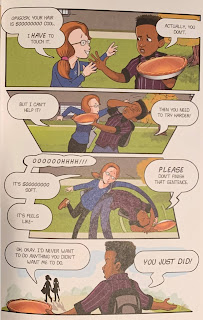
Just like with New Kid, Drew deals with the subtle and overt sorts of racism that pervade life at RAD. He is more athletic and popular than Jordan, though he won't go out for the basketball team because he does not want to be seen as a stereotype. He also has relationship issues, as he gets a girlfriend named Ashley, who tries to impress him with a constant stream of baked goods. She keeps baking him sweet potato pies, which makes him uneasy because it's well intended but also racist. She, and other kids, insist on touching his hair, which really makes him uneasy when they totally ignore his telling them not to. 
Drew also gets singled out to lead a tour of students from their new "sister school" Cardinal De Bard Junior High School in the south Bronx, because he "looks more" like the students there. This makes him pause because it's a place close by Jordan's house, so he would seem to be a better choice, but the teacher organizing this relationship (a white man) thinks that the visitors will be more comfortable with the darker-skinned Drew. 

This theme of exchange runs throughout the book, first in the school visit, but later when Jordan and Drew visit the home of their ultra-rich classmate Liam over the Thanksgiving break. Liam's house is huge, he owns all the video games, and his family insists on eating weird, overly-crunchy flatbread pizza, so the two boys feel like they are in a different world. They also wonder if they could ever truly be friends with someone whose life is so different from their own. Later still, Liam visits Jordan's house, eats a variety of different sorts of food, and gets to hang out with other kids at the local rec center. Although all the boys live in the same borough, it seems like they live in different worlds, though they start to learn to appreciate where the other is from. 

What is impressive about this book is how well it brings out issues of race in relatable and moving ways that are not utterly overt or didactic. Part of this characteristic lays in the artwork, which is colorful and inviting. It also rewards fans of comics and graphic novels, with chapter breaks that reference popular books like This Was Our Pact, Hey Kiddo, and Real Friends as well as other popular media. This book is fun, full of visual puns (especially with local businesses and signage) and witty repartee that make the book feel human and realistic. I particularly like Jordan and Drew's game of calling each other by different, inventive names, a playful way of addressing the fact that many of the teachers at the school constantly confuse them or forget their names. And the supporting cast is very strong, from the frequently misguided teachers at RAD to the pesky Andy, who tries too hard to fit in, to the fantastic Alexandra, a strange and wise girl who definitely walks to the beat of her own drummer. Dispensing wisdom from a hand puppet, she is the Yoda/Silent Bob of this book, and one of my favorites because she appears so comfortable with who she is.

In many ways, this is a book about experiences in middle school, full of big questions and the unease of finding one's way in the world. Certainly, today that also includes navigating systems of institutionalized inequality and racism. And it is not utterly dismissive about what it satirizes, even the consistently tone-deaf attempts by the RAD administration to address racism. It offers no pat answers, but it does put human faces to this very important conversation.

Jerry Craft wrote and drew this book. In addition to New Kid, he has drawn multiple children's books and graphic novels, mostly based on his comic strip Mama's Boyz. He speaks extensively about his work on Class Act in this interview.

All of the reviews I have read of this book have been positive. Esther Keller advised, "Librarians should stock up on as many copies as they can." Kirkus Reviews gave it a starred review that concluded (with a pun even!), "A well-Crafted, visually rich, truth-telling tale for our troubled times that affirms the eternal importance of friends." In another starred review, Publishers Weekly wrote, "Deftly weaving discussions of race, socioeconomics, colorism, and solidarity into an accessible narrative, Craft offers a charming cast journeying through the complicated landscapes of puberty, self-definition, and changing friendships, all while grappling with the tensions of attending an institution that structurally and culturally neglects students of color."

Class Act was published by Quill Tree Books, and they offer a teachers guide and more info about it here.